





Context and Objectives of Decree No. 296/2026/NĐ-CP
On July 23, 2026, the Government issued Decree No. 296/2026/NĐ-CP (“Decree No.296”) amending and supplementing certain provisions of Decree No. 168/2025/NĐ-CP (“Decree No.168”) on enterprise registration. Although it only revises a number of articles, Decree 296 introduces significant changes that directly affect enterprise registration activities. The amendments not only focus on simplifying registration procedures, improving online registration processes, and adding mechanisms for managing temporarily suspended enterprises, but also refine regulations on beneficial ownership in line with international standards on ownership transparency and anti-money laundering.
Decree 296 was promulgated in the context of Vietnam’s legal framework on enterprises and investment being continuously improved toward simplifying administrative procedures, promoting digital transformation from paper-based filings to electronic data, enhancing transparency in corporate governance, and meeting international standards on anti-money laundering. Accordingly, Decree 296 focuses on the following key objectives:
- Establishing a legal basis for implementing new provisions of the Law on Enterprises 2020 (as amended in 2025), particularly regarding enterprise registration and information management.
- Ensuring consistency within the legal system while aligning with international standards on anti-money laundering through improved regulations on identifying and managing beneficial ownership information.
- Advancing administrative reform and digital transformation by leveraging national databases, reducing required documents, limiting resubmission of existing records, and standardizing online registration procedures.
- Enhancing state management efficiency by strengthening electronic authentication, refining mechanisms for managing temporarily suspended enterprises, and supplementing rules on storing enterprise information after dissolution.
Building on these policy objectives, Decree No. 296 introduces a number of significant amendments to Decree No. 168. One of the most notable changes is the official prohibition on nominee shareholding arrangements, effective from 23 July 2026, under which individuals are prohibited from holding equity interests in an enterprise on behalf of another person. The following are the key changes that businesses, investors, and legal practitioners should be aware of:
1. Refinement of Regulations on Identifying Beneficial Owners
The addition of criteria for identifying beneficial owners is considered one of the most significant aspects of Decree 296. Previously, beneficial ownership was mainly determined based on shareholding or capital ownership ratios. Article 3 of Decree 296 expands this approach by defining beneficial owners as individuals who ultimately own or control an enterprise in practice.
Accordingly, the beneficial owner of a legal entity is one or more individuals who directly or indirectly own or ultimately control the enterprise, excluding individuals representing state capital in the enterprise. This approach reflects modern regulatory trends, aiming to identify the true controlling parties rather than merely those listed in legal documents.
In addition to maintaining the threshold of 25% or more of charter capital or voting shares, Decree 296 introduces several new criteria to determine beneficial owners, including:
- Identification through multiple layers of ownership;
- Recognition of combined direct and indirect ownership;
- Aggregation of ownership among family members or contractual co-owners;
- Automatic recognition of all general partners as beneficial owners, regardless of capital contribution ratio;
- Identification through actual control over enterprise operations;
- A fallback mechanism when beneficial owners cannot be determined.
These amendments mark a shift from ownership-ratio-based identification toward a more comprehensive approach, emphasizing actual ownership and control. This refinement aligns Vietnam’s regulations with international standards set by the Financial Action Task Force (FATF) and anti-money laundering laws, while limiting practices such as splitting ownership stakes or using intermediary legal entities to conceal the true beneficial owner.
2. Official Prohibition on Nominee Shareholding in Enterprises
One of the notable new provisions in Decree 296 is the explicit prohibition against owners, members, and shareholders acting as nominees to contribute capital on behalf of others.
Specifically, Clause 1, Article 1 of Decree 296 supplements Clause 1, Article 4 of Decree 168 as follows:
“The owner, shareholder, or member of a company must fully comply with the provisions on contributed assets under Clause 2, Article 34 of the Law on Enterprises, and shall not act as a nominee to contribute capital on behalf of another person.”
This marks the first time such a rule has been directly incorporated into enterprise registration legislation. The addition aims to restrict the use of “nominee shareholders” or “nominee members” to conceal the true beneficial owner of an enterprise. It also provides an important legal basis for enhancing transparency in corporate governance and supporting anti-money laundering, tax evasion prevention, and the handling of sham transactions.
3. Enterprises Must Proactively Declare and Report Beneficial Owners
Another significant change introduced by Decree 296 is that, beyond adding criteria for identifying beneficial owners, it also imposes a duty on enterprise founders and enterprises themselves to declare beneficial ownership information.
To fulfill this obligation, enterprises must review their entire ownership structure, tracing through each level of ownership until the individual(s) with ultimate ownership or control in practice are identified.
At the same time, Decree 296 establishes a three-step process for determining and declaring beneficial ownership information:
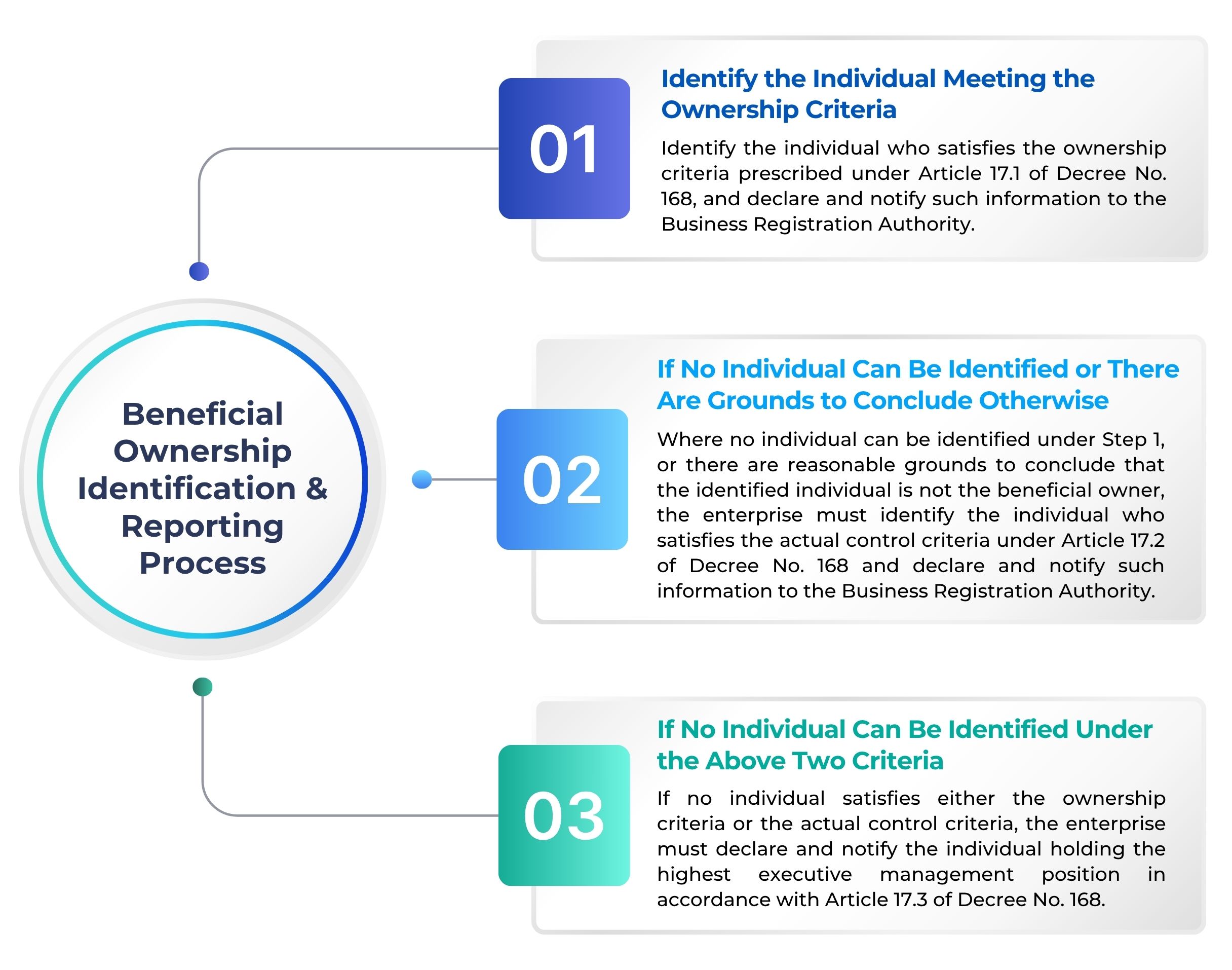
This is an entirely new requirement compared to Decree 168. It reflects a significant shift from merely recording information provided by enterprises to requiring enterprises to proactively identify their beneficial owners and assume responsibility for the accuracy of the declared beneficial ownership information.
Notably, Decree No. 288, which amends and supplements Decree No. 122, introduces administrative penalties for violations relating to the declaration of beneficial ownership information. In particular:
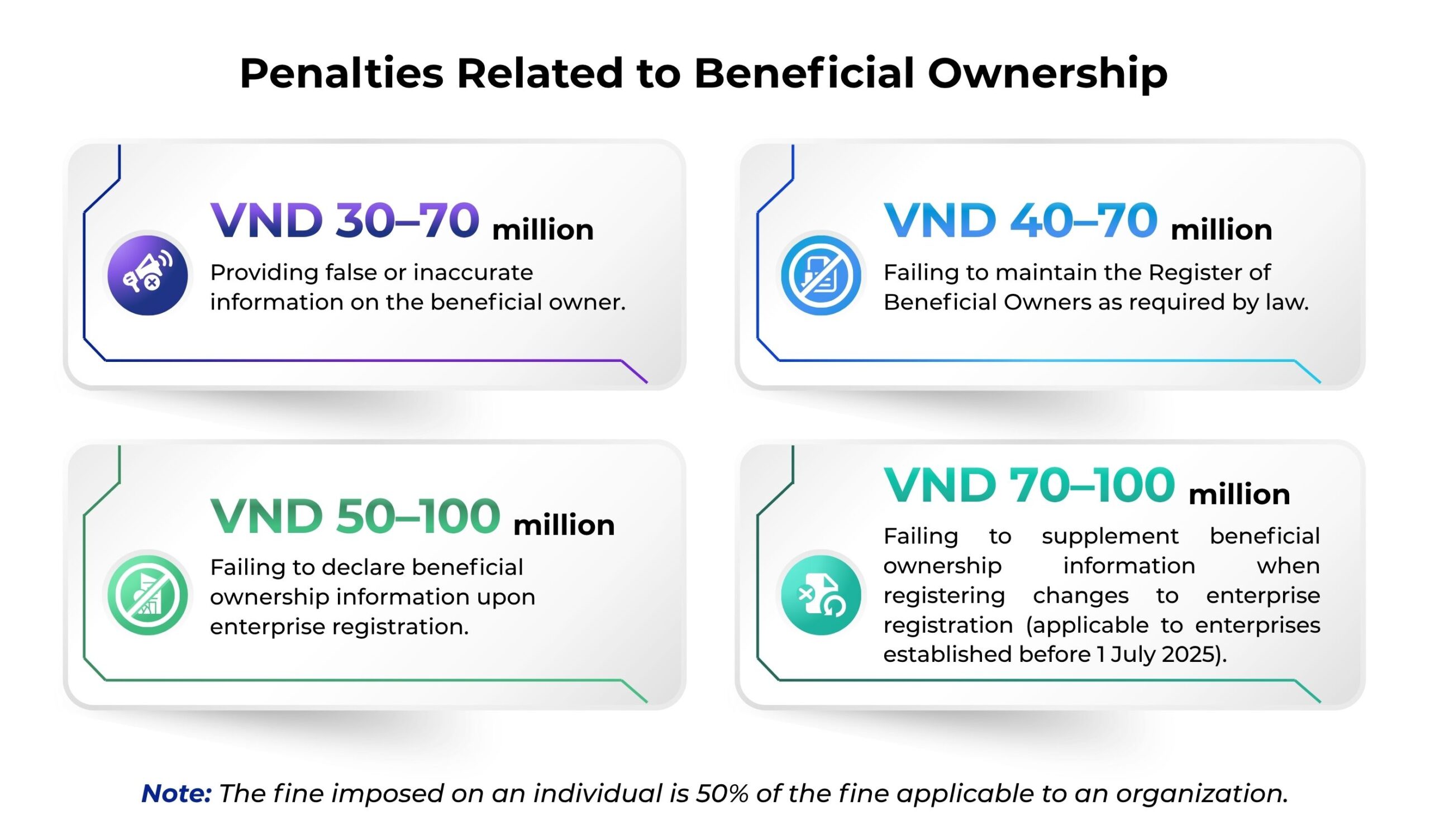
4. No Re-submission of Documents Already Available in Government Databases
Decree No. 296/2026 continues to advance administrative reform under the principle of “declare once, use multiple times,” reducing paperwork and simplifying enterprise registration procedures.
Pursuant to Clause 2 Article 1 of Decree 296 (supplementing Clause 7 Article 4 of Decree 168), the provincial-level business registration authority must retrieve and use information already available in the National Enterprise Registration Database and other national or specialized databases. Accordingly, applicants are not required to re-submit copies of the following documents if such information is already accessible:
- Enterprise Registration Certificate;
- Cooperative Registration Certificate;
- Household Business Registration Certificate;
- Tax Registration Certificate or Investment Registration Certificate;
- Approval issued by the investment registration authority for capital contribution, share acquisition, or capital contribution purchase by foreign investors or foreign-invested economic organizations;
- Establishment and Operation License or a copy of the approval issued by the State Securities Commission of Vietnam;
- Legally effective court decisions;
- Other documents included in the enterprise registration dossier.
Only where the relevant data cannot be accessed or is incomplete may the provincial business registration authority request the applicant to provide copies of the above documents.
This amendment significantly reduces documentation requirements, shortens processing time, lowers compliance costs, and facilitates enterprise registration and subsequent amendments to enterprise registration information.
5. Simplified Registration Dossiers for Wholly State-Owned Enterprises
Under Clause 2 Article 1 of Decree 296 (supplementing Clause 7 Article 4 of Decree 168), for single-member limited liability companies wholly owned by the State, the requirement to submit the owner’s resolution or decision and the authorization document appointing the authorized representative in the enterprise registration dossier has been simplified.
Instead, these documents may be replaced by a written document issued by the competent organization or individual in accordance with the laws governing the management and investment of state capital in enterprises and other relevant legal regulations.
This amendment simplifies enterprise registration dossiers for wholly state-owned enterprises by reducing the number of required supporting documents. It also enhances consistency between the Law on Enterprises and the legal framework governing the management and investment of state capital in enterprises.
6. Mandatory Electronic Authentication for Authorized Enterprise Registration Changes
Pursuant to Article 2 of Decree No. 296 (amending Clause 5 Article 12 of Decree No. 168), both the principal and the authorized representative must complete electronic authentication when carrying out enterprise registration procedures by authorization for the following changes:
- Change of the legal representative;
- Change of the company owner;
- Change of members of a limited liability company;
- Change of information relating to founding shareholders, foreign-investor shareholders of non-listed and non-publicly traded joint stock companies, private enterprise owners, and general partners.
Where the electronic authentication process is temporarily disrupted, the principal may complete the electronic authentication after the Enterprise Registration Certificate has been issued.
If the principal does not confirm the authorization or denies having granted the authorization, the provincial-level business registration authority will require the enterprise to submit an explanation in accordance with Clause 5 Article 21 of Decree No. 296.
Where the principal does not yet have an electronic identification account, the enterprise registration dossier must include a copy of the principal’s identity card, citizen identification card, passport, foreign passport, or another valid passport-substitute document.
These provisions ensure the continuity of administrative procedures in the event of technical issues during electronic authentication while strengthening safeguards against unauthorized filings. They also enhance the authenticity, security, and transparency of enterprise registration procedures conducted through electronic means.
7. Changes to the Competent Commune-Level Business Registration Authority
Compared to Decree No. 168, Decree No. 296 introduces a more flexible approach to determining the commune-level business registration authority, allowing the registration system to better align with the administrative structure and organizational model of each locality.
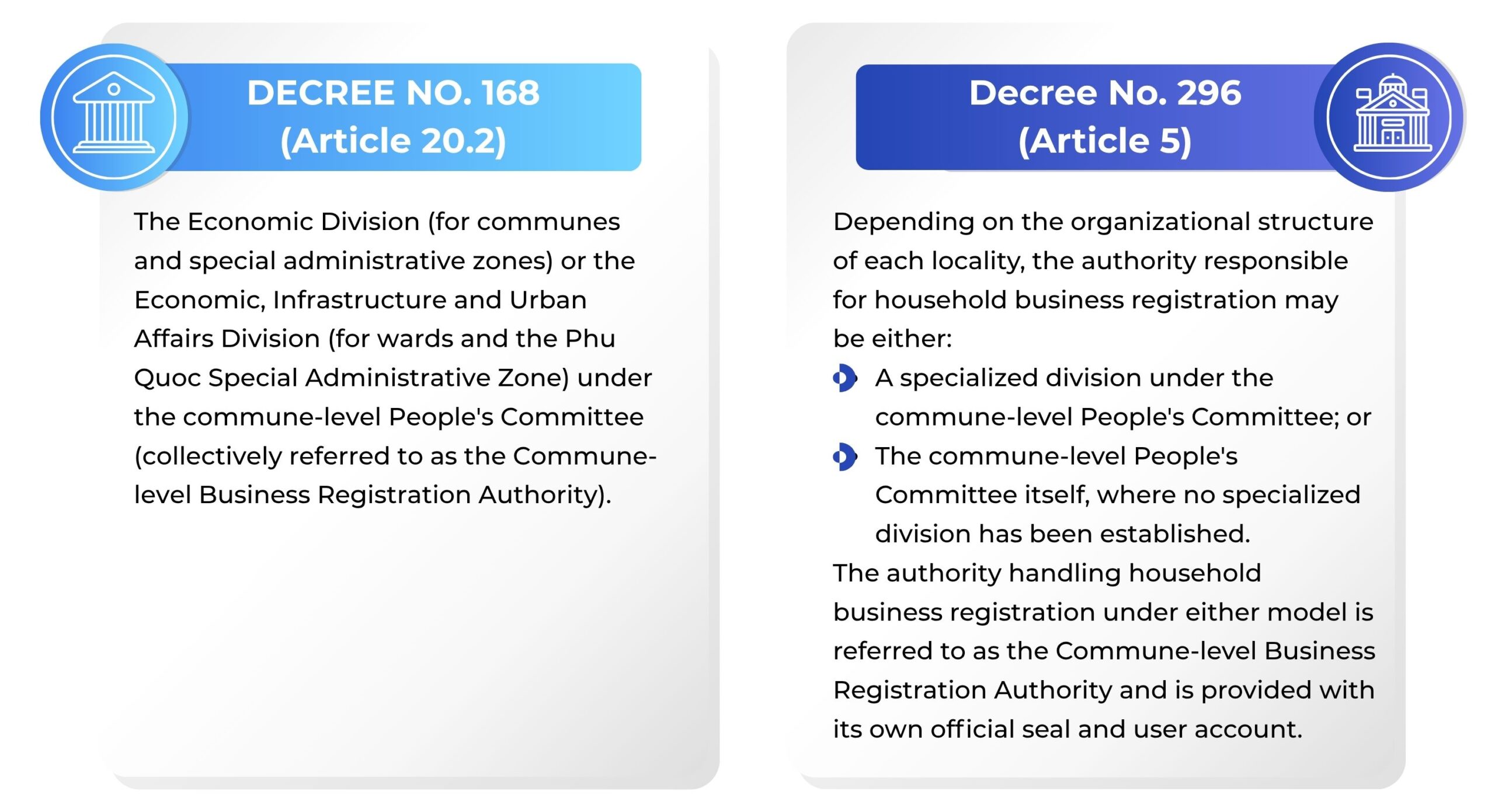
Under the new regulations, the authority responsible for handling household business registration procedures in both cases is uniformly designated as the Commune-level Business Registration Authority. This amendment provides greater flexibility in the organization and implementation of registration procedures while aligning with the ongoing restructuring of administrative units and the reorganization of local government.
8. Retention of Shareholder Information After Enterprise Dissolution
In addition to amendments relating to enterprise registration procedures, Decree No. 296 introduces a new requirement on the updating and retention of shareholder information. Accordingly, information on shareholders of non-listed joint stock companies and joint stock companies not registered for securities trading must be retained in the National Enterprise Registration Database for six years from the date the company is dissolved.
This provision helps ensure the continuity of enterprise registration data, facilitating state administration, inspections, audits, and the resolution of disputes that may arise after an enterprise has ceased operations.
9. Simplified Procedures for Foreign Investors
Another notable amendment under Decree No. 296 is the simplification of enterprise registration dossiers for foreign investors in certain cases governed by the investment laws.
Specifically, Article 7 of Decree No. 296 supplements Clause 6 to Article 24 of Decree No. 168, allowing foreign investors who establish an enterprise before applying for the issuance or amendment of an Investment Registration Certificate (IRC) to omit the submission of a copy of the IRC in the enterprise registration dossier.
Instead, the foreign investor is only required to declare and undertake compliance with the applicable market access conditions in the enterprise registration application.
This amendment reduces documentary requirements, shortens processing time, and facilitates foreign investment activities in Vietnam.
10. Continued Reform of Online Enterprise Registration Procedures
Decree No. 296 further improves the online enterprise registration process by aligning it with the national electronic identification system, promoting digitalization, and simplifying administrative procedures.
Article 9 of Decree No. 296 amends and supplements Article 39 of Decree No. 168 with several key changes, including:
- Expanded login methods, allowing applicants to access the system through the National Public Service Portal or the National Digital Identity Application, in addition to the National Enterprise Registration Portal;
- Separate procedures for the person authorized to sign the registration dossier and the person authorized to submit it, providing greater clarity regarding their respective responsibilities;
- Simplified electronic dossiers, exempting certain applications from digital signatures, handwritten signatures, and document uploads where the application or notification requires only one signatory and has been completed online; Clarification of cases where signatures and document uploads remain mandatory, including documents requiring multiple signatures and other supporting documents forming part of the registration dossier;
- Mandatory electronic authentication for online submissions, enhancing security and ensuring consistency with the national electronic identification system;
- Streamlined dossier processing rules, whereby the business registration authority is only required to examine the validity of the dossier and issue results in accordance with the Law on Enterprises, instead of prescribing detailed handling procedures for each scenario.
These amendments further promote digital transformation in enterprise registration while improving the security, transparency, and convenience of online administrative procedures for organizations and individuals.
11. Stricter Requirements for Business Suspension Procedures
Decree No. 296 introduces several new measures to strengthen the management of business suspension procedures, including:
- The maximum consecutive suspension period is limited to 24 months.
- A notice of business suspension or suspension of operations must include the telephone number and email address of the enterprise’s legal representative (new requirement).
- Within 05 working days after the suspension period expires, the legal representative must confirm that the enterprise has resumed operations and declare that it has fulfilled all enterprise registration obligations.
- If no confirmation is made within 10 working days after the expiry of the above confirmation period, the business registration authority will require the enterprise to submit a report and will coordinate with the tax authority for further management.
- If the enterprise fails to submit the required report within 06 months after the reporting deadline, its Enterprise Registration Certificate will be revoked, and the enterprise must proceed with dissolution procedures.
Conclusion
Decree No. 296 does more than merely amend the enterprise registration framework. It reflects the Government’s continued commitment to administrative reform and digital transformation. On the one hand, the Decree further streamlines administrative procedures by reducing documentary requirements, replacing paper-based documents with electronic data, and promoting digital enterprise registration, thereby making compliance more efficient for businesses. On the other hand, it introduces more stringent requirements on ownership transparency, beneficial ownership disclosure, and reporting responsibilities. These measures are expected to strengthen state oversight, enhance anti-money laundering efforts, and foster a more transparent and secure investment environment in line with international standards. Overall, Decree No. 296 marks a significant shift from paper-based administration to data-driven governance, from nominal ownership to beneficial ownership, and from ex ante control to ex post supervision based on enterprises’ reporting obligations and accountability.
What support could CNC provide?
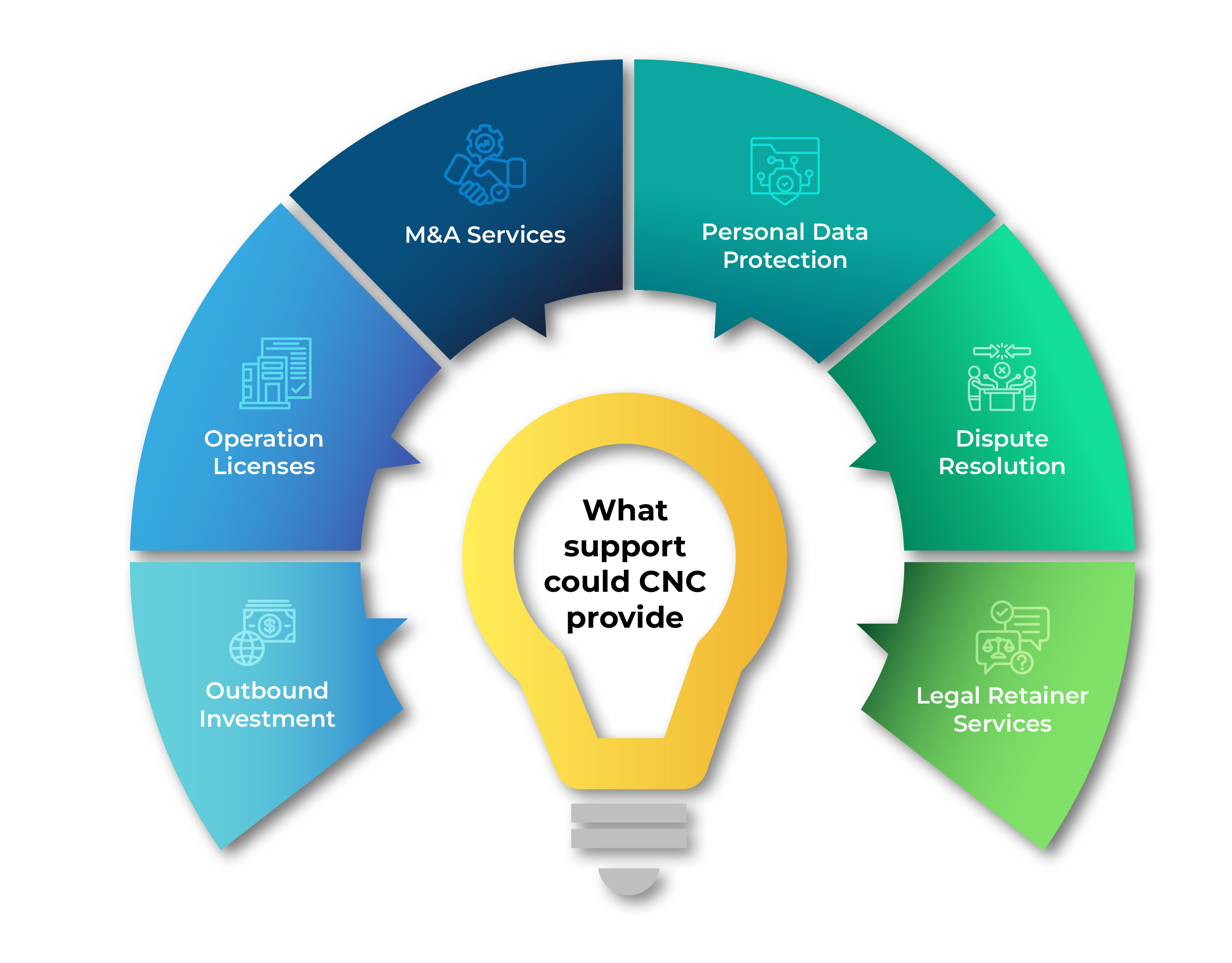
- Outbound Investment: Company Establishment, Investment Registration and Post-registration Services in relation to tax, accounting, labor, insurance, salary, and outsourced legal department;
- Operation Licenses: We could provide support in the application for operation licenses for business activities in fields such as manufacturing, commerce, services, e-commerce, healthcare, education, or food & beverage (restaurants);
- M&A Services: Conduct legal due diligence, structure transactions, draft and negotiate transaction documents, provide advice on competition law compliance (including merger control filings and related approvals), obtain necessary regulatory approvals and licenses, and provide post-closing support;
- Personal Data Protection: Provide support in compliance with the data protection regulations, including the drafting and reviewing of Data Protection Impact Assessment (DPIAs), Data Processing/Transfer Agreement, Privacy Policies, and other necessary documents under the Personal Data Protection Decree (PDPD);
- Dispute Resolution: Litigation and Commercial Arbitration (VIAC SIAC ICC); and
- Legal Retainer Services per the clients’ requests.
Please contact Mr. Chris Luong – Partner through the email address of chris.luong@cnccounsel.com or Ms. Ngan Nguyen – Partner through the email address of ngan.nguyen@cnccousel.com for prompt and timely support.
Managed by
 |
Nguyen Thi Kim Ngan I Partner
Phone: (84) 919 639 093 Email: ngan.nguyen@cnccounsel.com |
 |
Luong Van Chuong I Partner
Phone: (84) 938 04 7969 Email: chris.luong@cnccounsel.com |
 |
Bui Thi Minh Phuong | Legal Assistant
Phone: (84) 28 6276 9900 Email: phuong.bui@cnccounsel.com |
Contact Us
For further information, please contact:
CNC Vietnam Law Firm
Address: The Rise Building, 2A1 Nguyen Thi Minh Khai, Sai Gon Ward, Ho Chi Minh City, Vietnam
Phone: (84) 28-6276 9900
Hotline: (84) 916-545-618
Email: contact@cnccounsel.com
Website: cnccounsel
We would be delighted to welcome you at CNC’s office, where you’ll have the opportunity to consult with the lawyer best suited to your circumstances. Of course, if you are unable to meet in person, simply email us via contact@cnccounsel.com or call us via (+84-28) 6276 9900.
Copyright © CNC Counsel. All Rights Reserved.
Ownership: This document and the content contained herein (the “Document”) are proprietary materials exclusively owned by CNC Counsel. Use of this Document does not, by itself, create any contractual relationship or attorney-client relationship between CNC Counsel and any party.
Disclaimer: All materials contained in this Document are provided for informational purposes only and may not reflect the most current legal developments. Summaries of laws, regulations, and practices are subject to change. This Document does not constitute legal, professional, or other advice with respect to any specific matter.
It is not intended to replace reference to (and compliance with) the detailed provisions of any applicable laws, rules, regulations, or official forms. Readers are strongly encouraged to seek legal advice before taking, or refraining from taking, any action based on the information contained in this Document.
CNC Counsel, its editors, and authors make no representations or warranties as to the accuracy or completeness of the information contained herein and disclaim any liability to any person or entity with respect to any actions taken or omitted based on all or any part of this Document. This Document may contain links to external websites, and external websites may contain links to this Document.
CNC Counsel is not responsible for the content, accuracy, availability, or operation of any such external websites and disclaims all liability arising from or related to the content or operation of any external websites.
Notice: Prior results do not guarantee a similar outcome. Every matter is unique and must be assessed based on its own specific facts and circumstances