




Decree 342/2026/ND-CP, issued on 3 September 2026 and effective from 18 October 2026 (hereinafter referred to as “Decree 342”), has officially replaced Decree 09/2018/ND-CP – the foundational legal instrument governing goods trading activities of foreign investors in Vietnam after more than eight years of implementation (hereinafter referred to as “Decree 09/2018”).
Decree 342 not only updates Vietnam’s international commitments but also clearly reflects a shift in regulatory mindset: from strict control toward greater facilitation, while still maintaining requirements on national security and market order.
This article introduces a number of notable new points of Decree 342, discusses certain issues that we consider important for foreign investors, and provides practical observations for enterprises’ reference.
I. Notable New Points of Decree 342
1. ENT Criteria Streamlined and Clarified
The number of ENT criteria groups has been reduced from five to four. In addition, a clear threshold of 5,000 m² has been introduced to determine the level of the geographical market area affected (below 5,000 m²: commune/ward level; from 5,000 m² upwards: provincial level).
2. Cases Requiring National Security Review
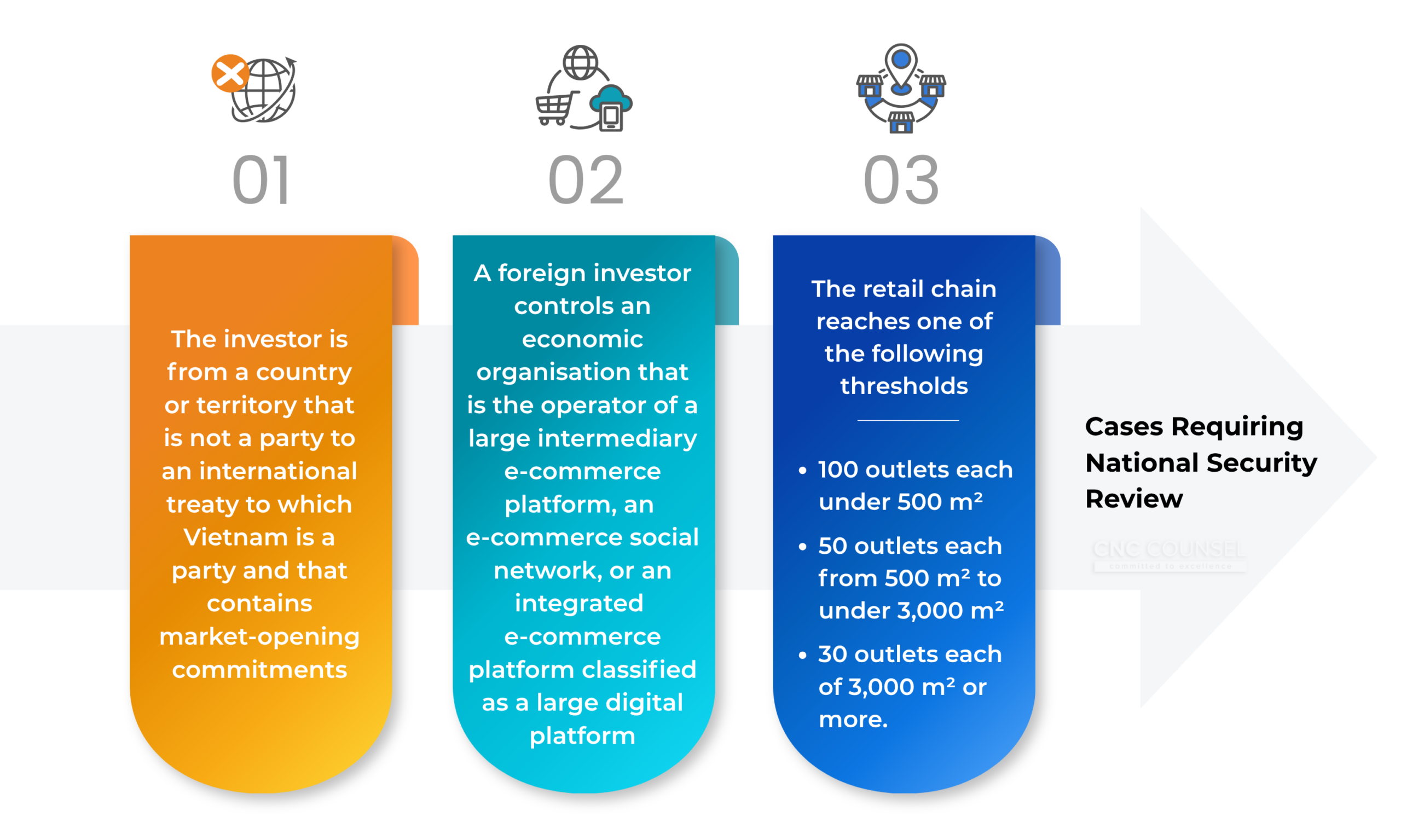
This is an entirely new requirement introduced by Decree 342. The licensing authority must obtain opinions from the Ministry of Public Security and the Ministry of National Defence in the following cases:
- The investor is from a country or territory that is not a party to an international treaty to which Vietnam is a party and that contains market-opening commitments;
- A foreign investor controls an economic organisation that is the operator of a large intermediary e-commerce platform, an e-commerce social network, or an integrated e-commerce platform classified as a large digital platform;
- The retail chain reaches one of the following thresholds: 100 outlets each under 500 m²; 50 outlets each from 500 m² to under 3,000 m²; or 30 outlets each of 3,000 m² or more.
3. Enhanced Reporting Regime
Enterprises are now required to submit periodic reports twice a year (before 15 January and 15 July), instead of only once a year as previously required.
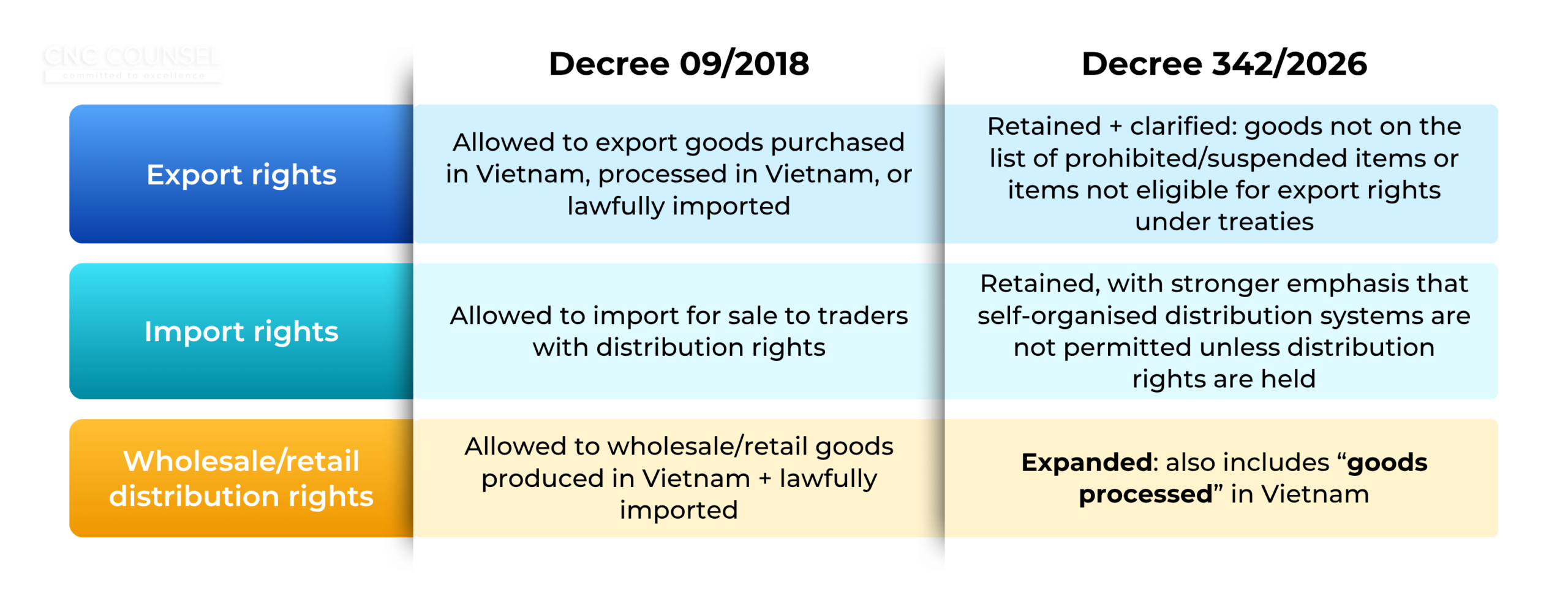
4. Clarification of Export – Import – Distribution Rights
Decree 342 officially classifies “brokerage” activities under distribution rights, thereby unifying the previously inconsistent interpretation.
5. Conditions for Issuance of Business Licences
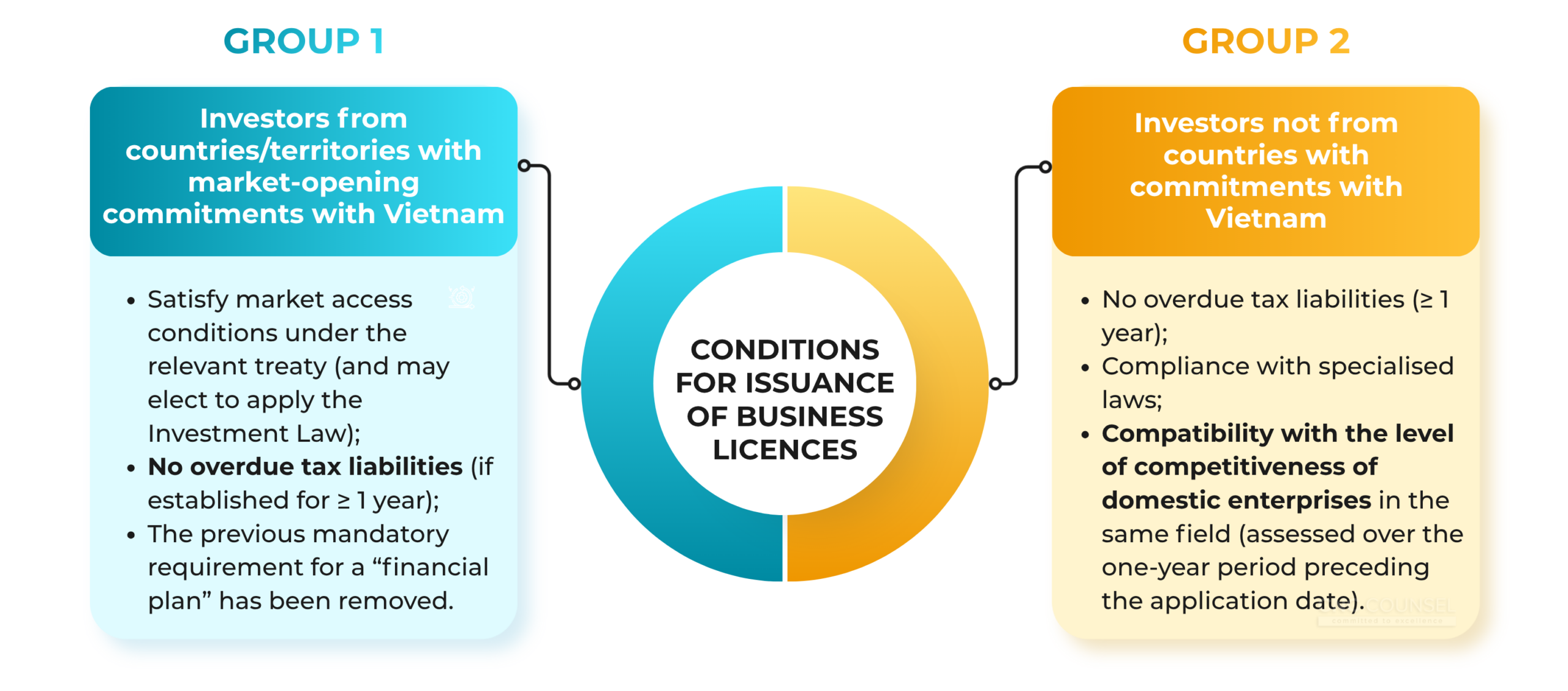
The structure of conditions remains divided into two groups but with adjustments:
Group 1 – Investors from countries/territories with market-opening commitments with Vietnam:
- Satisfy market access conditions under the relevant treaty (and may elect to apply the Investment Law);
- No overdue tax liabilities (if established for ≥ 1 year);
- The previous mandatory requirement for a “financial plan” has been removed.
Group 2 – Investors not from countries with commitments with Vietnam:
- No overdue tax liabilities (≥ 1 year);
- Compliance with specialised laws;
- Compatibility with the level of competitiveness of domestic enterprises in the same field (assessed over the one-year period preceding the application date).
Decree 342 retains criteria relating to job creation and budget contribution, but with more concise wording. Another new point is that simultaneous submission of applications for a Business Licence and a Retail Outlet Establishment Licence (for the first outlet) is permitted if both are in the same province/city as the enterprise’s head office, thereby shortening processing time.
In addition, where a domestic enterprise receives foreign investment capital and becomes an FDI enterprise, it may continue retail activities for a maximum of 12 months while completing the relevant licensing procedures (Business Licence and/or Retail Outlet Establishment Licence).
6. Obligation to Maintain Market Access Conditions Throughout Operations
Enterprises must continue to satisfy market access conditions throughout their period of operation, not only at the time of licence application. This is a stricter requirement than before.
7. Changes to Inter-agency Consultation Mechanism
Decree 09/2018 required consultation with the Ministry of Industry and Trade in many cases. Decree 342 removes this requirement for most ordinary applications and replaces it with consultation with the Ministry of Public Security and the Ministry of National Defence in cases involving national security elements.
8. Additional Information Fields on Licences
Business Licences must clearly state the nationality of owners, members and founding shareholders, as well as the specific list of goods permitted for trading.
9. Additional Grounds for Licence Revocation
The Decree provides clearer grounds for revocation, creating a more solid legal basis for post-licensing supervision.
10. Dossier Procedures & Processing Timeframes
The dossier for a Business Licence under Decree 342 basically comprises:
- Application form;
- Explanatory statement (business plan, labour demand, socio-economic impact assessment, etc.);
- Tax clearance certificate (issued no more than 6 months earlier);
- Copies of the Enterprise Registration Certificate and Investment Registration Certificate (if any);
- Supporting documents for specific categories of goods;
- New point: The licensing authority is entitled to extract data from national databases. Enterprises are only required to supplement documents when such data cannot be extracted.
Processing timeframes have been further streamlined:
- Dossier check: 3 working days;
- Condition assessment: 10 working days;
- Consultation with the Ministry of Public Security and Ministry of National Defence (if required): 14 working days;
- Issuance of result after receiving opinions: 3 working days.
Overall processing time is shorter than under Decree 09/2018. Enterprises may also submit applications through multiple channels: in person, via public postal service, private postal service, or online via the National Public Service Portal.
II. Some Issues Relating to the Economic Needs Test (ENT)
Decree 09/2018 was issued at a time when Vietnam had just acceded to the WTO and begun implementing market-opening commitments in the distribution sector. It introduced the “ENT” – a mandatory economic needs test when an FDI enterprise establishes a retail outlet beyond the first one (from the second store onwards). At that time, the ENT was maintained as a selective protection tool, allowing authorities to assess the necessity of additional retail outlets based on criteria relating to market size, impact on traditional markets, and socio-economic contribution.
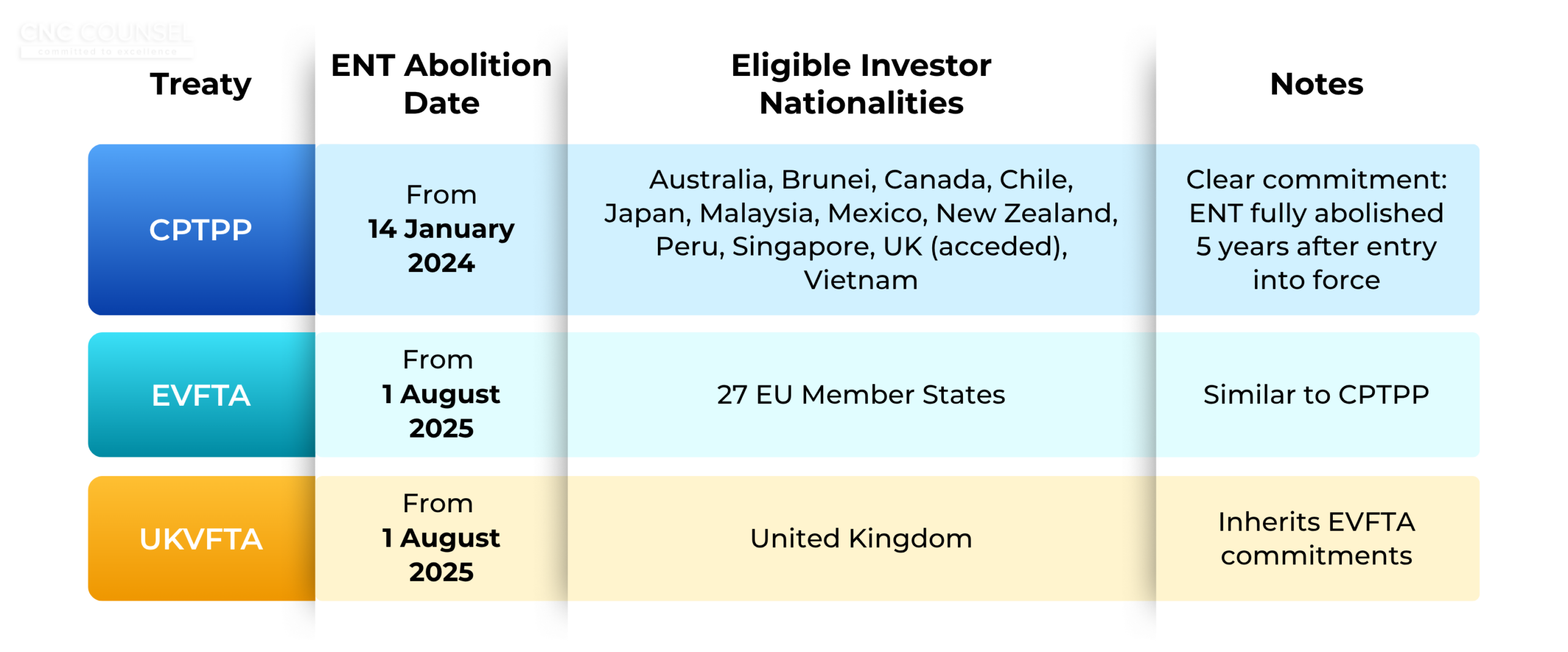
After nearly a decade, the context has fundamentally changed. Vietnam has completed the transitional reservation periods for the ENT under the CPTPP (from 14 January 2024) and the EVFTA/UKVFTA (from 1 August 2025). Continuing to apply the ENT to all foreign investors is no longer consistent with international obligations. At the same time, the rapid development of e-commerce, modern retail chains, and national security requirements in the digital era have necessitated a new legal framework.
Decree 342 both domesticates the commitments to abolish the ENT and introduces a national security review mechanism for large digital platforms and large-scale retail chains, while simplifying administrative procedures in the direction of data-driven governance.
A quick comparison of ENT criteria between Decree 09/2018 and Decree 342/2026 is set out below:
| Criterion | Decree 09/2018 | Decree 342/2026 |
| Commitment to abolish ENT | Not expressly stated in the Decree | Expressly provides exemption from ENT if the treaty contains a commitment to abolish it |
| Scope of application | Second and subsequent retail outlets (subject to exemptions) | Similar, but foreign investors from countries/territories that are parties to treaties with Vietnam containing commitments to abolish the ENT are not required to undergo ENT when establishing outlets beyond the first (except where the <500 m² shopping-mall exemption does not apply) |
| Exemption from ENT | Outlets under 500 m² located in shopping malls and not convenience stores or mini-supermarkets | Essentially retained, with additional clarification of the “supermarket” category |
| Definition of outlet types | Less detailed | More precise:
|
| Assessment criteria | The ENT Council assesses 5 groups of criteria:
1. The scale of the geographical market area affected. 2. The number of retail outlets currently operating in the area. 3. The impact on market stability and the operations of existing retail outlets and traditional markets. 4. The impact on traffic density, environmental hygiene, and fire prevention and fighting. 5. The ability to contribute to socio-economic development:
|
The ENT Council assesses 4 groups of criteria (more concise), but with practical adjustments:
1. Scope of the geographical market area:
2. Impact on market stability and traditional markets:
3. Ability to contribute to socio-economic development:
4. Compatibility with requirements on security, order and social safety:
Important points: Combined consultation with the Ministry of Public Security and the Ministry of National Defence in certain cases (particularly those involving security or investors from countries without relevant commitments). |
| Geographical market area | Not clearly defined | Below 5,000 m²: commune/ward level; from 5,000 m² upwards: provincial level |
| ENT Council | Established by the provincial People’s Committee | The ENT Council is still established by the provincial People’s Committee and conducts its assessment within approximately 20 working days (similar to previously).
Participants: A representative of the provincial People’s Committee (or an authorised agency) acts as Chairperson; Representatives of the Department of Industry and Trade, the Department of Finance, and the provincial Public Security; Other relevant departments, agencies, organisations and bodies.
If the location of the retail outlet borders another province/city, the ENT Council must obtain the opinion of the People’s Committee of the neighbouring province.
The Chairperson of the ENT Council issues a written conclusion proposing whether to permit or refuse the establishment of the retail outlet, which must clearly state the assessment opinion on the compatibility or incompatibility with the ENT criteria. |
| ENT Procedures & Timeframes
|
a/ Initial dossier check: approx. 3–5 days
b/ Establishment of the ENT Council: approx. 7 days c/ Assessment by the ENT Council: 20–30 days d/ Consultation with the Ministry of Industry and Trade (if required): Yes e/ Estimated total time: 30–45 days (in practice often longer) |
a/ 3 days
b/ Integrated into the process c/ 20 working days d/ Mainly transferred to the provincial People’s Committee e/ In theory approximately 25–40 days (in practice depending on the specific case)
|
| General conditions for the issuance of a Retail Outlet Establishment Licence (including cases subject to ENT)
|
For the first retail outlet (no ENT required):
For retail outlets beyond the first:
The licensing authority shall also take into account:
|
The most significant point is that Decree 342 formally recognises the effect of the CPTPP, EVFTA and UKVFTA commitments. Investors from member countries of these agreements will no longer be required to undergo the ENT process when opening second and subsequent stores (except where the exemption does not apply). However, the ENT continues to apply to investors from countries without corresponding commitments.
Based on Vietnam’s official commitments, as of the date of this article (September 2026), the treaties under which Vietnam has clear commitments to abolish the ENT (or for which the reservation period has expired) are as follows:
In addition, the treaties to which Vietnam is a party that have not yet committed to abolish the ENT or that continue to maintain it (at a level equivalent to the WTO) can be summarised as follows:
- WTO (2007 accession commitments): Continues to maintain the ENT for the second and subsequent retail outlets.
- RCEP: Commitments on distribution services are equivalent to or lower than those under the WTO/AFAS. There is no commitment to abolish the ENT as under the CPTPP/EVFTA.
- ASEAN+1 FTAs (such as ACFTA, AKFTA, AJCEP, AANZFTA, AIFTA, AHKFTA, etc.): Essentially maintain commitments at the WTO or AFAS level, meaning the ENT continues to apply.
- Other bilateral FTAs of Vietnam, such as VKFTA (Korea), VJEPA (Japan), VCFTA (Chile), VN-EAEU FTA (Russia + Belarus, Kazakhstan, Armenia, Kyrgyzstan), VIFTA (Israel), etc.: Do not contain strong commitments to abolish the ENT comparable to the CPTPP/EVFTA. These FTAs mainly focus on goods, and their commitments on distribution services are generally equivalent to or lower than those under the WTO.
Accordingly, the ENT rules (subject to the existing exemption) will continue to apply to investors from China, Korea, Japan (if not relying on the CPTPP), ASEAN countries outside the CPTPP, Russia, India, Chile, Israel, the UAE, and most other countries.
In addition, even where an investor is exempt from the ENT, the enterprise must still fully satisfy the location conditions (which have been significantly expanded compared with previously, covering compliance with the laws on land, planning, investment, construction, fire prevention and fighting, traffic safety and environmental hygiene).
III. Decree 342 Expands the Concept of “E-commerce” Compared with Decree 09/2018
Decree 09/2018 already required foreign-invested economic organisations to obtain a Business Licence when “providing e-commerce services”, defined as commercial activities whereby the service provider establishes an e-commerce website to provide an environment for other traders, organisations or individuals to conduct trade promotion, sell goods or supply services, particularly the marketplace model.
The new point of Decree 342 is that it replaces and expands the terminology relating to “e-commerce” activities, as illustrated in the following comparison:
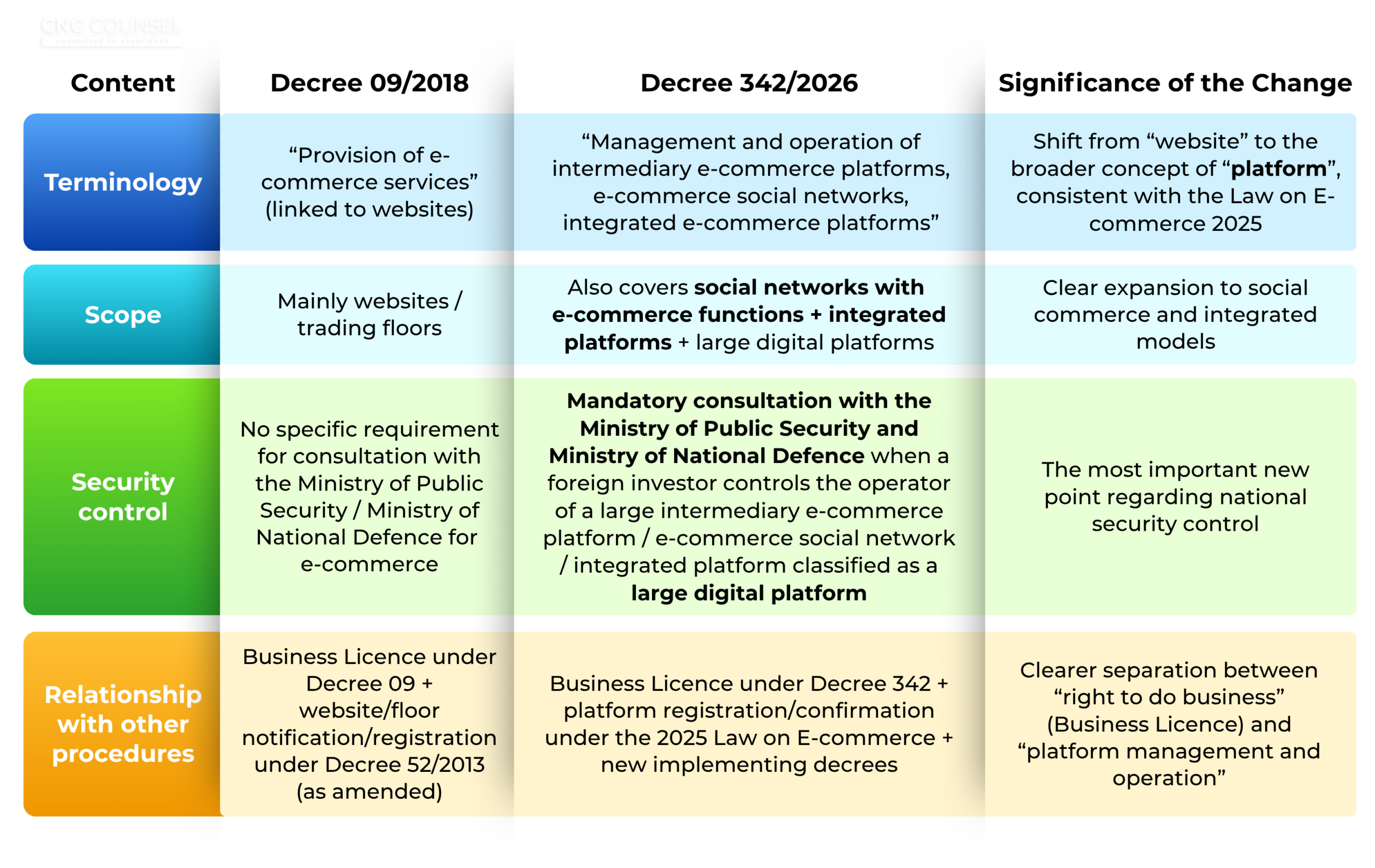
The term “e-commerce platform” used in Decree 342 now carries a broader and more modern meaning, covering social networks conducting e-commerce (social commerce), integrated e-commerce platforms, and large digital platforms (under consumer protection criteria).
Decree 342 has updated the terminology to align with technological reality and the Law on E-commerce 2025 (and its implementing decrees), while tightening national security control over large platforms controlled by foreign-invested enterprises.
IV. Some Key Takeaways
Alongside the progressive aspects, Decree 342 still leaves certain gaps that need to be monitored in the coming period:
- The method of assessing “full compliance” with location conditions has not yet been guided in detail, creating room for differences among localities and interpretive discretion that depends significantly on the views of the licensing authority, which may lead to requests for additional documents and prolonged processing times;
- The process of obtaining opinions from the Ministry of Public Security and the Ministry of National Defence for large chains and digital platforms may result in extended processing times;
- The obligation to maintain market access conditions throughout operations requires enterprises to regularly review and update their compliance status.
Foreign-invested enterprises should take advantage of the period before 18 October 2026 to review their entire ownership structure, existing legal documentation and prepare plans to meet the new requirements, particularly the twice-yearly reporting regime and related obligations.
V. Conclusion
Decree 342/2026/ND-CP marks an important step forward in completing the legal framework for goods trading activities of foreign investors in Vietnam. The abolition of the ENT for investors under new-generation FTAs, the simplification of dossier procedures and the transfer of licensing authority to the local level are positive signals, demonstrating Vietnam’s commitment to creating a more favourable business environment. However, enterprises should also clearly recognise that greater openness regarding the ENT is accompanied by tighter controls in the areas of national security, ownership transparency and the continuous maintenance of operating conditions. Only enterprises that carefully prepare their legal structure, documentation and compliance will be able to maximise the opportunities offered by the new Decree 342.
In the coming period, monitoring detailed guiding documents from the Ministry of Industry and Trade, the Ministry of Public Security and practical implementation at the local level will be critical factors enabling enterprises to make investment decisions and expand retail chains in a safe and effective manner.
VI. How CNC Can Assist
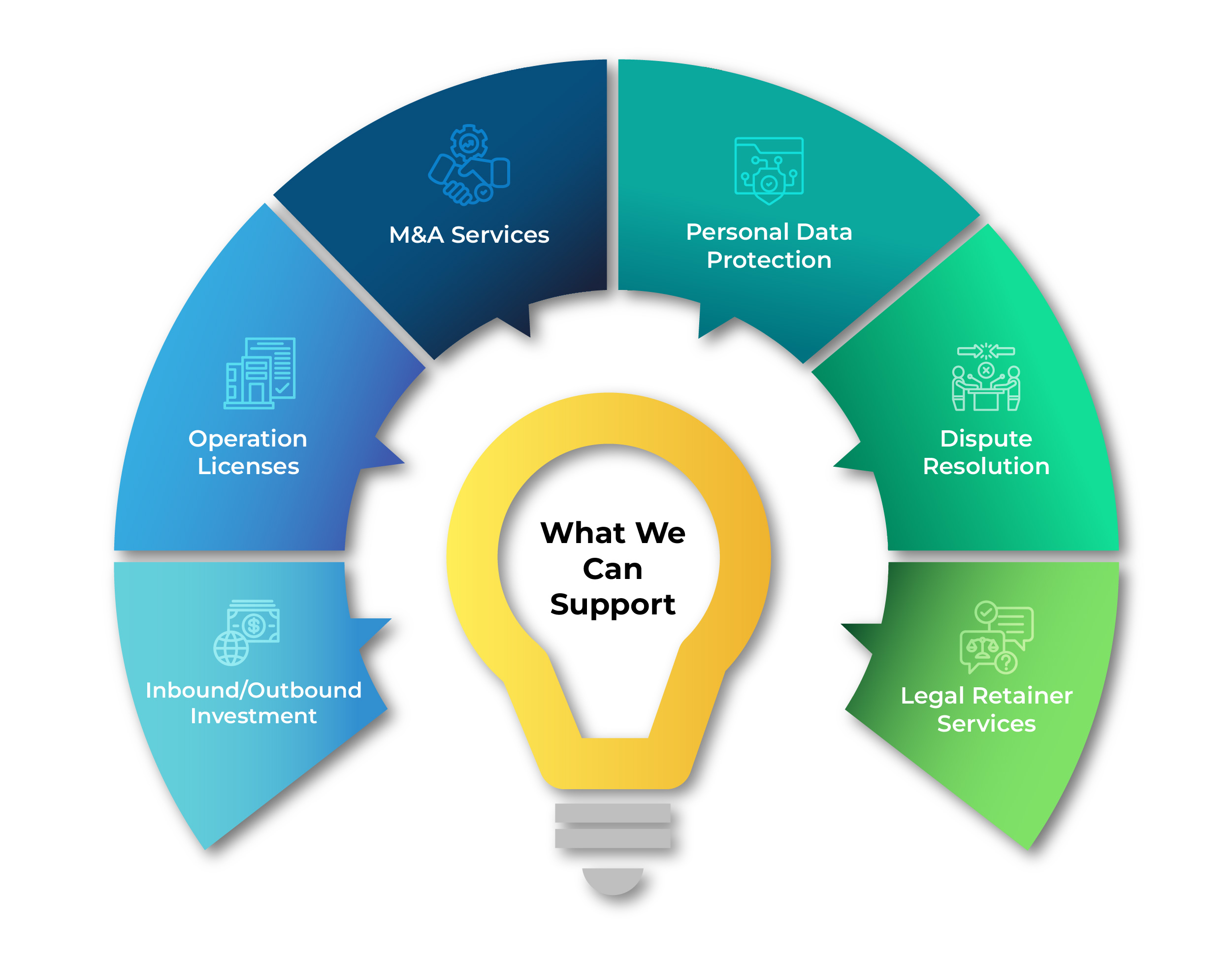
- Foreign investment: Company establishment, investment registration and post-registration compliance (tax, accounting, labour, insurance, payroll and outsourced legal department);
- Licensing: Support in obtaining licences for specific business activities such as manufacturing, trading, services, e-commerce, healthcare, education or food & beverage (restaurants), etc.;
- M&A services: Legal due diligence reports; transaction structuring; drafting and negotiating transaction documents; competition law compliance advice, including economic concentration control filings and related approvals; obtaining necessary approvals and licences; and post-transaction support;
- Personal data protection: Support for compliance with data protection regulations, including drafting and reviewing Data Protection Impact Assessments (DPIAs), Data Processing/Transfer Agreements, Privacy Policies and other documents required under the Personal Data Protection Law (PDPL);
- Dispute resolution: Court litigation and commercial arbitration (VIAC, SIAC, ICC); and
- Ongoing legal advisory services as required by clients.
Please contact Mr Chris Luong – Partner via email chris.luong@cnccounsel.com or Ms Ngan Nguyen – Partner via email ngan.nguyen@cnccounsel.com for prompt assistance.
Managed by
 |
Nguyen Van Thinh I Partner
Phone: (84) 907 535 199 Email: thinh.nguyen@cnccounsel.com |
 |
Nguyen Thi Kim Ngan I Partner
Phone: (84) 919 639 093 Email: ngan.nguyen@cnccounsel.com |
 |
Luong Van Chuong I Partner
Phone: (84) 938 04 7969 Email: chris.luong@cnccounsel.com |
Contact Us
For further information, please contact:
CNC Vietnam Law Firm
Address: The Rise Building, 2A1 Nguyen Thi Minh Khai, Sai Gon Ward, Ho Chi Minh City, Vietnam
Phone: (84) 28-6276 9900 – 081 235 3839
Hotline: (84) 916-545-618
Email: contact@cnccounsel.com
Website: cnccounsel
We would be delighted to welcome you to CNC’s office, where you’ll have the opportunity to consult with the lawyer best suited to your circumstances. Of course, if you are unable to meet in person, email us via contact@cnccounsel.com or call us via (+84-28) 6276 9900.
It would be a pleasure for CNC’s lawyers to help you build a solid legal foundation, thus ensuring the success and sustainable development of your project!
————————————
Copyright © CNC Counsel. All rights reserved.
Ownership Rights: This document and the content contained herein (Document) are proprietary resources exclusively owned by CNC Counsel. Access to or use of this Document does not, by itself, create any contractual relationship or lawyer-client relationship between CNC Counsel and any person or entity.
Disclaimer: All Documents are provided solely for informational purposes and may not reflect the most current legal developments. Summaries of laws, regulations, and practices are subject to change. This Document is not intended to constitute legal, professional, or other advice with respect to any specific matter. Nor is it intended to substitute for reference to, or compliance with, the detailed provisions of any applicable law, regulation, rule, or official form. Readers are strongly encouraged to seek independent legal advice before taking, or refraining from taking, any action based on the information contained in this Document. CNC Counsel, together with its editors and authors, makes no representations or warranties as to the accuracy, completeness, or currency of the Document and disclaims all liability to any person or entity arising from reliance on all or any part of the Document. This Document may contain links to external websites, and external websites may contain links to this Document. CNC Counsel is not responsible for the content, operation, availability, or practices of any such external websites and expressly disclaims any liability in connection therewith. Note: Past results do not guarantee similar outcomes in future matters. Each matter is unique and must be assessed based on its own facts and circumstances.