




I. Overview
Vietnam is moving towards transformation by encouraging the application of advanced technologies and processes from around the world, thereby contributing to trade activities and national growth.
The 2017 Law on Technology Transfer was amended and supplemented in 2025 (the “2025 Law on Technology Transfer”), together with Decree No. 101/2026/ND-CP detailing and guiding the implementation of certain provisions of the Law on Technology Transfer, establishing a new legal framework for organizations and individuals to optimize the acquisition and mastery of clean and advanced technologies that are appropriate to the new circumstances.
This bulletin summarizes key updates under the applicable laws, which took effect on 1 April 2026, with a view to helping enterprises understand and comply with their obligations.
II. Key highlights of the 2025 Law on Technology Transfer
1. Revision of the definition of “technology transfer”
The 2025 Law on Technology Transfer revises the definition of “technology transfer” as a science, technology and innovation activity carried out through the transfer of ownership rights to technology or rights to use technology, with the aim of putting technology into practical application to create new products, services or production methods.
Meanwhile, the former provision under Clause 7 Article 2 of the 2017 Law on Technology Transfer[1] was limited in scope and did not clearly articulate the objectives of application and innovation.
The revised definition clearly reflects the legislative intention to promote innovation not only through the implementation of technology transfer activities, but also towards the ultimate objective of putting technology into practical applications to create new products, services or production methods. Under this approach, transferred technology is closely associated with its effective exploitation, application and commercialization.
This represents a shift from administrative management towards promoting the economic value of technology. Accordingly, the new approach to defining this concept is considered necessary and practically significant. However, this approach also indirectly imposes requirements on the transferee’s capacity to receive, master and operate the technology to ensure its effective application in practice.
2. Expansion of the scope of transferable technologies
Clause 3, Article 1 of the Amended Law[2] expands and updates the scope of technologies subject to transfer by replacing former terms such as “drawings” with “designs” and “computer software” with “software”, while also adding new subject matters such as models and algorithms.
Meanwhile, the former provision under Point b, Clause 1, Article 4 of the 2017 Law on Technology Transfer[3] was limited to traditional technological elements and did not encompass modern forms of digital technology.
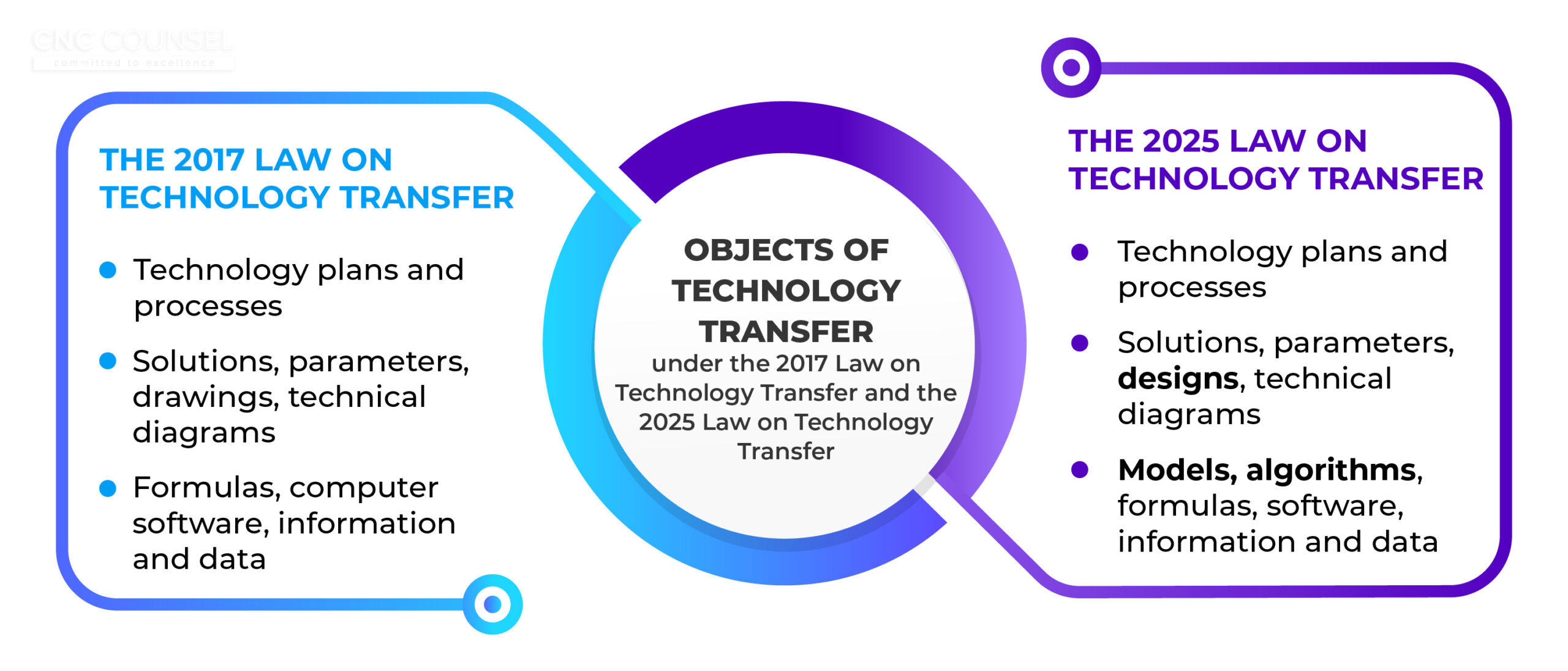
Objects of Technology Transfer under the 2017 Law on Technology Transfer and the 2025 Law on Technology Transfer
3. Introduction of preferential policies for technology transfer[4]
– Priority shall be given to the transfer of strategic technologies, green technologies and technologies serving projects of national importance; particular attention shall be paid to technology transfer activities in mountainous and island areas.
– Technology transfer involving strategic technologies shall be promoted, with emphasis placed on the dissemination of strategic technologies from foreign-invested enterprises to domestic enterprises.
– Foreign organizations and individuals are encouraged to conduct technology transfer activities with Vietnamese organizations and individuals in order to enhance the domestic capacity to absorb, master and innovate technologies; technology transfer in foreign investment activities shall be carried out on a voluntary basis and upon agreement between the parties, ensuring compliance with intellectual property laws and consistency with treaties to which the Socialist Republic of Vietnam is a member.
– Priority shall be given to the application of investment, tax, land and credit incentives, as well as other incentive measures, to foreign-invested projects involving technology transfer, human resource training, or the development of research, design, manufacturing or technology application capabilities in Vietnam.
Previously, the former law did not contain specific provisions providing clear policy orientations on these matters.
4. Clarification of rights relating to technology transfer[5]
The addition of rights relating to technology transfer activities aims to further improve the legal framework governing technology transfer. This approach helps mitigate legal risks and facilitates the parties’ full and effective exercise of their respective rights and performance of their obligations, particularly in the context of promoting domestic technology transfer and encouraging innovation.
Notably, the 2025 Law on Technology Transfer officially recognizes the transferee’s right to improve, develop and exploit the transferred technology based on such technology, in accordance with the laws on intellectual property and other relevant laws.
The recognition of this right is expected to promote both domestic and cross-border technology transfer activities, as the transferee is no longer limited to merely exploiting the technology but is also enabled to improve and develop the technology transferred. This, in turn, contributes to enhancing the effectiveness of practical applications and the economic value of the transferred technology.
In addition, the 2025 Law on Technology Transfer clarifies that, where technology is integrated into a product, machinery, equipment or system, ownership rights or rights to use such technology shall not automatically arise together with ownership rights or rights to use the product, machinery, equipment or system, unless otherwise provided by law or otherwise agreed by the parties in accordance with the law.
This provision represents a reasonable and practically significant development of the legal framework, helping the parties mitigate legal risks by clearly identifying and distinguishing ownership rights and rights to use the technology from ownership rights and rights to use the product, machinery, equipment or system incorporating such technology when entering into and performing technology transfer agreements.
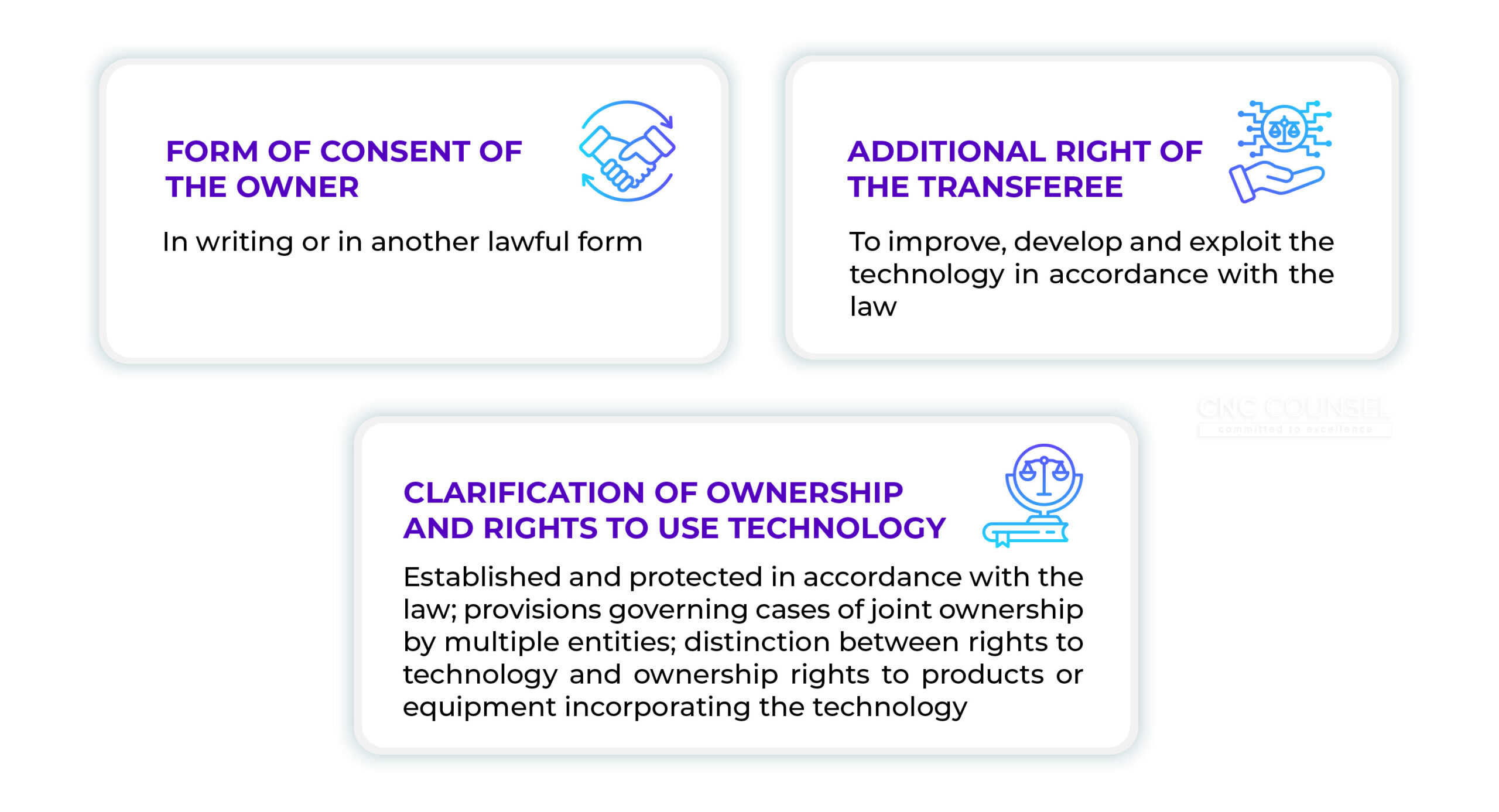
Rights Relating to Technology Transfer
5. Specific Provisions on Capital Contribution in the Form of Technology[6]
Technology is recognized by experts not merely as a means of production, but also as a valuable type of asset that may be valued and used for capital contribution.
On this basis, the amended Law on Technology Transfer has significantly expanded the scope of capital contribution in the form of technology by allowing organizations and individuals having lawful ownership rights over technology to use such technology as capital contribution to an enterprise, rather than limiting such capital contribution to investment projects as provided under the 2017 Law on Technology Transfer.
This approach reflects a comprehensive legislative perspective, ensuring consistency between the legal framework governing technology transfer and investment practices and capital contribution activities in Vietnam.
In addition, the State encourages capital contribution in the form of technologies developed from science, technology and innovation activities conducted by Vietnamese organizations, individuals and enterprises through support measures relating to technology valuation and the establishment of lawful ownership rights or rights to use technology.
This is considered a noteworthy new development, providing an important legal basis for promoting domestic technology transfer activities while encouraging the commercialization of research and development outcomes.
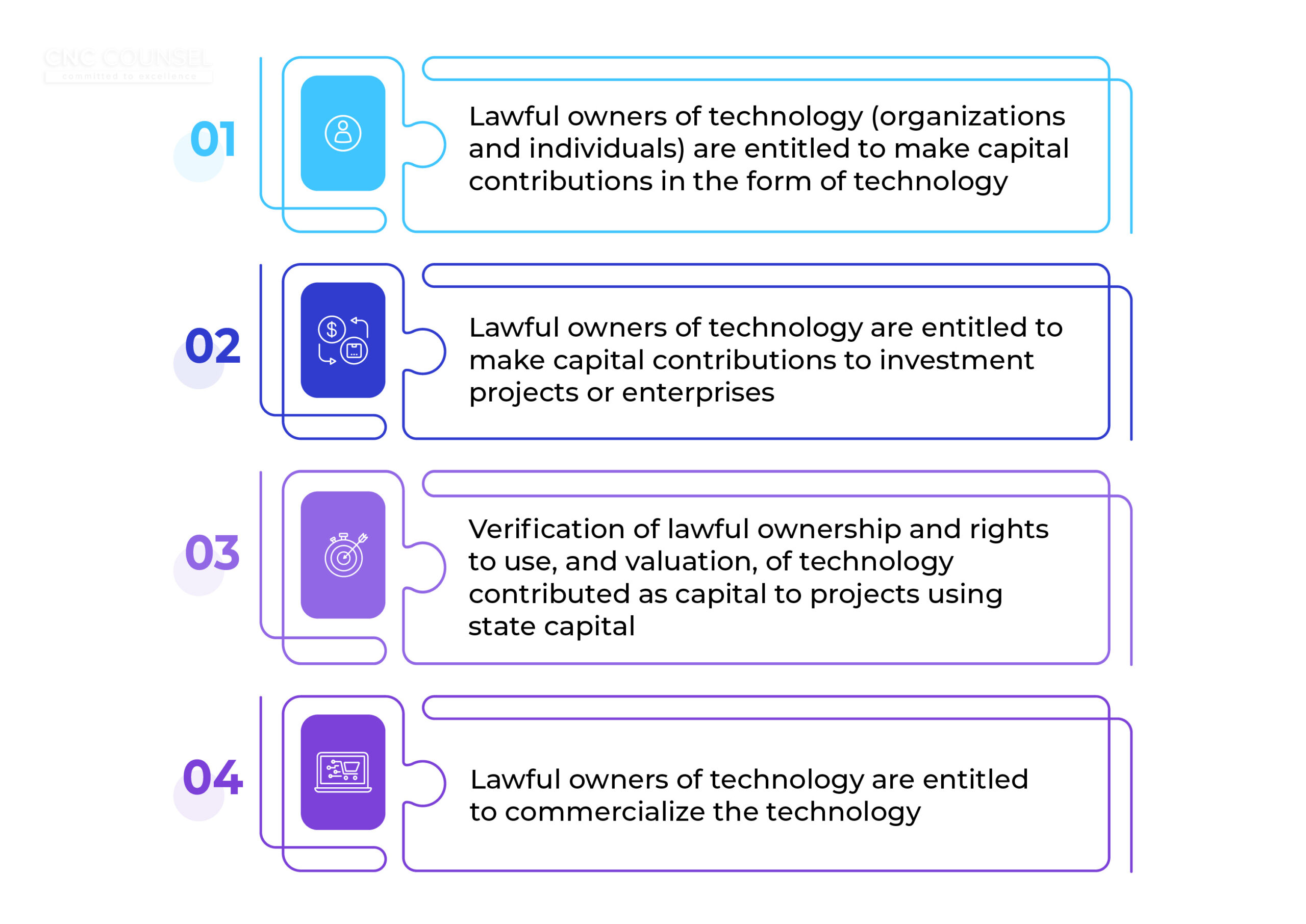
Provisions on Capital Contribution in the Form of Technology
6. Encouragement of Registration and Provision of Information on Technology Transfer
Based on enhanced digitalization, the new regulations introduce additional provisions and encourage enterprises engaged in technology transfer activities to provide complete and accurate information on their technology transfer activities through the National Digital Platform for Management of Science, Technology and Innovation[7].
The disclosure and standardization of information enhance the transparency of technology transfer transactions and the effectiveness of state management, mitigate risks, and facilitate the participation of relevant parties in the national innovation ecosystem.
Registration of technology transfer is mandatory in cases involving the transfer of technology using state investment capital or indicating cross-border technology transfer, such as transfers from overseas to Vietnam and vice versa[8].
In such cases, the transferee (in the case of industrial processing from overseas to Vietnam or within Vietnam) and the transferor (in the case of industrial processing from Vietnam to overseas) may, on behalf of the parties, submit the application dossier for registration of industrial technology to the competent authority.
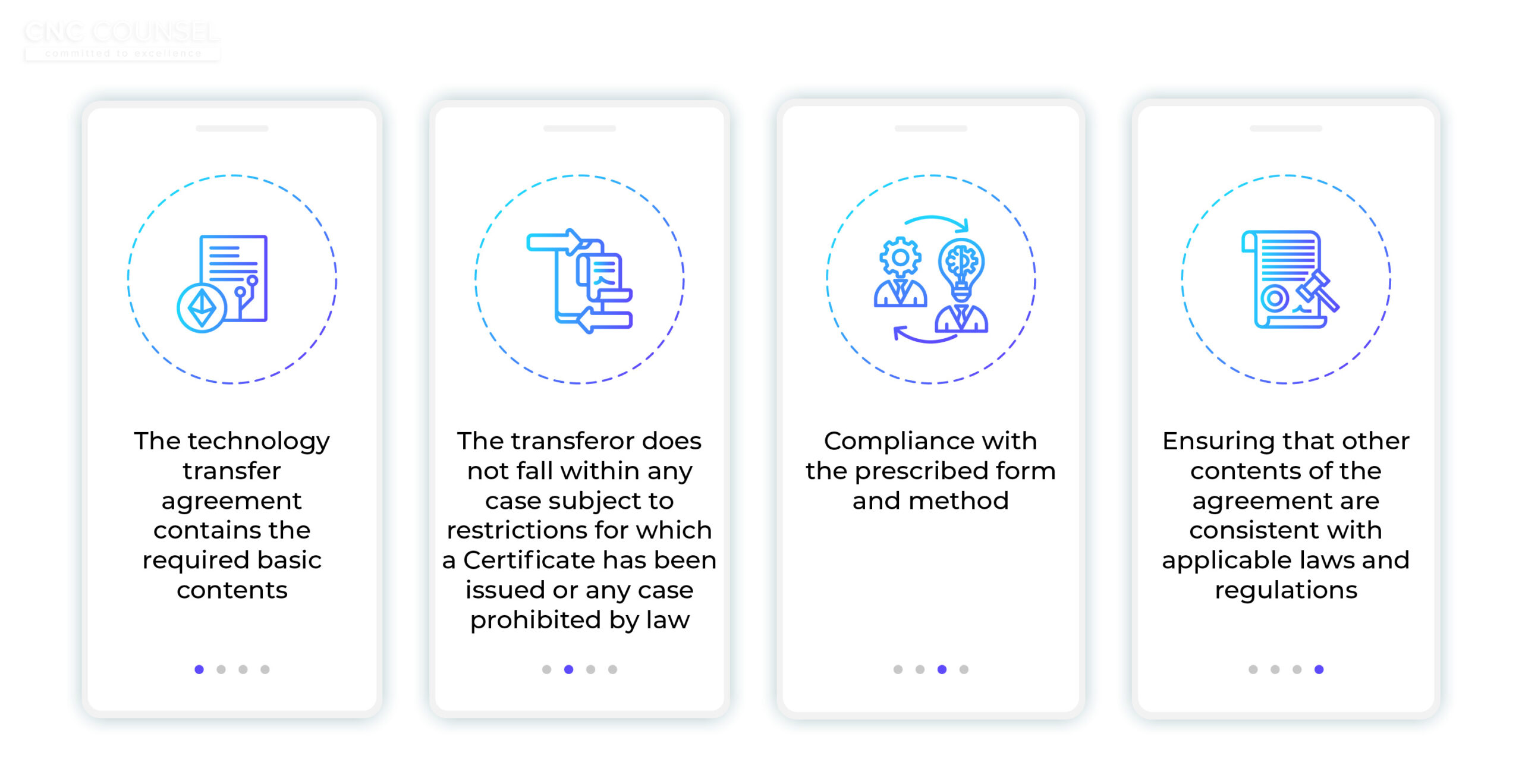
In addition to ensuring the completeness of the required quantity and list of documents in the application for a Certificate of Registration of Technology Transfer, enterprises should pay attention to the following factors[9]:
- the technology transfer agreement between the parties must contain the required basic contents;
- the transferor must not fall within any case subject to restrictions for which a certificate has been issued or any case prohibited by law;
- the prescribed form and method must be duly complied with; and
- other contents of the agreement must be consistent with applicable laws and regulations.
Currently, to promote and shorten the time required for technology transfer, the State encourages cases in which registration is not required for technology transfer. However, registration and issuance of a Certificate constitute a basis for technology enterprises to receive priority in the selection process or in being directly assigned science, technology and innovation tasks, while also enabling them to benefit from preferential policies.
Provisions on Registration and Provision of Information on Technology Transfer
7. Transitional Provisions for Technology Transfer Agreements and Projects
The new Law introduces detailed transitional provisions providing guidance on the treatment of agreements, dossiers and projects existing before the new Law takes effect.
– Technology transfer agreements entered before 1 April 2026 shall continue to be performed in accordance with the agreements; any amendment, supplementation or extension made after that date shall be subject to Law No. 115/2025/QH15.
– Registration and extension application dossiers for technology transfer agreements that were received and processed before 1 April 2026 but remain unresolved shall be governed by Law No. 07/2017/QH14, as amended and supplemented by Law No. 16/2023/QH15 and Law No. 93/2025/QH15.
– Applications for approval and licensing of technology transfer that were received and processed before 1 July 2025 but remain unresolved as of 1 April 2026 shall be governed by Law No. 07/2017/QH14, as amended and supplemented by Law No. 16/2023/QH15 and Law No. 93/2025/QH15.
– Projects using technologies restricted from transfer or technologies that may adversely affect the environment, which were approved before 1 April 2026 but had not yet undergone technology appraisal or consultation on technology, shall, if the technological contents are adjusted after 1 April 2026, be subject to technology appraisal or consultation in accordance with Law No. 115/2025/QH15.
Meanwhile, the former law did not contain specific provisions on these matters, which could give rise to difficulties and uncertainty in application.
III. Conclusion
The 2025 Law on Technology Transfer marks an important milestone in the further development of the legal framework, creating strong momentum for the commercialization and localization of technology in the era of digital transformation and deepening international integration.
By promoting greater decentralization of management and simplifying administrative procedures, the Law not only helps optimize the processing of application dossiers but also significantly mitigates legal risks, thereby encouraging relevant parties to proactively engage in technology transfer activities, particularly in the domestic market.
This clearly demonstrates the State’s strategic orientation towards promoting innovation and establishing a transparent and efficient business environment.
Against the backdrop of rapid digital transformation, a proper understanding and application of the new provisions on the right to improve technology, as well as investment incentive policies, will constitute a key competitive advantage.
Although further refinement will be necessary to keep pace with practical developments and trends, the 2025 Law on Technology Transfer is expected to create an integrated technology transfer ecosystem that closely responds to enterprises’ sustainable development needs.
Managed by
 |
Luong Van Chuong I Partner
Phone: (84) 938 04 7969 Email: chris.luong@cnccounsel.com |
 |
Collaborator – Bui Huong Giang
Phone: (84) 347 924 900 |
Contact Us
For further information, please contact:
CNC Vietnam Law Firm
Address: The Rise Building, 2A1 Nguyen Thi Minh Khai, Sai Gon Ward, Ho Chi Minh City, Vietnam
Phone: (84) 28-6276 9900 – 081 235 3839
Hotline: (84) 916-545-618
Email: contact@cnccounsel.com
Website: cnccounsel
We would be delighted to welcome you at CNC’s office, where you’ll have the opportunity to consult with the lawyer best suited to your circumstances. Of course, if you are unable to meet in person, simply email us via contact@cnccounsel.com or call us via (+84-28) 6276 9900.
It would be a pleasure for CNC’s lawyers to help you build a solid legal foundation, thus ensuring the success and sustainable development of your project!
————————————
Copyright © CNC Counsel. All rights reserved. Ownership: This documentation and content (Content) is a proprietary resource owned exclusively by CNC Counsel. Use of this Content does not of itself create a contractual relationship, nor any attorney/client relationship, between CNC Counsel and any person. Disclaimers: The Content provided is for informational purposes only and may not reflect the latest legal or regulatory developments. Summaries of laws, regulations, and practices are subject to change. This Content does not constitute legal or professional advice for any specific situation and should not be relied upon as a substitute for reviewing and complying with applicable laws, rules, regulations, or official forms. Always seek legal counsel before making any decisions or taking any action based on this Content. CNC Counsel, along with its editors and contributing authors, make no guarantees regarding the accuracy of the Content and explicitly disclaim any liability for any consequences resulting from actions taken, allowed, or omitted, whether fully or partially based on any part of the Content. The Content may include links to external websites, and external sites may also link to it. CNC Counsel is not responsible for the content or functionality of any such external websites and disclaims all liability for any issues arising from their content or operation. Please note: Past results do not guarantee similar outcomes.
————————————
[1] Clause 7, Article 2 of the 2017 Law on Technology Transfer: “Technology transfer refers to the transfer of the ownership or the right to use a given technology from the party that has the right to transfer such technology to the transferee.”
[2] Clause 3, Article 1 of the 2025 Law on Technology Transfer: “Technological plans or processes; engineering solutions, parameters, designs or diagrams; models, algorithms, formulas, software programs, information and data.”
[3] Point b, Clause 1, Article 4 of the 2017 Law on Technology Transfer: “Technology plans or processes; engineering solutions, parameters, drawings or diagrams; formula, computer software and database.”
[4] Clause 2, Article 1 of the 2025 Law on Technology Transfer.
[5] Clause 5, Article 1 of the 2025 Law on Technology Transfer.
[6] Clause 6, Article 1 of the 2025 Law on Technology Transfer.
[7] Clause 14, Article 1 of the 2025 Law on Technology Transfer.
[8] Clause 14, Article 1 of the 2025 Law on Technology Transfer.
[9] Clause 4, Article 20 of Decree No. 101/2026/ND-CP.