




The petroleum industry occupies a unique position in Vietnam’s economy because it is closely connected to energy security, state-budget revenues, supporting industries, national sovereignty, and international investment relations. In recent years, petroleum operations have faced increasing challenges: large fields with favorable exploitation conditions are gradually declining; exploration and production activities are moving toward deepwater and offshore areas; investment costs and technical requirements are rising; and environmental and emissions-reduction standards are receiving greater attention.
The 2022 Petroleum Law established a new legal framework for petroleum operations. However, implementation in practice has shown that several issues require further improvement, particularly investment procedures, contractor selection, approval of field development plans, incentive mechanisms for small and marginal fields, and the determination of the scope of petroleum operations in relation to new energy activities.
Against this background, the amendment of the Petroleum Law pursues three principal objectives: resolving practical obstacles, enhancing the attractiveness of the investment environment, and establishing a legal foundation for the energy transition. The draft of Amended Petroleum Law was structured into 12 chapters and 62 articles, whereas the existing Petroleum Law comprises 11 chapters and 69 articles. This structure reflects an effort to reorganize the regulations in a more streamlined manner while introducing new provisions consistent with the industry’s development requirements.
On 23 August 2026, the National Assembly officially passed the 2026 Amended Petroleum Law with a very high level of support from the deputies. The Law consists of 12 chapters and 62 articles, having one more additional chapter and seven fewer articles than the 2022 Petroleum Law, which reflecting the direction of streamlining regulations, simplifying procedures, and strengthening the legal framework for petroleum operations.
1. Key Directions of the 2026 Amended Petroleum Law
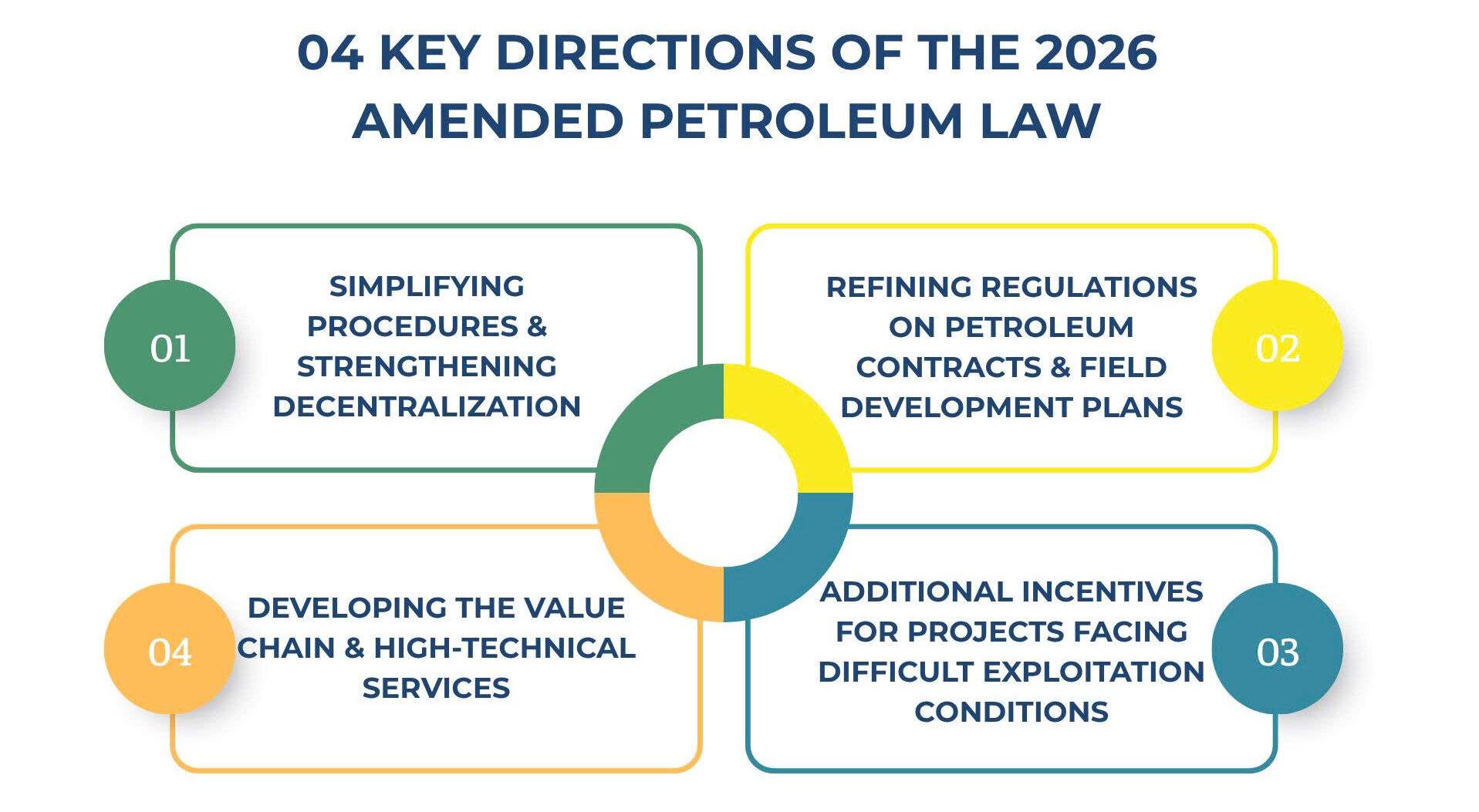
1.1. Simplifying Procedures and Strengthening Decentralization
One of the key directions of the 2026 Amended Petroleum Law is to promote decentralization and delegation of authority in state management of petroleum activities. This approach aims to shorten the time required to process applications, reduce overlap among authorities, and enhance the accountability of competent entities.
Clearly distinguishing the functions of petroleum contractors, investors, and entities performing specific tasks assigned by the State is particularly important. In the petroleum sector, one entity may simultaneously perform several roles, such as investing, operating a project, providing technical services, or carrying out energy-security functions. If these roles are not clearly defined, there may be a significant risk of conflicts of interest, difficulties in allocating responsibility, and disputes concerning rights and obligations.
Decentralization, however, does not mean that the State will reduce its oversight of strategic matters. Issues relating to national defense, security, national sovereignty, and force majeure events should remain subject to direct state control through the competent authorities. Accordingly, the central issue is not only “to whom authority is delegated,” but also the clear determination of the limits, conditions, and supervisory mechanisms governing the exercise of delegated authority.
With respect to Vietnam National Industry – Energy Group (Petrovietnam), the assignment of additional powers and responsibilities should be accompanied by mechanisms for supervision, transparency, and accountability. These mechanisms are necessary to ensure that decentralization improves governance without weakening transparency or creating an imbalance between authority and responsibility.
1.2. Refining Regulations on Petroleum Contracts and Field Development Plans
A petroleum contract forms the legal foundation of the relationship between the State and the contractor. Unlike many ordinary investment contracts, petroleum contracts generally have long terms, require substantial capital, involve significant geological risks, and are materially affected by fluctuations in energy prices, extraction technology, and environmental policies.
Accordingly, refining the procedures for preparing, appraising, and approving petroleum contracts may improve project transparency and predictability. The 2026 Amended Petroleum Law also provides greater clarity on procedures relating to field development plans, early production plans, and detailed development plans. These documents are critical to the timing of field development, total investment capital, technical solutions, and the project’s economic efficiency.
From an investor’s perspective, a clear procedure should address at least four issues.
- First, which authority is responsible for leading and deciding each stage?
- Second, how long will the application-processing period take, and what are the legal consequences of delay?
- Third, to what extent may the contractor modify the plan if geological or market conditions change?
- Fourth, how will changes in planning, tax policies, or environmental requirements affect the economic equilibrium of the contract?
If these matters continue to be delegated to implementing regulations without sufficiently clear statutory principles, the objective of improving legal certainty may not be fully achieved. Conversely, if the Law establishes appropriate criteria, timelines, and adjustment mechanisms, it will provide an important basis for reducing compliance costs and limiting disputes during contract performance.
1.3. Additional Incentives for Projects Facing Difficult Exploitation Conditions
The 2026 Amended Petroleum Law introduces an orientation toward incentive policies for projects involving the development of small and marginal fields, deepwater and offshore operations, enhanced oil recovery, and the recovery of remaining resources from petroleum fields or blocks.
These incentives respond to changing exploitation conditions. Such projects generally involve high exploration and development costs, substantial technical risks, lengthy payback periods, and economic returns that are highly sensitive to fluctuations in oil and gas prices. If they are subject to the same financial obligations and investment conditions as large, favorably located fields with low production costs, many may fail to meet commercial viability thresholds.
In principle, petroleum investment incentives should strike a balance between two objectives. On the one hand, incentives must be sufficiently attractive to encourage investors to accept risks and develop difficult projects. On the other hand, incentives should not cause unnecessary losses to the state budget or encourage inefficient exploitation.
Accordingly, incentive mechanisms should be linked to objective criteria, such as reserve size, geological conditions, distance from shore, investment level, operating costs, expected recovery factors, and payback periods. A periodic review mechanism is also necessary to ensure that incentives are maintained only for the required duration and within the necessary scope. This would help prevent incentives from being applied too broadly or remaining in place after the project’s economic conditions have changed.
1.4. Developing the Value Chain and High-Technology Technical Services
A notable feature of the 2026 Amended Petroleum Law is the expansion of business activities connected with the petroleum sector, thereby facilitating the development of high-technology technical services and offshore energy activities.
If properly implemented, this policy may help the petroleum industry move from a model focused primarily on resource extraction toward a broader value-chain model, including engineering, fabrication, operations, maintenance, geological data processing, environmental services, and technological solutions for offshore energy.
The significance of this direction extends beyond expanding business opportunities for petroleum enterprises. In the long term, it may support the formation of a supporting-industry ecosystem, strengthen the capabilities of domestic enterprises, and enhance their participation in energy projects involving advanced technical requirements.
However, expanding the scope of activities also requires a clear distinction between activities “connected with petroleum operations” and independent energy activities. If this boundary is unclear, differing interpretations may arise regarding licensing authority, business conditions, asset-management regimes, and safety responsibilities. Implementing regulations should therefore clarify the criteria for determining a direct or necessary connection between supporting activities and core petroleum operations.
2. The Legal Framework for Emissions Reduction and Carbon Capture and Storage (CCS)
2.1. The Need for CCS Regulations
The introduction of a legal framework for emissions reduction and carbon capture and storage represents one of the most significant new elements of the 2026 Amended Petroleum Law. Under the stated policy direction, CCS activities are regulated to the extent that they are directly connected with petroleum operations.
CCS may help reduce emissions from petroleum extraction, processing, and refining facilities, particularly in sectors where completely replacing fossil fuels or eliminating emissions in the short term remains difficult. However, CCS involves a range of complex legal and technical issues, including rights to use storage areas, liability for carbon leakage, long-term monitoring, incident response, and the determination of rights to carbon credits.
Recognizing CCS under the 2026 Petroleum Law provides an initial legal basis for pilot projects and investment in this area. Nevertheless, the Law should primarily establish a framework of principles. Technical matters—including site-selection standards, measurement and verification requirements, methods for determining storage capacity, and post-closure monitoring mechanisms—will need to be further specified in implementing regulations.
2.2. Carbon Credits and Post-Closure Responsibility
A key issue is determining the contractor’s rights to carbon credits generated by CCS activities. According to information from the Ministry of Industry and Trade, the draft Amended Petroleum Law was revised to clarify contractors’ rights to carbon credits and to provide for monitoring, observation, and incident-remediation responsibilities after field closure.
The allocation of carbon-credit rights directly affects a project’s financial feasibility. Investors need to know which entity will be entitled to the credits, the scope within which the credits may be traded, and whether they may be used to satisfy emissions-reduction obligations. At the same time, post-closure responsibility must be clearly allocated to avoid uncertain transfers of liability or legal gaps extending over a lengthy period after project completion.
A sound mechanism may need to distinguish among responsibilities during the operational phase, responsibilities during post-closure monitoring, and liabilities arising from incidents attributable to the fault of particular entities. The law should also provide for technical records, monitoring data, and independent verification mechanisms to ensure the reliability of the quantity of carbon captured and stored.
2.3. Shared Use of Offshore Infrastructure
The 2026 Amended Petroleum Law also encourages the shared use of existing infrastructure for offshore energy facilities, provided that safety is ensured and petroleum operations are not adversely affected.
This approach may generate significant economic benefits because offshore projects typically require substantial expenditure on ports, pipelines, logistics bases, transmission systems, and ancillary facilities. Utilizing existing infrastructure may reduce capital expenditure, shorten implementation timelines, and improve asset utilization.
Nevertheless, a shared-use mechanism must clearly address access rights, priority arrangements, cost allocation, maintenance responsibilities, insurance, incident response, and compensation for damage. Where conflicts arise between petroleum operations and offshore energy activities, the law should also establish criteria for decisions by the competent authorities rather than relying solely on a qualitative standard such as “not affecting petroleum operations.”
3. Impact on Relevant Stakeholders
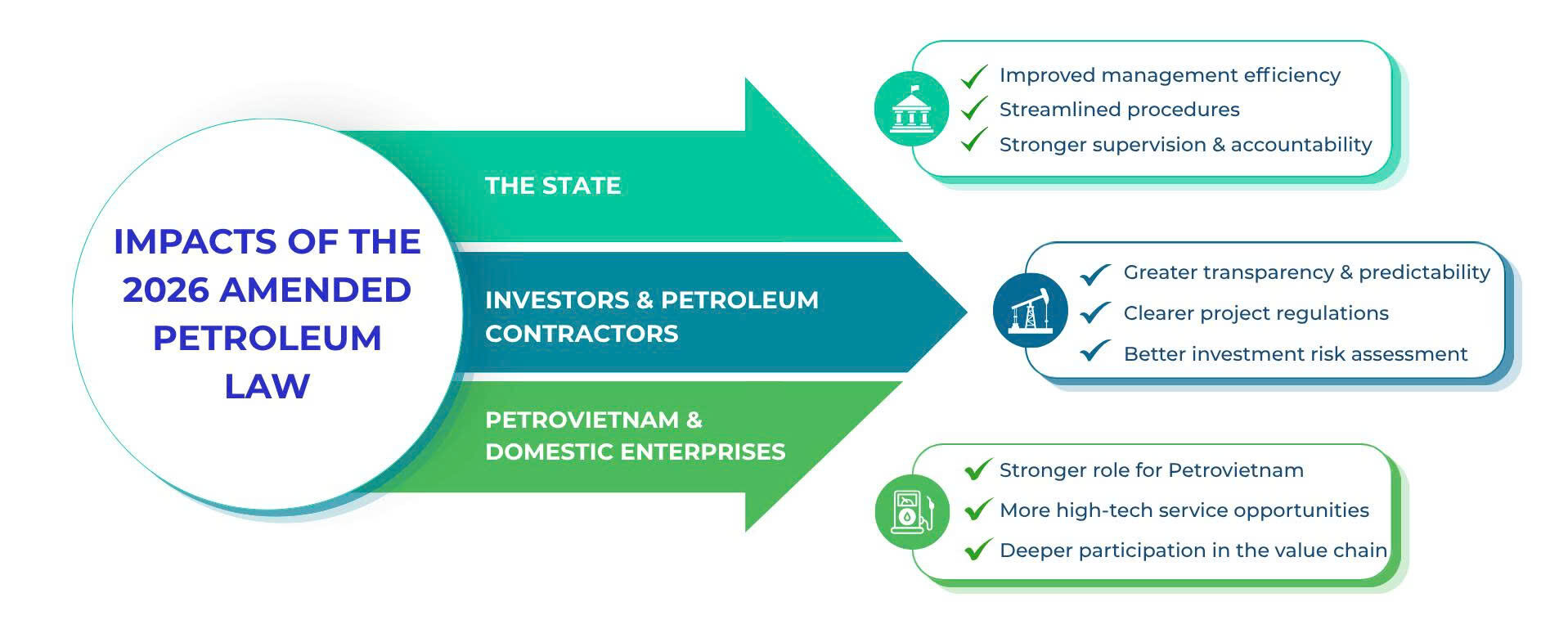
3.1. The State
For the State, the 2026 Amended Petroleum Law may improve management efficiency by clarifying authority, streamlining procedures, and establishing a legal basis for new activities. Incentives for difficult-to-exploit projects may also increase the ability to mobilize social resources for areas that previously failed to achieve commercial viability.
However, management effectiveness will depend on the quality of the supervisory mechanisms introduced after decentralization. Without adequate inspection, reporting, and accountability mechanisms, delegation may result in inconsistent application of the law among authorities or localities. Investment incentives and revenue-allocation mechanisms should also be periodically reviewed to maintain an appropriate balance among the interests of the State, contractors, and other relevant stakeholders.
3.2. Investors and Petroleum Contractors
For investors, the principal benefit of the new legal framework lies in the potential improvement of project transparency and predictability. Clearer regulations on contracts, field development plans, and incentives for projects facing difficult exploitation conditions may assist investors in developing financial models and assessing legal risks.
Investors should nevertheless continue to monitor matters that may affect project returns, including actual procedural timelines, the ability to adjust field development plans, the stability of fiscal policies, and environmental obligations throughout the project life cycle. For CCS and offshore energy projects, the allocation of long-term responsibilities will be particularly important during negotiations and investment decision-making.
3.3. Petrovietnam and Domestic Enterprises
Strengthening the role of Vietnam National Industry – Energy Group (Petrovietnam) and expanding opportunities for high-technology technical services may encourage domestic enterprises to participate more deeply in the petroleum value chain. Enterprises with capabilities in engineering, offshore construction, geological data, maintenance, and environmental services may gain additional opportunities to provide services for new projects.
However, granting additional powers to a state-owned enterprise occupying a central position in the sector should be accompanied by requirements for governance transparency, functional separation, and mechanisms to control conflicts of interest. This is particularly important where an entity may both conduct commercial activities and perform certain tasks assigned by the State.
4. Issues Requiring Further Development
Although the amendment direction is necessary, implementation of the Law may give rise to several issues requiring further clarification.
First, decentralization provisions should specify the authority of each agency, processing timelines, and mechanisms for resolving disagreements among regulatory authorities. Otherwise, the objective of simplifying procedures may not be achieved as expected.
Second, incentive policies for small and marginal fields, deepwater fields, and enhanced or residual recovery activities should be based on transparent criteria. These criteria should be sufficiently specific to allow investors to assess eligibility before deciding whether to participate in a project.
Third, CCS regulations should be integrated with the laws on environmental protection, resource protection, carbon credits, and liability for damages. If CCS is regulated solely within the petroleum-law framework without ensuring consistency with related areas of law, businesses may face multiple layers of overlapping procedures and obligations.
Fourth, the shared use of offshore infrastructure requires sufficiently detailed rules on infrastructure access, service pricing, capacity allocation, and dispute resolution. These issues are likely to arise directly during project operations and should not be left solely to contractual arrangements where fundamental legal principles are absent.
5. Conclusion
The 2026 Amended Petroleum Law reflects Vietnam’s continuing effort to improve the legal framework for the petroleum industry amid the increasingly interconnected requirements of energy security, investment efficiency, and the energy transition. Its five principal policy groups combine procedural reform, administrative decentralization, investment incentives, value-chain development, and emissions control.
The significance of the amendment lies not merely in the number of chapters and articles added or removed, but in the way the new provisions may change the governance of petroleum projects throughout their life cycle. If implemented through transparent, stable, and predictable regulations, the Law may unlock resources for complex petroleum projects, promote high-technology technical services, and establish an initial legal foundation for CCS and offshore energy.
Conversely, if issues relating to authority, incentives, carbon credits, post-closure responsibility, and shared infrastructure are not adequately addressed in implementing regulations, the reform objectives may encounter difficulties in practice. Accordingly, the development of implementing legislation and the organization of enforcement after the Law’s promulgation will be decisive to the practical effectiveness of the amended policy framework.
6. What CNC Can Support?

- Real Estate, Energy, Construction, Infrastructure & Project Finance: Full-cycle legal advisory for constructions contracts (including FIDIC, EPC), energy, project finance, operational setup, and hands-on contract management.
- Foreign Direct Investment: Company establishment, Investment registration, and Post-registration compliance such as tax, accounting, labor, insurance, payroll, and Outsourced Legal Department services;
- Business Operating Licenses: We assist in obtaining operating licenses for specific business activities including manufacturing, trading, services, e-commerce, healthcare, education, or food & beverage (restaurants), etc.;
- M&A Services: Conducting Legal Due Diligence Reports; Structuring transaction frameworks; Drafting and Negotiating transaction documents; Advising on competition law compliance, including economic concentration control filings and related approvals; Obtaining necessary approvals and licenses; and Post-closing support;
- Personal Data Protection: Support in complying with personal data protection regulations, including drafting and reviewing Data Protection Impact Assessments (DPIAs), Data Processing/Transfer Agreements, Privacy Policies, and other required documents under the Personal Data Protection Law (PDPL);
- Dispute Resolution: Court litigation and commercial arbitration (VIAC, SIAC, ICC); and
- Legal Retainer Services.
Please feel free to contact Mr. Chris Luong – Partner via email: chris.luong@cnccounsel.com or Mr. Le The Hung – Managing Partner via email: hung.le@cnccounsel.com for further support.
Managed by
 |
Luong Van Chuong I PartnerPhone: (84) 938 04 7969
Email: chris.luong@cnccounsel.com |
Copyright © CNC Counsel. All rights reserved.
Ownership: This documentation and content (Content) is a proprietary resource owned exclusively by CNC Counsel. Use of this Content does not of itself create a contractual relationship, nor any attorney/client relationship, between CNC Counsel and any person.
Disclaimers: The Content provided is for informational purposes only and may not reflect the latest legal or regulatory developments. Summaries of laws, regulations, and practices are subject to change. This Content does not constitute legal or professional advice for any specific situation and should not be relied upon as a substitute for reviewing and complying with applicable laws, rules, regulations, or official forms. Always seek legal counsel before making any decisions or taking any action based on this Content. CNC Counsel, along with its editors and contributing authors, make no guarantees regarding the accuracy of the Content and explicitly disclaim any liability for any consequences resulting from actions taken, allowed, or omitted, whether fully or partially based on any part of the Content. The Content may include links to external websites, and external sites may also link to it. CNC Counsel is not responsible for the content or functionality of any such external websites and disclaims all liability for any issues arising from their content or operation.
Please note: Past results do not guarantee similar outcomes.