




The registration of foreign loans has long been regarded as one of the most important regulatory procedures for foreign-invested enterprises in Vietnam, particularly given that many FDI enterprises regularly receive funding from their parent companies, affiliated entities, or foreign credit institutions to support their investment, production, and business activities.
However, transactions on registration of foreign loans are subject to strict oversight by the State Bank of Vietnam from a foreign exchange management perspective.
To address the practical needs of enterprises, on 19/05/2026, the Governor of the State Bank of Vietnam issued Circular No. 17/2026/TT-NHNN, which focuses on foreign loans and internationally issued bonds guaranteed by the Government. The Circular officially takes effect on 25/07/2026.
In this article, CNC provides readers with a comprehensive overview of the procedures for registration of foreign loans in Vietnam.
Changes to the procedures for registration of foreign loans
The most noteworthy development introduced by Circular No. 17/2026/TT-NHNN is the shortening of the application processing duration and the decentralization of authority for the registration of foreign loans and internationally issued bonds guaranteed by the Government. Specifically, instead of being primarily handled by the State Bank of Vietnam and its Foreign Exchange Management Department as was previously the case, the authority to certify loan registrations and amendments to registered loans has been delegated to the Directors of the Regional Branches of the State Bank of Vietnam in the locality where the headquarters of the loanee or the international bond issuer is located.
This change has great significance since the decentralization of authority to Regional Branches of the State Bank of Vietnam allows the receipt, processing, and management of application to be carried out closer to the loanee’s place of business. The new approach is consistent with the Government’s broader objective of administrative reform in the field of foreign exchange.
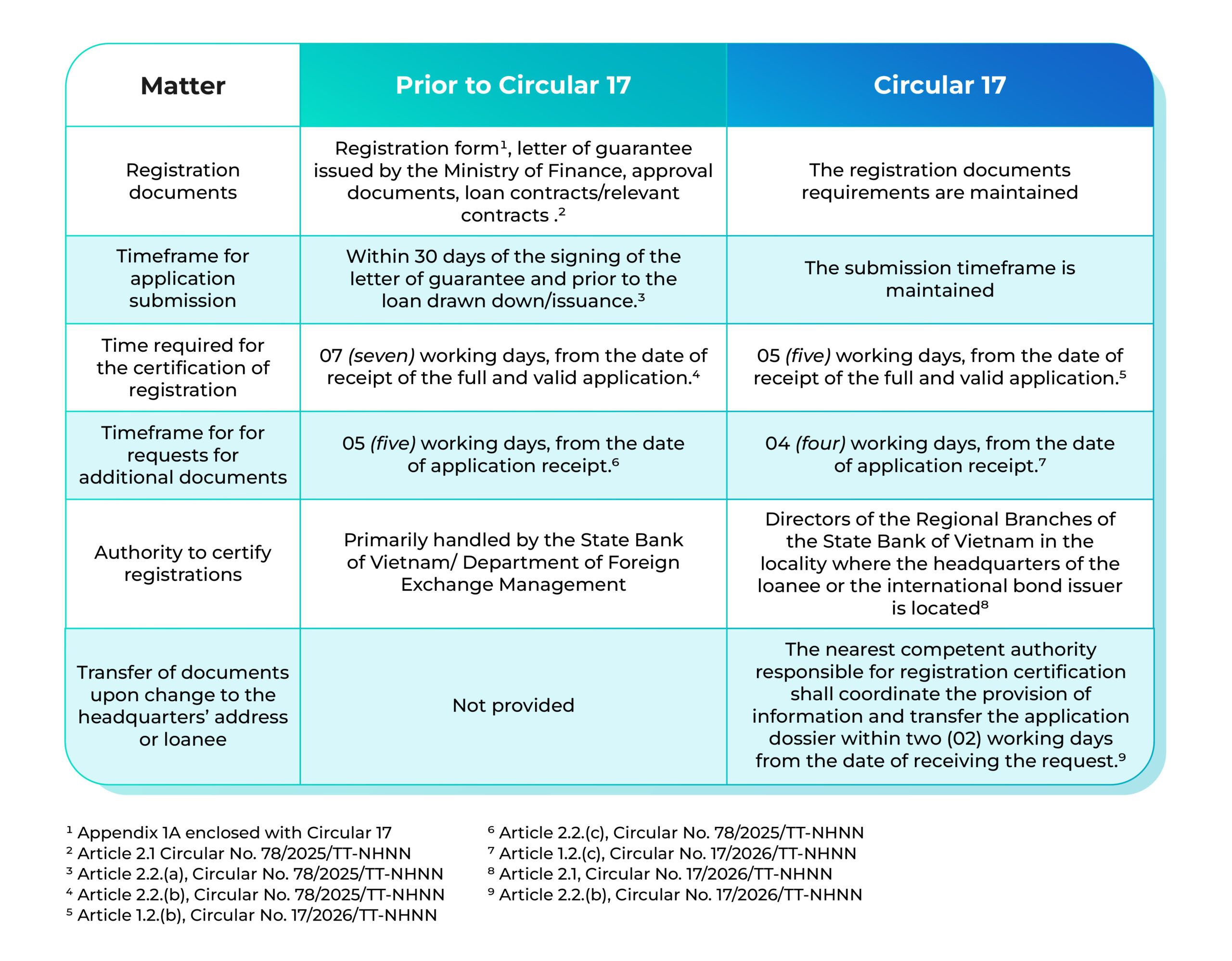
Comparison of the foreign loan registration procedures before and after the promulgation of Circular 17
From the above changes, it is evident that Circular No. 17/2026/NHNN does not fundamentally change the foreign loan registration obligations, instead, it introduces significant improvements to the processing time and the competent authorities responsible for handling application. This is an important premise for enterprises to be more proactive in their plans for loan drawdowns, international bond issuances, and the structuring of foreign borrowing arrangements.
Procedures and required documents for foreign loan registration application
Normally, there are 02 (two) common forms of foreign loans:
- Foreign loans guaranteed by the Government and
- Foreign loans not guaranteed by the Government
After determining that the loan is subject to registration procedures, Enterprises must prepare documents and perform procedures according to their forms of foreign loan. Specifically:
Regarding foreign loans guaranteed by the Government
Application documents for the certification of foreign loan registration and issuance of international bond guaranteed by the Government include:
- First, Foreign loan registration form in accordance with Appendix 1A;
- Second, Letter of guarantee issued by the Ministry of Finance;
- Third, Approval documents of the competent authorities in accordance with the laws on investment project or the business and production plan financed by the proceeds of the foreign loan or the international bond issuance;
- Fourth, executed foreign loan contracts or contracts relevant to the issuance of international bonds per the structure of the issuance.
Regarding the procedures, Enterprises shall proceed in accordance with the following flowchart:
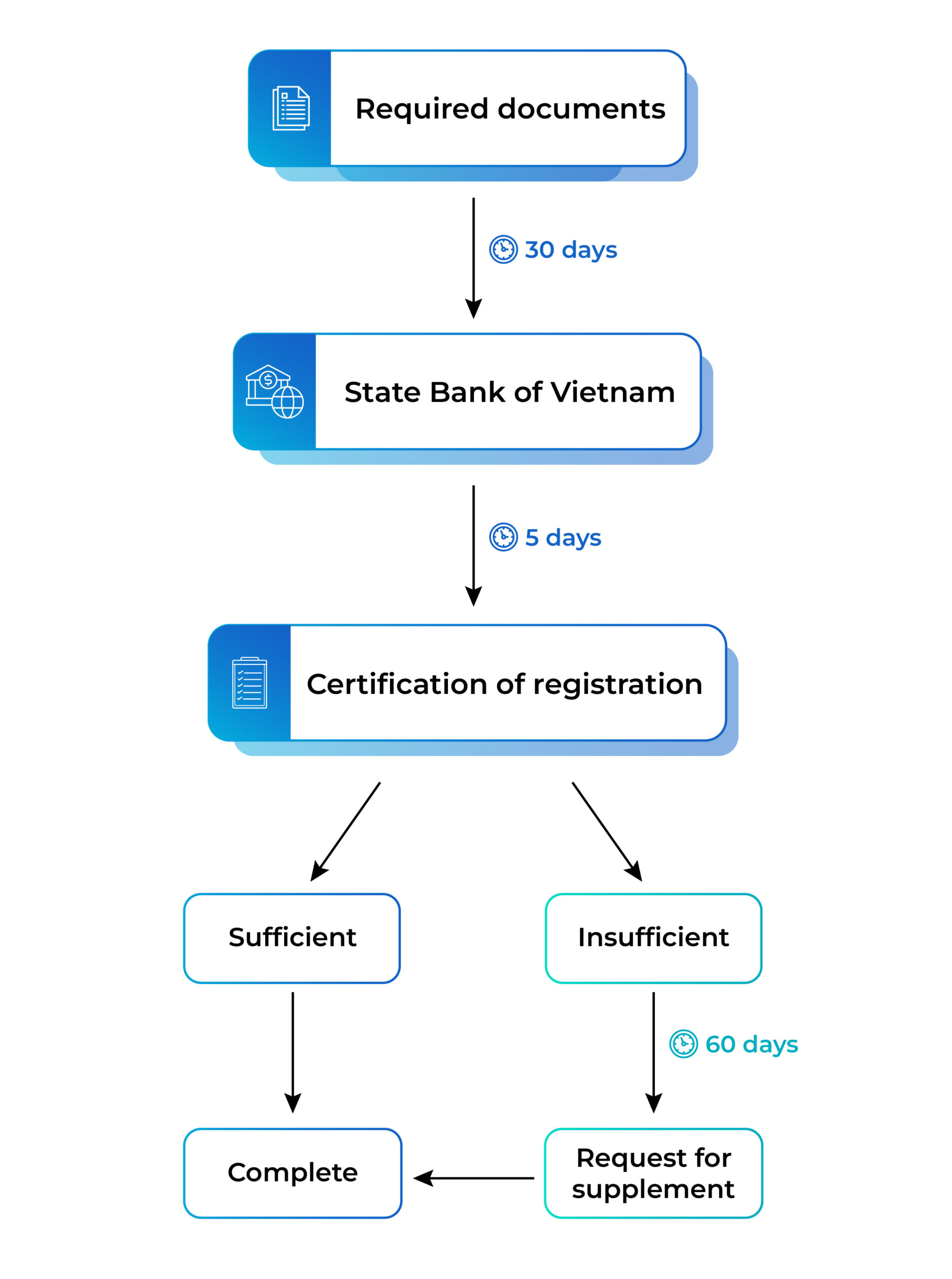
Overall, for foreign loans guaranteed by the Government, enterprises should especially pay attention to the two timeframes: the 30-day period for the submission of application, which commences from the guarantee letter’s execution date, and the date of loan drawdown. If the loan drawdown is made prior to the completion of the registration procedures, enterprises could be exposed to the risks of non-compliance with Vietnam’s foreign exchange control regulations.
Regarding foreign loans not guaranteed by the Government
For most FDI enterprises , foreign loans typically fall within the category of foreign loans not guaranteed by the Government. The application documents for registration of foreign loan not guaranteed by the Government includes, but is not limited to, the following documents:
- First, the registration form for foreign loans not guaranteed by the Government;
- Second, copies of the loanee’s legal documents, including but not limited to the Enterprise Registration Certificate, Establishment License, Cooperative Registration Certificate, Union of Cooperatives Registration Certificate, and any amendments or supplements thereto (if any), or other equivalent documents;
- Third, copies or originals of documents evidencing the purpose of the loan;
- Fourth, a copy of the foreign-language foreign borrowing agreement together with its Vietnamese translation, and any agreement extending a short-term foreign loan into a medium- or long-term loan (if applicable);
- Fifth, a copy of the foreign-language guarantee commitment document together with its Vietnamese translation, where the loan is guaranteed;
- Sixth, a copy of the approval or consent document issued by the competent authority authorizing the foreign loan;
- Seventh, documents and supporting evidence demonstrating the lawful distribution of profits in Vietnamese Dong.
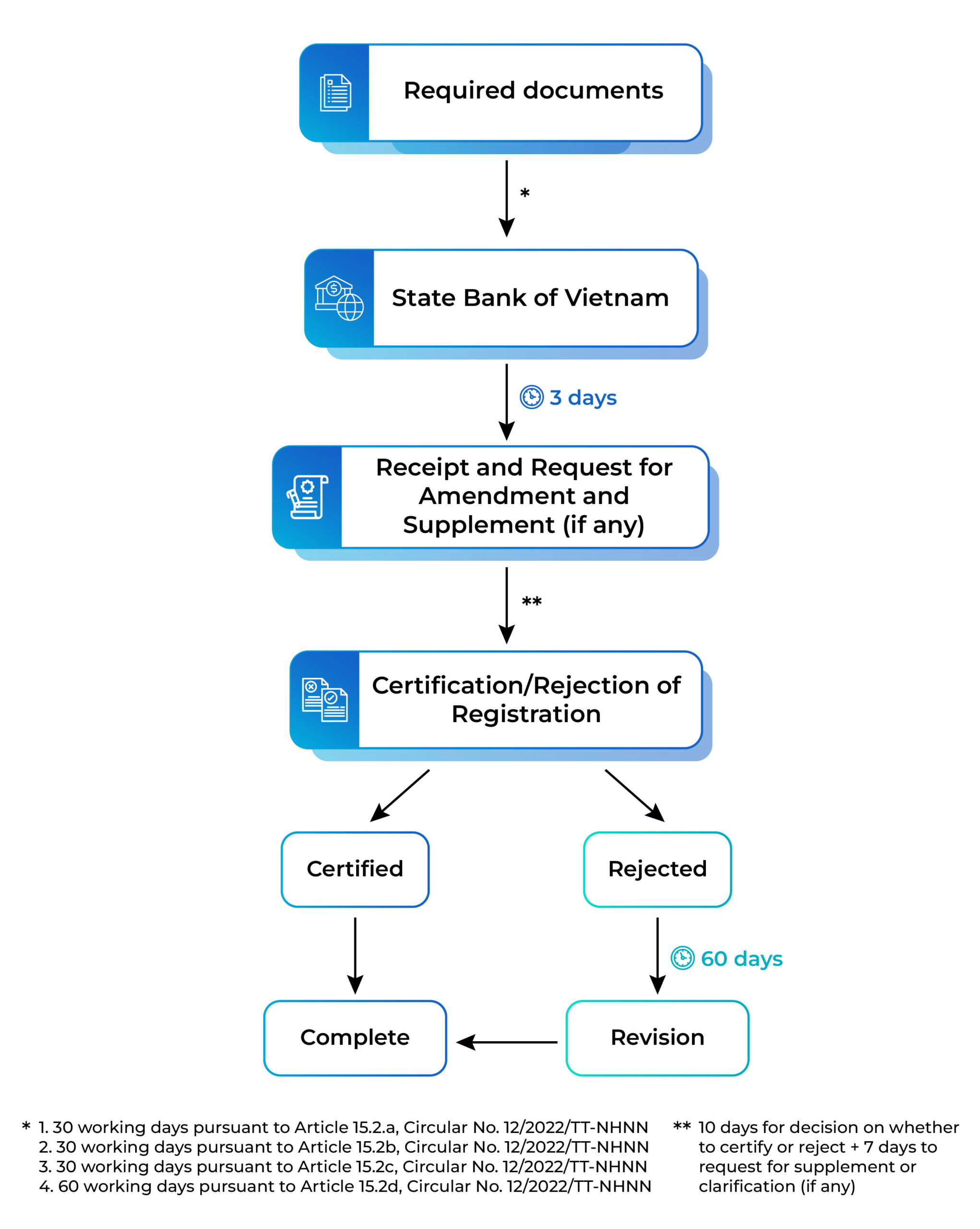
Regarding the procedures, Enterprises shall proceed in accordance with the following flowchart:
Administrative penalties for violations of regulations on procedures for foreign loan registration
Failure to comply with the registration procedures applicable to foreign loans may result in the registration application not being certified. In addition, enterprises may be required to supplement and rectify their application documents, and in certain circumstances may also be subject to administrative penalties.
Under the current regulations, since FDI enterprises are organizations, the applicable monetary penalties are generally determined in accordance with the principle that fines imposed on organizations are doubled[10]. Notable violations include, among others:
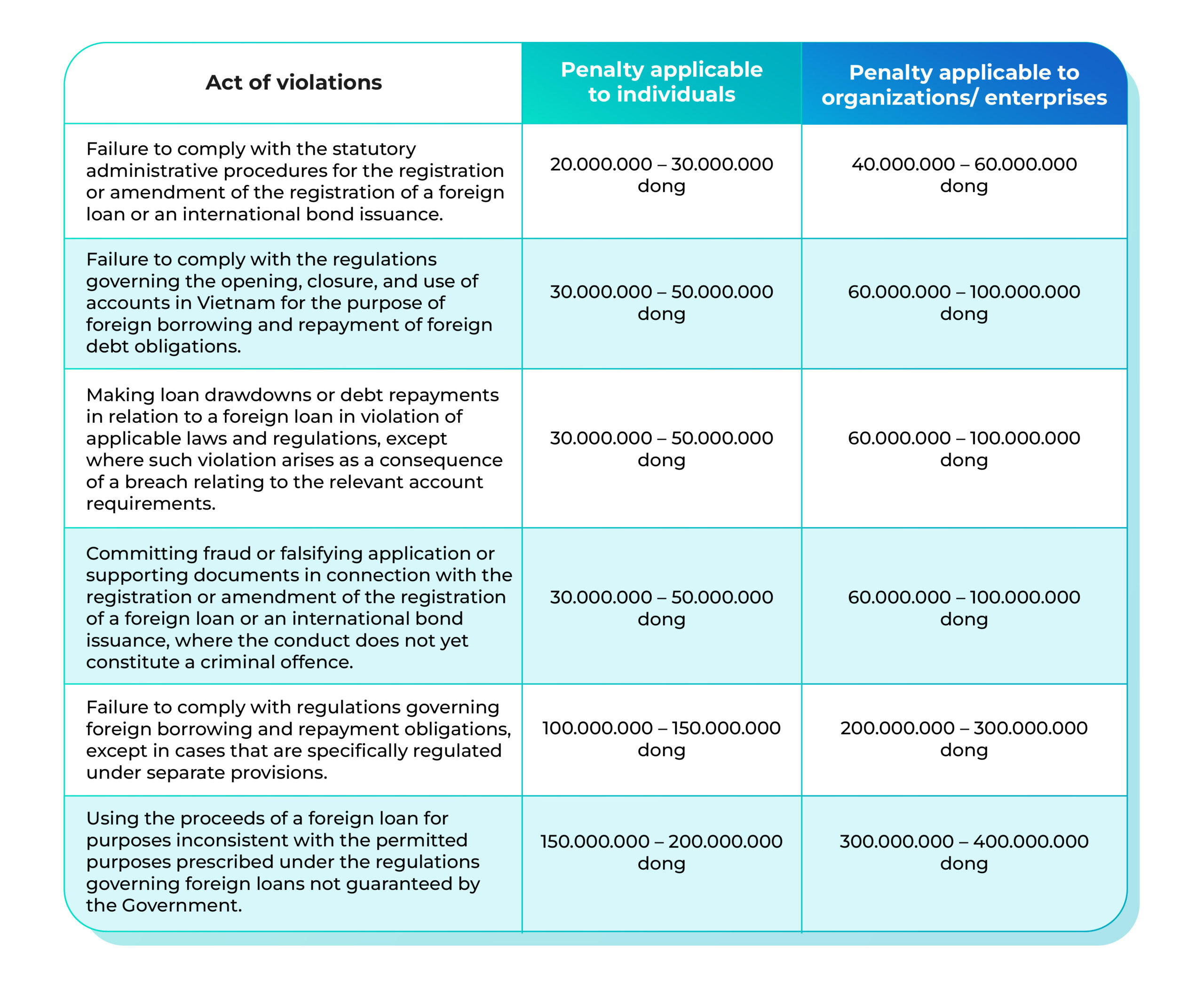
Penalties applicable to violations of foreign loan registration procedure
Accordingly, non-compliance with foreign loan registration procedures may expose an enterprise to three concurrent consequences: (i) refusal of registration certification, (ii) delays in the processing of the application, and (iii) administrative penalties for regulatory violations.
Enterprises should therefore carefully review the applicable loan conditions, registration requirements, submission deadlines, and drawdown plans before entering into any foreign borrowing arrangement so as to minimize potential regulatory risks.
What We Can Support?

- Inbound/Outbound Investment: Company Establishment, Investment Registration and Post-registration Services in relation to tax, accounting, labor, insurance, salary, and outsourced legal department;
- Operation Licenses: We could provide support in the application for operation licenses for business activities in fields such as manufacturing, commerce, services, e-commerce, healthcare, education, or food & beverage (restaurants);
- M&A Services: Conduct legal due diligence, structure transactions, draft and negotiate transaction documents, provide advice on competition law compliance (including merger control filings and related approvals), obtain necessary regulatory approvals and licenses, and provide post-closing support;
- Personal Data Protection: Provide support in compliance with the data protection regulations, including the drafting and reviewing of Data Protection Impact Assessment (DPIAs), Data Processing/Transfer Agreement, Privacy Policies, and other necessary documents under the Personal Data Protection Decree (PDPD);
- Dispute Resolution: Litigation and Commercial Arbitration (VIAC SIAC ICC); and
- Legal Retainer Services per the clients’ requests.
Please contact Mr. Chris Luong – Partner through the email address of chris.luong@cnccounsel.com or Ms. Ngan Nguyen – Partner through the email address of ngan.nguyen@cnccousel.com for prompt and timely support.
Managed by
 |
Nguyen Thi Kim Ngan I Partner
Phone: (84) 919 639 093 Email: ngan.nguyen@cnccounsel.com |
 |
Luong Van Chuong I Partner
Phone: (84) 938 04 7969 Email: chris.luong@cnccounsel.com |
 |
Trinh Minh An | Legal Intern
Phone: (84) 28 6276-9900 Email: an.trinh@cnccounsel.com |
Contact Us
For further information, please contact:
CNC Vietnam Law Firm
Address: The Rise Building, 2A1 Nguyen Thi Minh Khai, Sai Gon Ward, Ho Chi Minh City, Vietnam
Phone: (84) 28-6276 9900
Hotline: (84) 916-545-618
Email: contact@cnccounsel.com
Website: cnccounsel
We would be delighted to welcome you at CNC’s office, where you’ll have the opportunity to consult with the lawyer best suited to your circumstances. Of course, if you are unable to meet in person, simply email us via contact@cnccounsel.com or call us via (+84-28) 6276 9900.
It would be a pleasure for CNC’s lawyers to help you build a solid legal foundation, thus ensuring the success and sustainable development of your project!
————————————
Copyright © CNC Counsel. All rights reserved. Ownership Rights: This document and the content contained herein (Document) are proprietary resources exclusively owned by CNC Counsel. Access to or use of this Document does not, by itself, create any contractual relationship or lawyer-client relationship between CNC Counsel and any person or entity. Disclaimer: All Documents are provided solely for informational purposes and may not reflect the most current legal developments. Summaries of laws, regulations, and practices are subject to change. This Document is not intended to constitute legal, professional, or other advice with respect to any specific matter. Nor is it intended to substitute for reference to, or compliance with, the detailed provisions of any applicable law, regulation, rule, or official form. Readers are strongly encouraged to seek independent legal advice before taking, or refraining from taking, any action based on the information contained in this Document. CNC Counsel, together with its editors and authors, makes no representations or warranties as to the accuracy, completeness, or currency of the Document and disclaims all liability to any person or entity arising from reliance on all or any part of the Document. This Document may contain links to external websites, and external websites may contain links to this Document. CNC Counsel is not responsible for the content, operation, availability, or practices of any such external websites and expressly disclaims any liability in connection therewith. Note: Past results do not guarantee similar outcomes in future matters. Each matter is unique and must be assessed based on its own facts and circumstances.
————————————
[1] Appendix 1A enclosed with Circular 17
[2] Article 2.1 Circular No. 78/2025/TT-NHNN
[3] Article 2.2.(a), Circular No. 78/2025/TT-NHNN
[4] Article 2.2.(b), Circular No. 78/2025/TT-NHNN
[5] Article 1.2.(b), Circular No. 17/2026/TT-NHNN
[6] Article 2.2.(c), Circular No. 78/2025/TT-NHNN
[7] Article 1.2.(c), Circular No. 17/2026/TT-NHNN
[8] Article 2.1, Circular No. 17/2026/TT-NHNN
[9] Article 2.2.(b), Circular No. 17/2026/TT-NHNN
[10] Article 5.3.(a) Decree No. 340/2025/ND-CP