





9 common bidding methods and new application approaches in 2025
9 common bidding methods and new application approaches in 2025 are of great significance in the law on bidding.
A clear understanding of the characteristics, conditions for application, and implementation procedures of each bidding method not only enables employers, contractors, and investors to proactively prepare for and participate in the process, but also helps ensure legality, transparency, and economic efficiency throughout the project selection and execution stages.
In the following sections, CNC will provide an overview of the contractor and investor selection methods currently permitted under the law, together with the basic procedures and application approaches for each method, in order to offer a comprehensive and practical reference for real-world application.
Methods of contractor selection
Competitive Bidding
True to its “competitive” nature, this is a bidding method applicable to all packages with no limitation on the number of participating contractors[1], except for those that involve special methods[2]
Limited Bidding
In contrast to “competitive bidding”, limited bidding is a form of contractor selection in which only qualified contractors who meet the requirements of the tenderer could participate, to be specific:
- Packages with high technical requirements or involving technologies of specialized nature that only certain contractors could meet the package requirements;
- Sponsor of the projects and packages require the application of limited bidding as specified in international conventions, international loan agreements.
Direct Contracting
This is considered a special bidding method, accordingly, direct contracting is only applicable where the employer sends the request for proposal to one or more contractors for the implementation of the packages[3]
In particular, direct contracting is often applicable to the packages specified in point d, dd, e, g, h, I, k and l, Clause 1, Article 23 of the Law on Bidding if only one contractor is directly contracted and those specified in point dd, e, h, k, and l, Clause 1, Article of the Law on Bidding if more than one contractor is contracted. To be specific:
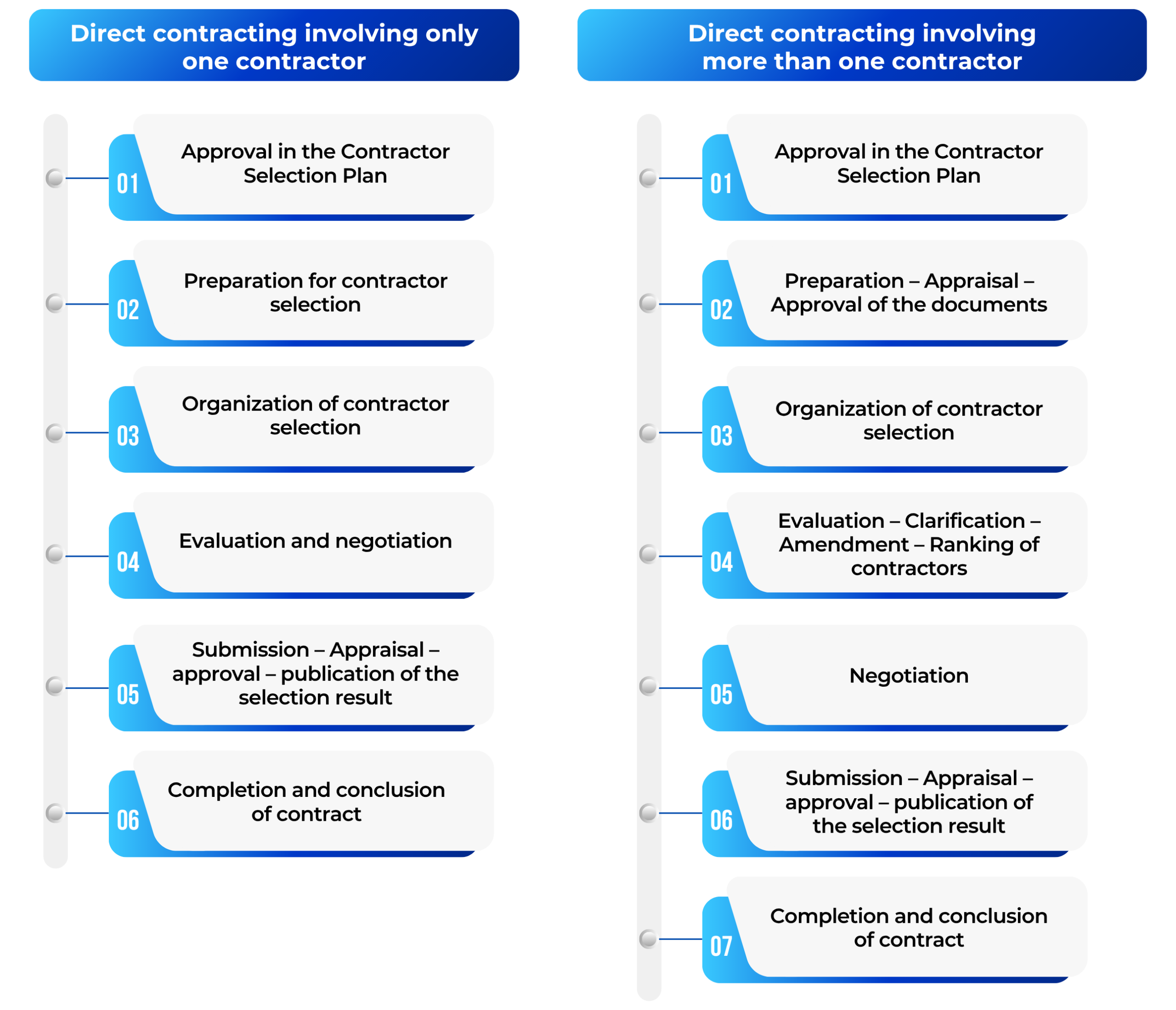
Overview of the process of direct contracting
Furthermore, in some particular cases, expedited direct contracting would not require the approval in the contractor selection plan[4]
It should be noted that, due to the expedited nature, the parties must complete the procedures for direct contracting within 15 days of the package implementation. The process involves the following steps[5]:
- Preparation and delivery of the draft of the contract;
- Contract completion;
- Submission and approval of the result of the direct contracting;
- Contract conclusion;
- Management of contract performance;
- Publication of the result of the direct contracting on the National Bidding Network System.
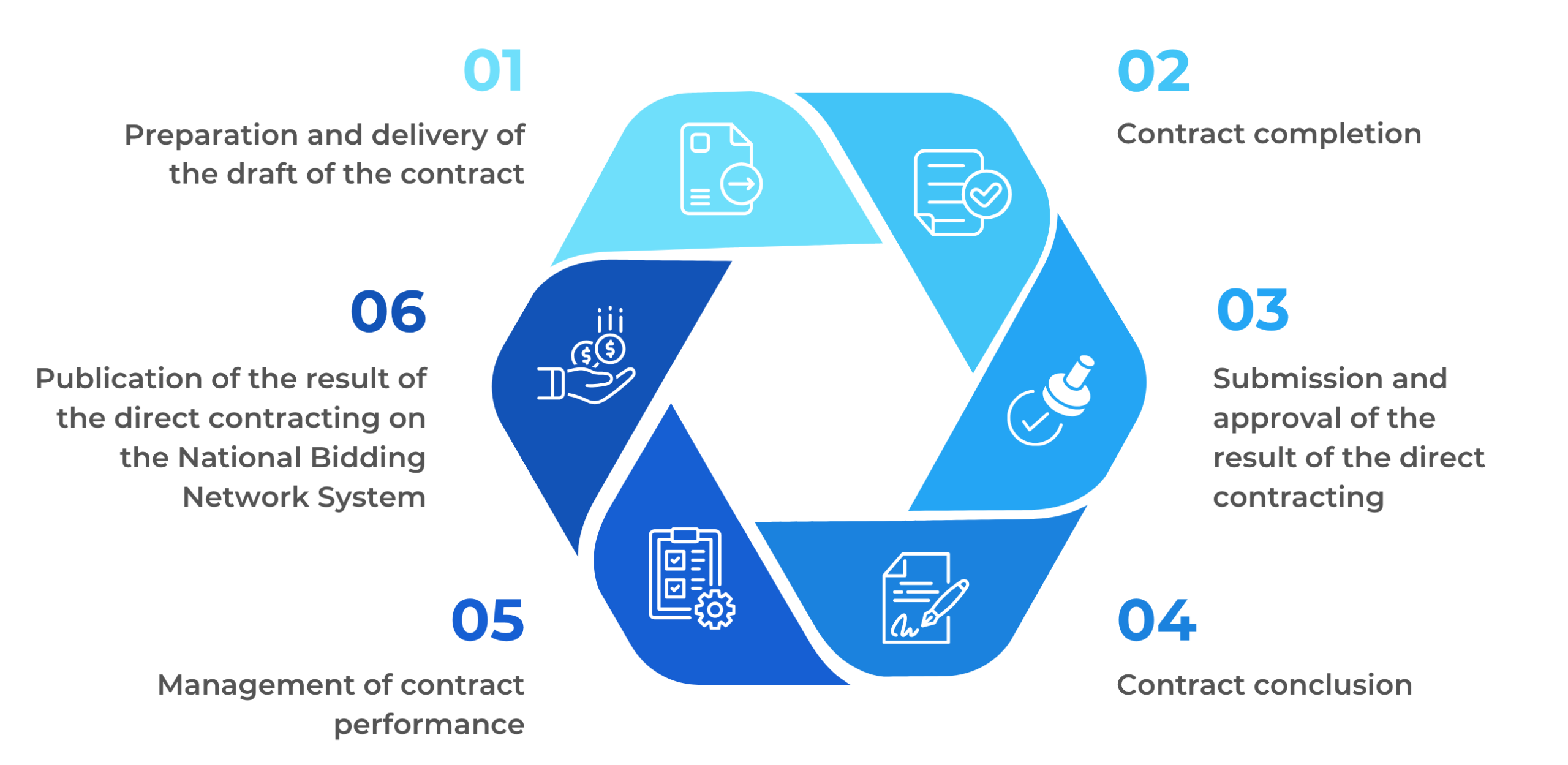
Simplified process of expedited direct contracting
Shopping
Shopping would be applied for packages whose value does not exceed 05 (five) billion dong that fall under the below categories:
- Common and simple consultant services;
- Common goods that are available on the market with equivalent quality;
- Construction of simple works that already have approved drawings;
- Mixed procurement and construction packages
The process of shopping involves the following steps[6]:
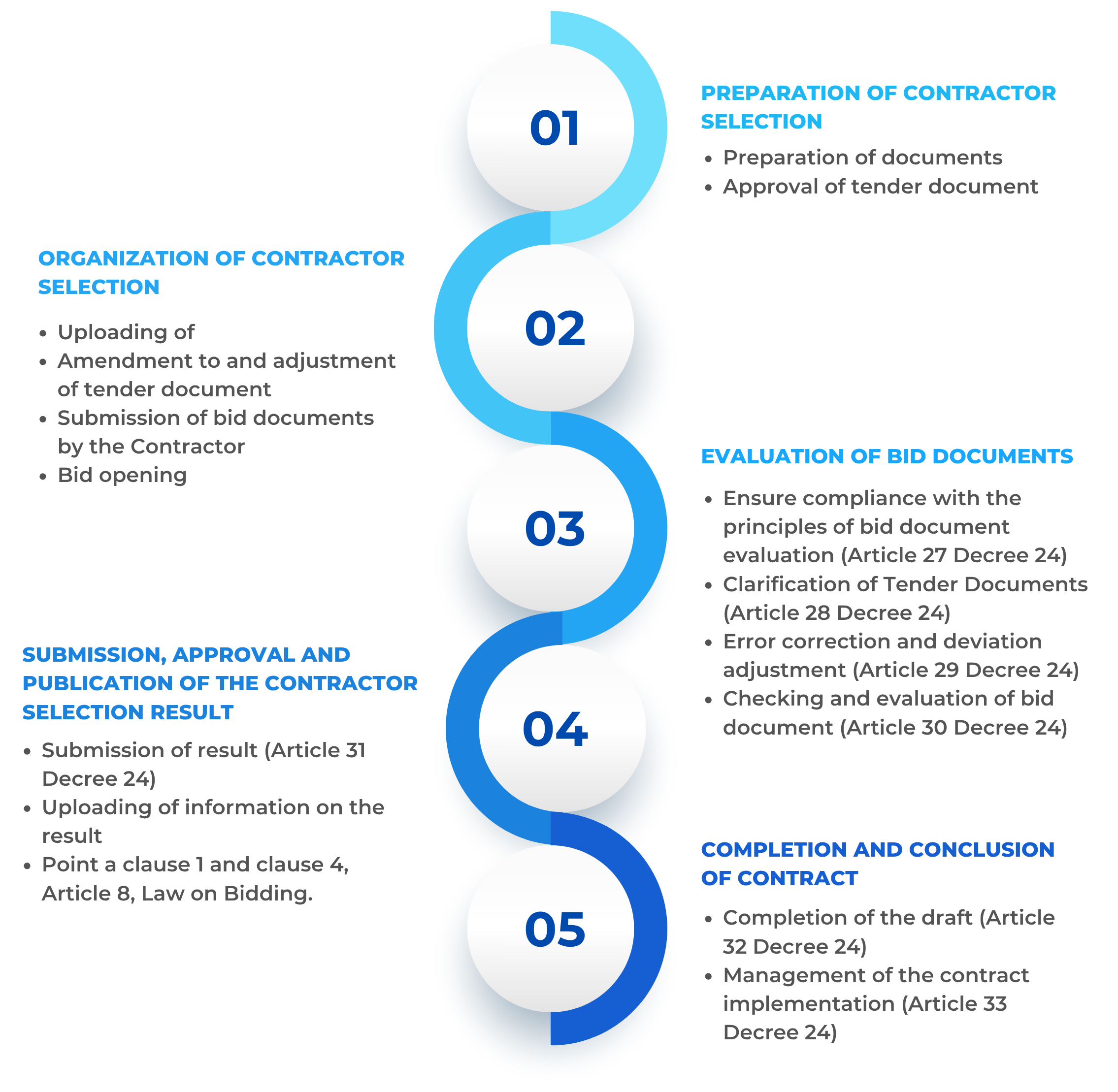
Simplified process of shopping
Direct Procurement
Direct procurement is a bidding method in which the employer shall directly select a contractor who have previously won similar bids. This method is applicable to procurement packages for equivalent goods in the same project or procurement cost estimation or in other projects or procurement cost estimations, provided that they meet the conditions prescribed by the law.[7]
The main purpose of this bidding method is to expedite the procurement process, thereby saving time and cost, while also ensuring the efficiency, transparency, and comformity to the market.
The process of direct procurement follows the below sequence:
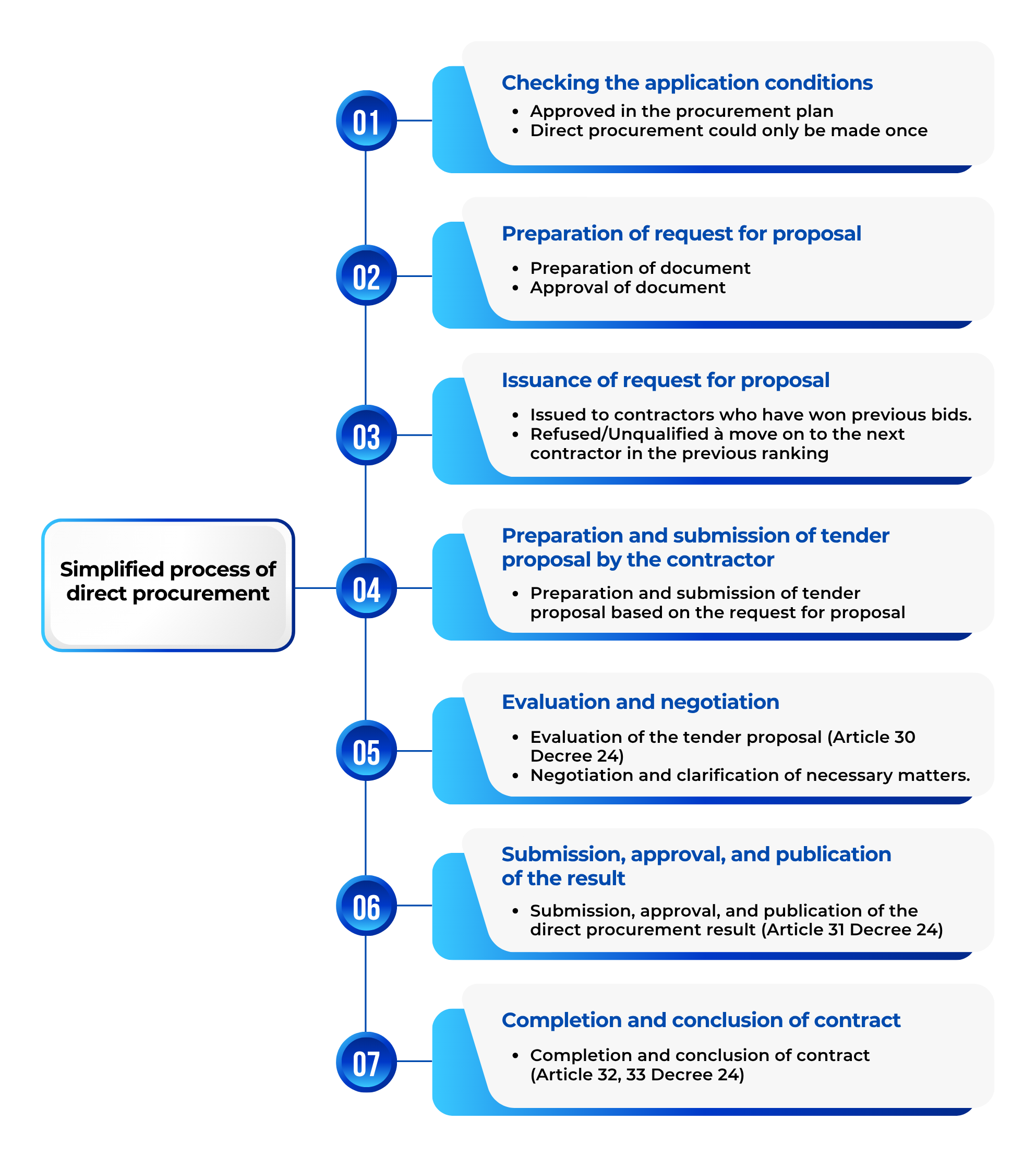
Simplified process of direct procurement
Self-performance
This is a bidding method in which the employer shall be in charge of the management, use, and implementation of the packages in the project or the cost estimation for procurement, provided that the following conditions are met:[8]
- Having functions, missions, area of operation, or operating in business sector appropriate to the requirements of the package;
- Possessing technical and financial capacity, and experience that meet the requirements of the package;
- Having a feasible mobilization plan for workers, machinery, and equipment that meet the requirement on the package implementation package.
Accordingly, the employer could either directly conduct the bidding or delegate it to a subsidiary branch, or a department, division within that organization
It should be noted that, the unit or organization that implement the package shall not assign works whose value equal to 10% of the value of the package or exceed 50 billion dong to another individual or organization.
The process of self-performance bidding method involves 4 main steps, to be specific:
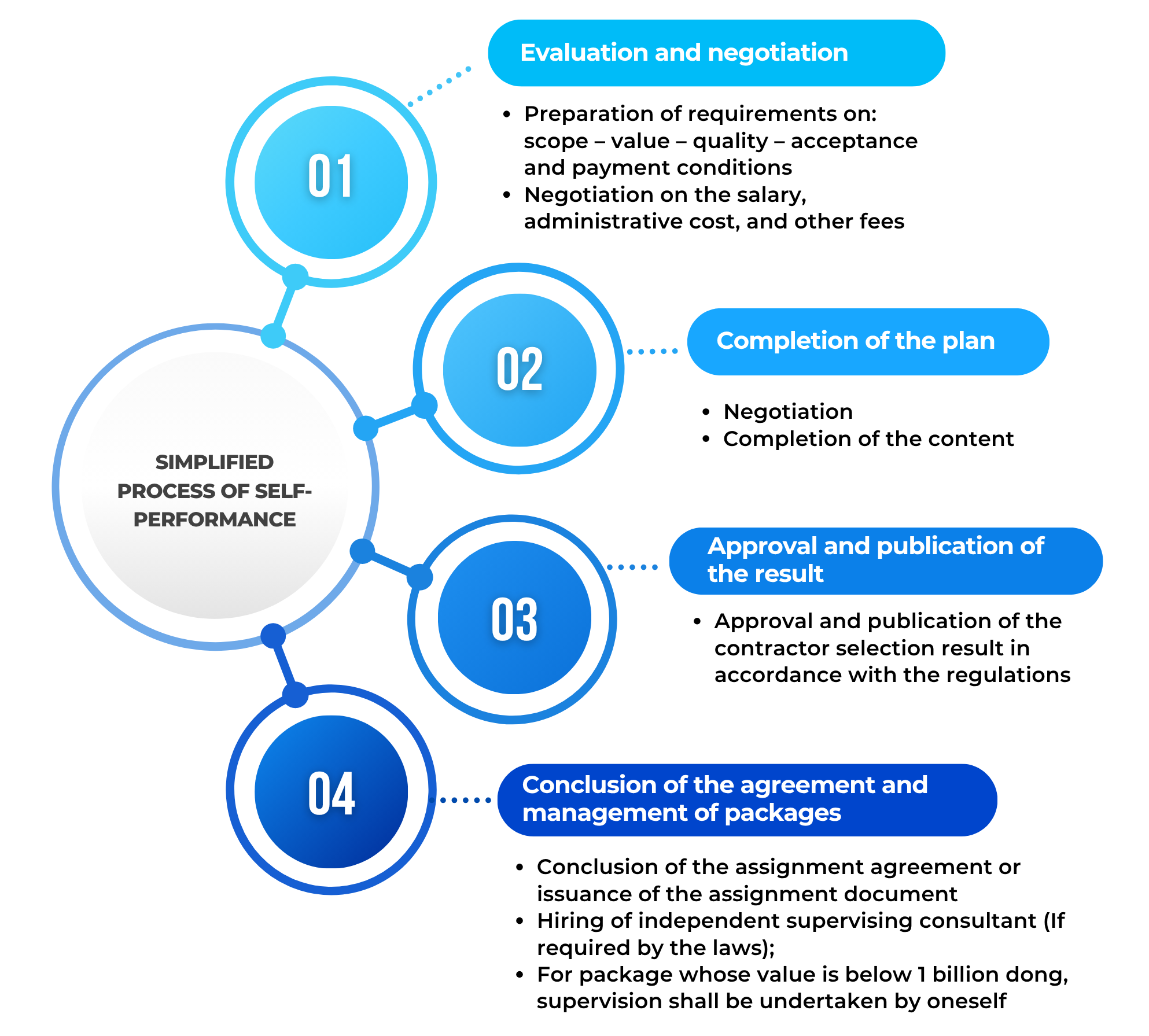
Simplified process of self-performance
Community participation
Community participation shall be applied when:
- Necessary condition: A local resident, division, group, or organization that have sufficient capability to implement the packages; and
- Sufficient condition: Packages whose value does not exceed 5 billion dong, under the national target program or public investment project that are undertaken by both the state and the civilian.
Price negotiation
Price negotiation shall be applicable to the following packages:
- Procurement package for original brand-name drugs and biological reference products
- Procurement package for specialized medicine, medical equipment, laboratory supplies that have limited manufacturer with sufficient capability.
Regarding the price negotiation bidding method, the Ministry of Medicine shall be the competent authority
Contractor selection in special circumstances
Contractor selection in special circumstances shall be applied when the bidding methods mentioned above are not appropriate due to their peculiarities regarding the process, procedure, standards of the contractor selection, or the conditions for contract conclusion, contract performance, or implementation of cases that are “sensitive” in nature.[9] In these cases, contractor selection in special circumstances shall be applicable to these kinds of packages in accordance with the laws[10].
Online contractor selection
Aside from the popular bidding methods mentioned above, in some cases, more optimal contractor selection methods might emerge. These shall involve the utilization of progressive and modern electronic means that are appropriate to the era of progression that is promoted by the Government.
An example of this method is online bidding, which allow the entire process of contractor selection, issuance of documents, submission of documents, bid openings, evaluation to be performed through the national bidding network system (Electronic Government Procurement System)
It should be noted that, the Minister of the Ministry of Planning and Investment issued the Circular on the guidelines for the provision and uploading of information on contractor selection and template for bid documents on the National bidding network system, which include[11]:
- Competitive bidding
- Limited bidding
- Domestic Shopping
The expansion and promotion of the application of online bidding is a necessary step considering the push for integration and development, however, a proper schedule is also necessary to ensure that relevant parties, especially the small and local contractors, are technically supported, trained and not left behind by the digitalization of the bidding activities. CNC shall delve further into this matter in other articles.
Methods of investor selection
Similar to methods of contractor selection, investor selection methods also share the main objective of selecting the best possible unit to handle the investment projects under certain criteria. Accordingly, there are 03 methods of investor selection:
Competitive Bidding
This is the most popular method, applicable to business investment projects with no limitation on the number of participating investors. Accordingly, all investors that have sufficient qualifications in accordance with the laws could participate, thereby creating a sustainable, transparent, and fair environment for both domestic and foreign entities[12]
Limited Bidding
Different from competitive bidding, this method is only applicable to projects with high technical and technological requirements or peculiar in nature in accordance with specialized laws. In these cases, only investors who have appropriate capability and satisfy certain criteria are invited, thereby ensuring the quality and the effectiveness of the project[13]
Contractor selection in special circumstances
Finally, in certain special circumstances, when a business investment project has exclusive requirements and conditions – such as those relevant to the procedures for investment, land allocation, land lease, exploitation of the sea region, or those whose selection criteria, contract content are considered peculiar in nature or directly related to national defense, security, foreign affairs, border sovereignty, national interests, or national-class political missions – the investor selection shall be implemented under special mechanism. In these cases, neither competitive bidding or limited bidding is applicable, instead, the implementation shall be based on specific the practical needs and the strategic objective of the Government.[14]
Managed by
 |
Huynh Le Thao Trang | Junior Associate
Phone: (84) 938 533 393 Email: trang.huynh@cnccounsel.com |
 |
Trinh Minh An | Legal Intern
Phone: (84) 28 6276-9900 |
Contact
For more information, please contact:
CNC Vietnam Law Firm Co., Ltd:
Address: 2A1 Nguyen Thi Minh Khai, Sai Gon Ward, Ho Chi Minh City
Phone: 028 6276 9900
Hotline: 0916 545 618
Email: contact@cnccounsel.com
Website: cnccounsel
We would be pleased if you could visit the office of CNC, where you could exchange with the most suitable Lawyers for your specific circumstances. However, if you could not make the time for direct meeting, please feel free to contact us via the email: contact@cnccounsel.com or call (+84-28) 6276 9900
Disclaimers:
This article is prepared or used for the purposes of introducing or updating the clients on the issues and/or developments of the legal perspectives in Vietnam. The information contained in this article shall not constitute an advice of any kind, and could be subject to change without prior notice.
———————————————————–
[1] Article 21.1; Article 21.2, Law on Bidding 2023
[2] Article 21.2, Law on Bidding 2023
[3] Article 76; Article 77, Decree 24/2024/ND-CP on guidelines for Law on Bidding regarding contractor selection
[4] Article 78.1, Decree 24/2024/ND-CP on guidelines for Law on Bidding regarding contractor selection
[5] Article 78.2, Decree 24/2024/ND-CP on guidelines for Law on Bidding regarding contractor selection
[6] Article 79, Decree 24/2024/ND-CP on guidelines for Law on Bidding regarding contractor selection
[7] Articles 25.1 and 25.2 of the Law on Bidding 2023
[8] Article 26.1, Law on Bidding 2023
[9] Article 29, Law on Amendment to the Law on Planning, Law on Investment, Law on Public-Private Partnership Investment, and Law on Bidding No. 57/2024/QH15
[10] Article 29.1, Law on Bidding 2023
[11] Article 50.1, Law on Bidding 2023
[12] Article 34.1, Law on Bidding 2023
[13] Article 34.2, Law on Bidding 2023
[14] Article 34a, supplemented by Article 4.12 of Law on Planning, Law on Investment, Law on Public-Private Partnership Investment, and Law on Bidding No. 57/2024/QH15