




Definition of Cost-Plus Contract
A Cost-Plus Contract is a new type of construction contract recently added to Vietnamese legislation. The term “Cost-Plus Contract” was first recognized in Article 64.5 of the Bidding Law 2023. Specifically:
“Cost-plus contracts apply to works or services where, at the time of contractor selection, there is insufficient basis to determine the scope of work or the necessary input factors and costs required to perform the intended work under the contract. At the time of signing the contract, the parties agree on management costs, general overheads, profit, and calculation methods based on direct costs; methods for determining direct costs as a basis for calculating direct costs and other terms to perform the contract.“
The above definition of a Cost-Plus Contract is actually not new; it inherits and specifies the provision on “Cost-Plus Contract Price” previously set forth in Decree 50/2021/ND-CP.
Accordingly, Article 1.5(a) provides that: “Cost-plus contract price refers to a contract price whose value is undetermined at the time of contract execution, where the parties only agree on management costs, overheads, and profit due to an insufficient basis to determine the scope of work and direct costs required to execute the contractual work.”
Nevertheless, it can be seen that Vietnamese law only describes the circumstances in which Cost-Plus Contracts are applied without highlighting the core nature of a Cost-Plus Contract. For example, the Bidding Law 2023 only specifies:
- Conditions for application: when selecting a contractor, there is insufficient basis to determine the scope of work and/or the necessary input factors and costs.
- Principles of application: the parties only agree on management costs, general overheads, profit, and the method for calculating direct costs.
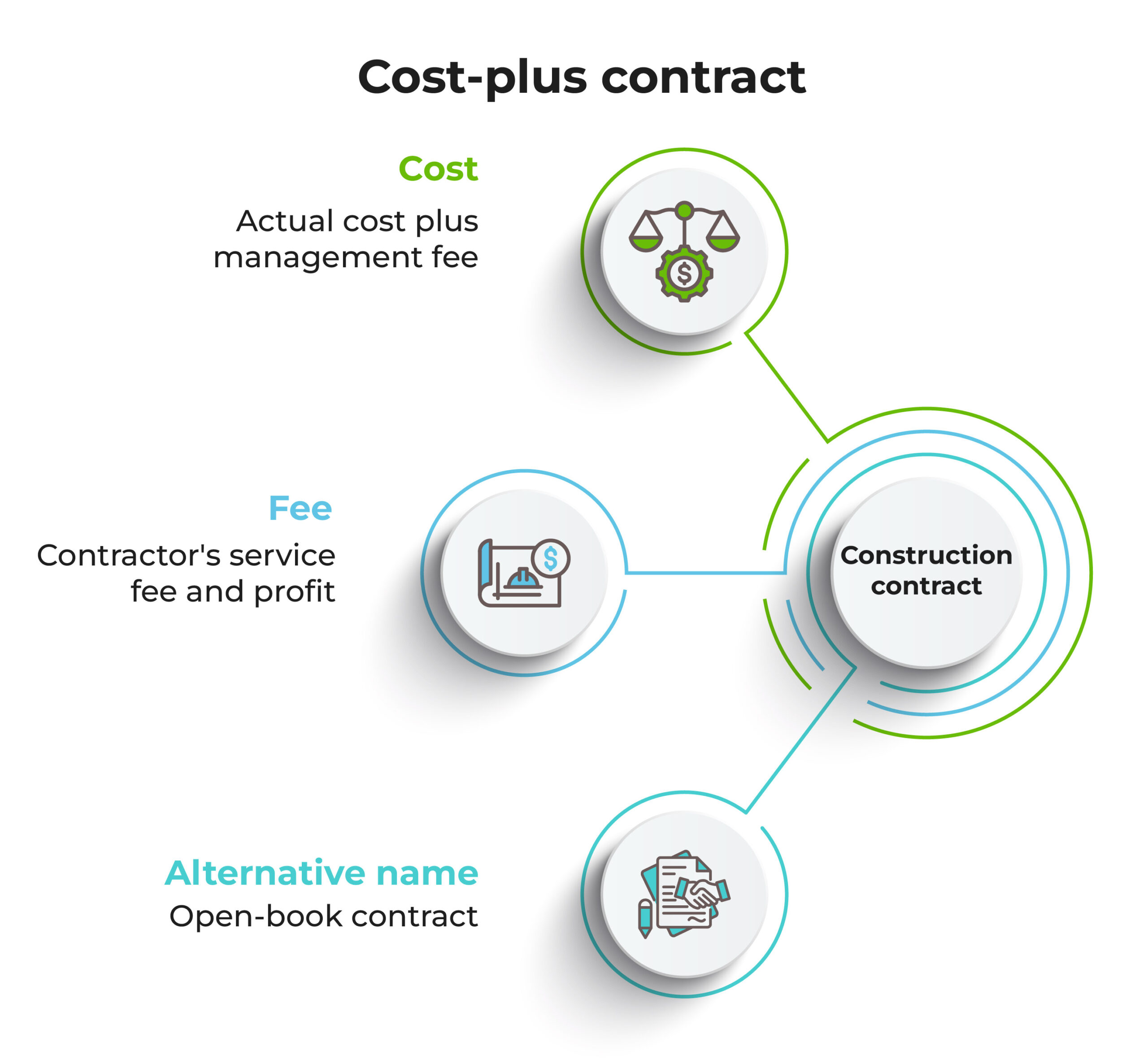
By referencing the term itself, a Cost-Plus Contract can be understood as a contract under which the buyer agrees to reimburse the seller for all actual costs incurred to perform a specific task, along with an agreed profit fee.
Therefore, because the buyer reimburses all costs to the seller, a Cost-Plus Contract is also known as an Open-Book Contract. Under this definition, all project execution costs are transparently disclosed by the seller and can be audited, reviewed, and evaluated in detail by the buyer.
Application of Cost-Plus Contracts
Globally, the application of Cost-Plus Contracts was initially reserved for small-scale works, particularly those related to repair and renovation. However, the adoption of Cost-Plus Contracts has recently become widespread due to their flexibility and transparency.
According to CNC’s observations, Cost-Plus Contracts are not yet widely used in Vietnam. This is due not only to their recent recognition in law but also to practical barriers in implementation.
Specifically, as a contract requiring the seller (contractor) to provide full documentation and vouchers for actual costs incurred—such as invoices, payment vouchers, bank transfer slips, etc.—contractors face difficulties in collecting and presenting these cost documents.
Moreover, when required to disclose all information related to contract performance to the buyer (especially the Employer), contractors may feel exposed regarding their resources, subcontractor and supplier relationships, as well as management and business methods. This directly impacts contractors’ willingness to enter into Cost-Plus Contracts.
Of course, practical grounds for applying Cost-Plus Contracts do exist. In many cases involving Employers—particularly state-related entities—such as building field hospitals during the Covid-19 pandemic or constructing temporary housing for disaster and flood victims.
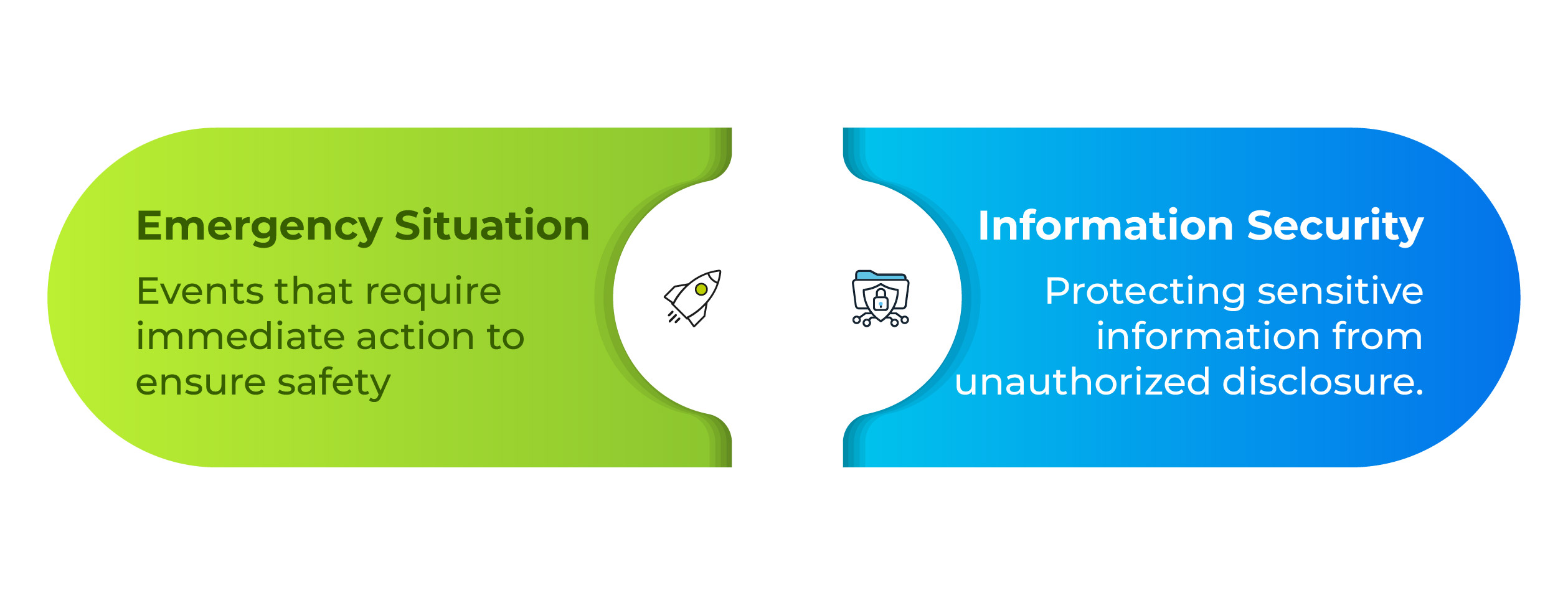
In these emergency situations, standard bidding procedures are unsuitable for both Employers and Contractors. Adhering to statutory bidding timelines and procedures would fail to meet the urgent need to protect life and property.
This may explain why the Bidding Law 2023 expanded the circumstances allowing direct contracting (procurement appointment). Many instances listed under Article 23.1 of the Bidding Law 2023 address emergency situations, national security secrets, etc.
In these contexts, a Cost-Plus Contract is the most suitable solution. The Employer only needs to evaluate the Contractor’s construction capacity and agree on appropriate rates for overheads, management costs, and profit. Once these two elements are set, the remaining task is simply paying the actual costs incurred by the Contractor.
2 cases where cost-plus contracts are applied
Types of Cost-Plus Contracts
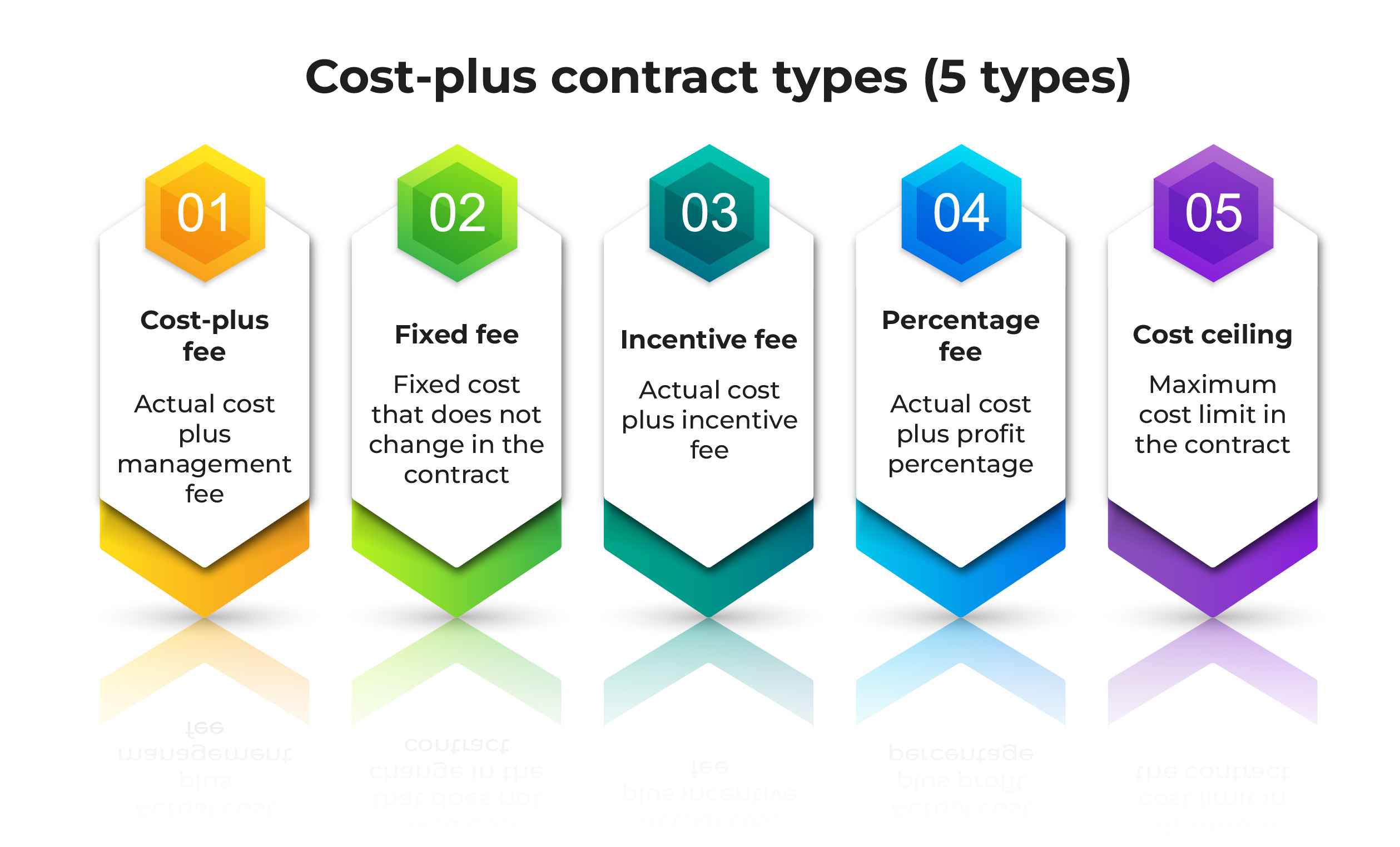
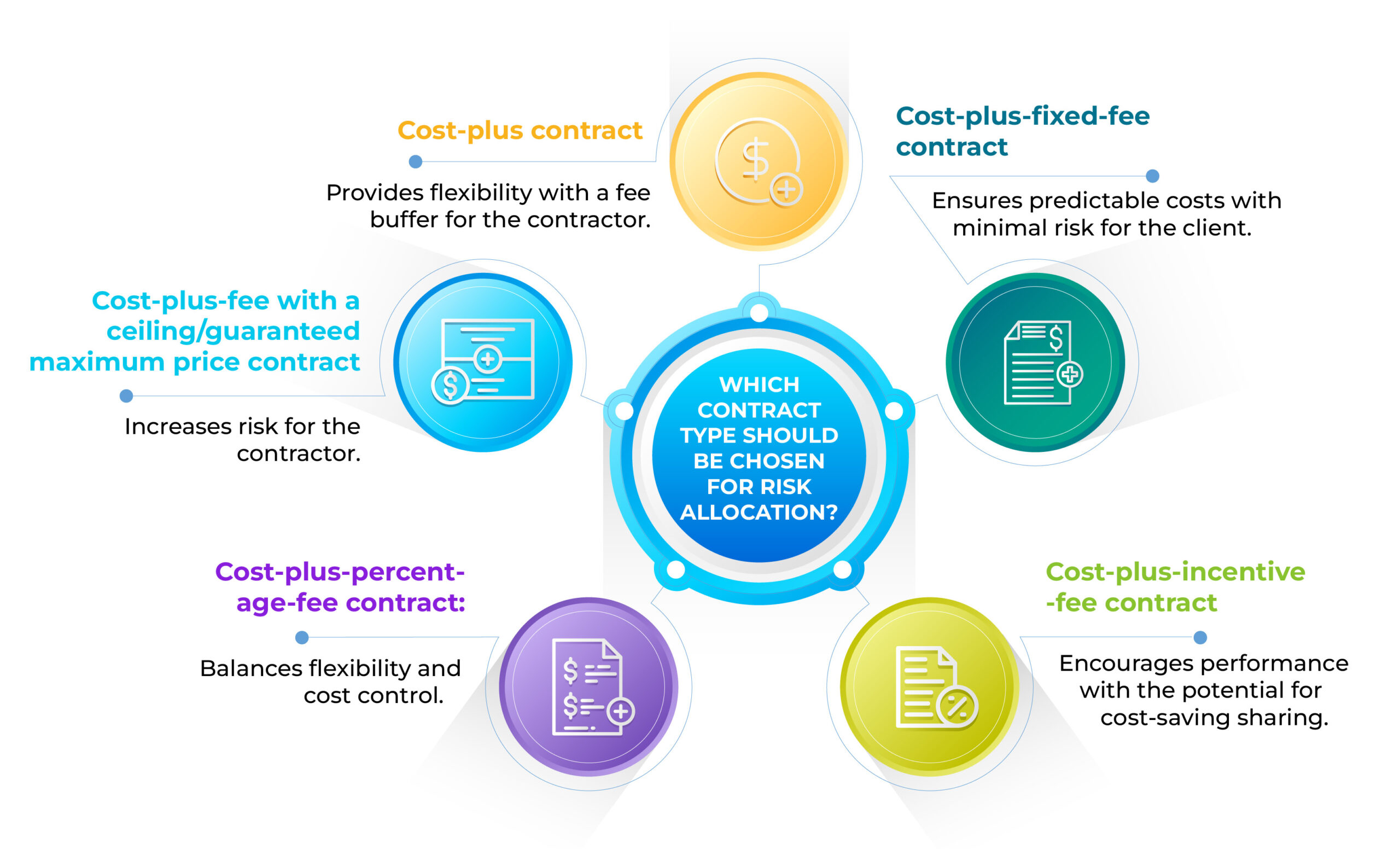
Although classified as a type of construction contract, Cost-Plus Contracts have 5 common variations, including:
- Cost-Plus-Fee Contract.
- Cost-Plus-Fixed-Fee Contract.
- Cost-Plus-Incentive-Fee Contract.
- Cost-Plus-Award-Fee Contract (Percentage-based Fee).
- Cost-Plus-Contract with Guaranteed Maximum Price
Below, CNC provides basic information regarding these 5 variations to assist Clients in selecting the appropriate model.
First: Cost-Plus-Fee Contract
This is the classic form of Cost-Plus Contract and the origin of the term itself.
The initial idea is to establish a procurement mechanism where work execution costs are fully transparent and auditable. In addition to reimbursing actual costs, the buyer agrees to pay the seller a profit fee for their performance efforts.
This serves as the foundation for developing other variations. In Vietnam, Cost-Plus Contracts have only recently been recognized by law, remain un-widely used, and are in the early stages of development. Consequently, there is currently no legal basis outlining how “fees” are determined under Vietnamese law.
Second: Cost-Plus-Fixed-Fee Contract
A Cost-Plus-Fixed-Fee Contract means the Contractor is reimbursed for costs plus a fixed fee that remains unchanged regardless of the actual costs incurred.
The core difference between a Cost-Plus-Fixed-Fee Contract and a standard Cost-Plus Contract is that the seller agrees to fix their profit amount. In other words, the seller occupies a safer, more predictable position compared to a standard Cost-Plus Contract.
Third: Cost-Plus-Incentive-Fee Contract
A Cost-Plus-Incentive-Fee Contract means the Contractor receives a bonus benefit if contract performance achieves predetermined expectations.
Typically, performance expectations include completing the work by a specific target date or achieving outcomes with significant value (especially in research projects, application of intellectual products, etc.).
Typical examples include pharmaceutical drug research, vaccine development, or completing projects with positive social impacts.
Fourth: Cost-Plus-Award-Fee Contract (Percentage-based Fee)
A Cost-Plus-Award-Fee Contract allows the Contractor to earn fee benefits based on performance outcomes.
Typically, under this model, cost savings are directly proportional to the bonus fee earned by the Contractor.
For example, when building a house, the Contractor may present an estimated budget to the Homeowner. If execution costs total only 1 billion VND, the Contractor receives a 10% fee (100 million VND). If execution costs reach 1.2 billion VND, the fee rate drops to 8% (96 million VND). If costs reach 1.5 billion VND, the fee rate decreases to 5% (75 million VND).
Under this scenario, the total actual payment by the Homeowner to the Contractor varies significantly: 1.1 billion VND, 1.296 billion VND, and 1.575 billion VND, respectively.
Thus, under this contract type, the Homeowner is incentivized to request the lowest possible construction costs while offering generous performance bonuses to the Contractor.
Fifth: Cost-Plus-Contract with Guaranteed Maximum Price
This is the most complex type of Cost-Plus Contract, requiring significant investment and effort from the Seller (Contractor). The seller is obligated to guarantee that total performance costs (including service provision) will not exceed a pre-agreed ceiling. If costs exceed this threshold, the Seller/Contractor bears full financial responsibility.
The key benefit for the buyer is financial visibility—it provides a clear estimate of total required expenditure, serving as reliable input for capital arrangement and financial planning.
Naturally, for a contract model where risk is shifted to the seller, the Seller requires adequate time and resources to thoroughly study job requirements before proposing a suitable cap.
Risks arise for both parties if the Seller fails to perform diligent calculations or if the Buyer forces a price guarantee under volatile, unpredictable conditions.
Risks and Selection of the Appropriate Cost-Plus Contract
Benefits of Cost-Plus Contracts
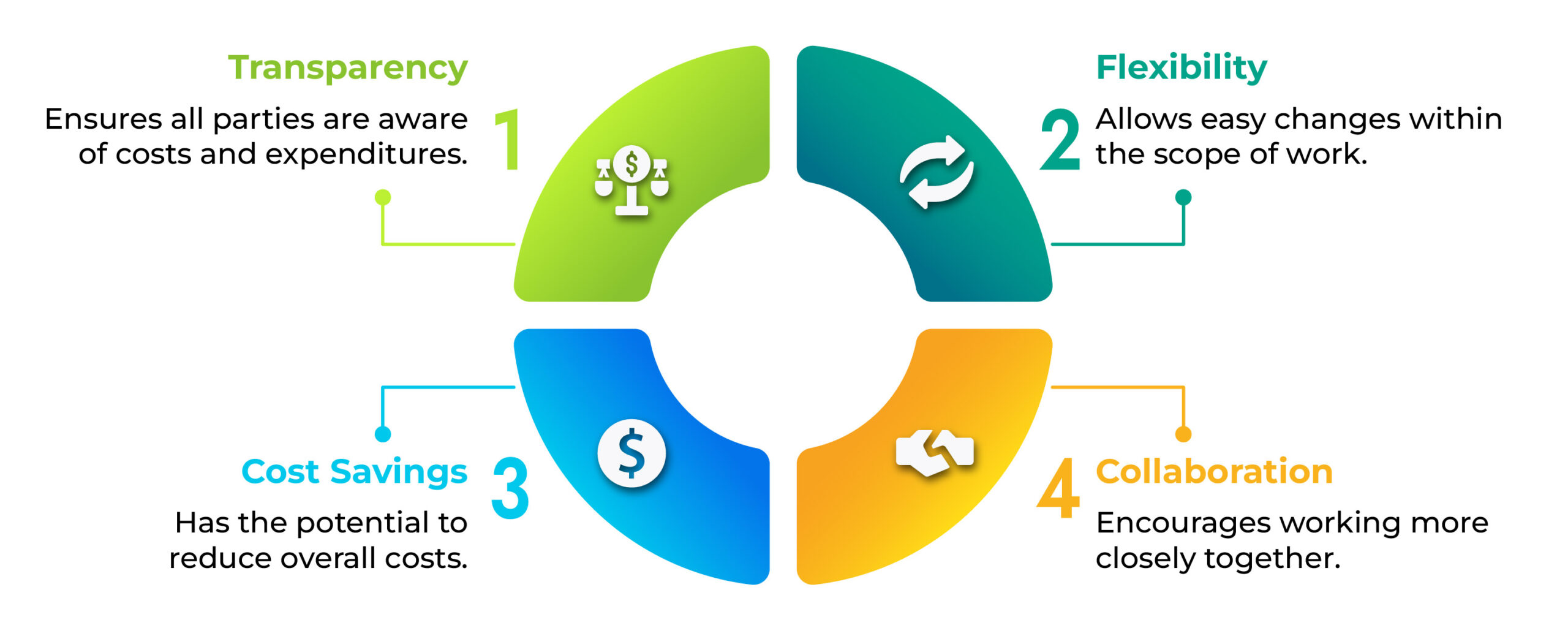
Designed as an alternative to overcome the disadvantages of fixed-price procurement strategies, Cost-Plus Contracts offer 4 primary benefits:
As an open-book contract, all costs incurred during performance must remain transparent, clear, and easily verifiable.
However, high transparency also exposes Contractors to higher risks. Specifically, Contractors bear risk when submitting individual cost items, additional item fees, and total earned fees for approval.
VWith a flexible approach, the Employer and the Contractor may add or omit any scope of work under the signed contract at any time. This provides the Employer with the opportunity to adjust the work in the most appropriate manner.
By selecting the appropriate contract type, the Employer has the opportunity to save on project execution costs—especially when utilizing a Cost-Plus Contract with a Guaranteed Maximum Price.
The adoption of a cost-plus contract fosters greater opportunity for collaboration between the parties.
4 Key Benefits of Applying Cost-Plus Contracts
Disadvantages of Cost-Plus Contracts
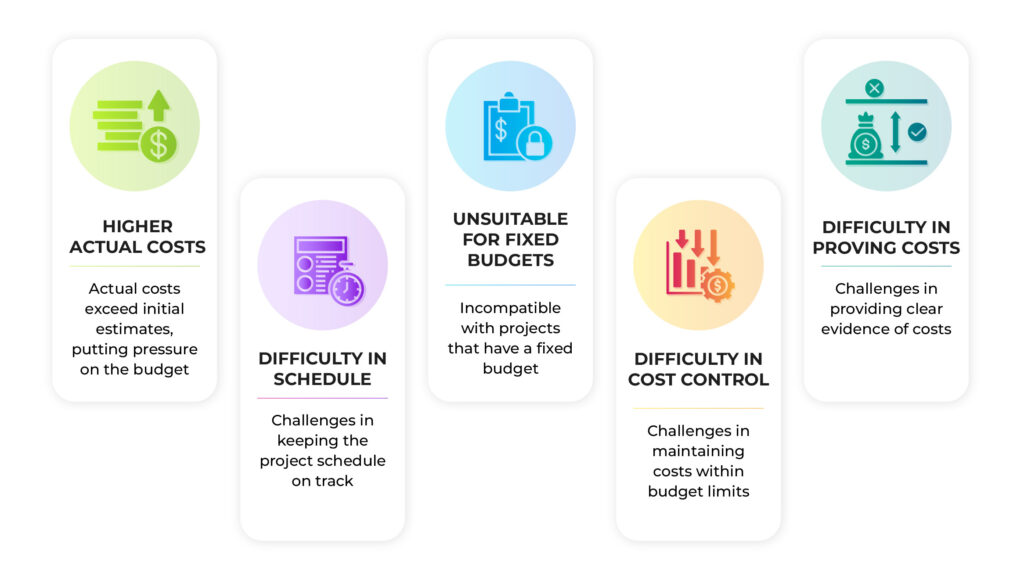
Implementing Cost-Plus Contracts involves several drawbacks that significantly impact project success. CNC highlights 5 primary risks and disadvantages:
- Actual costs often exceed initial estimates
- Contractors must maintain a transparent cost-control system
- Difficulty in controlling progress and overall costs
- Complex documentation requirements to substantiate actual costs
- Unsuitable for projects with strict, fixed budgets
5 Key Challenges of Applying Cost-Plus Contracts
Frequently Asked Questions (FAQ)
Below are 5 common questions regarding Cost-Plus Contracts that Clients frequently encounter in practice. CNC hopes this information is detailed and helpful.
Vietnam has not yet introduced a standard template for Cost-Plus Contracts. Therefore, the application of a Cost-Plus Contract form remains subject to the specific agreement between the Parties.
To mitigate potential risks, CNC recommends that clients consult with CNC’s lawyers prior to entering into any specific Cost-Plus Contract. Proceeding without comprehensive legal advice regarding Cost-Plus Contracts may lead to unforeseen legal consequences.
Please contact CNC at contact@cnccounsel.com or call 0916 545 618 (Lawyer Hung) for assistance.
No.
Although the general principle of a Cost-Plus Contract is that the Customer reimburses the Seller for all costs incurred during performance, exceptions do exist—particularly regarding costs arising from the Seller’s fault.
Substantiating execution costs is the single greatest challenge for the Seller when entering into a Cost-Plus Contract.
In principle, all project execution costs must be backed by specific invoices and supporting vouchers. Therefore, clearly stipulating cost categories, evidentiary requirements, and cost-auditing mechanisms is essential to ensure that all incurred costs are legitimate actual costs and will be fully reimbursed by the Customer.
Yes.
Hiring a Cost Management Consultant / Quantity Surveyor (QS) to manage and supervise costs during the execution of a Cost-Plus Contract offers the Customer numerous benefits, such as:
- Accurately defining the required work packages
- Forecasting project execution costs
- Reviewing cost estimates proposed by the Contractor
- Verifying and approving actual costs submitted by the Contractor
- Assisting the Customer with variations and additional work scope
Therefore, if the Customer lacks experience in managing Cost-Plus Contracts, hiring an experienced cost expert is a highly recommended solution.
Yes.
In principle, the Seller’s management overheads are also reimbursed by the Customer. However, it should be noted that the Seller’s management costs for executing the specific project must be strictly segregated from general management costs for other works. Segregating management costs for each individual task is no easy feat.
The Customer should consult with a lawyer and establish a clear agreement on the calculation methodology for management costs prior to executing a Cost-Plus Contract.
The calculation of payments due to the Contractor is stipulated under Article 112 of Decree No. 24/2024/ND-CP dated February 27, 2024.
Accordingly, the total amount payable by the Employer is calculated as follows:
Payable Amount = Execution Costs + (Execution Costs x Agreed Percentage Rate).
In which, Execution Costs refer to the total costs required to execute the work, including costs for materials, labor, construction machinery and equipment, bid security fees, as well as site management and supervision fees.
Percentage Rate (%) is the percentage agreed upon in the contract between the Employer and the Contractor.
For example: If the Execution Cost is 100.000.000 VND and the agreed Percentage Rate is 10%, the amount payable by the Employer to the Contractor at that time will be:
Payable Amount= 100.000.000 VND + (100.000.000 VND x 10%) = 110.000.000 VND.
Conclusion
Cost-Plus Contracts are a newly introduced contract type in Vietnam. Practical implementation still faces challenges in the Vietnamese market, particularly regarding the substantiation of actual costs.
Based on CNC’s experience, to ensure success when applying Cost-Plus Contracts, beyond using a standard contract template, the Parties must establish a common understanding on critical issues, including:
- Scope of Work
- Clear definition of Costs
- Selected Cost-Plus Contract type
- Verification and auditing methods for actual costs
- Variation and scope adjustment procedures
Should Clients require further consultation on Cost-Plus Contracts, please contact CNC at contact@cnccounsel.com or call 0916 545 618 (Lawyer Hung) for assistance.
Clients may submit their inquiries to CNC using the form below::

Ls Lê Thế Hùng | Giám đốc
CNC Vietnam Law Firm Limited
- Address: The Rise Building, 2A1 Nguyen Thi Minh Khai, Sai Gon Ward, Ho Chi Minh City, Vietnam
- Tel: 028 6276 9900
- Hotline: 0916 545 618
- Email: contact@cnccounsel.com
- Website: https://cnccounsel.com
- Fanpage: https://facebook.com/cnclaw
- LinkedIn: https://www.linkedin.com/company/cnccounsel/