




Two Stage – One Envelope Method: Optimization of technical aspects prior to price competition
In bidding activities, the determination of the correct contractor selection method is a decisive factor that ensure competitiveness, transparency, and effectiveness of a package. For packages on procurement of goods, construction, or mixed works that are technically complex or require new technologies while the Employer could not yet determine the specifics of the technical requirements at the time of tendering, the two stage -one envelope method specified in Article 32 of the Law on Bidding 2023 is the most optimal choice.
This article shall provide readers with insight into the two stage – one envelope method, thereby allowing them to effectively incorporate it into their bidding activities and project management. The main content shall cover the definition, application requirements, and detailed procedures that are recently updated through Decree No. 214/2025/ND-CP
See more on the article about one stage – one envelope here.
See more on the article about one stage – two envelop here.
What is the Two Stage – One Envelope Method?
Two stage – one envelope method is a contractor selection method designed to tackle packages that have complex technical requirements or involving the application of new technologies, where, at the time of tendering, it is not yet possible to fully and precisely define the technical requirements.
Two stage: This process does not involve two entirely separate instances of tendering, instead, they are successive evaluations. The first stage fully focus on the evaluation of the technical proposals, allowing the contractor to put forward solutions and proposals of alternative methods. The fundamental goal is to falititate the Employer and the contractor to exchange, clarify, thereby streamlining, and completing the detailed technical requirements prior to addressing financial matters.
One envelope: During second stage (after all of the technical requirements have been specified), the contractors who make it through the first stage shall submit the bidding documents in one envelope, which include both the technical proposal documents and the financial proposal documents. This is also the primary features that distinct this method from the two stage – two envelope methed, since the technical and financial documents are evaluated in the same submission, thereby enabling a more streamlined evaluation process and a shorter timeframe for reaching the final decision.
To summarize, the two stage – one envelope method is a flexible combination, allowing the tenderee to both ensure the competition in sophisticated technical solutions and optimize the integrated evaluation of technical and financial proposals, which is particularly suitable for technologically complex packages.
When to use the Two Stage – One Envelope method?
Pursuant to Article 32.1 of the Law on Bidding 2023, the two stage – one envelope method is designed exclusively for packages that, at the time of the tender, the tenderee could not determine the specifics of the technical requirements. Therefore, the contractors are facilitated to contribute opinions and technical solutions, allowing the package to the competed prior to the price evaluation.
To be specific, the two stage – one envelope shall be applied in the following cases:
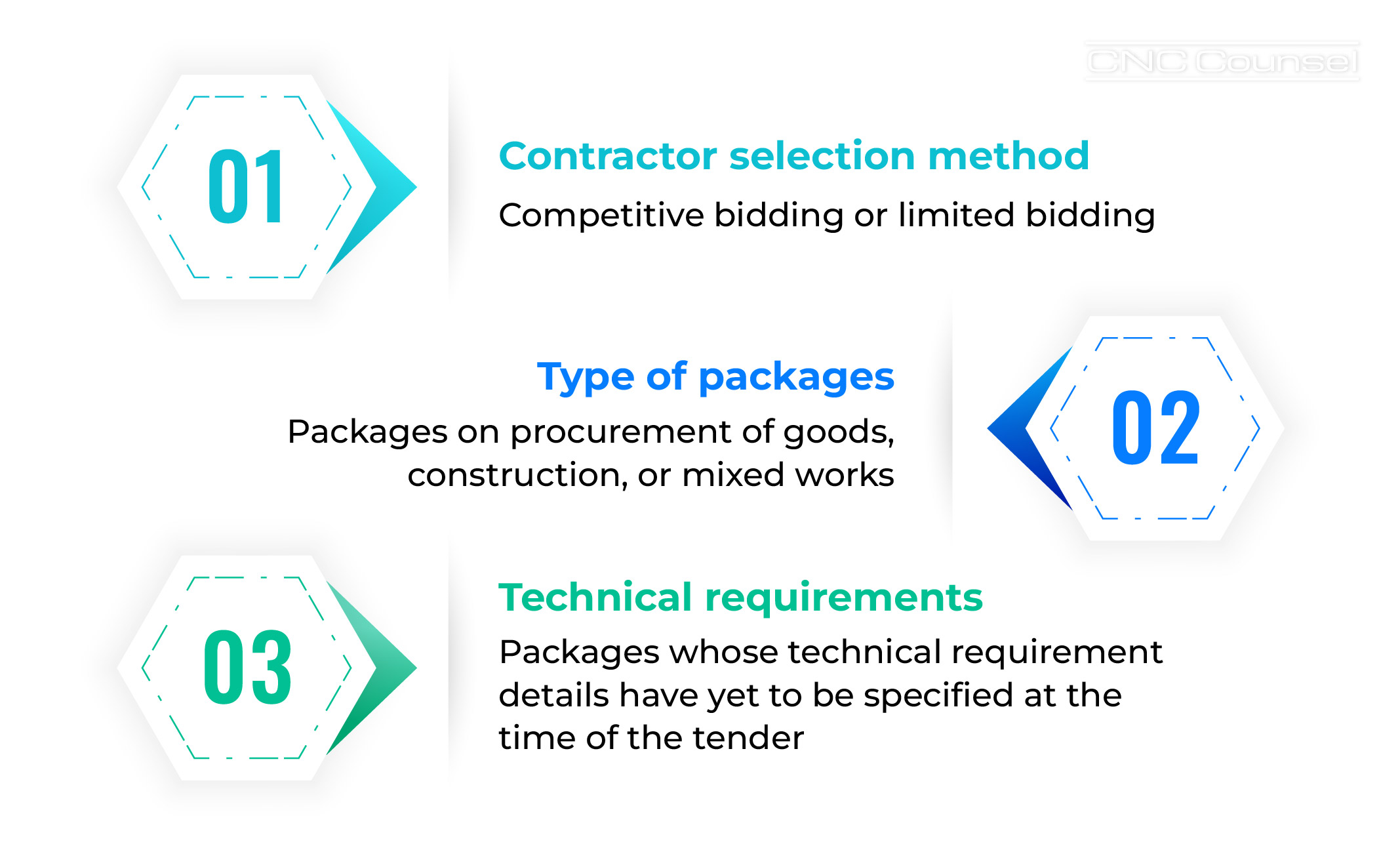
Evidently, technical requirement plays a decisive role in the application of the two stage – one envelope method. This is because the two stage – one envelope method is designed exclusively for packages involving complex technical requirements that could not be specified at the time of tendering. The first stage enables the contractor to propose technical solutions (including alternative solutions), on the basis of which the employer and the contractor shall engage in exchanges and clarification, and make adjustments to the technical requirements. As a result, the tender document of the second stage is finalized with all of the technical requirements fully and accurately detailed, thereby allowing for the choice of the most optimal method.
Procedures for two stage – one envelope method
First Stage:
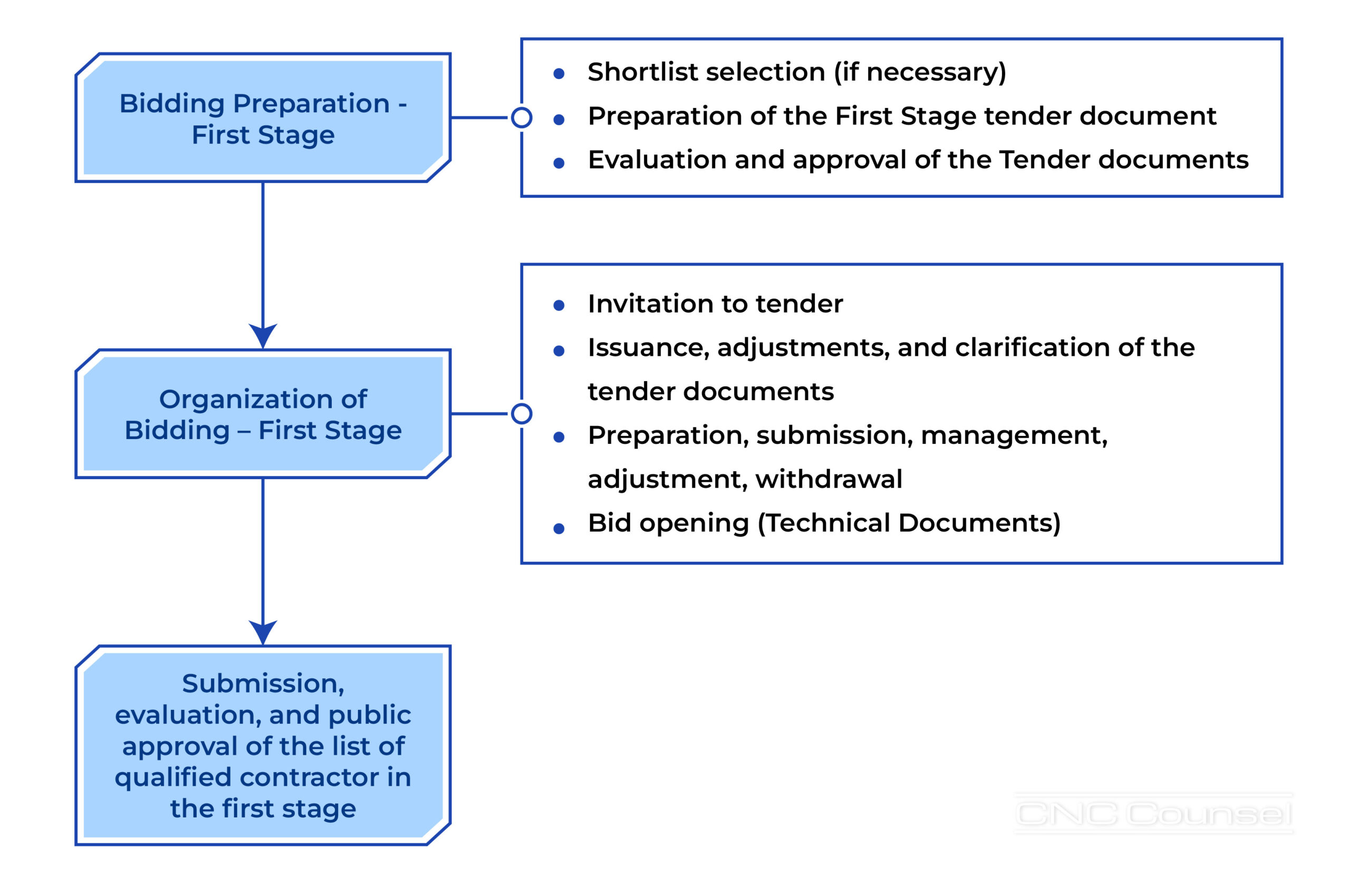
Step 1: Bidding Preparation – First Stage[1]
Shortlist preparation
The short list selection is the process of evaluating the bidding documents of the contractors to determine which contractor meet the preliminary capacity and technical requirements. The shortlist selection helps eliminate unqualified contractors, thereby saving time for the tenderee
Accordingly, the contractors named in the shortlist are not allowed to form a consortium to participate in the bidding, in the event that consortium is formed with contractors not named in the shortlist, the approval of the employer must be obtained prior to the bid closing date.
Preparation of the tender documents
Tender document is the most important basis for the tenderee to evaluate whether the plans of the contractors are feasible and align with the project’s direction. The tender documents establish a set of transparent and consistent criteria, allowing the tenderee to evaluate the capacity and proposals of the participating contractors in an objective manner
Evaluation and approval of the tender documents
During the evaluation, the unit/body responsible for the evaluation shall review the content of the tender documents to ensure that the technical requirements, evaluation criteria, contract conditions, as well as the provisions on bidding procedures are all clear and objective. Subsequent to the evaluation, the tender document shall be approved based on the request for approval and the report of the tender document evaluation.
Evaluation and approval of the tender documents serve a vital role in order to ensure the legality, transparency, and equality during the selection of contractor, while also contributing to the mitigation of subsequent risks.
Step 2: Organization of Bidding – First Stage[2]
Invitation to tender
The invitation to tender in the first stage shall be conducted in accordance with clause 1 Article 28 Degree 214/2025/ND-CP. Accordingly:
+ In the event that the shortlist selection procedure is not applied, the Employer/Tenderee shall give notice of tender in accordance with the regulations
+ In the event that the shortlist selection procedure is applied, request for tender shall be send to contractors named in the shortlist
Issuance, adjustments, and clarification of the tender documents
Together with the request for tender, the tenderee shall publicly publish the tender document on the National Electronic Procurement System. This would officially mark the initiation of the contractor selection process and provide the legal and technical basis for contractors to conduct their research. Subsequent to issuance of the tender documents, contractors are given time to study them and prepare their bids.
During this process, if issues were to arise or additional information is needed, the tenderee is responsible for receiving requests, issuing clarifications, or amending the tender documents. Such clarifications or amendments must be made within the prescribed timelines, ensuring that all contractors receive the information fairly and have sufficient time to adjust their bids.
Preparation, submission, management, adjustment, withdrawal
It should be noted that, the contractor shall only submit the technical proposal documents (which does not include bidding price) in accordance with the requirements of the tender documents based on the basic design or technical specifications of the package.
The contractor could propose alternative methods for the required content in the tender documents, however, such alternative methods must be submitted as separate proposals alongside the main technical proposal that is made in accordance with the requirements of the tender document.
Evidently, in comparison to the Law on Bidding 2013, Article 32 of the Law on Bidding 2023 has allowed the contractor to propose alternative methods for the required content in the tender documents.
This provision entails great significance as it encourages creativity and competition in solutions from contractors, while also expanding access to more advanced and optimized technologies and techniques for the package from the outset. Its core objective is to facilitate discussions and clarifications between the employer and contractors, thereby refining and finalizing the detailed technical requirements of the package.
Bid opening (Technical Documents)
Bid opening is an important step in the contractor selection process, conducted publicly and initiated within 2 hours from the bid closing time. At this stage, the tenderee opens the bidding documents in the presence of representatives of the participating contractors. The bid opening is then carried out in the following sequence: (i) checking the seals; (ii) opening the documents; and (iii) clearly reading out the relevant information for each bidding documents, in alphabetical order of the contractors’ names.
The disclosed information shall be recorded in the bid opening minutes and signed for confirmation by representatives of the Employer and the contractors attending the bid opening. These minutes must be sent to the participating contractors and published on the National Electronic Procurement System.
Step 3: Evaluation of the technical proposal documents, submission, approval, and publication of the list of qualified contractors[3]
Subsequently, the technical proposal documents will be evaluated based on the evaluation criteria set out in the tender documents, taking into account the submitted bids and any clarification or explanatory documents provided by the contractors, in order to ensure the selection of a contractor with sufficient capacity and experience, and a feasible solution for executing the package.
After completing the evaluation, the tenderee shall prepare a list of contractors that meet the requirements of the first stage tender documents and submit it to the competent authority for appraisal and approval. This list will be publicly disclosed on the National Electronic Procurement System no later than 5 working days from the date of approval.
Following the end of the first stage, which is marked by the publication of the contractors who fulfilled the technical requirements, the bidding process shall transition to the second stage. This is the decisive stage, where the employer and the selected contractors continue to discuss and clarify the technical aspects from the first stage in order to finalize the tender documents. Afterward, contractors will resubmit full bidding documents, including both technical and financial proposal documents, in a single envelope.
While the first stage primarily focuses on screening and identifying appropriate technical solutions, the second stage allows for a comprehensive evaluation of both technical aspects and price is conducted, leading to the ranking and selection of the winning contractor.
Second stage:
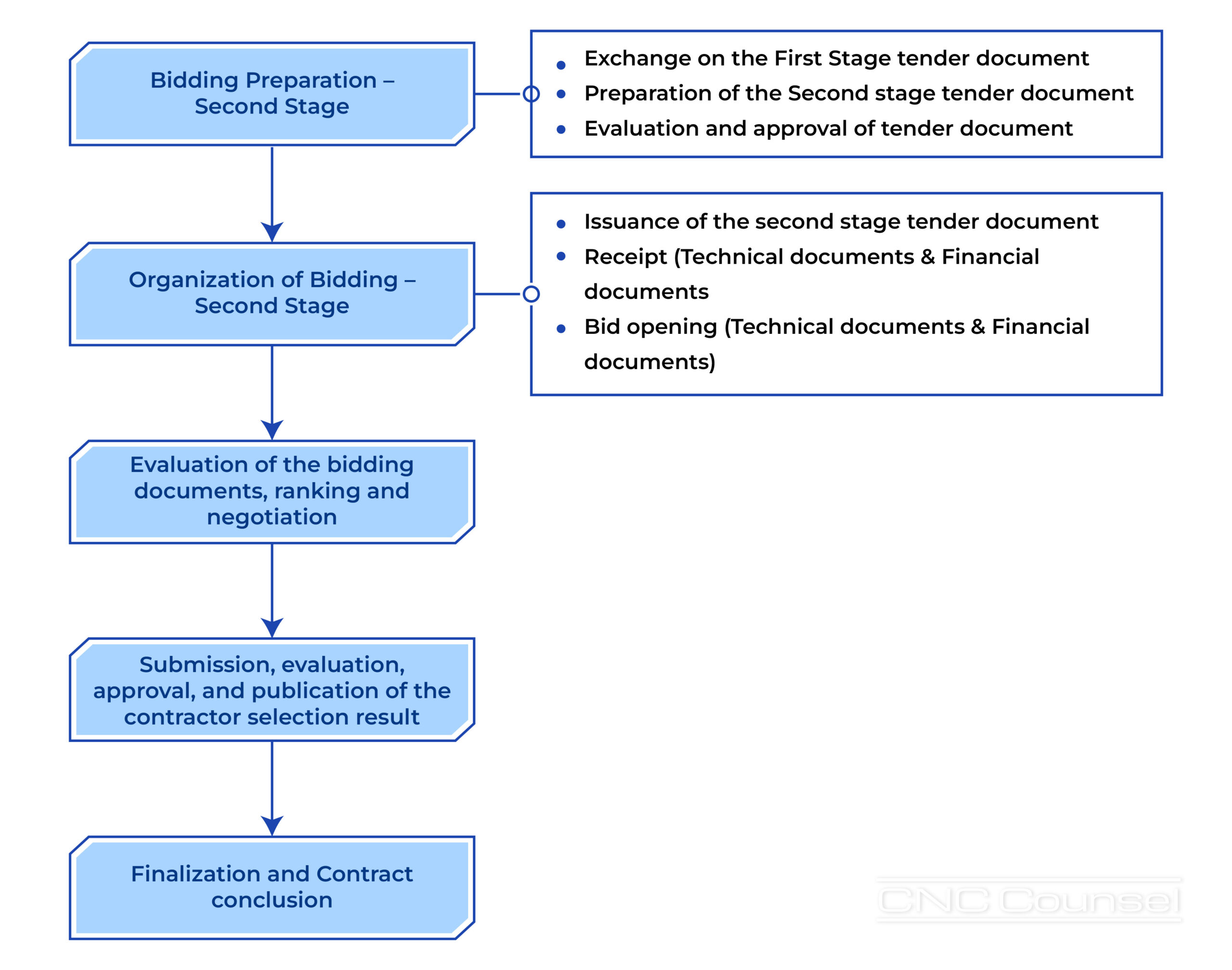
Step 1: Bidding preparation – Second stage[4]
Direct exchange between the tenderee and the contractors[5]
During the direct exchange period of the second stage, the tenderee will invite contractors who passed the first stage to participate in clarification meetings regarding the proposals they have submitted.
The clarification will cover required technical adjustments to the contractor’s proposals in the first stage, as well as feedback on the tender documents and any alternative technical solutions proposed by the contractors. The contents of these discussions must be recorded in minutes and kept confidential, ensuring that information is not disclosed
Preparation of the second stage tender document
Based on the clarification of technical proposals with each contractor, the expert team will consolidate and report to the Employer on the contents that need to be adjusted or supplemented, including instructions to contractors, evaluation criteria, technical requirements, contract conditions, and other aspects of the first stage tender documents. The employer is responsible for reviewing and deciding on such adjustments and supplements based on the expert team’s recommendations.
Consequently, the second stage tender documents inherit from the first stage while incorporating the feedback and clarifications from contractors who passed the technical round. As a result, the documents issued in the second invitation are clearer, with more detailed technical information, and are adjusted and supplemented in terms of technical requirements, evaluation criteria, and other conditions to better align with the actual circumstances of the package
Evaluation and approval of the second stage tender document
Similar to the first stage, once prepared, the second stage tender documents must be submitted for evaluation before approval. The approval of the tender documents is carried out in writing, based on the submission for approval and the evaluation report on the tender documents
Step 2: Organization of Bidding – Second Stage
Organization of Bidding
The organization of bidding in the second stage is carried out based on the technical requirements finalized from the first stage. The second stage tender documents will be issued to contractors listed as having met the requirements of the first stage tender documents[6]. Any amendments or clarifications to the second stage tender documents must also comply with Clause 2, Article 28 of Decree No. 214/2025/ND-CP
After receiving the finalized tender documents, contractors shall prepare, submit, receive, manage, amend, or withdraw their bidding documents in accordance with Clause 3, Article 28 of Decree No. 214/2025/ND-CP. The primary point of second stage is that the submission of bidding documents must include both the technical proposal and the financial proposal (including the bid price and bid security), all submitted together in a single envelope[7]
Bid Opening
Similar to bid opening in the first stage, within 2 hours from the bid closing time, the bidding documents will be opened publicly in the presence of representatives of the participating contractors. The bid opening will be conducted for each bidding document in alphabetical order and in the following sequence: (i) checking the seals; (ii) opening the bidding document; and (iii) clearly reading out the relevant information
Step 3: Evaluation[8]
The evaluation of bidding documents in the second stage is carried out in accordance with the principles set out in Articles 29, 30, 31, and 32 of Decree No. 214/2025/ND-CP. After conducting a comprehensive assessment of both the refined technical capacity and the financial efficiency of the contractors, the tenderee will rank the contractors based on their overall responsiveness. The highest-ranked contractor will be proposed for selection to proceed with contract negotiations.
Step 4: Negotiation and Contract Conclusion[9]
The contractor ranked first will be invited by the Employer to enter into contract negotiations. The negotiation focuses on clarifying and agreeing on key contractual terms, including scope of work, schedule, responsibilities of the parties, payment conditions, warranty, maintenance, and other legal provisions.
After reaching agreement, the tenderee will proceed with appraisal, approval, and public disclosure of the contractor selection results. Finally, the parties will finalize, sign, and manage the performance of the contract.
In summary, the two stage – one envelope method, as amended and specified under the Law on Bidding 2023 and Decree No. 214/2025/ND-CP, is a modern and flexible procurement mechanism. It not only ensures the principles of competition and transparency but also allows the Employer to fully leverage market expertise in determining the most appropriate technical requirements for the package, particularly for complex projects or those involving new technologies. Mastering this method is a key factor for organizations and individuals participating in procurement activities in Vietnam to achieve optimal effectiveness
Managed by
 |
Nguyen Le Anh Thu | Legal Assistant
Phone: (84) 28 6276-9900 Email: thu.nguyen@cnccounsel.com |
 |
Dao Quynh Anh | Legal Intern
Phone: (84) 28 6276-9900 |
Contact
For more information, please contact:
CNC Vietnam Law Firm Co., Ltd
Address: 2A1 Nguyen Thi Minh Khai, Sai Gon Ward, Ho Chi Minh City
Phone: 028 6276 9900
Hotline: 0916 545 618
Email: contact@cnccounsel.com
Website: cnccounsel
We would be pleased if you could visit the office of CNC, where you could exchange with the most suitable Lawyers for your specific circumstances. However, if you could not make the time for direct meeting, please feel free to contact us via the email: contact@cnccounsel.com or call (+84-28) 6276 9900
Disclaimers:
This article is prepared or used for the purposes of introducing or updating the clients on the issues and/or developments of the legal perspectives in Vietnam. The information contained in this article shall not constitute an advice of any kind, and could be subject to change without prior notice.
————————————
[1] Article 47 Decree No. 214/2025/ND-CP
[2] Article 48 Decree No. 214/2025/ND-CP
[3] Article 49 Decree No. 214/2025/ND-CP
[4] Article 50 Decree No. 214/2025/ND-CP
[5] Article 32.3 Law on Bidding 2023 and Article 50.1 Decree No. 214/2025/ND-CP
[6] Article 50.4.(a) Decree No. 214/2025/ND-CP
[7] Article 32.2.(a) Law on Bidding 2023
[8] Article 51 Decree No. 214/2025/ND-CP
[9] Article 52 Decree No. 214/2025/ND-CP