




As of 18 August 2026, Circular 38/2026/TT-NHNN (“Circular 38”) has officially taken effect, replacing Circular 06/2019/TT-NHNN and establishing a new mechanism for inward and outward remittances on investment capital accounts denominated in Vietnamese dong. Notably, Circular 38 resolves a long-standing practical difficulty: FDI enterprises that hold an Enterprise Registration Certificate (ERC) but have not yet obtained an Investment Registration Certificate (IRC) may now open a capital account from the investment preparation stage itself. Set out below are the key highlights of Circular 38 that foreign investors and FDI enterprises should note.
Expansion of the Scope of Application
One of the notable features of Circular 38 is the revision of terminology and the expansion of the scope of application. Specifically, prior references to “enterprises” have been replaced with “economic organizations”, while the term “Vietnamese investor” has been unified as “domestic investor”, thereby ensuring consistency and alignment with the current legal framework on investment.
On that basis, Circular 38 supplements and clarifies the scope of application with respect to the following groups of entities and investment activities:
- Member enterprises within an International Financial Centre in Vietnam (referred to as “member enterprises”), a new category of entities identified under Decree No. 329/2025/ND-CP;
- Investors in the petroleum sector: adds operators and contractors that are foreign investors performing petroleum contracts and petroleum agreements executed on behalf of the State or the Government of Vietnam.
- Investors from an International Financial Centre: adds capital flows and investment activities from International Financial Centres in Vietnam into the rest of Vietnam.
Notably, the Circular also adds the case where a foreign investor directly implements an investment project under the public-private partnership (PPP) method without establishing a PPP project enterprise, thereby broadening the scope of regulation to better accommodate new forms of investment and organizational models in practice.
Entities Required to Open an Investment Capital Account
Pursuant to Article 6 of Circular 38, the entities responsible for opening a foreign investment capital account in Vietnam (referred to as an “investment capital account”) fall into four groups, as follows:
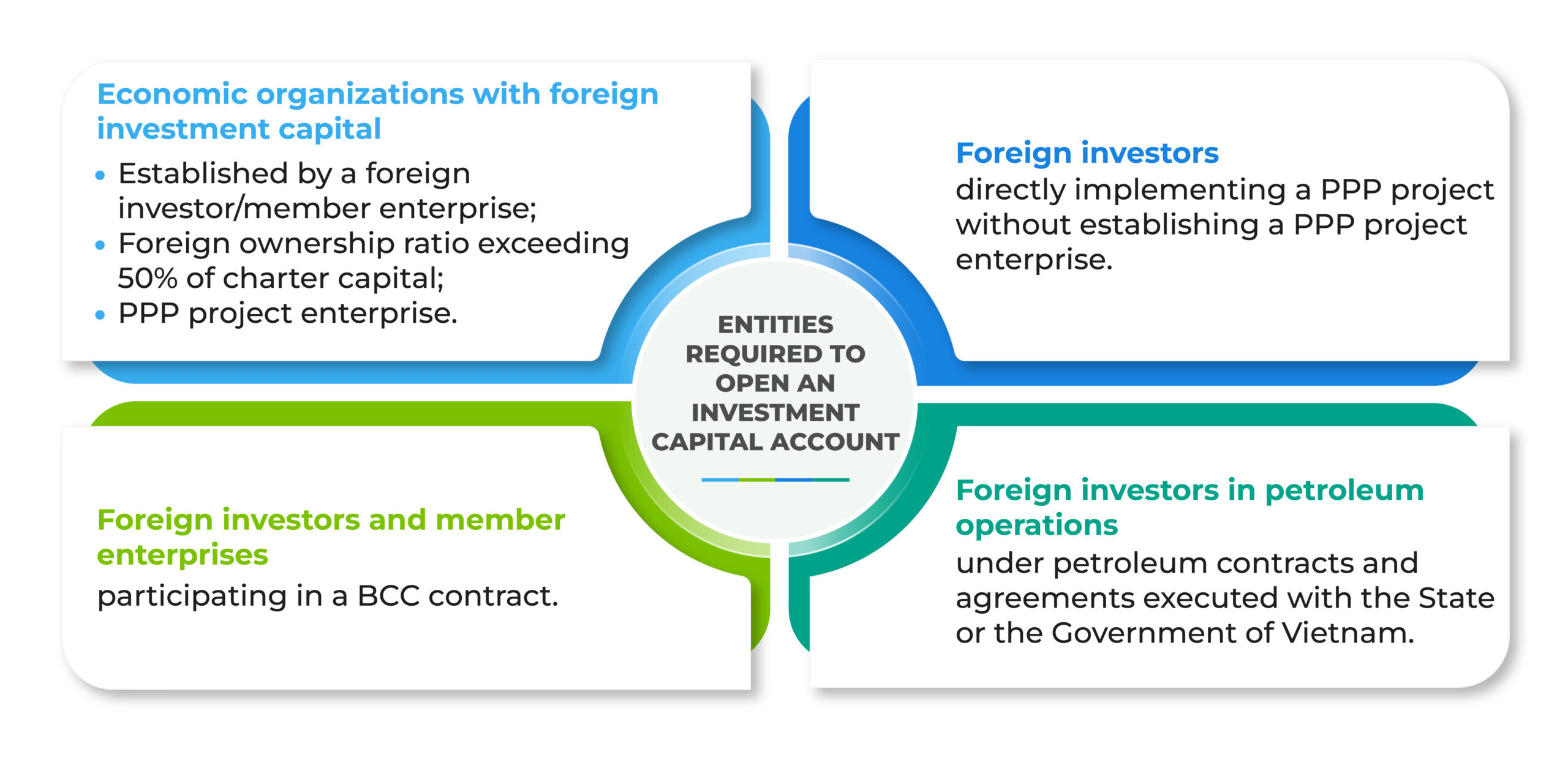
First, economic organizations with foreign investment capital, including:
- Economic organizations established by foreign investors or member enterprises in accordance with investment laws and other relevant laws;
- Economic organizations with foreign investment capital in which a foreign investor or member enterprise is a member or shareholder holding more than 50% of the charter capital through capital contribution, share purchase, or purchase of contributed capital;
- PPP project enterprises established by foreign investors.
Second, foreign investors and member enterprises participating in a Business Cooperation Contract (BCC).
Third, foreign investors directly implementing a PPP project without establishing a PPP project enterprise.
Fourth, contractors that are foreign investors under petroleum contracts and petroleum agreements executed on behalf of the State or the Government of the Socialist Republic of Vietnam with a foreign contracting party (referred to as “foreign investors in petroleum operations”).
As such, the entities required to open an investment capital account under Circular 38 are not limited to economic organizations with foreign investment capital, but also extend to investors and member enterprises participating in BCC contracts, those directly implementing PPP projects, and foreign investors in petroleum operations. This demonstrates that the regulatory mechanism has been adjusted to be more comprehensive and inclusive, ensuring consistency with the diversity of forms and activities of foreign investment in this promising market.
Remittances for Investment Preparation Activities Before and After Obtaining an IRC/ERC
Remittances for investment preparation activities in Vietnam are divided into two stages: before and after the competent authority issues the necessary legal documents, including the IRC, the notification of satisfaction of conditions for capital contribution, share purchase, or purchase of contributed capital by a foreign investor, the ERC, an establishment and operation license under specialized laws, or before/after execution of a PPP contract. Specifically:
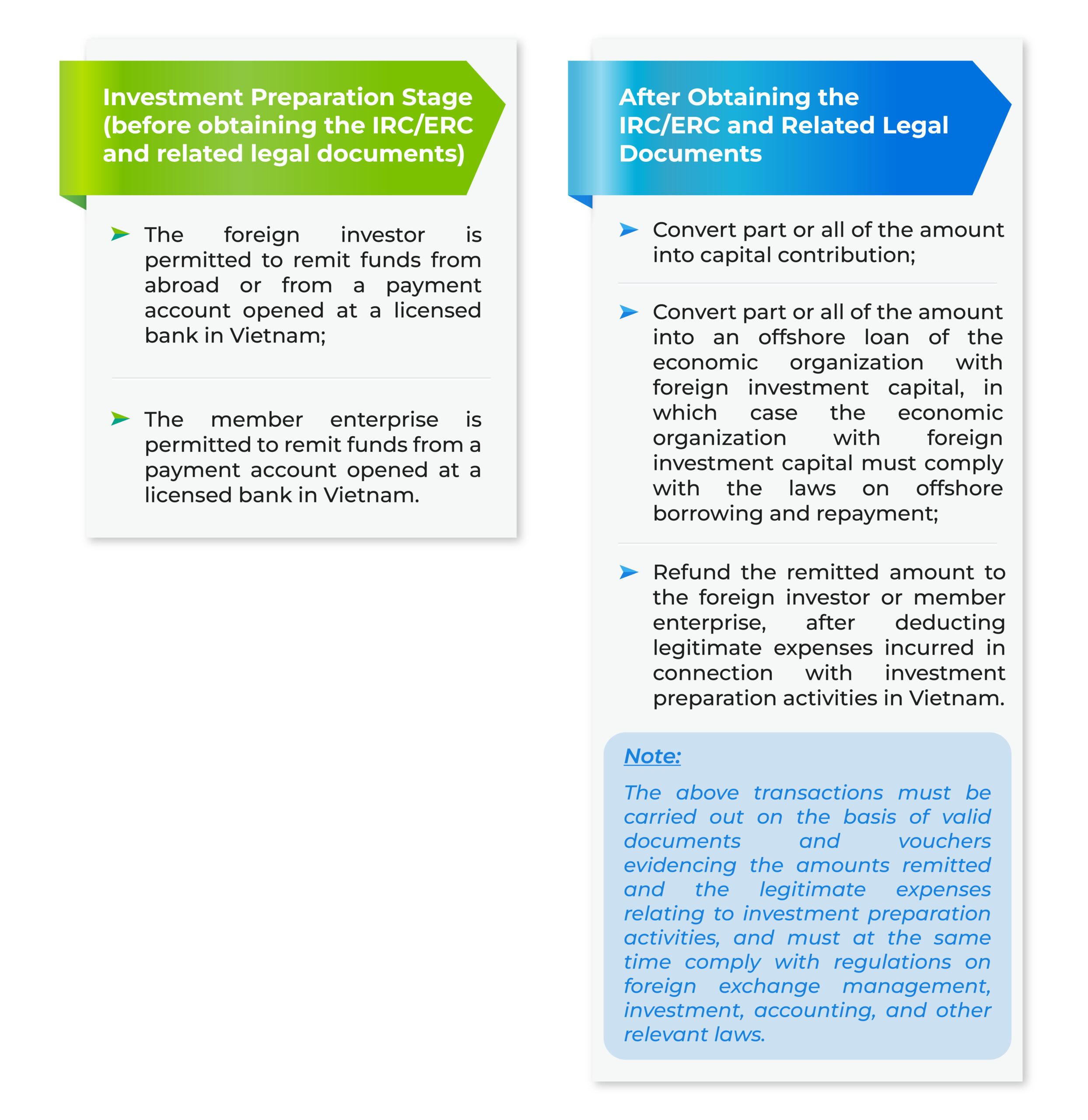
Special case: If a foreign investor has established an economic organization before carrying out the procedures for issuance or adjustment of the IRC, and that economic organization has already opened an investment capital account under Clause 3, Article 7 of Circular 38, remittances for investment preparation activities must be made through the investment capital account already opened.
Opening a DICA Before Obtaining an IRC Is Now Officially Permitted
Where a foreign investor establishes an economic organization before carrying out the procedures for issuance or adjustment of the IRC, the economic organization with foreign investment capital is permitted to open:
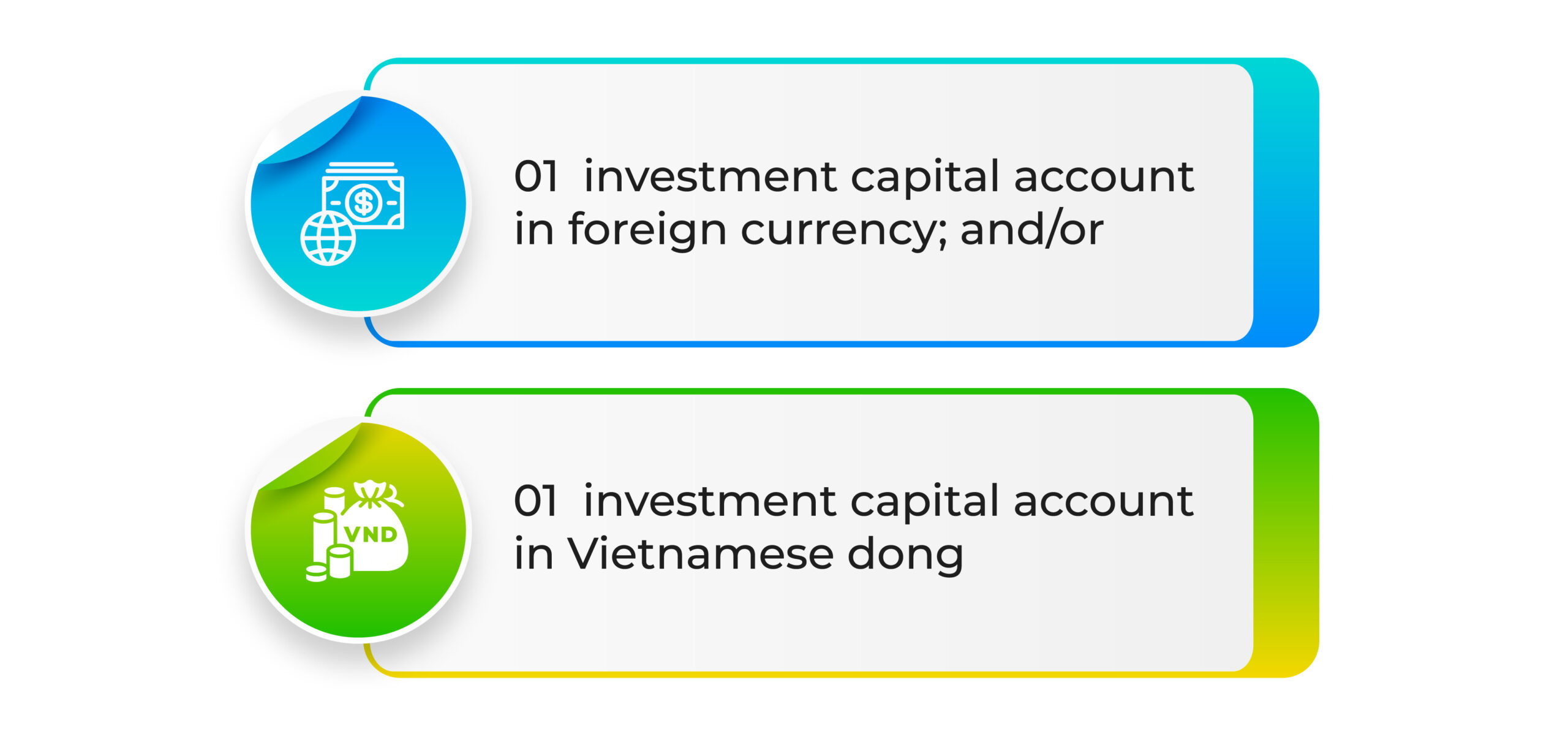
During this stage, the investment capital account may only be used to:
- Receive charter capital;
- Receive interest accrued on the account balance;
- Pay legitimate expenses relating to investment preparation activities in Vietnam; and
- Refund capital to the investor or member enterprise in the event the IRC is not issued or adjusted.
Once the IRC is issued or adjusted, the economic organization with foreign investment capital may only open an additional investment capital account in another foreign currency (if needed) as prescribed. At the same time, the previously opened investment capital account will continue to be used for inward and outward remittances in accordance with the law.
Cases Where an ERC Is Held but a Foreign Investment Capital Account (DICA) May Not Be Opened
The fact that an enterprise has been issued an ERC does not automatically mean that the enterprise is required to open a direct investment capital account. Under Circular 38, the obligation to open an investment capital account also depends on the foreign investor’s ownership ratio, as well as the enterprise’s listing or trading-registration status. Specifically:
-
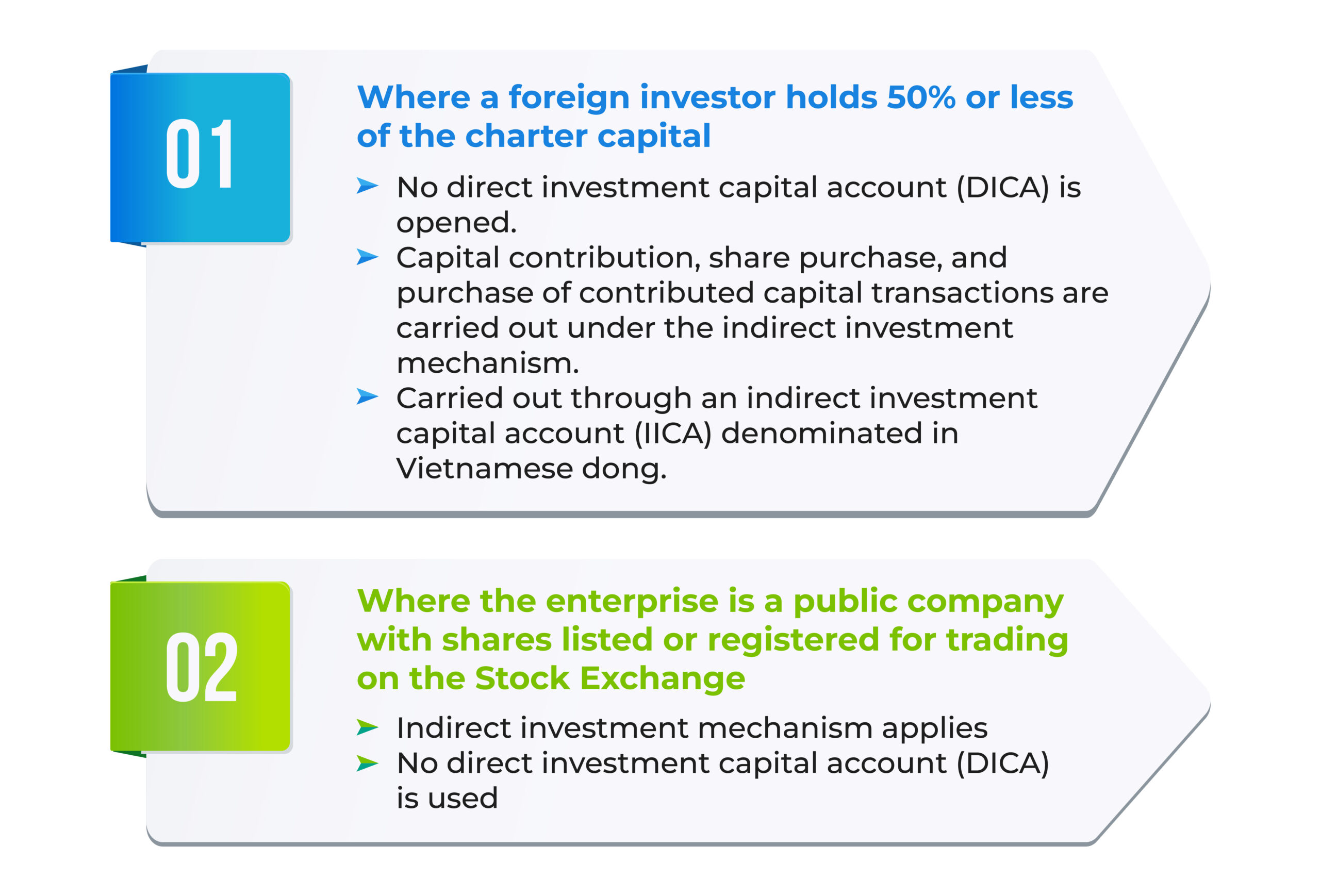
Where a foreign investor holds 50% or less of the charter capital:
An economic organization is only required to open an investment capital account where a foreign investor or member enterprise holds more than 50% of the charter capital[1]. Accordingly, if the foreign ownership ratio is 50% or less of the charter capital[2], the enterprise is not required to open an investment capital account under the direct investment mechanism. In this case, capital contribution, share purchase, and purchase of contributed capital transactions are carried out in accordance with the regulations on indirect investment[3], through an indirect investment capital account (IICA) denominated in Vietnamese dong.
[1] Clause 6, Article 7 of Circular 38/2026/TT-NHNN
[2] Point b, Clause 5, Article 7 of Circular 38/2026/TT-NHNN
[3] Clause 2, Article 4 of Circular 03/2025/TT-NHNN
-
Where the enterprise is a public company with shares listed or registered for trading on a Stock Exchange:
Notwithstanding the participation of a foreign investor, activities relating to transactions on the Stock Exchange at such enterprise are carried out under the indirect investment mechanism. Accordingly, the enterprise does not apply the foreign exchange management mechanism for direct investment activities and does not use a direct investment capital account (DICA) for these transactions.
The foregoing shows that an ERC is merely one of the bases for determining an enterprise’s legal status, but is not the sole condition for determining whether the enterprise is required to open an investment capital account. Accordingly, an enterprise should have regard to the foreign investor’s ownership ratio and its listing or trading-registration status in order to select the appropriate type of account and mechanism for carrying out its investment transactions.
Points to Note for Foreign Investors in the Petroleum Sector
Foreign investors in petroleum operations that had invested in Vietnam prior to 18 August 2026 are permitted to open and use an investment capital account to carry out inward and outward remittances relating to their investment activities.
If a foreign investor in petroleum operations had previously used a payment account to carry out such transactions, it may continue to use that account during the transitional period, until the opening of the investment capital account is completed. Within 12 months from the effective date of the Circular, the investor must complete the opening of an investment capital account as required.
The transfer of balances, rights, and obligations from the payment account to the investment capital account shall be carried out in accordance with an agreement with the bank, and must at the same time comply with regulations on foreign exchange management.
Transitional period: 12 months from the effective date of the Circular (18 August 2026) to complete the opening of the investment capital account.
Within the same 12-month period referred to above, entities that are required to close an investment capital account but have not yet done so must complete the closure of such account, including:
- Economic organizations that no longer have any foreign investor or member enterprise holding shares or contributed capital in that economic organization;
- Economic organizations that have not been issued, or have not had adjusted, an IRC as required by investment law, and that have refunded the contributed capital amounts to the foreign investor or member enterprise.
Accordingly, foreign investors in the petroleum sector should proactively review the status of their accounts and complete the procedures for opening, converting, or closing investment capital accounts within 12 months to ensure that their investment activities and capital transactions in Vietnam are carried out in compliance with the regulations on foreign exchange management.
CNC có thể hỗ trợ gì?

- Inbound/Outbound Investment: Company Establishment, Investment Registration and Post-registration Services in relation to tax, accounting, labor, insurance, salary, and outsourced legal department;
- Operation Licenses: We could provide support in the application for operation licenses for business activities in fields such as manufacturing, commerce, services, e-commerce, healthcare, education, or food & beverage (restaurants);
- M&A Services: Conduct legal due diligence, structure transactions, draft and negotiate transaction documents, provide advice on competition law compliance (including merger control filings and related approvals), obtain necessary regulatory approvals and licenses, and provide post-closing support;
- Personal Data Protection: Provide support in compliance with the data protection regulations, including the drafting and reviewing of Data Protection Impact Assessments (DPIAs), Data Processing/Transfer Agreements, Privacy Policies, and other necessary documents under the Personal Data Protection Decree (PDPD);
- Dispute Resolution: Litigation and Commercial Arbitration (VIAC SIAC ICC); and
- Legal Retainer Services per the clients’ requests.
Please contact Mr. Chris Luong – Partner through the email address of chris.luong@cnccounsel.com or Ms. Ngan Nguyen – Partner through the email address of ngan.nguyen@cnccousel.com for prompt and timely support.
Managed by
 |
Nguyen Thi Kim Ngan I Partner
Phone: (84) 919 639 093 Email: ngan.nguyen@cnccounsel.com |
 |
Luong Van Chuong I Partner
Phone: (84) 938 04 7969 Email: chris.luong@cnccounsel.com |
 |
Bui Thi Minh Phuong I Legal Assistant
Phone: (84) 28 6276 9900 Email: phuong.bui@cnccounsel.com |
Contact Us
For further information, please contact:
CNC Vietnam Law Firm
Address: The Rise Building, 2A1 Nguyen Thi Minh Khai, Sai Gon Ward, Ho Chi Minh City, Vietnam
Phone: (84) 28-6276 9900 – 081 235 3839
Hotline: (84) 916-545-618
Email: contact@cnccounsel.com
Website: cnccounsel
We would be delighted to welcome you to CNC’s office, where you’ll have the opportunity to consult with the lawyer best suited to your circumstances. Of course, if you are unable to meet in person, email us via contact@cnccounsel.com or call us via (+84-28) 6276 9900.
It would be a pleasure for CNC’s lawyers to help you build a solid legal foundation, thus ensuring the success and sustainable development of your project!
————————————
Copyright © CNC Counsel. All rights reserved.
Ownership Rights: This document and the content contained herein (Document) are proprietary resources exclusively owned by CNC Counsel. Access to or use of this Document does not, by itself, create any contractual relationship or lawyer-client relationship between CNC Counsel and any person or entity.
Disclaimer: All Documents are provided solely for informational purposes and may not reflect the most current legal developments. Summaries of laws, regulations, and practices are subject to change. This Document is not intended to constitute legal, professional, or other advice with respect to any specific matter. Nor is it intended to substitute for reference to, or compliance with, the detailed provisions of any applicable law, regulation, rule, or official form. Readers are strongly encouraged to seek independent legal advice before taking, or refraining from taking, any action based on the information contained in this Document. CNC Counsel, together with its editors and authors, makes no representations or warranties as to the accuracy, completeness, or currency of the Document and disclaims all liability to any person or entity arising from reliance on all or any part of the Document. This Document may contain links to external websites, and external websites may contain links to this Document. CNC Counsel is not responsible for the content, operation, availability, or practices of any such external websites and expressly disclaims any liability in connection therewith. Note: Past results do not guarantee similar outcomes in future matters. Each matter is unique and must be assessed based on its own facts and circumstances.
————————————
[1] Article 1 of Decision No. 4560/QD-UBND.
[2] Clause 1, Clause 2, and Point (a) of Clause 3, Article 7a of Resolution No. 98/2023/QH15, as supplemented by Clause 5, Article 1 of Resolution No. 260/2025/QH15.
[3] Clause 5, Article 12 of Resolution No. 98/2023/QH15.
[4] Clauses 1 and 2, Article 7a, as supplemented by Clause 5, Article 1 of Resolution No. 260/2025/QH15.
[5] Article 1.8 of Resolution No. 260/2025/QH15.
[6] Clause 5 and Points (c) and (d) of Clause 7, Article 7a of Resolution No. 98/2023/QH15, as supplemented by Clause 5, Article 1 of Resolution No. 260/2025/QH15.
[7] Clause 6, Article 7a of Resolution No. 98/2023/QH15, as supplemented by Clause 5, Article 1 of Resolution No. 260/2025/QH15.
[8] Article 4 of Decision No. 4560/QĐ-UBND.