




The beneficial owner of an enterprise is always a “hot” issue, but it is accompanied by numerous inadequacies. Consequently, the consequence of concealing the beneficial owner through nominee arrangements, holding capital for others, or complex ownership structures poses major risks regarding tax evasion, money laundering, and transaction insecurity.
To overcome this inadequacy, Decree 296/2026/NĐ-CP (effective from July 23, 2026) clearly stipulates: “It is not permitted to act as a nominee for another person to contribute capital to an enterprise.”[1]
In this issue, CNC will outline the criteria for identifying beneficial owners according to Decree No. 296/2026/NĐ-CP, while clarifying violations related to beneficial owners and corresponding penalties under current regulations.
Further Reference: Vietnam Officially Bans Nominee Shareholding From 23 Jul 2026 – CNC | CNC Vietnam Law Firm
Concept and Legal Nature of Beneficial Owners
Concept of Beneficial Owner
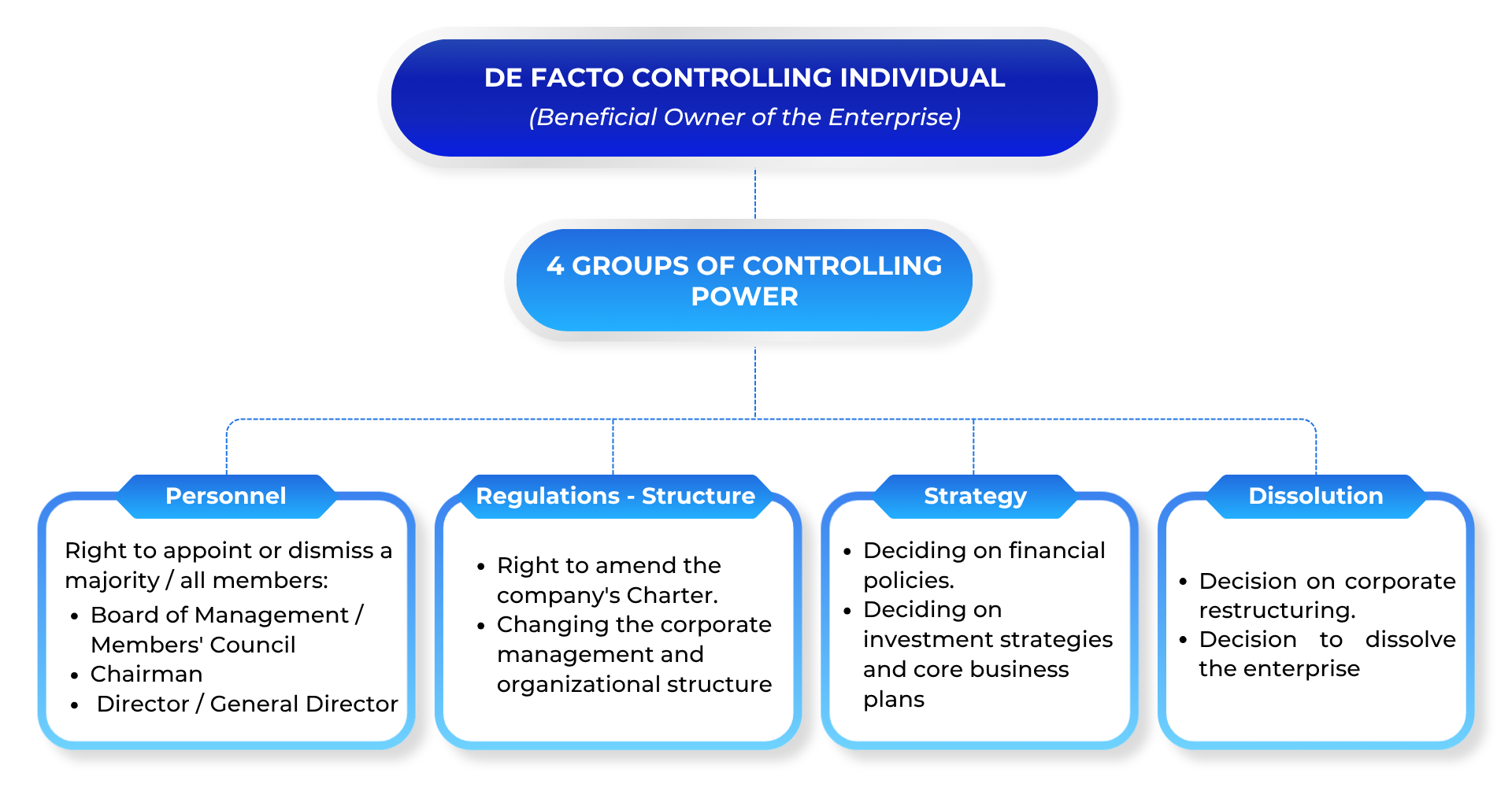
A beneficial owner of an enterprise is one or more individuals who ultimately own or control, directly or indirectly, the enterprise with legal personality. In other words, these are the people who truly dominate or decide the operations of the enterprise, even if ownership or control may be exercised through multiple intermediary levels or various forms.[2]
However, the concept of an enterprise’s beneficial owner does not include individuals representing state capital shares in the enterprise. These persons only exercise the right of representation authorized by the State regarding the contributed capital portion and are not the ultimate beneficial owners or controllers of the enterprise in reality.
From the above concept, it can be seen that the key point of the beneficial owner regulation does not lie in whose name is on the papers, but in the person who actually owns, controls, or ultimately benefits.
Distinguishing between Nominal Nominees and Individuals with Actual Ultimate Control
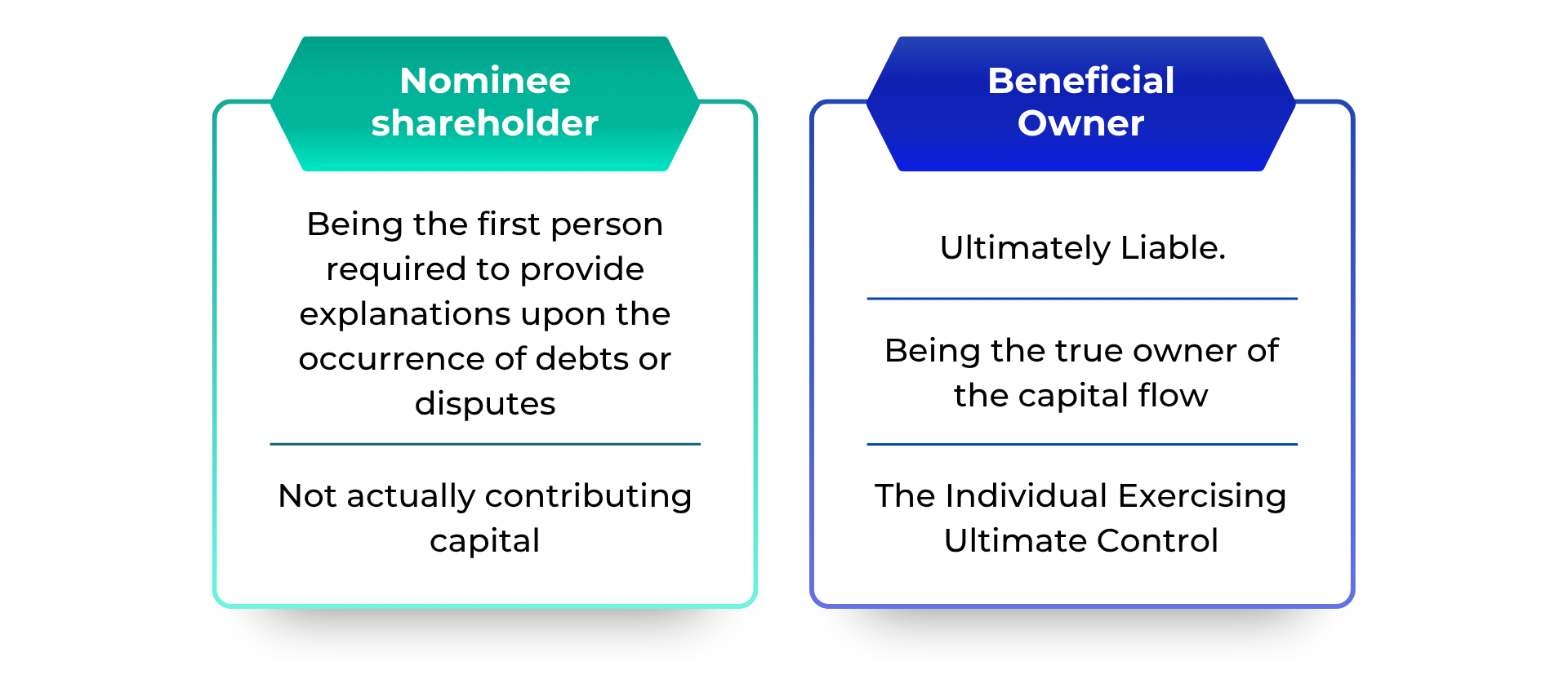
Based on this significance, Decree 296/2026/NĐ-CP has thoroughly overcome the previously fragmented legal situation by establishing a practical and synchronized regulatory framework. For the first time, the act of acting as a nominee or holding capital for others to conceal the beneficial owner is directly prohibited, accompanied by the mandatory obligation for enterprises to proactively declare and update beneficial owner information according to specific quantitative and qualitative criteria right from the business registration stage.
Accordingly, this mechanism completely shifts the compliance responsibility to the enterprise, forcing the legal representative to bear ultimate responsibility for the veracity of the declared information, thereby ending the era of ownership “camouflage” and creating a fair and transparent investment environment.
However, identifying beneficial owners in practice is not an easy task. To solve this problem, Decree 296/2026/NĐ-CP was issued to establish a mechanism to identify the ultimate beneficial owner.
How to Identify Beneficial Owners
Rules for Identifying Beneficial Owners
Enterprises are required to apply the order of inspection from Tier 1 to Tier 3. Only move to the next tier when the preceding tier is not feasible or does not reflect the true nature of actual control.
Details on How to Identify Beneficial Owners
Tier 1: Capital Ownership Criteria (Clause 1)[3]:
Primary application priority based on quantitative information.
Method 1: Direct and Indirect Ownership Forms
a. Direct Ownership:
An individual officially named on the Register of Shareholders, Capital Contribution Certificate, or Certificate of Enterprise Registration with a ratio of 25%. This is the simplest and easiest case to identify.
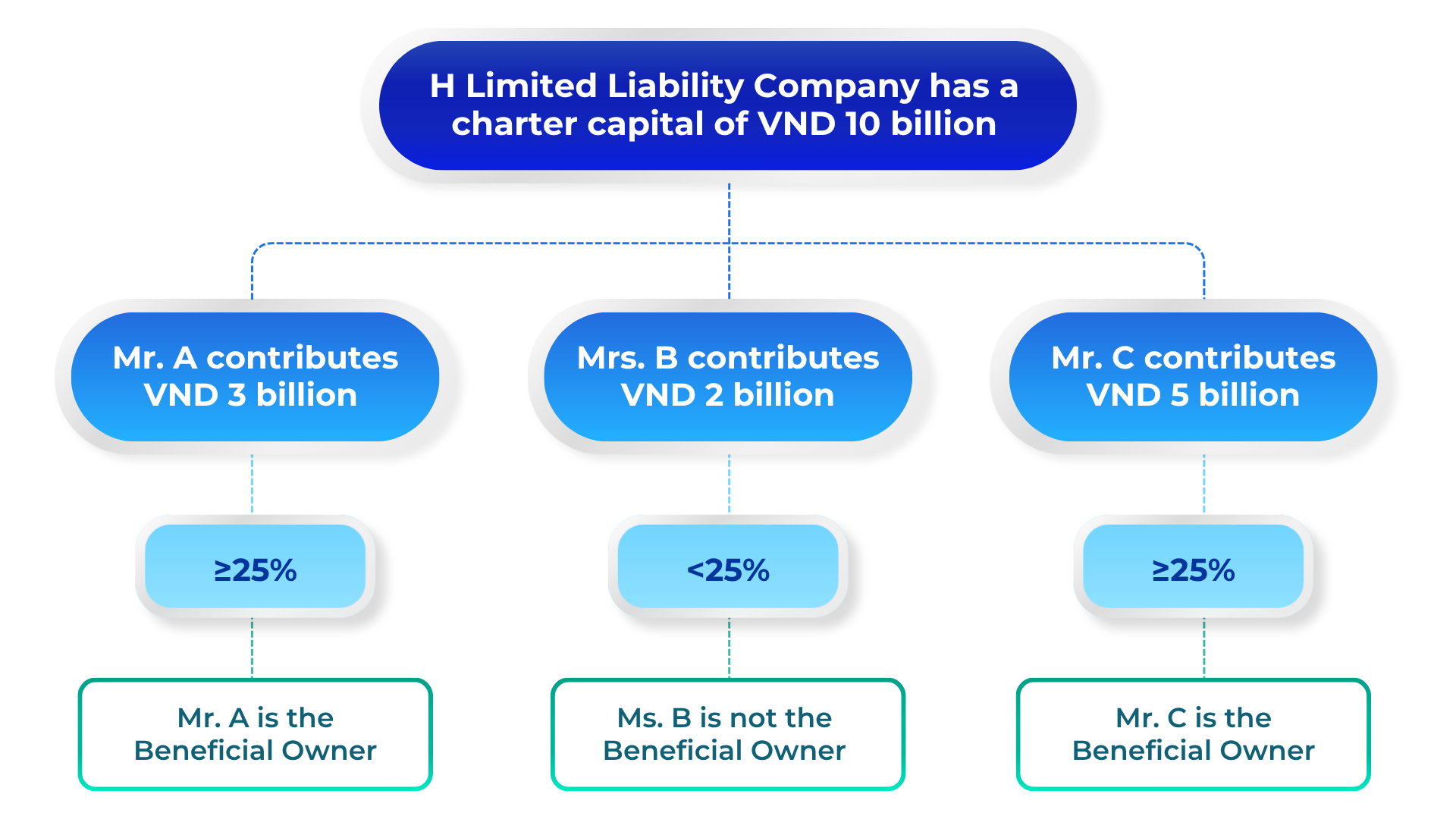
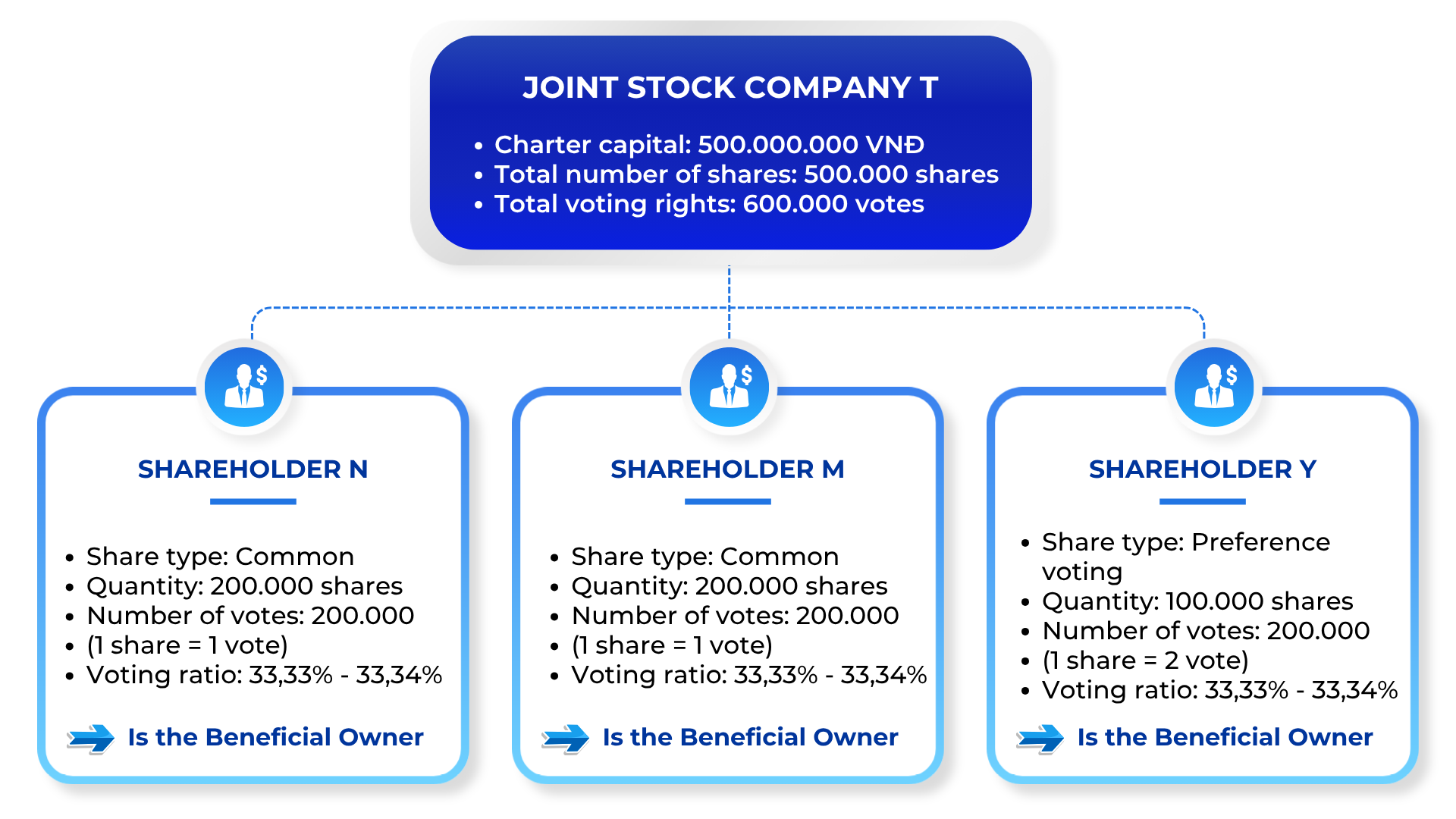
b. Indirect Ownership:
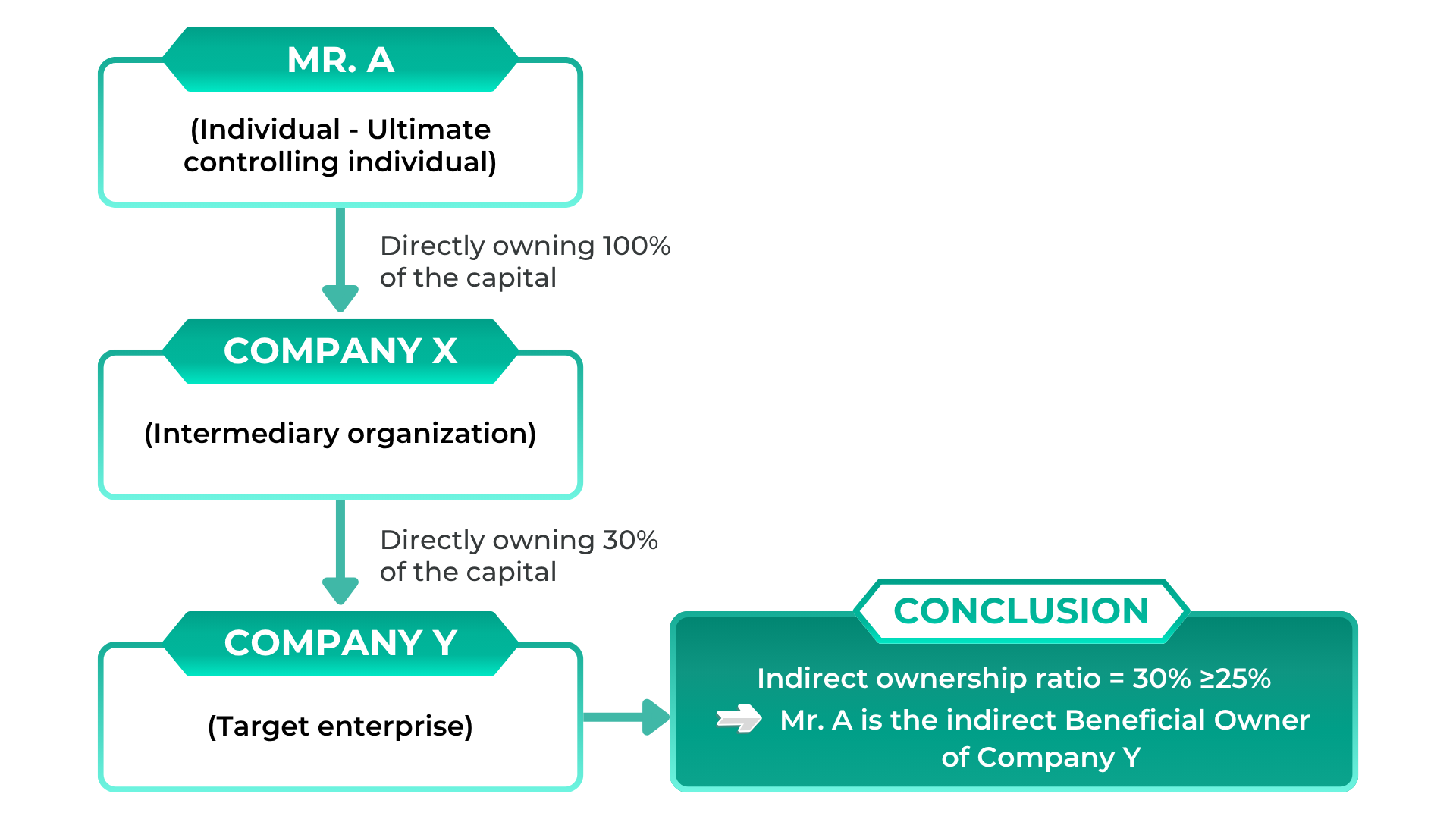
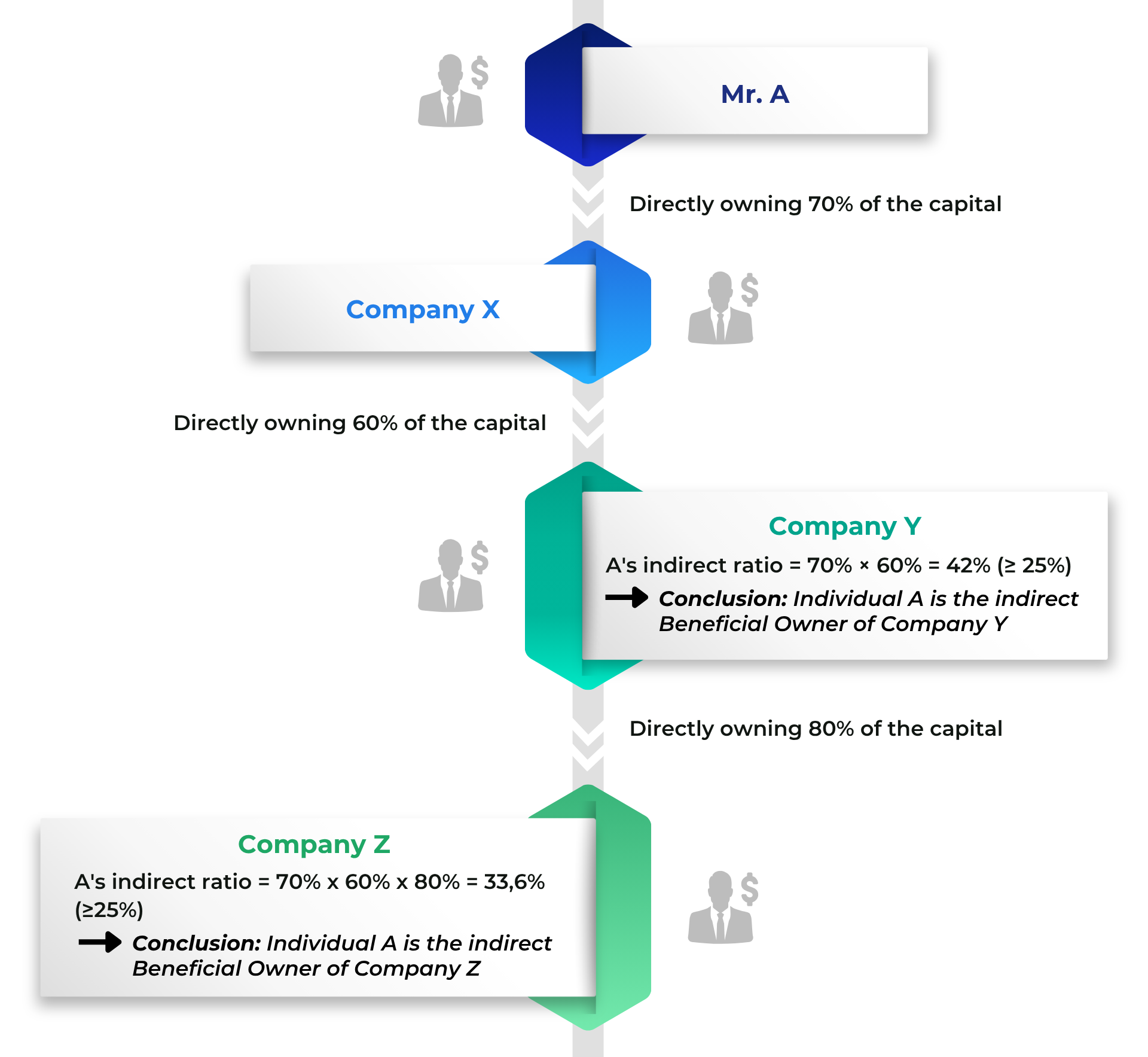
Indirect ownership is when an individual holds a ratio through other organizations or legal agreements[4].
Example 1:
Example 2:
Method 2: Group Aggregation Rule
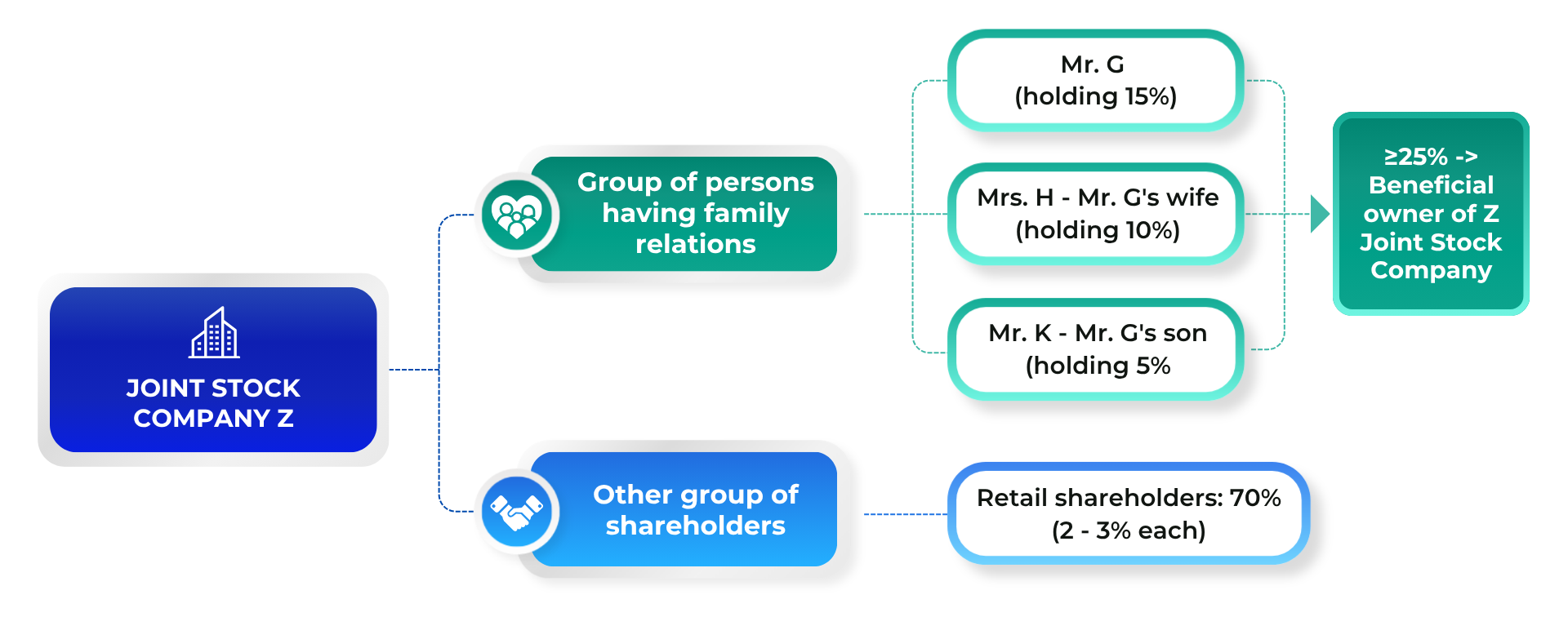
A group of individuals having a family relationship[5] (husband, wife, children, parents…) or having a linked agreement contract together hold a cumulative total of 25% of the charter capital or voting shares or more.
Example:
Method 3: Specific Rule
Partnership Company: 100% of general partners are naturally beneficial owners (regardless of capital ratio or voting rights) due to the unlimited liability regime[6].
Example:
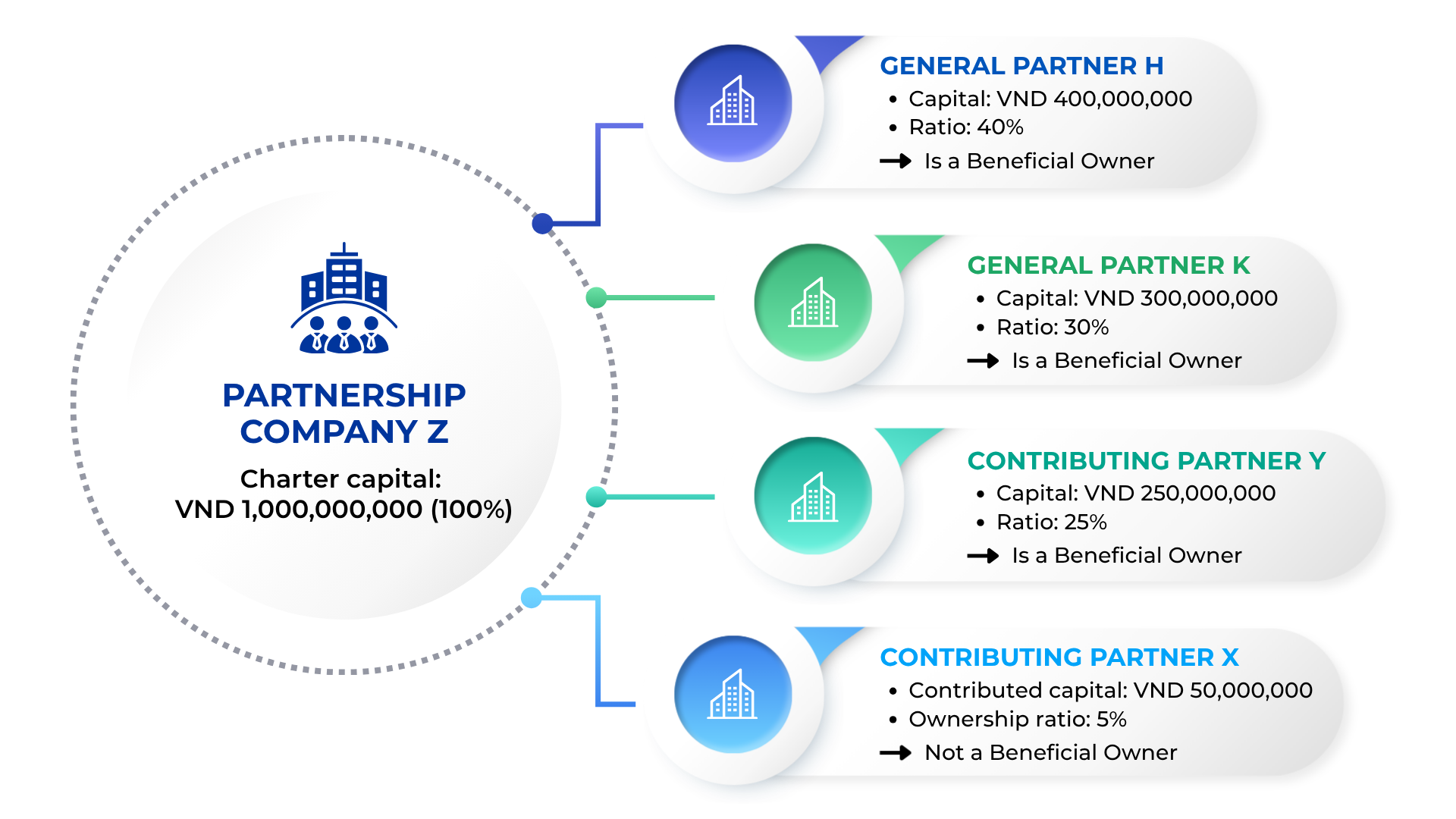
Therefore, in the case of a partnership, every general partner is a beneficial owner of the business, regardless of their ownership stake or voting power.
Tier 2: Actual Control Criteria (Clause 2)[7]:
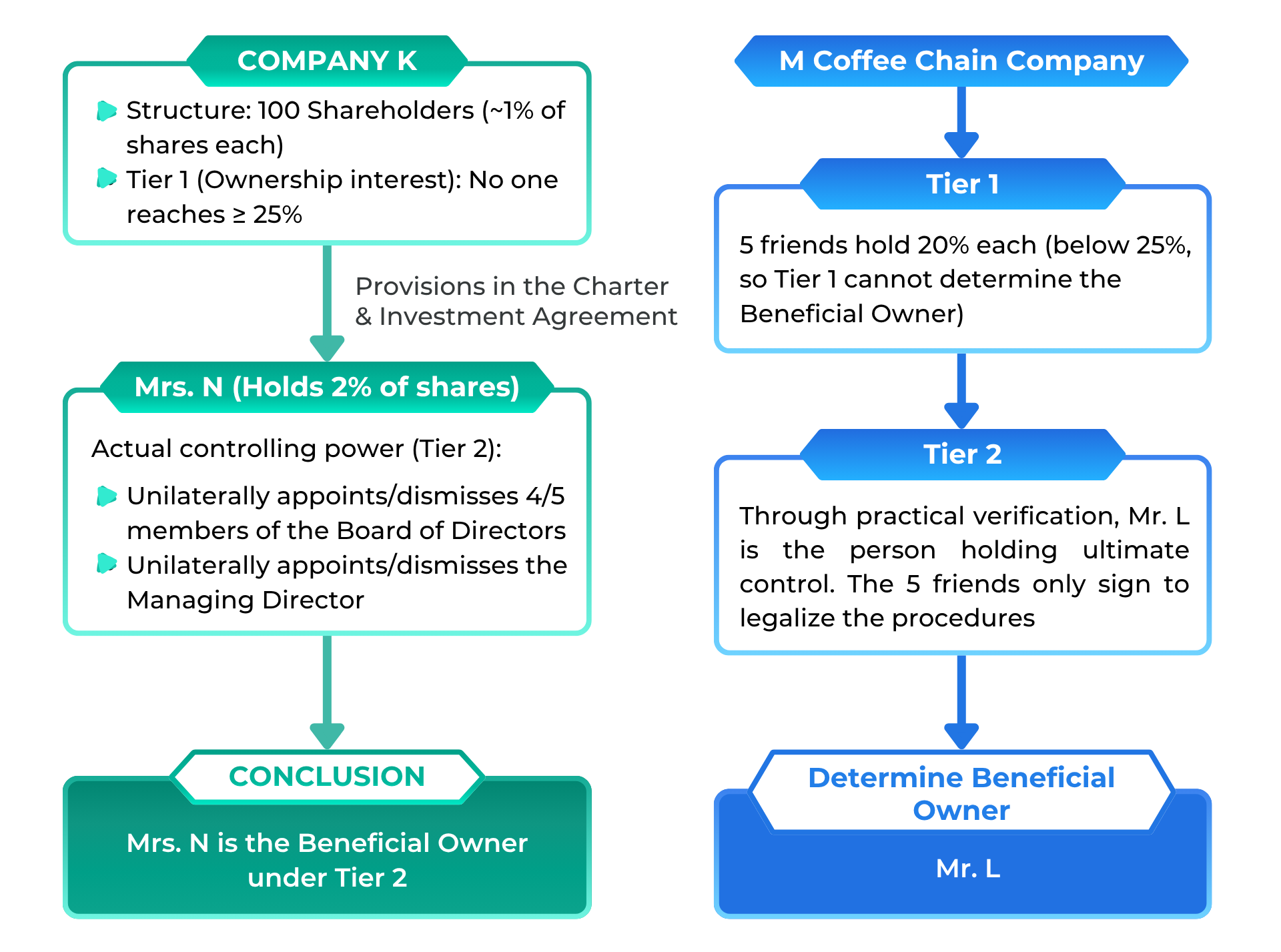
Triggered when Tier 1 fails to identify an individual owning 25% or more of the charter capital, or when there is grounds to believe that the individual at Tier 1 is merely a “nominee”.
Example 1:
Example 2:
Tier 3: Final Resort Principle (Clause 3)[8]:
Applied when both Tier 1 and Tier 2 cannot point out a beneficiary.
Mechanism for Identifying Beneficial Owner: The enterprise applies the legal presumption rule, designating 01 individual who is the enterprise Manager with the highest authority (Chairperson of the Board of Directors/Members’ Council or Director/General Director) as the beneficial owner.
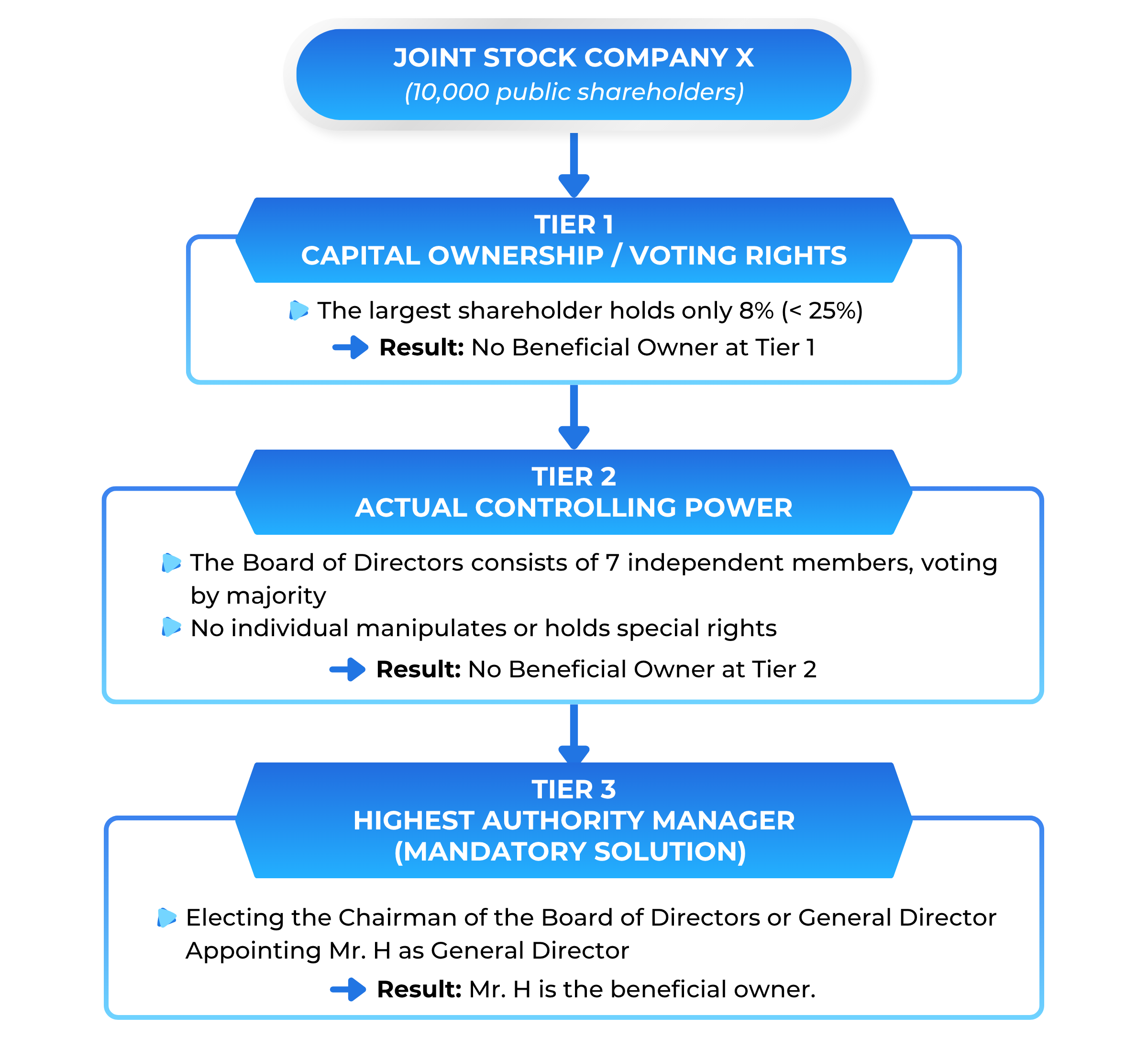
Example: Joint Stock Company Group X has 10,000 shareholders.
Tier 1 Check: The largest shareholder holds only 8% of the charter capital. No Beneficial Owner at Tier 1.
Tier 2 Check: The Board of Directors consists of 7 independent members, deciding by majority, with no individual manipulating or holding special rights. No Beneficial Owner at Tier 2.
Tier 3 Solution: The enterprise is required to select 01 individual who is the Highest Authority Manager to report as the Beneficial Owner. At this time, the enterprise will appoint the Chairman of the Board of Directors or the General Director (Example: Mr. H – General Director) as the Beneficial Owner.
Exception Note: If Mr. H is the representative of State capital contribution in Group X, the law does not allow selecting Mr. H. The enterprise must select the next senior management individual who does not represent State capital (for example, the Executive Deputy General Director).
Violations Related to Beneficial Owners
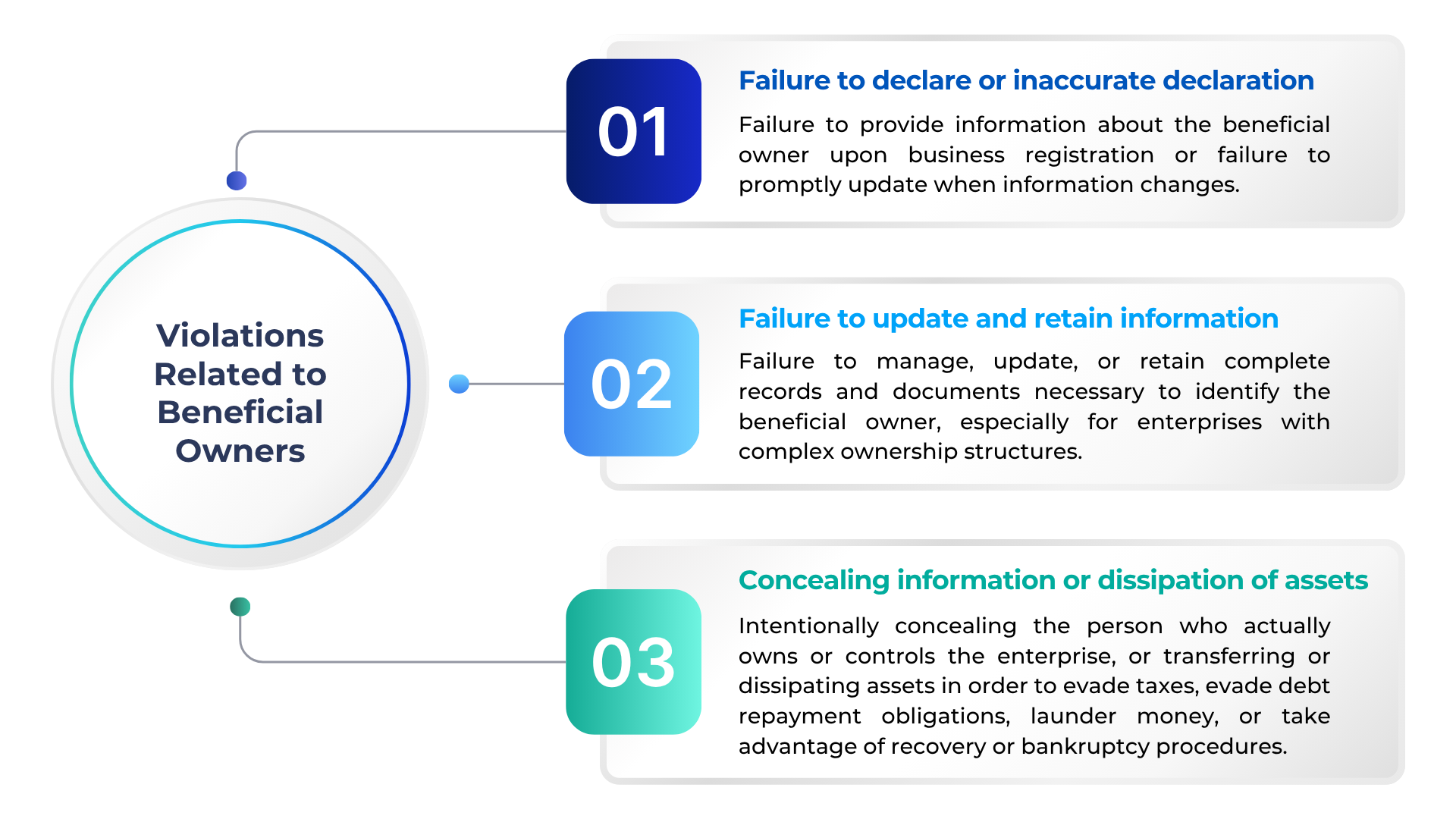
Violations related to beneficial owners mainly arise from the enterprise failing to ensure the completeness, accuracy, and transparency of information about the person who actually owns or controls the enterprise. Specifically:
- Failure to declare or inaccurate declaration: Failure to provide information about the beneficial owner upon business registration or failure to promptly update when information changes.
- Failure to update and retain information: Failure to manage, update, or retain complete records and documents necessary to identify the beneficial owner, especially for enterprises with complex ownership structures.
- Concealing information or dissipation of assets: Intentionally concealing the person who actually owns or controls the enterprise, or transferring or dissipating assets in order to evade taxes, evade debt repayment obligations, launder money, or take advantage of recovery or bankruptcy procedures.
In general, the above acts reduce the transparency regarding the actual entity behind the enterprise, and may cause difficulties for controlling violations of the law and tracing the origin of assets.
Penalties for Violations Related to Beneficial Owners
In addition to the administrative penalties introduced under Decree No. 288/2026/ND-CP for violations such as providing false or inaccurate information or failing to declare information on beneficial owners (as discussed in CNC’s previous article, “Vietnam Officially Bans Nominee Shareholding From 23 Jul 2026“), the Government has also issued Decree No. 252/2026/ND-CP, introducing stricter enforcement measures to strengthen tax administration.
Accordingly, the tax authority is empowered to directly impose an exit suspension on taxpayers in certain circumstances. Notably, this includes cases where the legal representative or the beneficial owner of an enterprise, cooperative, or cooperative union is associated with an entity that has outstanding tax liabilities of VND 500 million or more, such tax debt has remained overdue for at least 120 days, and the entity is subject to enforcement of an administrative decision on tax administration.
Depending on the circumstances, the tax authority may apply different enforcement procedures. In cases involving tax debts of business individuals, enterprises, or taxpayers that are no longer operating at their registered addresses, the tax authority must provide a 30-day prior notice of its intention to impose an exit suspension. If the taxpayer fails to remedy the violation or fulfil the outstanding tax obligation within this period, the tax authority will issue an exit suspension notice and transmit it to the immigration authority for implementation.
Shortly after the Decree took effect, this mechanism was implemented in practice. On 29 July 2026, the Gia Lai Provincial Tax Department issued Notice No. 49016/TB-GLA-KDT, announcing its intention to impose an exit suspension on Mr. Le Thai Sam, the beneficial owner of Tre Viet Aviation Joint Stock Company. According to the notice, the company had outstanding tax liabilities exceeding VND 440.7 billion as of 29 July 2026.
This is considered one of the first cases in which an exit suspension has been applied to a beneficial owner under the new regulatory framework. It demonstrates that beneficial owners are no longer merely required to declare and disclose beneficial ownership information. Instead, they may now face direct legal consequences where the enterprise fails to fulfil its tax obligations and falls within the statutory tax enforcement regime.
The introduction of exit suspension measures applicable to beneficial owners marks a significant shift in Vietnam’s regulatory approach. Beneficial owners are no longer responsible solely for transparency and disclosure of beneficial ownership information but are increasingly expected to ensure that enterprises under their control comply with tax obligations. This development strengthens accountability, enhances tax enforcement, and promotes greater transparency in corporate governance.
CONCLUSION
Decree 296/2026/NĐ-CP officially ends the era of “nominee shareholders, holding capital for others,” making the identification of beneficial owners a mandatory legal obligation to transparentize the market and prevent economic violations. Falsely declaring a beneficial owner is no longer merely a procedural error but entails risks of administrative penalties, suspension of transactions, or criminal liability for the Legal Representative.
HOW CAN CNC SUPPORT?

- Foreign Direct Investment (FDI): Company establishment, Investment registration, and Post-registration compliance such as tax, accounting, labor, insurance, payroll, and outsourced Legal Department;
- Operating Licenses: We assist in obtaining operating licenses for specific business activities such as production, trade, services, e-commerce, healthcare, education, or F&B (restaurants), etc.;
- M&A Services: Conducting Legal Due Diligence Reports; Transaction structuring; Drafting and negotiating transaction documents; Advising on competition law compliance, including economic concentration control dossiers and related approvals; Obtaining necessary approvals and licenses; and Post-transaction support:
- Personal Data Protection: Assisting in compliance with data protection regulations, including drafting and reviewing Data Protection Impact Assessments (DPIAs), Data Processing/Transfer Agreements, Privacy Policies, and necessary documents according to the Personal Data Protection Law (PDPL).
- Dispute Resolution: Court proceedings and Commercial Arbitration (VIAC, SIAC, ICC); and
- Regular legal consulting services upon client request.
Please contact Mr. Chris Luong – Partner through the email address of chris.luong@cnccounsel.com or Ms. Ngan Nguyen – Partner through the email address of ngan.nguyen@cnccousel.com for prompt and timely support.
Managed by
 |
Luong Van Chuong I Partner
Phone: (84) 938 04 7969 Email: chris.luong@cnccounsel.com |
 |
Trinh Minh An | Legal Assistant
Phone: (84) 28 6276-9900 Email: an.trinh@cnccounsel.com |
 |
Lam Ngoc Thao Ngan | Legal Intern
Phone: (84) 28 6276-9900 |
Contact Us
For further information, please contact:
CNC Vietnam Law Firm
Address: The Rise Building, 2A1 Nguyen Thi Minh Khai, Sai Gon Ward, Ho Chi Minh City, Vietnam
Phone: (84) 28-6276 9900
Hotline: (84) 916-545-618
Email: contact@cnccounsel.com
Website: cnccounsel
————————
Copyright © CNC Counsel. All rights reserved. Ownership: This documentation and content (Content) is a proprietary resource owned exclusively by CNC Counsel. Use of this Content does not of itself create a contractual relationship, nor any attorney/client relationship, between CNC Counsel and any person. Disclaimers: The Content provided is for informational purposes only and may not reflect the latest legal or regulatory developments. Summaries of laws, regulations, and practices are subject to change. This Content does not constitute legal or professional advice for any specific situation and should not be relied upon as a substitute for reviewing and complying with applicable laws, rules, regulations, or official forms. Always seek legal counsel before making any decisions or taking any action based on this Content. CNC Counsel, along with its editors and contributing authors, make no guarantees regarding the accuracy of the Content and explicitly disclaim any liability for any consequences resulting from actions taken, allowed, or omitted, whether fully or partially based on any part of the Content. The Content may include links to external websites, and external sites may also link to it. CNC Counsel is not responsible for the content or functionality of any such external websites and disclaims all liability for any issues arising from their content or operation. Please note: Past results do not guarantee similar outcomes.
————————
[1] Clause 1.1 of Decree No. 296/2026/ND-CP dated July 23, 2026, providing for amendments and supplements to a number of articles of the Government’s Decree No. 168/2025/ND-CP dated June 30, 2025, on enterprise registration (Decree No. 296/2026/ND-CP)
[2] Article 3 of Decree No. 296/2026/ND-CP dated July 23, 2026, providing for amendments and supplements to a number of articles of the Government’s Decree No. 168/2025/ND-CP dated June 30, 2025, on enterprise registration (Decree No. 296/2026/ND-CP)
[3] Clause 1, Article 3 of Decree No. 296/2026/ND-CP dated July 23, 2026, providing for amendments and supplements to a number of articles of the Government’s Decree No. 168/2025/ND-CP dated June 30, 2025, on enterprise registration (Decree No. 296/2026/ND-CP)
[4] Clause 1, Article 3 of Decree No. 296/2026/ND-CP dated July 23, 2026, providing for amendments and supplements to a number of articles of the Government’s Decree No. 168/2025/ND-CP dated June 30, 2025, on enterprise registration (Decree No. 296/2026/ND-CP)
[5] Clause 22, Article 4 of the 2020 Law on Enterprises
[6] Point d, e, Clause 2, Article 181 of the 2020 Law on Enterprises
[7] Clause 2, Article 3 of Decree No. 296/2026/ND-CP dated July 23, 2026, providing for amendments and supplements to a number of articles of the Government’s Decree No. 168/2025/ND-CP dated June 30, 2025, on enterprise registration (Decree No. 296/2026/ND-CP)
[8] Clause 3, Article 3 of Decree No. 296/2026/ND-CP dated July 23, 2026, providing for amendments and supplements to a number of articles of the Government’s Decree No. 168/2025/ND-CP dated June 30, 2025, on enterprise registration (Decree No. 296/2026/ND-CP)