




On 26 June 2026, theo Government of Vietnam issued Decree 243/2026/ND-CP amending a number of provisions on DPPA under Decree 57/2025/ND-CP and rooftop solar under Decree 58/2025/ND-CP. This Decree shall come in force on the issuance date.
Decree No. 243/2026/ND-CP is expected to address many of the challenges facing rooftop solar power development in particular and the renewable energy sector more broadly.
CNC sincerely introduces 09 key changes in policy on DPPA and rooftop solar power under Decree 243/2026.
Recognition of IZ Power Retailer as a DPPA Contracting Party
Under Decree 57/2025, DPPA regime was only applied for Renewable Energy Generation Corporation (“RE GENCO”) and Large Power Consumer that (i) buys electricity for consumption, and (ii) has large consumption capacity and output under the regulations of the Ministry of Industry and Trade (“MoIT”).[1]
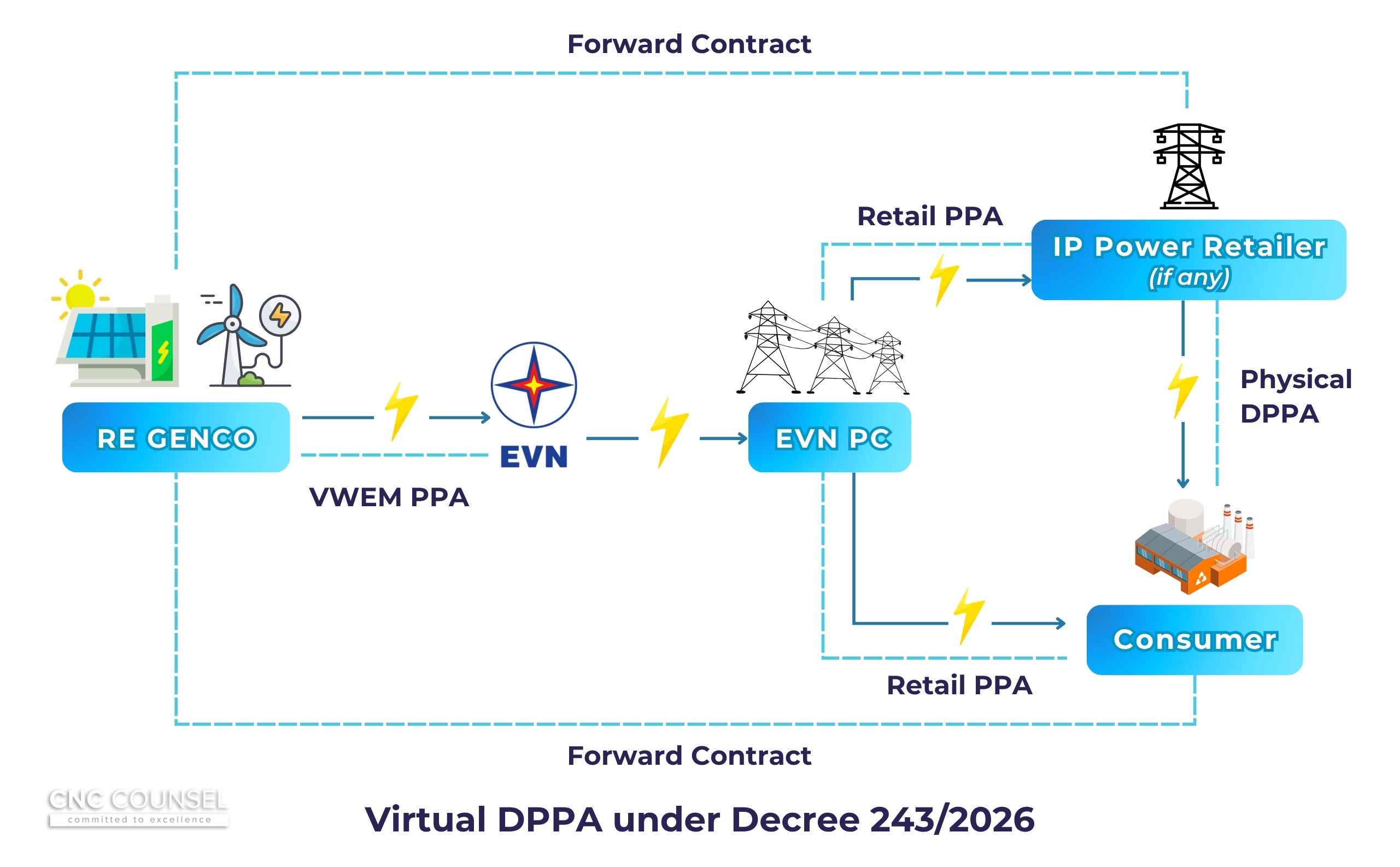
For Large Power Consumer under Virtual DPPA regime located inside Industrial Zones and similar areas (“IZ”), such consumer shall authorize power retailers within IZ (“IZ Power Retailer”) to purchase power from EVN Power Corporations (“EVNPC”) or EVNPC Subsidiaries and conclude Forward Contract with RE GENCO.[2]
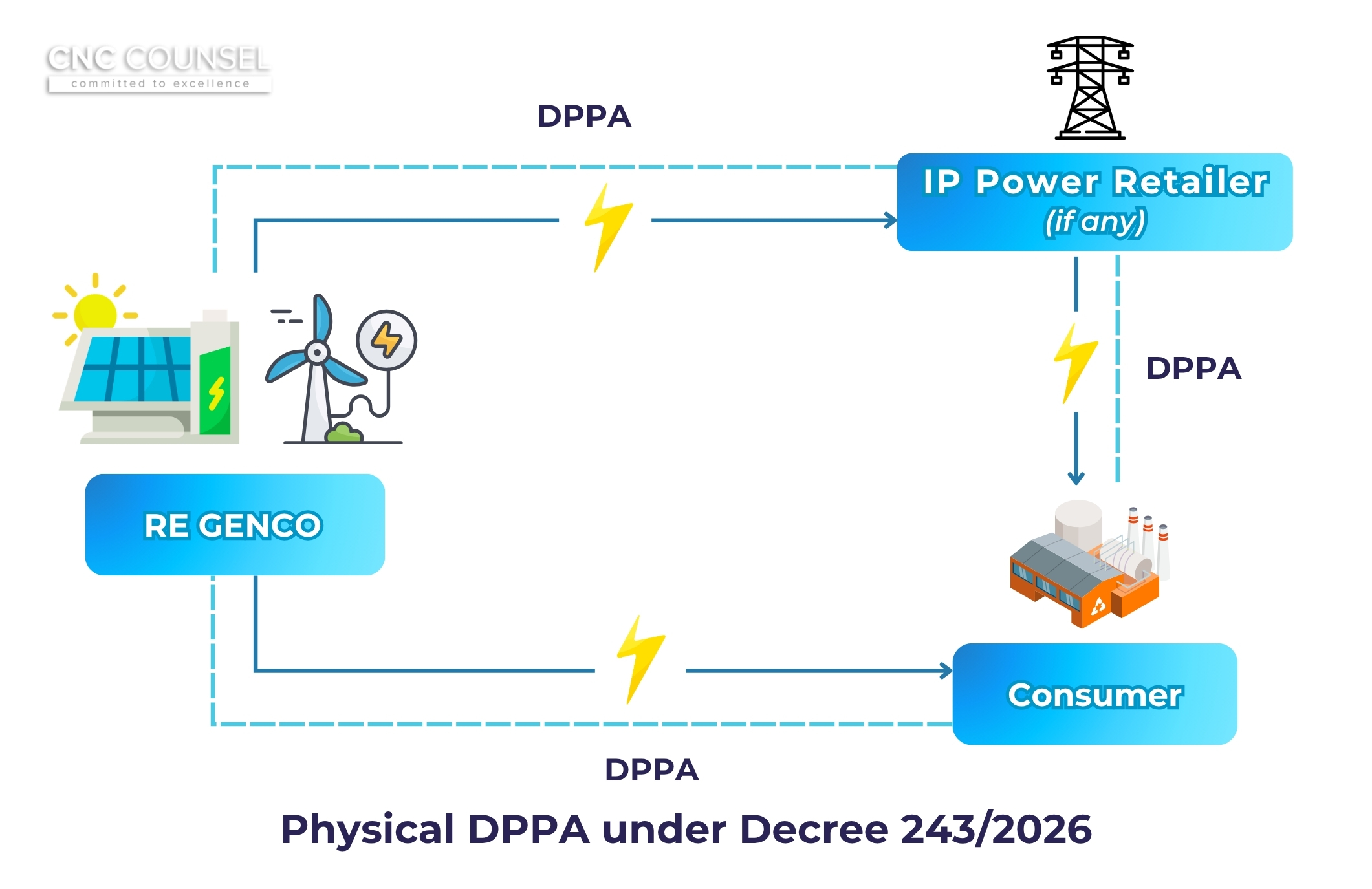
Turning to Decree 243/2026, IZ Power Retailer is eligible to become a Contracting Party entering into a DPPA. Accordingly, IZ Power Retailer may act as power purchaser under a DPPA concluded with RE GENCO, and act as power seller under a DPPA entered into with a Large Power Consumer.[3]
Changes in DPPA’s Operation
Following the addition of IZ Power Retailer as a Contracting Party in DPPA, it shall be changes in DPPA’s Operation under Decree 243/2026.
Specifically, regarding any DPPA activity which involves IZ Power Retailer, Decree 243/2026 permits such IZ Power Retailer:[4]
- In case Physical DPPA: Purchasing power from RE GENCO; and/or selling power to Large Power Consumer if IZ Power Retailer invests in renewable energy generation for such purposes;
- In case Virtual DPPA: On its own behalf, purchasing power from EVNPC/EVNPC Subsidiaries and concluding forward contract with RE GENCO.
Increase in the Maximum Excess Electricity Output that RE GENCOs Are Permitted to Sell
Decree 57/2025 and Decree 243/2026 permits the RE GENCO operating rooftop solar power under Physical DPPA regime to sell the excess electricity to EVNPC/EVNPC Subsidiaries.
Both Decrees prescribe the selling price of excess output shall be the average electricity market price in the preceding year, as announced by the National System Management Operator (“NSMO”), and shall not exceed the price ceiling for ground solar power, as announced by the MoIT.[5]
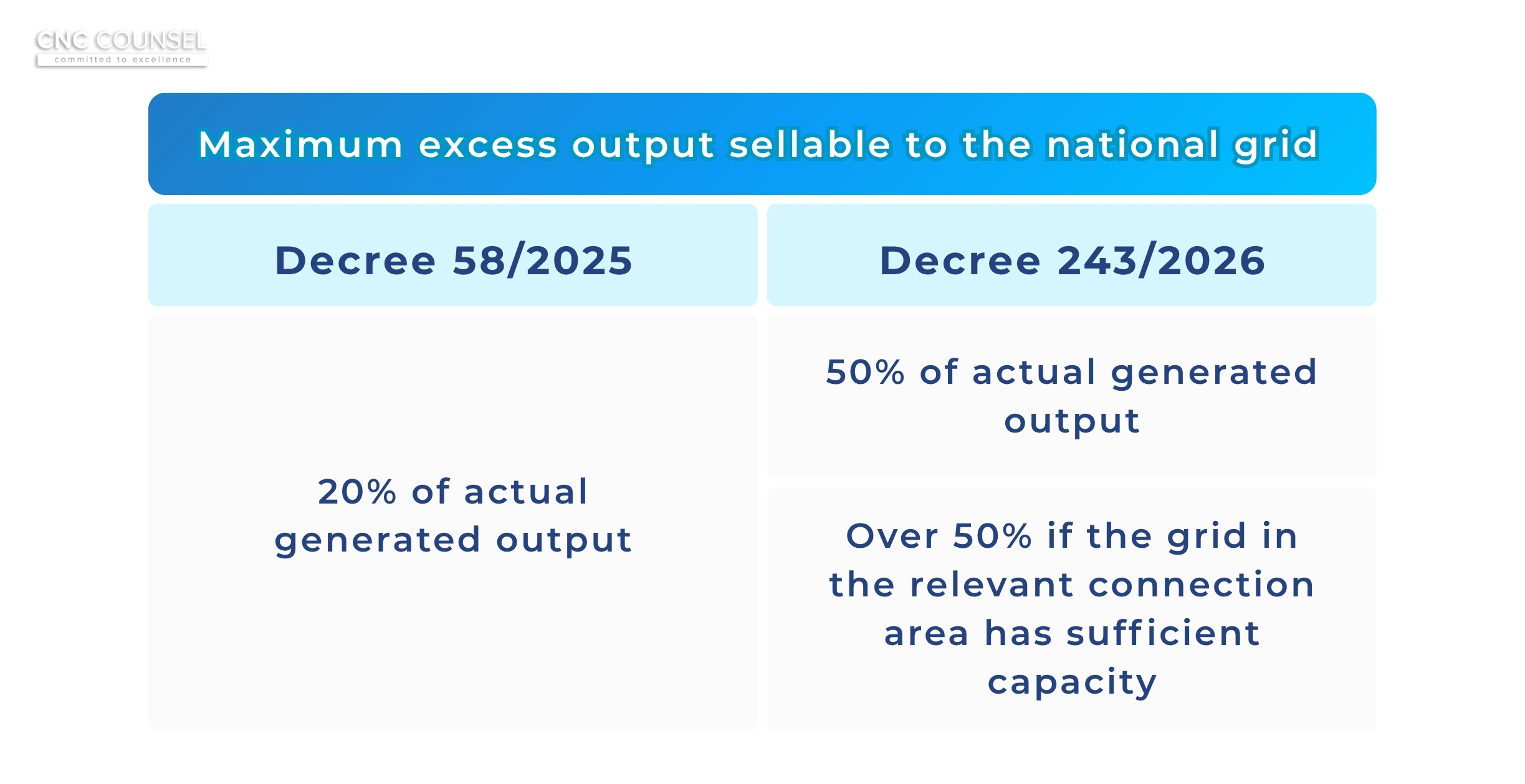
However, the two Decrees fix different limits on the sale of excess electricity output. Under Decree 57/2025, the excess electricity output sellable to grid is capped at 20% of the actual generated output, whereas Decree 243/2026 increases this cap to 50%.
The above limit of Decree 243/2026 applies to RE GENCO and IZ Power Retailer that invests in rooftop solar power generation for the purpose of selling power to Large Power Consumer.
Expanding the Scope of Large Power Consumer Eligible to Enter into a Virtual DPPA
Under Decree 57/2025 and Decree 243/2026, Large Power Consumers that use electricity for production or providing electric vehicle charging services are eligible to enter into Virtual DPPA.[6]
However, Decree 243/2026 also permits Large Power Consumer that uses electricity for data center activities to enter into Virtual DPPA.[7]
Abolition of the Registration Procedures for Rooftop Solar Power Development by RE GENCO
Decree 57/2025 requires RE GENCO entering into DPPA shall comply with the regulations governing the issuance of electricity operation licences.[8] Accordingly, RE GENCO operating solar power systems is required to complete the registration procedures for rooftop solar power development.[9]
Turning to Decree 243/2026, such procedures are abolished under this Decree.[10]
Permission for Private-Wire Owners to Purchase Excess Electricity from Self-RTS Developers
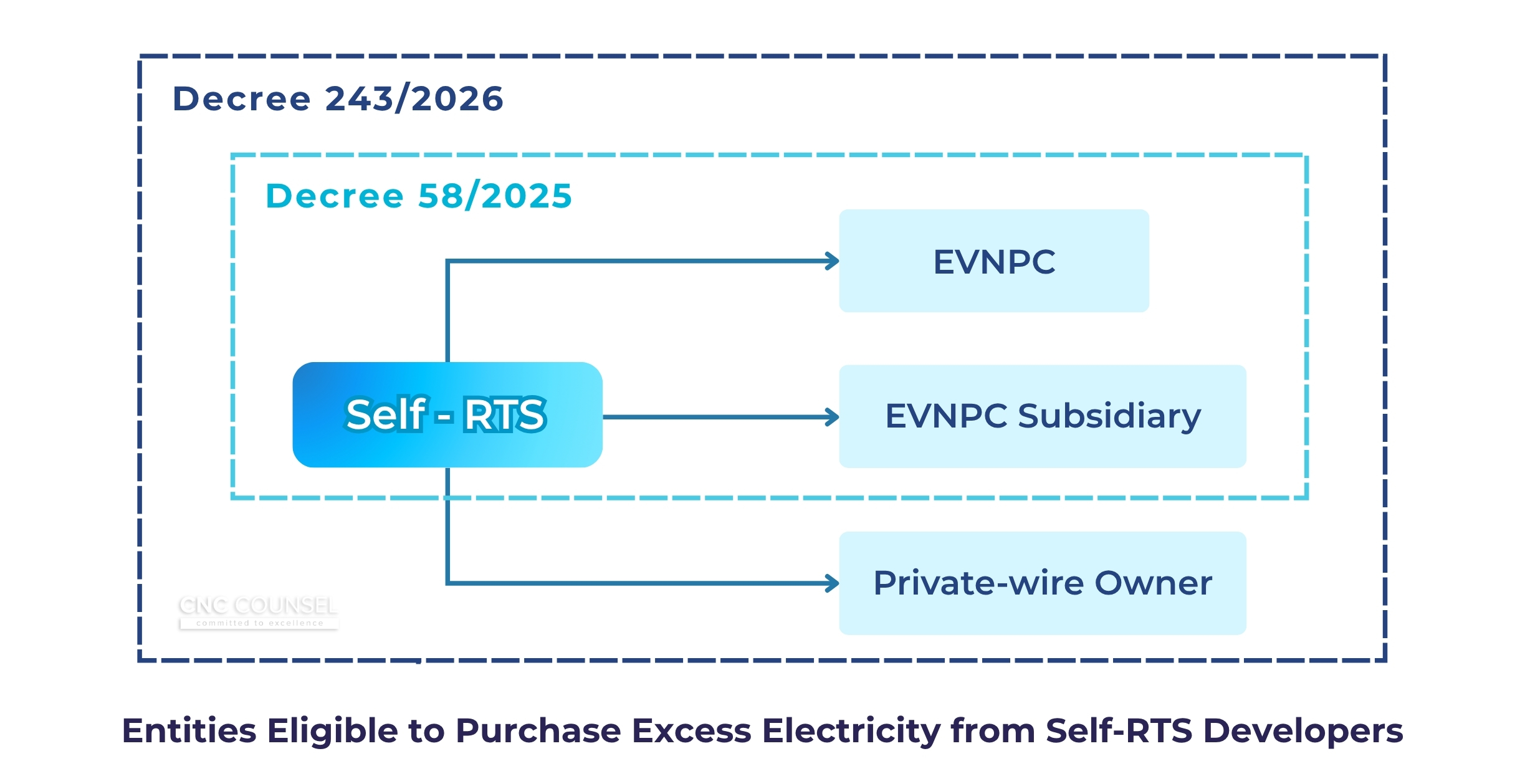
Decree 58/2025 only permits entities that develop self-production-and-self-consumption rooftop solar systems (“Self-RTS Developer”) to sell excess electricity to EVNPC/EVNPC Subsidiaries.[11]
However, Decree No. 243/2026/ND-CP expands the range of eligible purchasers by permitting private-wire owners to purchase excess electricity generated by self-RTS developers.[12]
These amendments are expected to facilitate the sale of excess electricity by self-RTS developers.
Increase in the Maximum Excess Electricity Output that Self-RTS Developers Are Permitted to Sell
Similar to RE GENCOs under the Physical DPPA regime, Decree 243/2026 permits self-RTS developers to sell excess electricity output which does not exceed 50% of the actual electricity generated, as determined based on solar radiation intensity.[13] This represents a significant increase from the 20% cap prescribed under Decree 58/2025.[14]
Furthermore, self-RTS developers are also permitted to sell excess electricity output exceeding 50% cap until 31 December 2030, in case (1) such developers and purchasers agree so and (2) the power grid in the relevant connection area has sufficient capacity to receive the additional output.[15]
Requirement to Install a Zero-Export System for Self-RTS Developers
There is no provision on Zero-Export System in Decree 58/2025.
Under Decree 243/2026, self-RTS developers are required to install Zero-Export connecting to the national grid, in case (1) their RTS systems are connected to the national grid at the medium-voltage level (from 01 kV to 35 kV) and (2) such developers shall not sell excess electricity output.
The Zero-Export system shall normally be operated in the off mode and shall be switched to the on mode upon the request of the competent authority.[16]
Streamlining Notification/Registration Procedures for Rooftop Solar Power Development by Self-RTS Developers
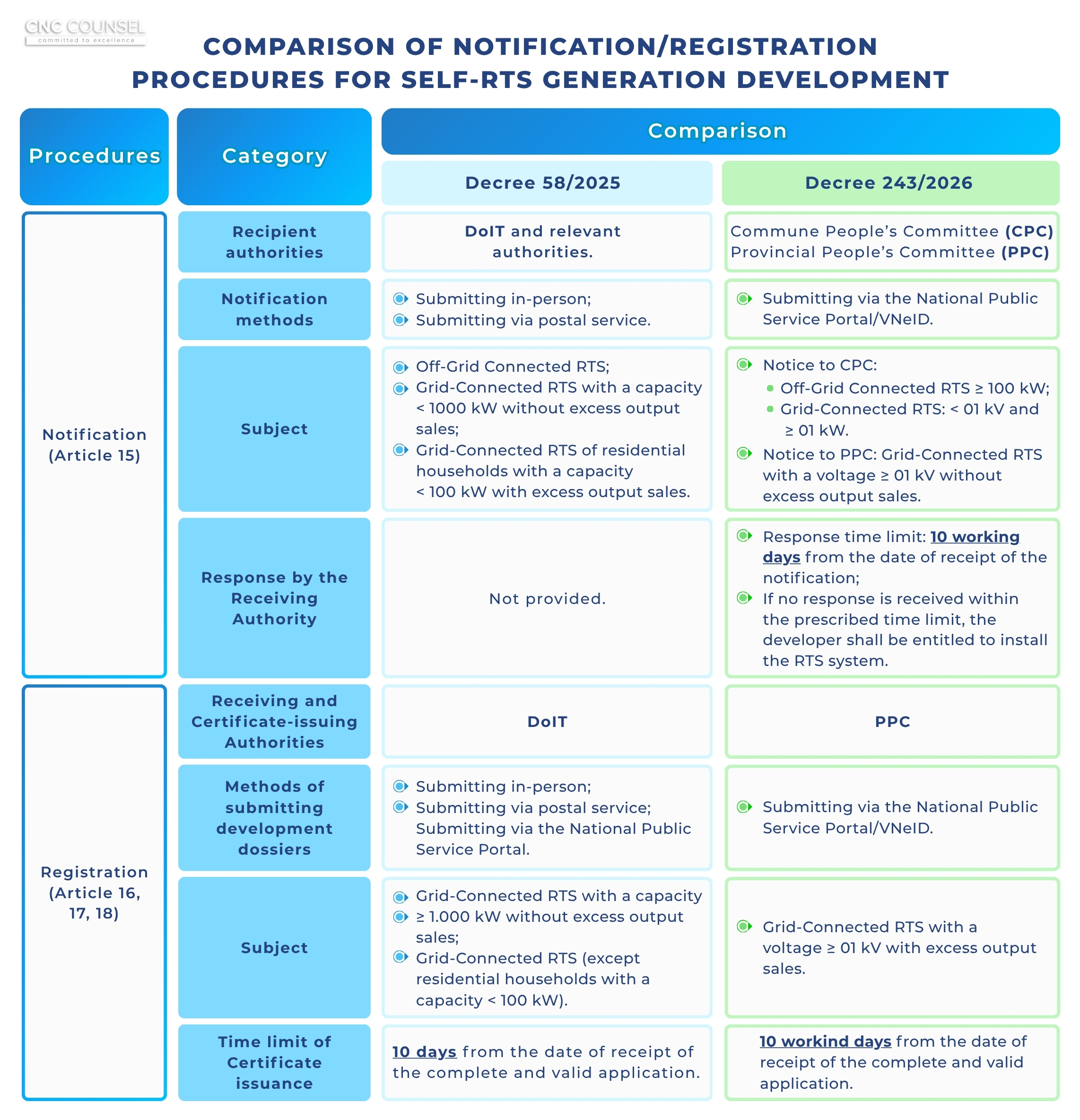
Under Decree 58/2025, self-RTS developers are required to notify or register with the Department of Industry and Trade (“DoIT”) for rooftop solar power development.
Turning to Decree 243/2026, however, these administrative procedures have been transferred to the Provincial People’s Committee (“PPC”) or the Commune People’s Committee (“CPC”), depending on the category of the developer.[17]
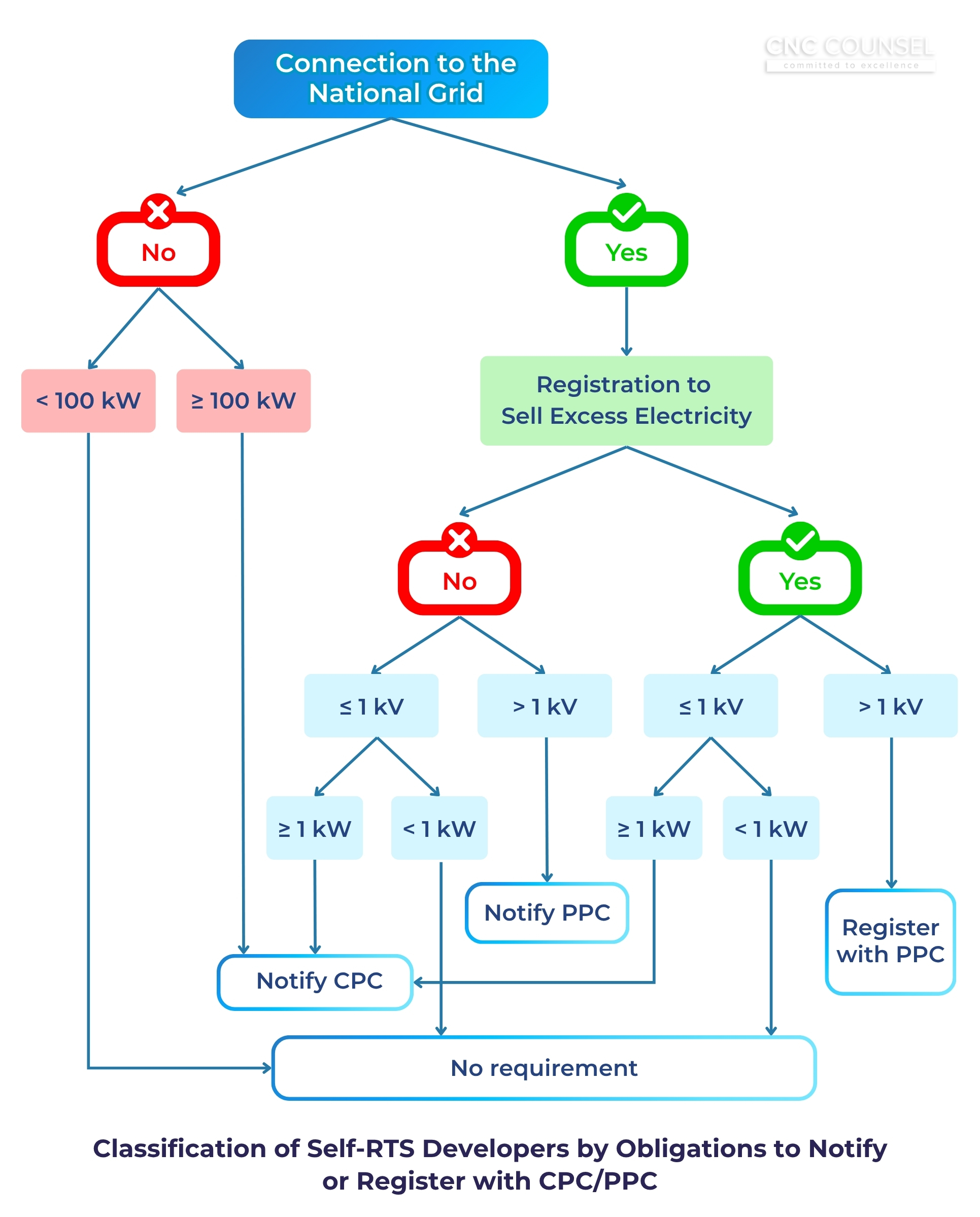
Accordingly, self-RTS developers shall notify:[18]
- CPC: if developing off-grid RTS systems with a capacity of at least 100 kW; or Low-voltage grid-connected RTS systems;
- PPC: if developing grid-connected RTS systems with a capacity of at least 01 kW and a connection voltage of at least 1 kV.
In addition, self-RTS developers are required to register the development of their self-RTS systems with PPC if they (i) develop self-RTS systems connected at the medium-voltage level or above, and (ii) register to sell excess electricity.
Written by
 |
Partner I Tran Pham Hoang Tung
Phone: (84) 901 334 192 Email: tung.tran@cnccounsel.com |
 |
Associate I Pham Nguyen Tan Trung
Phone: (84) 028 6276 9900 Email: trung.pham@cnccounsel.com |
Contact Us
For further information, please contact:
CNC Vietnam Law Firm
Address: The Rise Building, 2A1 Nguyen Thi Minh Khai, Sai Gon Ward, Ho Chi Minh City, Vietnam
Phone: (84) 28-6276 9900
Hotline: (84) 916-545-618
Email: contact@cnccounsel.com
Website: cnccounsel
We would be delighted to welcome you at CNC’s office, where you’ll have the opportunity to consult with the lawyer best suited to your circumstances. Of course, if you are unable to meet in person, simply email us via contact@cnccounsel.com or call us via (+84-28) 6276 9900.
It would be a pleasure for CNC’s lawyers to help you build a solid legal foundation, thus ensuring the success and sustainable development of your project!
Disclaimers:
This article has been prepared and published for the purpose of introducing or informing our Clients and potential clients on information pertaining to legal issues, opinions and/or developments in Vietnam. Information presented in this article does not constitute legal advice of any form and may be adjusted without advance notice.
———————————————————
[1] Article 2 and 3.10 Decree 57/2025.
[2] Article 2.2(c) Decree 57/2025.
[3] Article 1.2 Decree 243/2026.
[4] Article 1.4 Decree 243/2026.
[5] Article 6.3 Decree 57/2025 and Article 1.6(d) Decree 243/2026.
[6] Article 2.2(b) Decree 57/2025.
[7] Article 1.2(b) Decree 243/2026.
[8] Article 5.1 Decree 57/2025.
[9] Article 3.11 Decree 61/2025.
[10] Article 1.8 Decree 243/2026.
[11] Article 3.2 Decree 58/2025.
[12] Article 2.1 Decree 243/2026.
[13] Article 2.8 Decree 243/2026.
[14] Article 14.2 Decree 58/2025.
[15] Article 2.8 Decree 243/2026.
[16] Article 2.4(b) Decree 243/2026.
[17] Article 2.9 Decree 243/2026.
[18] Article 2.10 Decree 243/2026.