




Deposits dispute in Vietnam: Key developments effective 15 october 2026
“Deposits in civil and real estate transactions” are commonly used to secure the conclusion or performance of a contract. Effective from 15 October 2026, Resolution No. 03/2026/NQ-HDTP of the Judicial Council of the Supreme People’s Court provides guidance on the application of certain legal provisions governing deposit disputes. When a transaction collapses, disputes may extend beyond the return or forfeiture of the deposit to issues concerning the validity and purpose of the deposit agreement, the reasons why the main contract was not concluded or performed, the parties’ respective fault, and the remedies available.
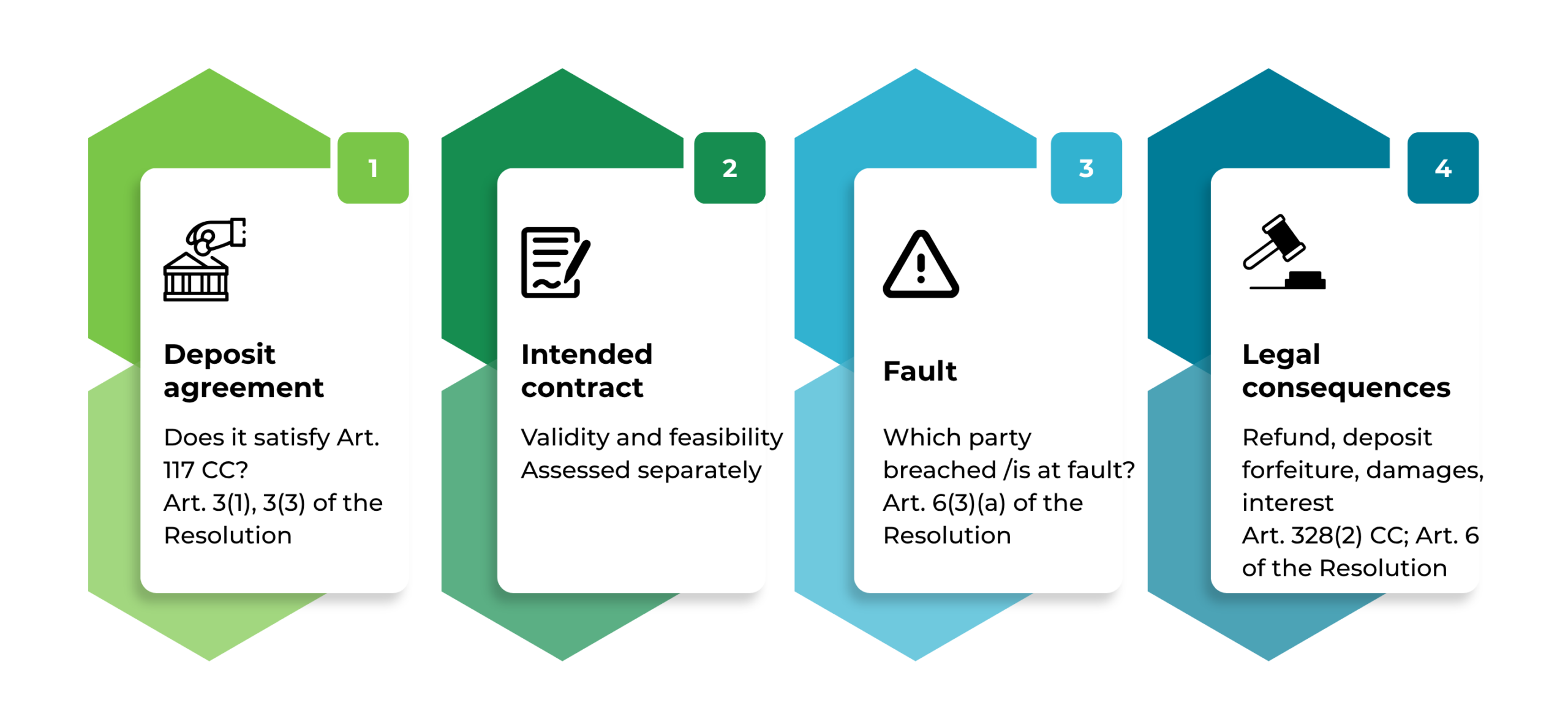
The central lesson is to distinguish: (i) the validity of the deposit agreement; (ii) the validity and feasibility of the contemplated main contract; (iii) which party breached an obligation or was at fault for the transaction’s failure; and (iv) the resulting remedies, including return of the deposit, deposit forfeiture or double repayment, damages and default interest. It should not automatically be inferred that a deposit agreement is invalid merely because the contemplated sale contract is not yet legally feasible, or that expiry of the deadline automatically triggers a deposit penalty.
1. Validity of the deposit agreement: Distinct from the main contract
Under Article 328 of the 2015 Civil Code, a deposit involves one party delivering money, precious metals, gemstones or another valuable asset to the other for a period of time to secure the conclusion or performance of a contract. In real estate transactions, a deposit may be paid before the recipient completes title registration or before all transfer conditions have been satisfied.. Specifically, Article 3.1 provides that a deposit agreement is legally valid where it satisfies the requirements set out in Article 117 of the Civil Code. Article 3.3 further clarifies that a deposit agreement intended to secure the conclusion of a contract may remain valid if those requirements are satisfied, even where the contemplated contract would have been invalid had it been concluded at the time the deposit was made. This does not legalize an unlawful transfer or itself give the deposit recipient the right to transfer the property.
Example 1 – The deposit recipient is not yet registered as the land user
Issue: A accepts a deposit from B for a land transfer, although the land is not yet registered in A’s name. A promises to complete the formalities within a specified period but fails to do so. Is the deposit agreement automatically invalid, and must A pay a deposit penalty?
Analysis: The deposit agreement’s validity must be assessed under Article 117 of the Civil Code and Article 3 of the Resolution. The consequences of the deposit must be considered separately under Article 328 of the Civil Code and Article 6 of the Resolution No. 03/2026, including the role of fault. The Party A’s lack of registered title does not automatically invalidate a separate deposit agreement that satisfies the statutory validity requirements. However, if A undertook to complete the formalities and failed for reasons attributable to A, that may support a finding of fault. If completion was prevented by an objective obstacle or fault on both sides, the relevant exceptions and evidence must be examined. If the property is jointly owned, the authority to dispose of it and any required consent must also be considered. The approach reflected in Article 3.3 of Resolution 03/2026, helps prevent automatic invalidation merely because the recipient is not yet the registered owner. It does not immunize the recipient from liability or dispense with the transfer-eligibility review.
Example 2 – Unclear price or land area
Issue: A and B enter into a deposit agreement for a land transfer but leave the price, area or other material terms unclear. One party later refuses to sign the main contract and argues that the deposit agreement is invalid because of the ambiguity.
Analysis: Article 3(2) of the Resolution No. 03/2026, as described in the materials discussed, indicates that ambiguity preventing the main contract from being concluded or performed does not automatically invalidate the deposit agreement if it satisfies Article 117 of the Civil Code. The court should distinguish unresolved terms of the main contract from defects affecting the validity of the deposit agreement itself. It should review the written agreement, pre- and post-contract communications, related documents and each party’s specific undertakings. If the parties’ commitments cannot be identified, attributing fault will be difficult; nevertheless, a party should not automatically be allowed to rely on ambiguity it created to escape responsibility. Missing information does not automatically invalidate the deposit agreement. The outcome depends on its substance, the statutory validity requirements and evidence of fault.
2. Fault, objective obstacles and deposit penalties
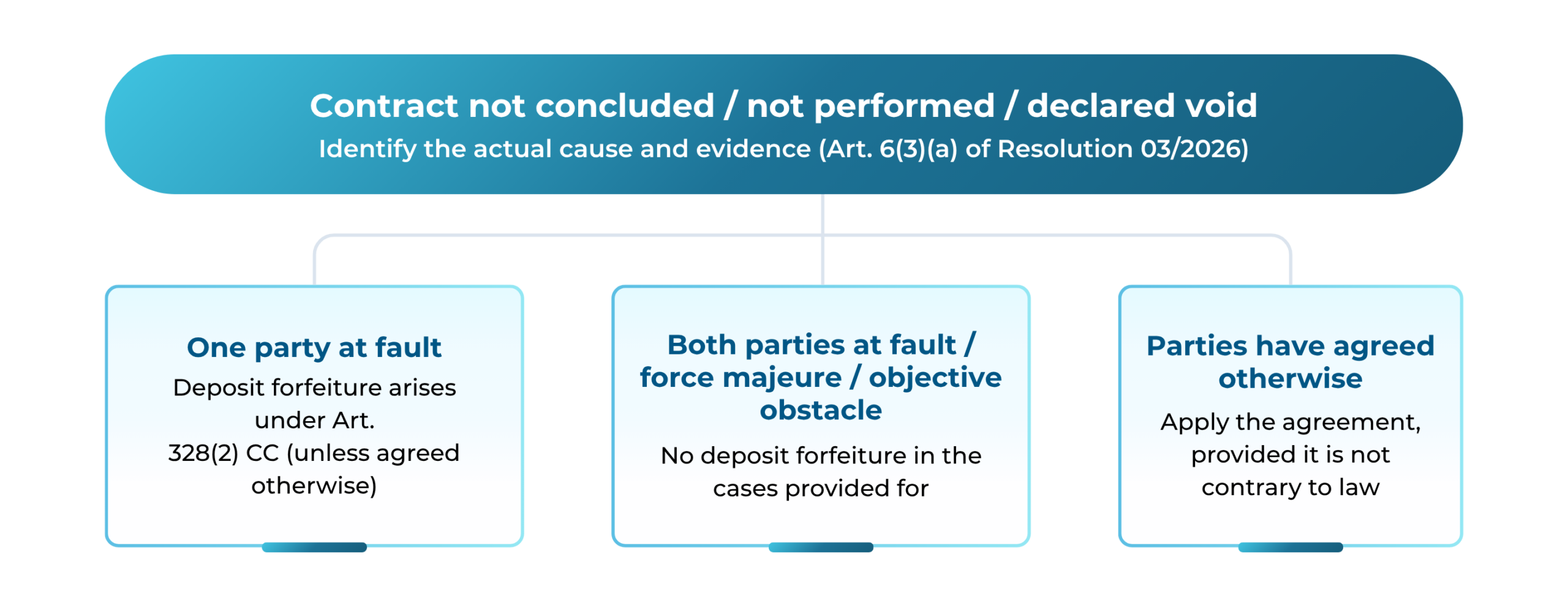
Point (a), Clause 3, Article 6 of the Resolution No. 03/2026,, focuses on fault that causes the contract not to be concluded, not to be performed or to be invalid. If one party is at fault, a deposit penalty may arise [1] , subject to any different agreement and applicable exceptions. Where both parties are at fault, or performance is prevented by force majeure or an objective obstacle, the Resolution directs that no deposit penalty be imposed. Expiry of the deadline is therefore not the sole test; the actual cause and supporting evidence must be examined.
Example 3 – Delay in issuance of the Land Use Rights Certificate (pink-book) by a state authority
Issue: B receives a deposit and undertakes to complete the certificate formalities within three months. B submits a complete application on time, but the authority has not processed it by the deadline. Must B pay a deposit penalty?
Analysis: Article 6(3)(a) of the Resolution No. 03/2026 deposit penalties are excluded due to force majeure events or objective impediments.
The guidance also refers to a delay in issuance despite the recipient having duly submitted the application. If B proves that the application was valid and timely, that B performed all obligations within B’s control, and that the delay was genuinely attributable to the competent authority, B may argue that a deposit penalty should not apply. Conversely, if the application was incomplete, B failed to supplement it, outstanding financial obligations remained, or B’s conduct delayed the process, reliance on the authority may fail. Not every administrative delay automatically constitutes an objective obstacle. The Resolution No. 03/2026 provides a clearer test but does not automatically excuse the recipient. Evidence of causation and the recipient’s diligence is critical.
Example 4 – The buyer changes their mind or the seller cannot transfer the property
Issue: After a deposit is paid, one party refuses to proceed. The seller says the buyer must forfeit the deposit; the buyer argues that the property is not legally transferable. Who bears the consequences?
Analysis: Article 328(2) of the Civil Code and Article 6.1 of the Resolution sets out the basic consequences of refusing to conclude or perform the contract, unless the parties agree otherwise. Point (a), Clause 3, Article 6 of the Resolution requires an assessment of fault and addresses cases of mutual fault or objective obstacles under the specified guidance. If the seller has met the agreed obligations and the buyer unjustifiably withdraws, the buyer may forfeit the deposit. If the seller undertook to complete legal formalities but failed for reasons attributable to the seller, the seller may have to return the deposit and pay the applicable penalty. If both parties knew of the legal obstacle but did not agree on an alternative, the court should examine the contractual commitments, disclosures, cooperation duties and evidence of demands for performance. The fact that one party announced withdrawal first does not, by itself, determine fault. The court must identify the obligations, actual cause and fault, rather than simply asking which party declared the transaction off first.
3. Once the main contract is signed: Scope of the deposit clause
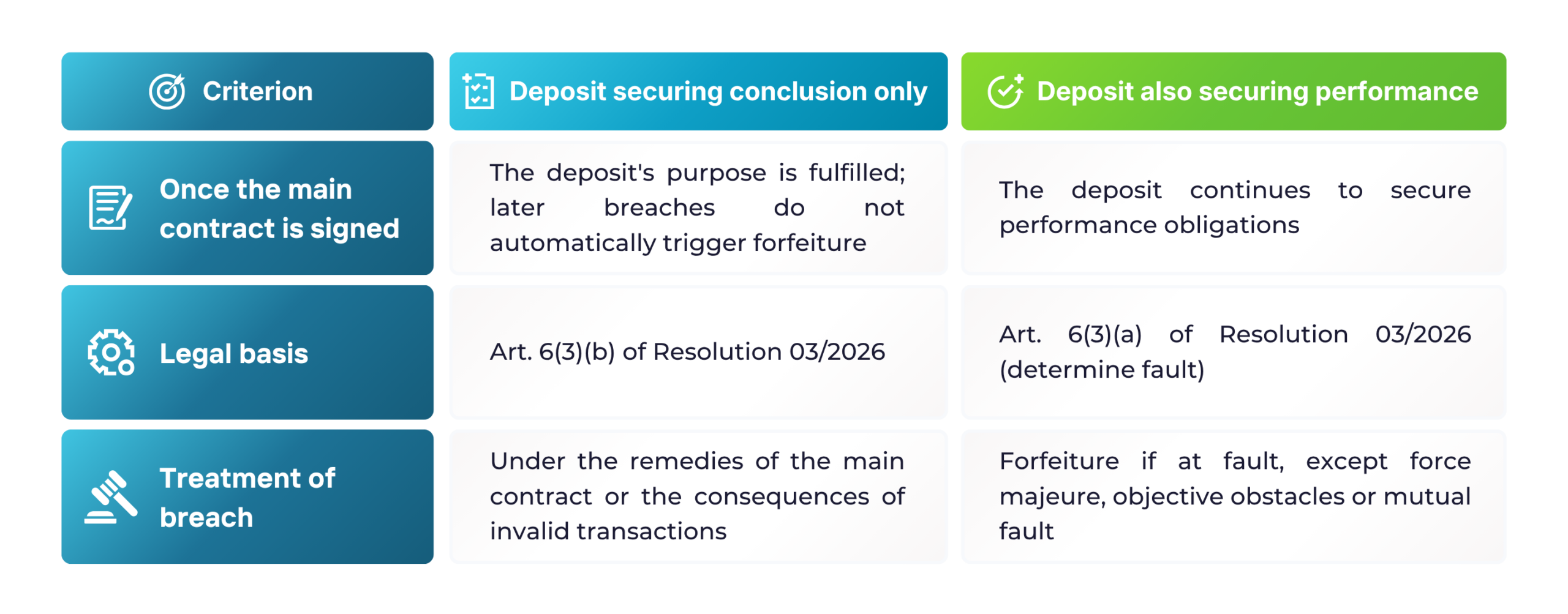
Article 6(3)(b), distinguishes a deposit intended solely to secure the conclusion of the contract from one intended to secure both conclusion and performance. Where the deposit secures both the conclusion and performance of a contract, the application of deposit penalties must be considered under Point (a), Clause 3, Article 6 of the Resolution. If the sole purpose was to secure signing, once the main contract has been signed, a later performance breach or discovery that the contract is invalid does not automatically trigger the original deposit penalty. The dispute must instead be assessed under the rules governing breach of the main contract or the consequences of an invalid transaction.
Example 5 – The transfer contract is notarized, but a party fails to perform
Issue: A pays a deposit to secure the signing of a real estate transfer contract. The parties execute a notarized contract, but B later fails to hand over the property or A fails to pay the balance. The non-breaching party seeks a penalty under the original deposit agreement.
Analysis: If the deposit was intended only to secure conclusion, and the parties have not otherwise agreed on the treatment of the deposit, Point (b), Clause 3, Article 6 of the Resolution No. 03/2026 does not automatically permit the deposit penalty for a breach occurring after the main contract has been signed. If the deposit also secures performance, the clause’s scope and relevant rules must be examined and fault must be determined in accordance with Point (a), Clause 3, Article 6. The court should interpret the purpose and wording of the deposit agreement. If its purpose was fulfilled upon notarization, the injured party may need to rely on remedies under the main contract, a claim for performance, damages or the rules on invalid transactions. The analysis may differ if the clause expressly states that the deposit secures performance as well. Stating the purpose of the deposit is critical; the deposit should not be assumed to be a universal penalty for every subsequent breach.
4. Deposit penalties, damages, contractual penalties and interest
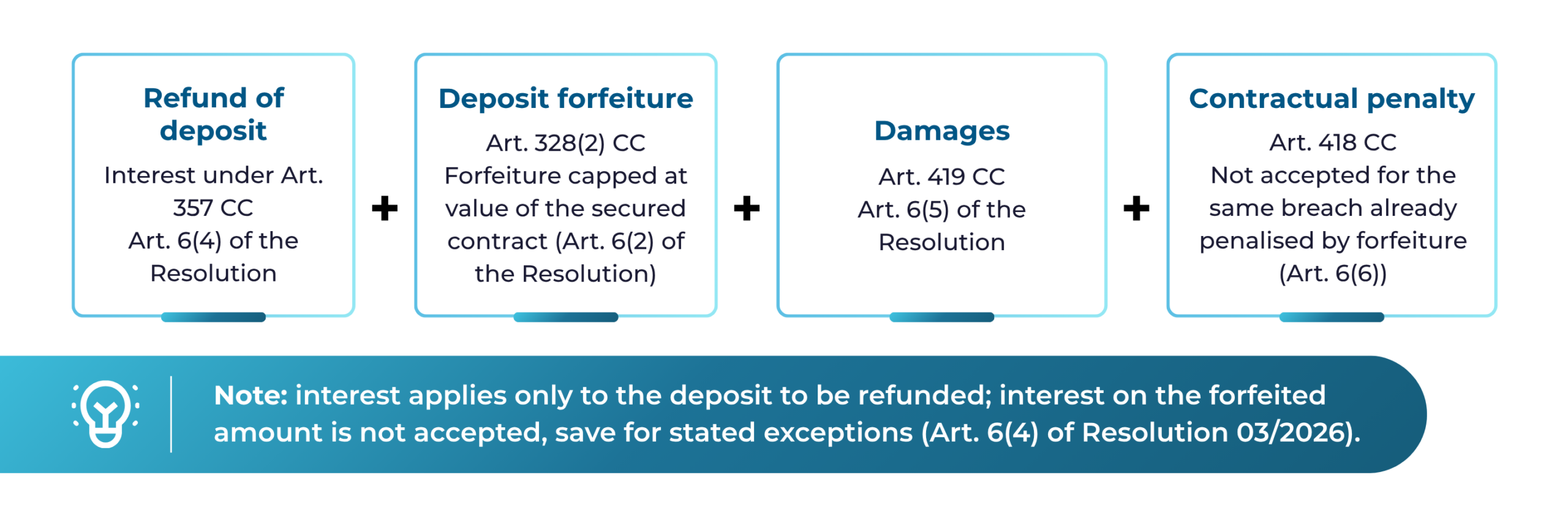
Under Article 6.2 of the Resolution No. 03/2026 as discussed, where the parties have not agreed otherwise, the court may accept both a deposit penalty and damages under Article 419 of the Civil Code. However, where the parties stipulate that the same breach attracts both a deposit penalty and a contractual penalty under Article 418, the guidance described provides for acceptance of the deposit penalty but rejection of the contractual-penalty claim in that situation. The Resolution also distinguishes interest on a deposit that must be returned from interest on the deposit penalty: interest on the refundable deposit is considered under Article 357 and begins on the day following the date the repayment obligation arises; interest on the deposit penalty is not accepted except as provided by the stated exceptions.
Example 6 – Can the claimant seek a deposit penalty, damages and default interest together?
Issue: A pays a VND 500 million deposit. B is at fault for the main contract not being concluded. A seeks repayment of VND 500 million, an additional VND 500 million deposit penalty, compensation for expenses and interest for delayed repayment.
Analysis: Article 6(5) of the Resolution allows the court to consider both a deposit penalty and damages[2] where the parties have not agreed otherwise. Article 6(4) addresses interest on a refundable deposit under Article 357 of the Civil Code, but does not automatically allow interest on the deposit penalty. A should separate the claims: (i) repayment of the deposit; (ii) the deposit penalty; (iii) damages; and (iv) default interest on the amount due for repayment. A must prove the legal basis, actual loss and causation for damages. For interest, the date on which the repayment obligation arose and the period of delay must be established. Not every self-reported expense is automatically recoverable. A deposit penalty and damages may both be awarded, but each has its own legal basis and evidentiary requirements. Penalties, damages and interest should not be aggregated without checking the applicable rules.
5. Deposit assets, third-party effectiveness and third-party rights
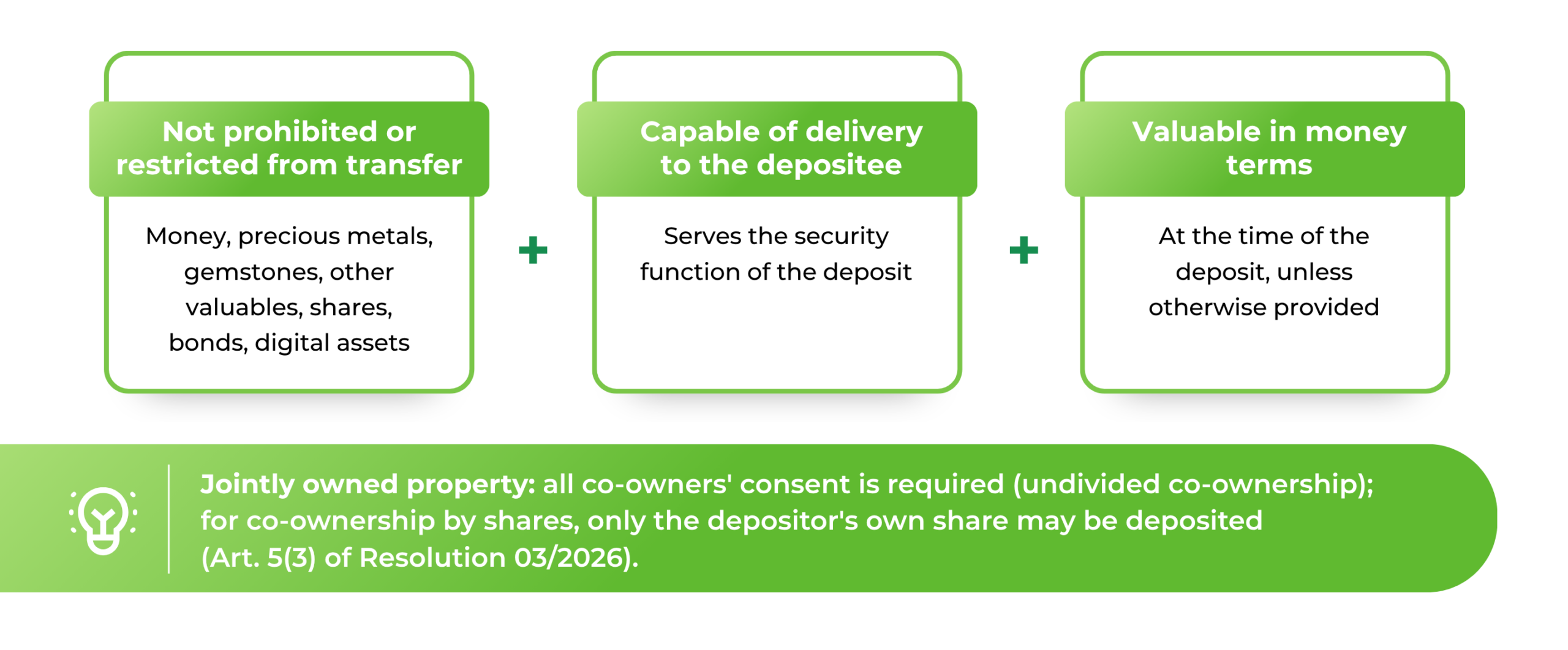
Article 5 of the Resolution clarifies that a deposit asset need not be cash; it may include precious metals, gemstones, other valuable items and identified assets such as shares, bonds or digital assets, provided legal requirements are met. The asset must not be prohibited or restricted from trading, must be capable of being delivered to the recipient, and must have a monetary value ascertainable at the time of deposit, unless otherwise provided by law. For jointly owned assets, Article 5.3 requires the consent of co-owners where property under joint ownership without divided shares is used as a deposit, unless otherwise provided by law or agreed by the parties. In the case of joint ownership with divided shares, a depositor may only provide as a deposit the portion of the property falling within that depositor’s ownership rights.. Article 4 of the Resolution is described as addressing effectiveness against third parties and priority of payment where an asset relates to multiple secured obligations.
Example 7 – A non-cash deposit asset is also used to secure a loan
Issue: A delivers a vintage car valued at VND 3 billion to B as a deposit securing the transfer of Party B’s land parcel valued at VND 2 billion, with an agreed deposit penalty of VND 1 billion.
Subsequently, Party B consents to Party A using the automobile as collateral for a VND 1 billion bank loan. When the transaction fails, B seeks priority in recovering the deposit penalty from the car’s value.
Analysis: Under Articles 4 and 5 of the Resolution, the analysis must address the deposit’s effectiveness against third parties, rights to recover the asset and priority under Article 308 of the Civil Code and relevant legislation. Under Article 4.1 of Resolution 03/2026, third-party enforceability of a deposit arrangement is governed by the law on secured transactions, including through possession of the secured asset. If the deposit arrangement becomes enforceable before a subsequent mortgage, the deposit recipient has priority in recovering the deposit penalty under Point (a), Clause 1, Article 308 of the Civil Code. The deposit asset must satisfy legal requirements and be sufficiently described and valued. B should prove when the asset was delivered, the deposit terms, possession, disclosures made to the bank and any relevant registration steps. The bank’s knowledge is relevant, however, payment priority must be determined under the applicable legal provisions, particularly the order in which the respective security interests became enforceable against third parties, together with the relevant documentary evidence.. Any joint ownership or restriction on disposal must also be checked. The Resolution provides a clearer framework for non-cash deposit assets, but third-party rights depend on the requirements for creation, the time effectiveness against third parties arose, and the applicable priority rules.
6. Court jurisdiction and limitation periods
Article 7 of the Resolution as described in the materials discussed, guides territorial jurisdiction for deposit disputes involving real estate and, for notarized deposit agreements, distinguishes a claim solely seeking invalidation of a notarized document from a case that also disputes the deposit agreement. Article 8 of the Resolution distinguishes limitation periods for deposit penalties, damages or other contractual claims under Article 429 of the Civil Code; claims to invalidate a transaction under Article 132 of the Civil Code; and claims to recover the deposited asset, for which the limitation period under Article 155(2) of the Civil Code.
Example 8 – Seeking return of a deposit after several years
Issue: A pays a deposit to B, but the transaction is not completed. Years later, A sues for repayment; B argues that the limitation period has expired.
Analysis: Article 8 of the Resolution distinguishes a claim to recover the deposited asset from claims for a deposit penalty, damages or invalidation of the transaction. The latter claims must be assessed under their respective limitation rules. If the claim is substantively for recovery of the deposited asset, the court shall not apply a limitation period pursuant to Article 8.2 of the Resolution. If A also seeks a deposit penalty or damages for breach, limitation under Article 429 of the Civil Code must be assessed separately. If A seeks invalidation, the grounds and Article 132 of the Civil Code must be considered. Classification of the claim may therefore determine the response to a limitation defence. A single limitation period should not be applied to every deposit-related claim. The claimant should identify the legal nature of each claim and prepare the corresponding evidence.
7. Comparison with some popular kind of disputes happened before the Resolution’s effective date
Dispute involving land not yet registered in the recipient’s name and classification of payments. An article of Vietnam Court Journal describes a deposit for the transfer of two land plots where the recipient had not completed the transfer from the former landholder. The dispute also concerned whether a later payment was a deposit or an advance against the purchase price, and whether spousal property rights were implicated. Under virtue of the Resolution No. 03/2026, the absence of registered title does not automatically invalidate the deposit agreement; however, each payment must be classified and authority to dispose of the property and fault must still be proven.
Dispute involving a portion of land that may not qualify for subdivision. Another disputed circumstance in the discussion describes a VND 500 million deposit for 150 square metres out of a 300-square-metre plot, where the property was mortgaged to the bank and the proposed subdivided area might fall below the local minimum. Under virtue of the Resolution No. 03/2026, the deposit agreement is not automatically invalid merely because the main contract faces an obstacle, but the Resolution does not dispense with subdivision requirements. The key issues remain the contractual commitments, the parties’ knowledge, fault and evidence.
Dispute involving delayed formalities. Another judgment records the recipient’s argument that the land registration authority delayed returning the file, while the court assessed the actual cause as attributable to the recipient. Under virtue of the Resolution, a party relying on an objective obstacle should prove that the application was complete and timely and that the delay was not caused by its own fault.
8. Practical recommendations for buyers, sellers and counsel involved into real-estate business in Vietnam
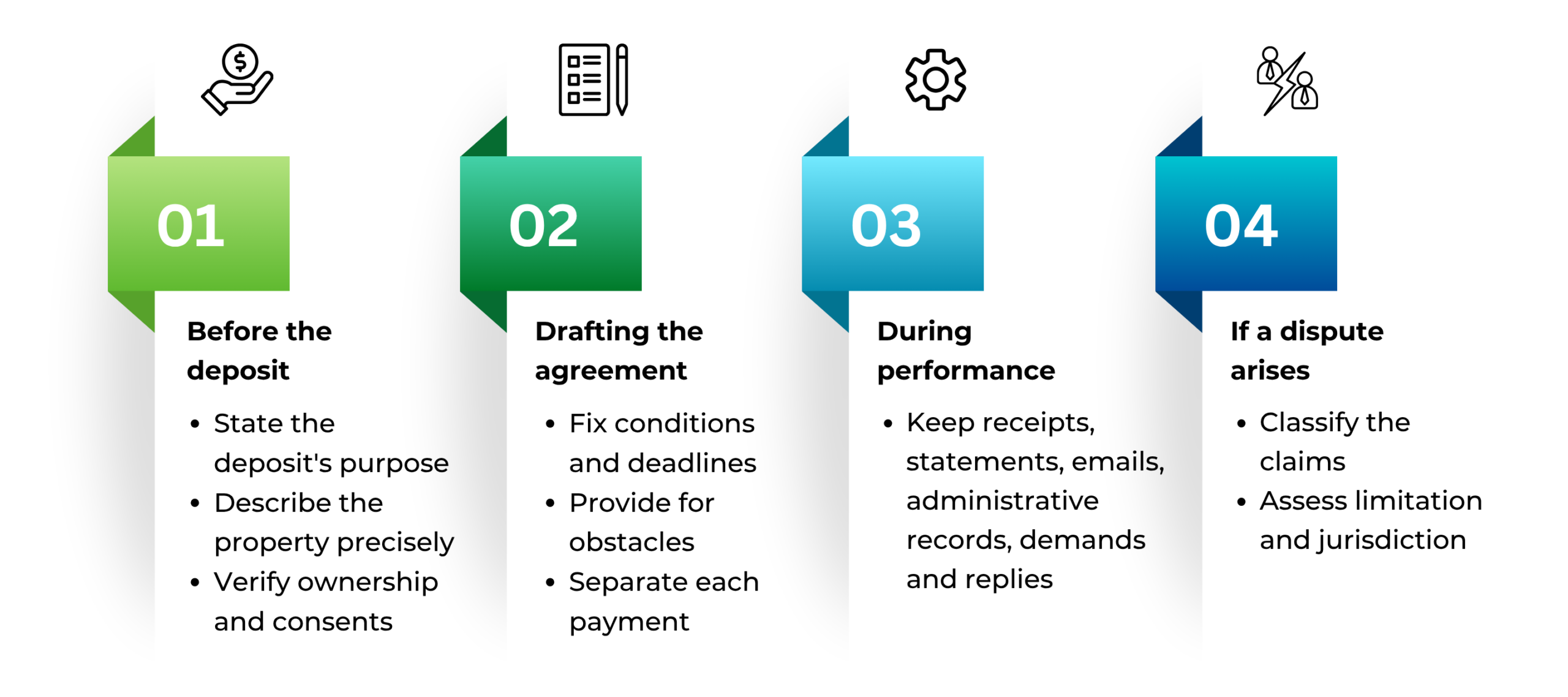
(i) State the purpose of the deposit: securing conclusion, performance, or both.
(ii) Identify the asset accurately: plot and map references, area, condition, registered owner, mortgages, disputes and restrictions on disposal.
(iii) Set conditions and deadlines: required filings, the responsible party, cure periods and the date for signing the main contract.
(iv) Address obstacles expressly: extensions, termination, refund of the deposit or non-application of a penalty; specify notice and evidence requirements.
(v) Separate the monetary components: deposit, advance payment, deposit penalty, contractual penalty, damages and interest.
(vi) Verify ownership and consent: particularly for marital property, co-owned assets and secured property.
(vii) Preserve evidence: receipts, bank records, emails, messages, administrative filings, demands for performance and responses.
(viii) (Classify claims before litigation: recovery of the asset, deposit penalty, damages or invalidation; then assess limitation and jurisdiction.
9. Conclusion
Resolution No. 03/2026/NQ-HDTP, as described in the materials discussed, seeks to promote consistent resolution of deposit disputes by clarifying the validity of the deposit agreement, fault, objective obstacles and legal consequences. Its principal practical value is to support a more structured analysis by courts and parties, rather than automatic conclusions based solely on the failure to conclude or perform the main contract.
For real estate transactions, an effective deposit agreement should do more than state the amount and signing date. It should accurately identify the property, specify legal conditions, allocate responsibilities, set verifiable deadlines and clearly prescribe what happens if the transaction does not proceed as expected. The Resolution may resolve certain inconsistencies in practice, but it does not replace careful drafting, evidence preservation and case-specific legal analysis.
What We Can Support?

- Inbound/Outbound Investment: Company Establishment, Investment Registration and Post-registration Services in relation to tax, accounting, labor, insurance, salary, and outsourced legal department;
- Operation Licenses: We could provide support in the application for operation licenses for business activities in fields such as manufacturing, commerce, services, e-commerce, healthcare, education, or food & beverage (restaurants);
- M&A Services: Conduct legal due diligence, structure transactions, draft and negotiate transaction documents, provide advice on competition law compliance (including merger control filings and related approvals), obtain necessary regulatory approvals and licenses, and provide post-closing support;
- Personal Data Protection: Provide support in compliance with the data protection regulations, including the drafting and reviewing of Data Protection Impact Assessment (DPIAs), Data Processing/Transfer Agreement, Privacy Policies, and other necessary documents under the Personal Data Protection Decree (PDPD);
- Dispute Resolution: Litigation and Commercial Arbitration (VIAC SIAC ICC); and
- Legal Retainer Services per the clients’ requests.
Please contact Mr. Chris Luong – Partner through the email address of chris.luong@cnccounsel.com through the email address for prompt and timely support.
Managed by
 |
Luong Van Chuong I Partner
Phone: (84) 938 04 7969 Email: chris.luong@cnccounsel.com |
 |
Le Nguyen Khanh Linh I Legal Intern
Phone: (84) 28 6276-9900 |
Contact Us
CNC Vietnam Law Firm
Address: The Rise Building, 2A1 Nguyen Thi Minh Khai, Sai Gon Ward, Ho Chi Minh City, Vietnam
Phone: (84) 28-6276 9900 – 081 235 3839
Hotline: (84) 916-545-618
Email: contact@cnccounsel.com
Website: cnccounsel
We would be delighted to welcome you at CNC’s office, where you’ll have the opportunity to consult with the lawyer best suited to your circumstances. Of course, if you are unable to meet in person, simply email us via contact@cnccounsel.com or call us via (+84-28) 6276 9900.
It would be a pleasure for CNC’s lawyers to help you build a solid legal foundation, thus ensuring the success and sustainable development of your project!
————————————
Copyright © CNC Counsel. All rights reserved.
Ownership Rights: This document and the content contained herein (Document) are proprietary resources exclusively owned by CNC Counsel. Access to or use of this Document does not, by itself, create any contractual relationship or lawyer-client relationship between CNC Counsel and any person or entity.
Disclaimer: All Documents are provided solely for informational purposes and may not reflect the most current legal developments. Summaries of laws, regulations, and practices are subject to change. This Document is not intended to constitute legal, professional, or other advice with respect to any specific matter. Nor is it intended to substitute for reference to, or compliance with, the detailed provisions of any applicable law, regulation, rule, or official form. Readers are strongly encouraged to seek independent legal advice before taking, or refraining from taking, any action based on the information contained in this Document. CNC Counsel, together with its editors and authors, makes no representations or warranties as to the accuracy, completeness, or currency of the Document and disclaims all liability to any person or entity arising from reliance on all or any part of the Document. This Document may contain links to external websites, and external websites may contain links to this Document. CNC Counsel is not responsible for the content, operation, availability, or practices of any such external websites and expressly disclaims any liability in connection therewith. Note: Past results do not guarantee similar outcomes in future matters. Each matter is unique and must be assessed based on its own facts and circumstances.
[1] Article 328 of the Civil Code.
[2] Article 419 of the Civil Code.