



Fundamental Changes of Circumstances in Construction Contracts
Practical Perspectives from Legal, Contract Management and Cost Consultancy
In the first months of 2026, the Vietnamese construction market has been experiencing an unprecedented period of volatility.
From geopolitical tensions and military conflicts in the Middle East, supply chain disruptions, and escalating fuel prices, to mounting pressure from public investment disbursement and infrastructure demand, all of these factors are creating cascading impacts directly affecting the costs and schedules of construction projects.
Diesel prices have surged. Steel, cement, asphalt, and construction input materials continue to fluctuate. Logistics and transportation costs have increased significantly. Commercial assumptions once considered “reasonable” at the tender stage are no longer valid.
What is particularly notable is that: most projects are not “impossible to perform”..
Construction works may still proceed. Projects may still be completed. However:
- actual costs have significantly exceeded the original budget;
- project schedules have become increasingly difficult to maintain;
- and the commercial equilibrium of contracts is being severely disrupted.
Against this backdrop, the issue of fundamental changes of circumstances in construction contracts has become one of the most discussed topics among:
- Employers;
- Contractors;
- Contract Managers;
- Commercial Teams;
- Consultants;
- and construction law practitioners.
When “ordinary commercial risk” is no longer ordinary
In practice, many businesses are currently facing difficult questions:
- Does the increase in material prices constitute force majeure?
- Can Article 420 of the 2015 Civil Code be applied?
- Are contractors entitled to request contract adjustments?
- How should employers respond while protecting both budget and project progress?
- What supporting documents are required for a cost escalation claim?
- If no agreement is reached, where will disputes ultimately lead?
These are no longer merely academic questions. They are practical issues arising daily across:
- infrastructure projects;
- EPC projects;
- energy developments;
- airport projects;
- transportation works;
- public investment projects;
- and large-scale construction developments.
In Official Letter No. 5026/BXD-KTQLXD dated 3 April 2026, the Ministry of Construction also acknowledged that, in many projects:
- actual costs have significantly deviated from tendered prices;
- original schedules are no longer feasible;
- and certain initial commercial assumptions underlying the contracts are no longer appropriate.
Following this, various directives, resolutions, and governmental instructions have continuously been issued to address difficulties relating to fuel prices, construction materials, and public investment progress.
In this context, understanding the true nature of:
- “Force Majeure”;
- “Fundamental Change of Circumstances”;
- and “commercial equilibrium of contracts”
has become more important than ever.
Is a Fundamental Change of Circumstances in Construction Contracts Truly Different from Force Majeure?
This is currently one of the most debated issues within the construction industry.
In reality, many businesses tend to:: “categorize every major disruption as force majeure”.
However, from a legal perspective, “Force Majeure” and “Fundamental Change of Circumstances” are two entirely different mechanisms.
While force majeure is generally associated with: situations where contractual performance becomes impossible, a fundamental change of circumstances in construction contracts relates to situations where:
- the contract may still be performed,
- but continuing performance under the original terms may seriously disrupt the commercial equilibrium between the parties.
This is precisely why Article 420 of the 2015 Civil Code is increasingly being invoked in:
- negotiations;
- cost escalation claims;
- dispute boards;
- and construction disputes.
Nevertheless, one of the biggest challenges today is that: many businesses are aware of Article 420, but do not yet fully understand how to apply it properly.
An Event That Goes Beyond Legal Theory — Focusing on How the Market Actually Operates
In response to these practical challenges, CNC, together with experts in:
- legal practice;
- contract management;
- and cost consultancy
is organizing the following seminar:
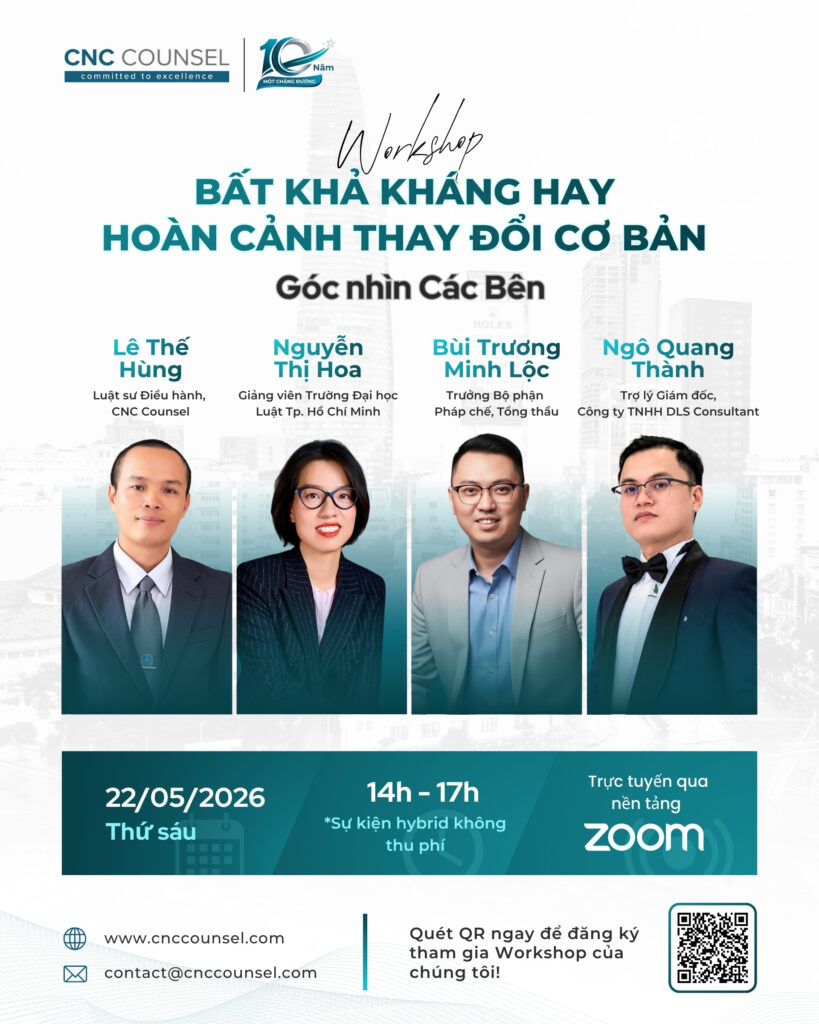
“Fundamental Changes of Circumstances in Construction Contracts – Practical Perspectives from Legal, Contract Management and Cost Consultancy”
What distinguishes this program is that: it is not merely a theoretical legal seminar.
Instead, the event is designed as a multidisciplinary practical forum where issues will be examined from:
- legal perspectives;
- project operation perspectives;
- claim and contract management perspectives;
- cost data perspectives;
- and commercial perspectives.
In other words: the program is not only about “legal provisions”, but about: what businesses should actually do when contractual equilibrium begins to collapse.
Practical Perspectives to Be Shared During the Program
Legal Perspective: How Should Article 420 Truly Be Understood?
Although Article 420 of the 2015 Civil Code has existed for nearly a decade, in practice:
- many businesses still confuse “Force Majeure” with “Fundamental Change of Circumstances”;
- or view Article 420 merely as a mechanism to “request price increases”.
In reality, the essence of Article 420 lies in: contract rebalancing.
This topic will be analyzed in depth during the seminar:
- When does cost escalation remain an ordinary commercial risk?
- When may it qualify as a fundamental change of circumstances?
- What are the actual conditions for application?
- Where does the burden of proof lie?
- Why do many claims fail despite substantial cost increases?
Contract Management Perspective: Why Do Many Claims Fail?
In project practice, the issue is often not:
“whether costs have increased.
Rather, it is:
“whether such impacts can be properly substantiated”.
Many contract adjustment requests encounter difficulties due to:
- lack of baseline data;
- insufficient market data;
- inability to prove actual impacts;
- inability to demonstrate mitigation efforts;
- or failure to establish the connection between market changes and disruption of contractual commercial equilibrium.
From a contract management and project operation perspective, the seminar will discuss:
- effective claim strategies;
- documentation logic;
- negotiation approaches;
- and practical lessons learned from contractors’ experiences.
Cost Consultancy Perspective: Data Is Becoming the Most Powerful Tool
One of the biggest changes in today’s market is that:
pricing data and market data are becoming decisive factors in contract adjustment request.
Participants will gain insights into:
- construction material price trends;
- the impact of fuel prices on construction costs;
- methods for assessing actual cost impacts;
- and how cost consultants evaluate the reasonableness of adjustment requests.
This is particularly important in a context where:
- auditors;
- employers;
- regulatory authorities;
- and dispute boards/arbitral tribunals
are requiring increasingly higher standards of proof.
Featured Speakers
TS. Nguyễn Thị Hoa là giảng viên Trường Đại học Luật Thành phố Hồ Chí Minh từ tháng 9/2019 trong đó bà giảng dạy và nghiên cứu chủ yếu về luật kinh doanh quốc tế, pháp luật giải quyết tranh chấp thương mại quốc tế ngoài toà án.
Từ 2010-8/2019, Bà Hoa cũng đã từng làm việc tại Sở Tư pháp Thành phố Hồ Chí Minh và công việc chủ yếu của Bà nổi bật liên quan đến tư vấn pháp lý đối với các lĩnh vực như: Pháp luật về hợp đồng, luật xây dựng, luật đầu tư, giải quyết tranh chấp quốc tế, thúc đẩy phát triển hoạt động trọng tài thương mại; công nhận và thi hành quyết định của cơ quan có thẩm quyền nước ngoài tại Việt Nam.
Bà Hoa cũng đã bảo vệ suất sắc Luận án tiến sĩ tại Trường Đại học Panthéon-Assas Paris II tại Cộng Hoà Pháp vào tháng 8/20218 về chủ đề “Thủ tục giải quyết tranh chấp trong lĩnh vực xây dựng quốc tế có sử dụng hợp đồng mẫu FIDIC”. Ngoài ra, Bà Hoa cũng có kinh nghiệm làm việc cho công ty Luật chuyên về lĩnh vực pháp luật xây dựng tại Paris, Pháp từ tháng 8-12/2018. Từ 2020-2022, Bà Hoa cũng đã tham gia nhóm nghiên cứu với tư cách là thư ký khoa học cho đề tài cấp nhà nước về “phương thức giải quyết tranh chấp bằng trọng tài trong bối cảnh hội nhập kinh tế quốc tế” được tài trợ bởi Quỹ phát triển khoa học và Công nghệ (NAFOSTED) cho đề tài số 505.01-2020.02 do Giáo sư Đỗ văn Đại làm chủ nhiệm.
Năm 2021-2023, bà đã hoàn thành đề tài cấp trường với tư cách là chủ nhiệm đề tài về “Bên thứ ba trong pháp luật trọng tài thương mại”. Thêm vào đó, Bà cũng có nhiều công trình nghiên cứu được công bố trên các tạp chí khoa học uy tín quốc tế về chủ đề giải quyết tranh chấp bằng trọng tài trong lĩnh vực xây dựng quốc tế. Ngoài ra, bà Hoa cũng có kinh nghiệm thực tế với tư cách là chuyên gia cho tranh chấp được đưa ra giải quyết bằng trọng tài quốc tế.
Kể từ tháng 4 năm 2022, bà cũng được mời làm phản biện cho Tạp chí khoa học quốc tế có uy tín về Pháp lý và Giải quyết Tranh chấp trong Kỹ thuật và Xây dựng (trong danh mục trên Scopus – xếp hạng Q1 năm 2020–2024) của Hiệp hội Kỹ thuật Xây dựng Hoa Kỳ.
Bà Hoa hiện cũng là thành viên Ban Chấp hành Hội Luật Xây dựng Việt Nam. Năm 2023, Bà Hoa cũng có kinh nghiệm làm nhân chứng chuyên gia cho vụ tranh chấp hợp đồng được đưa ra giải quyết tại Trung tâm trọng tài quốc tế Singapore (SIAC).
Dr. Nguyen Thi Hoa will provide in-depth academic and legal perspectives on:
- the distinction between force majeure and fundamental change of circumstances;
- applicable legal conditions;
- the legislative rationale behind Article 420;
- and how these concepts are viewed in relation to international practice.

Ông Bùi Trương Minh Lộc
Ông Lộc có 13 năm kinh nghiệm thực chiến trong ngành xây dựng, từng đảm nhiệm nhiều vị trí quản lý trọng yếu tại các doanh nghiệp hàng đầu Việt Nam với vai trò đa dạng từ Tổng thầu đến Chủ đầu tư phát triển dự án.
Với nền tảng kiến thức song bằng về Kỹ thuật và Luật, thế mạnh nổi bật của ông là sự kết hợp chuyên sâu giữa chuyên môn kỹ thuật và tư duy pháp lý trong quản trị hợp đồng.
Vào tháng 6/2024, ông đã Chứng chỉ Quản lý Hợp đồng FIDIC (FIDIC Certified Contract Manager- FCCM) bởi FIDIC.
Trong quá trình công tác, ông đã tham gia điều hành nhiều loại hình dự án quy mô lớn từ khu dân cư, phức hợp cao tầng, nhà xưởng công nghiệp đến các công trình hạ tầng kỹ thuật và hàng không. Ông sở hữu chuyên môn dày dạn trong việc quản trị các phương thức triển khai dự án đa dạng như Thiết kế và Thi công (D&B), Đấu thầu thi công (Bid-Build) hay Cải tạo công trình.
Bên cạnh hoạt động chuyên môn tại doanh nghiệp, ông còn tích cực đóng góp cho cộng đồng nghề nghiệp với tư cách là Thành viên Ban Thường vụ Hội Luật Xây dựng Việt Nam (SCLVN), góp phần thúc đẩy sự phát triển của lĩnh vực pháp lý và quản trị hợp đồng xây dựng tại Việt Nam.
Drawing from practical contract management experience, Mr. Bui Truong Minh Loc will share:
- real challenges currently faced by contractors;
- claim documentation strategies;
- negotiation experiences;
- and common “pain points” in dealing with project cost fluctuations.

Ông Ngô Quang Thành
Ông Ngô Quang Thành là kỹ sư dự toán và chuyên gia quản lý chi phí xây dựng với hơn 10 năm kinh nghiệm trong ngành xây dựng tại Việt Nam. Ông Thành đã tốt nghiệp Kỹ sư Xây dựng và Cử nhân Luật, đồng thời hoàn thành chương trình đào tạo nghề luật sư tại Học viện Tư pháp Việt Nam.
Anh đã được chứng nhận MRICS (Thành viên Viện thẩm định giá Hoàng gia Anh), thành viên SCLVN.
Hiện anh đang giữ vị trí Kỹ sư dự toán Cao cấp, trợ lý Giám đốc tại DLS Consultant (tiền thân là Arcadis Việt Nam).
Chuyên môn của ông bao gồm lập kế hoạch chi phí, quản lý đấu thầu và hợp đồng, kiểm soát chi phí xây dựng, đánh giá phát sinh, quyết toán và quản lý thanh toán cho các dự án dân dụng và công nghiệp quy mô lớn. Với nền tảng kỹ thuật kết hợp pháp lý, kinh nghiệm làm việc tại cả Chủ đầu tư và Tư vấn, ông mang đến thêm một góc nhìn trong quản lý chi phí và quản trị hợp đồng xây dựng.
Representing one of Vietnam’s leading cost consultancy and tender advisory firms, Mr. Ngo Quang Thanh will provide perspectives from market data and cost consultancy, including:
- assessment of cost impacts;
- material price fluctuation analysis;
- construction market trends;
- and methodologies for evaluating the reasonableness of contract adjustment requests.

Luật sư Lê Thế Hùng
Luật sư Lê Thế Hùng sở hữu kinh nghiệm dày dặn trong lĩnh vực Xây dựng và Bất động sản. Ông hiện dẫn dắt Nhóm Tranh tụng và Giải quyết Tranh chấp tại CNC – một hãng luật chuyên sâu tại Việt Nam, cung cấp hỗ trợ pháp lý cho các bên tham gia dự án, bao gồm Chủ đầu tư, Nhà thầu, Tư vấn, Nhà thầu phụ, Ngân hàng và các định chế tài chính, trong toàn bộ vòng đời phát triển dự án.
Ông thường xuyên hỗ trợ và đại diện Khách hàng trong các tranh chấp quốc tế tại Trung tâm Trọng tài Quốc tế Việt Nam (VIAC), Phòng Thương mại Quốc tế (ICC), Trung tâm Trọng tài Quốc tế Singapore (SIAC), Trung tâm Trọng tài Thương mại Tp. Hồ Chí Minh (Tracent), Trung tâm Trọng tài Thương mại Miền Trung (MCAC) và nhiều Trung tâm Trọng tài quy chế khác tại Việt Nam.
Luật sư Hùng cũng thường tham gia trao đổi tại các tọa đàm do VIAC, Hội Pháp luật Xây dựng Việt Nam (SCLVN), Đại học Luật Tp. Hồ Chí Minh tổ chức.
Với những đóng góp của mình, trong hai năm liên tiếp từ 2024 tới 2025, Hãng xếp hạng tín nhiệm Luật sư Law.Asia đã liệt kê Luật sư Lê Thế Hùng vào nhóm 100 Luật sư có tầm ảnh hưởng lớn nhất Việt Nam
Là luật sư chuyên sâu về xây dựng, EPC, FIDIC và giải quyết tranh chấp quốc tế, Luật sư Lê Thế Hùng sẽ chia sẻ:
- legal strategies for applying Article 420;
- the concept of contract rebalancing;
- common mistakes in cost escalation claims;
- and practical approaches to minimizing disputes while preserving commercial interest.

What Will Participants Gain?
The seminar is designed with strong practical orientation, focusing on: “frameworks that can be directly applied to ongoing projects”.
Participants will have access to:
✅ A Framework for Assessing the Applicability of Fundamental Changes of Circumstances in Construction Contracts
Including questions such as:
- Are the changes objective in nature?
- Did they occur after contract execution?
- Could they reasonably have been foreseen?
- How severely do they affect cost structures and project schedules?
- Have mitigation measures been implemented?
Đây là framework đặc biệt quan trọng đối với:
- nhà thầu;
- chủ đầu tư;
- quản lý thương mại;
- quản lý hợp đồng;
- và đội ngũ pháp chế dự án.
✅ Claim Preparation and Evidentiary Checklists
Including:
- baseline records;
- pricing data;
- impact documentation;
- mitigation records;
- and logical linkage between market changes and disruption of commercial equilibrium.
Đây cũng là một trong những yếu tố then chốt quyết định:
liệu yêu cầu áp dụng hoàn cảnh thay đổi cơ bản trong hợp đồng xây dựng có đủ sức thuyết phục hay không.
✅ A “Contract Rebalancing” Perspective”
One of the key insights of the seminar is that: Article 420 is not a mechanism for “requesting price increases“. Rather, it is: a mechanism for rebalancing contracts.
This means that solutions may include:
- schedule adjustments;
- cashflow adjustments;
- risk reallocation;
- modification of implementation methods;
- or restructuring of contractual commercial arrangements.
✅ A Dispute Avoidance Perspective
Instead of approaching issues from a: ““win–lose” perspective, the program aims to address, “how contracts can continue operating sustainably.”
This mindset is particularly important for:
- EPC projects;
- infrastructure developments;
- public investment projects;
- and long-term construction contracts.
Program Information
According to the program agenda:
- 14:00 – 14:15: Opening Remarks
- 14:15 – 14:45: Force Majeure vs Fundamental Change of Circumstances
- 14:45 – 15:15: Contractor’s Perspective
- 15:15 – 15:45: Cost Consultancy Perspective
- 15:45 – 16:15: Legal Perspective
- 16:15 – 16:45: Q&A and Practical Discussion
Format: Online & Offline.
In a Volatile Market, Understanding Article 420 Is No Longer an Academic Exercise
As war, fuel prices, logistics disruptions, and public investment pressures simultaneously affect the construction market, many contracts are entering a situation where:
they remain performable, but no longer commercially balanced.
In this context, properly understanding and applying the concept of fundamental changes of circumstances in construction contracts is no longer merely a legal issue:
- a project management issue;
- a commercial strategy issue;
- a risk management issue;
- and in many cases.
Through practical perspectives from legal practice, contract management, and cost consultancy, the seminar aims to provide:
- practical analysis;
- applicable frameworks;
- claim and negotiation strategies;
- and valuable lessons learned from the market.
to help businesses better evaluate, respond to, and navigate today’s rapidly changing environment.
Registration
📌 Physical attendance is limited.
📌 Priority confirmation will be given to:
- chủ đầu tư;
- nhà thầu;
- đơn vị tư vấn;
- quản lý hợp đồng/quản lý chi phí/quản lý thương mại;
- và đội ngũ pháp lý dự án.
👉 Đăng ký tham gia chương trình tại đây:
LINK ĐĂNG KÝ: https://us06web.zoom.us/webinar/register/WN_nS9lB5b4RySqPVdctKN81g
Hoặc mã QR

📩 Hoặc liên hệ Ban tổ chức để được hỗ trợ thông tin chi tiết về chương trình và hình thức tham dự:
- Email: trang.huynh@cnccounsel.com
- Hotline: 094 756 6869
Chúng tôi rất mong được gặp gỡ và trao đổi cùng Quý Anh/Chị tại chương trình.
Lưu ý: Nội dung chương trình và bài viết mang tính chất chia sẻ học thuật và thực tiễn nghề nghiệp. Đây không phải là ý kiến tư vấn pháp lý cho bất kỳ tình huống cụ thể nào. Việc áp dụng Điều 420 Bộ luật Dân sự 2015 hoặc các cơ chế điều chỉnh hợp đồng cần được đánh giá dựa trên từng hợp đồng và hoàn cảnh thực tế cụ thể.