




Categories of Construction Contracts – Efficient application requires proper understanding
According to Article 2.1 Decree No. 37/2015/ND-CP, Construction Contracts are “written civil contracts between the principal and contractor for performance of part or the whole of the work in construction investment activities”. In which, the principal could be the employer, the representative of the employer, the principal contractor, or the main contractor; while the contractor could be the principal contractor or the main contractor if the principal is the employer; or subcontractor in cases in which the principal is the principal contractor or the main contractor. The contractor may also be a joint venture of contractors.
In practice, depending on the relationship between parties of the construction contracts, the nature of the work, or the contract price, construction contracts may be categorized into different types depending on the applicable criteria. This article provides a detailed analysis of categories of construction contracts so that Clients may make an appropriate selection based on a proper understanding.
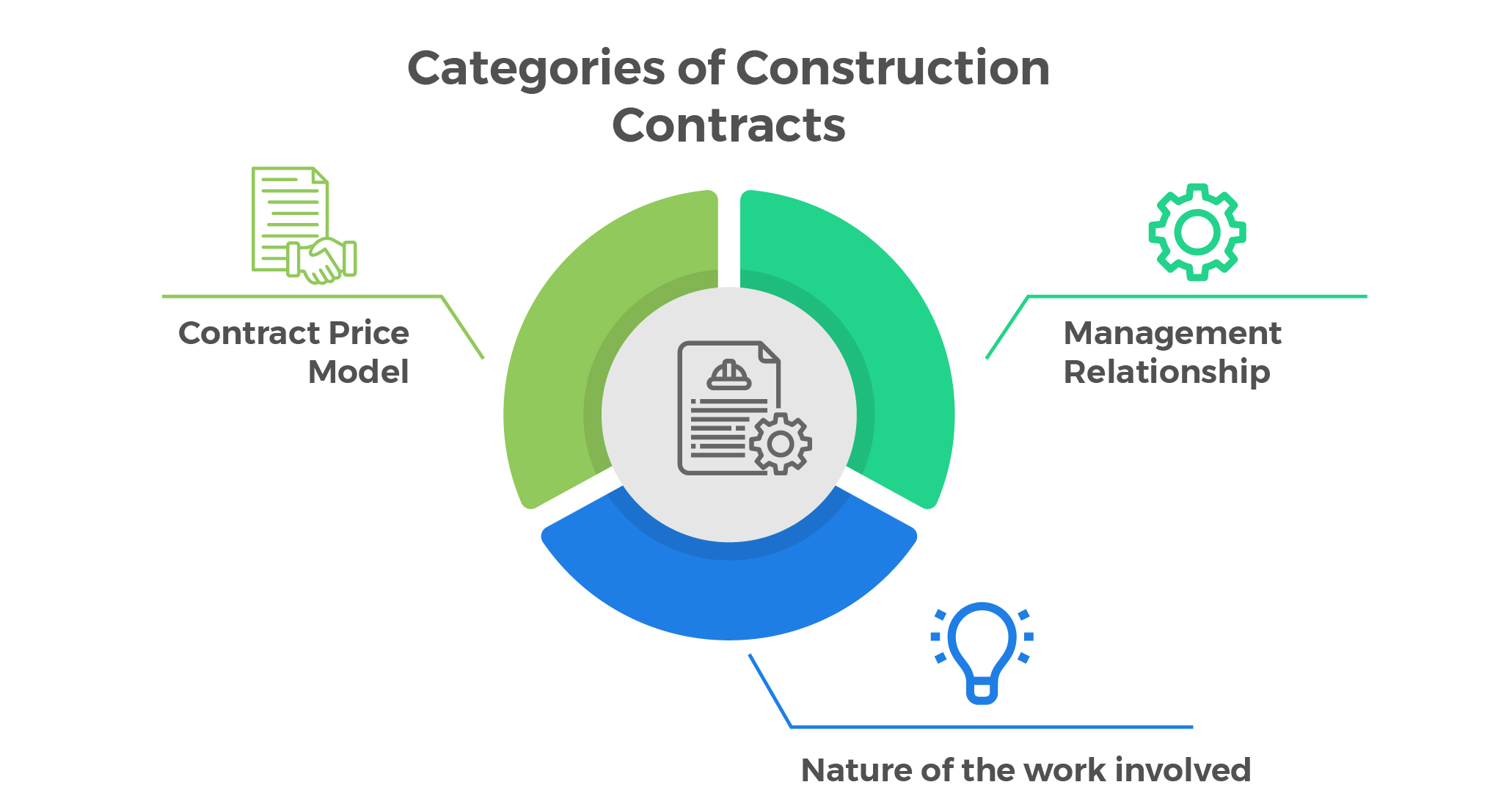
3 Main types of categorization for construction contracts
The details related to categorization of construction contracts, as well as the application of each type of contract is as follows:
Based on relationship
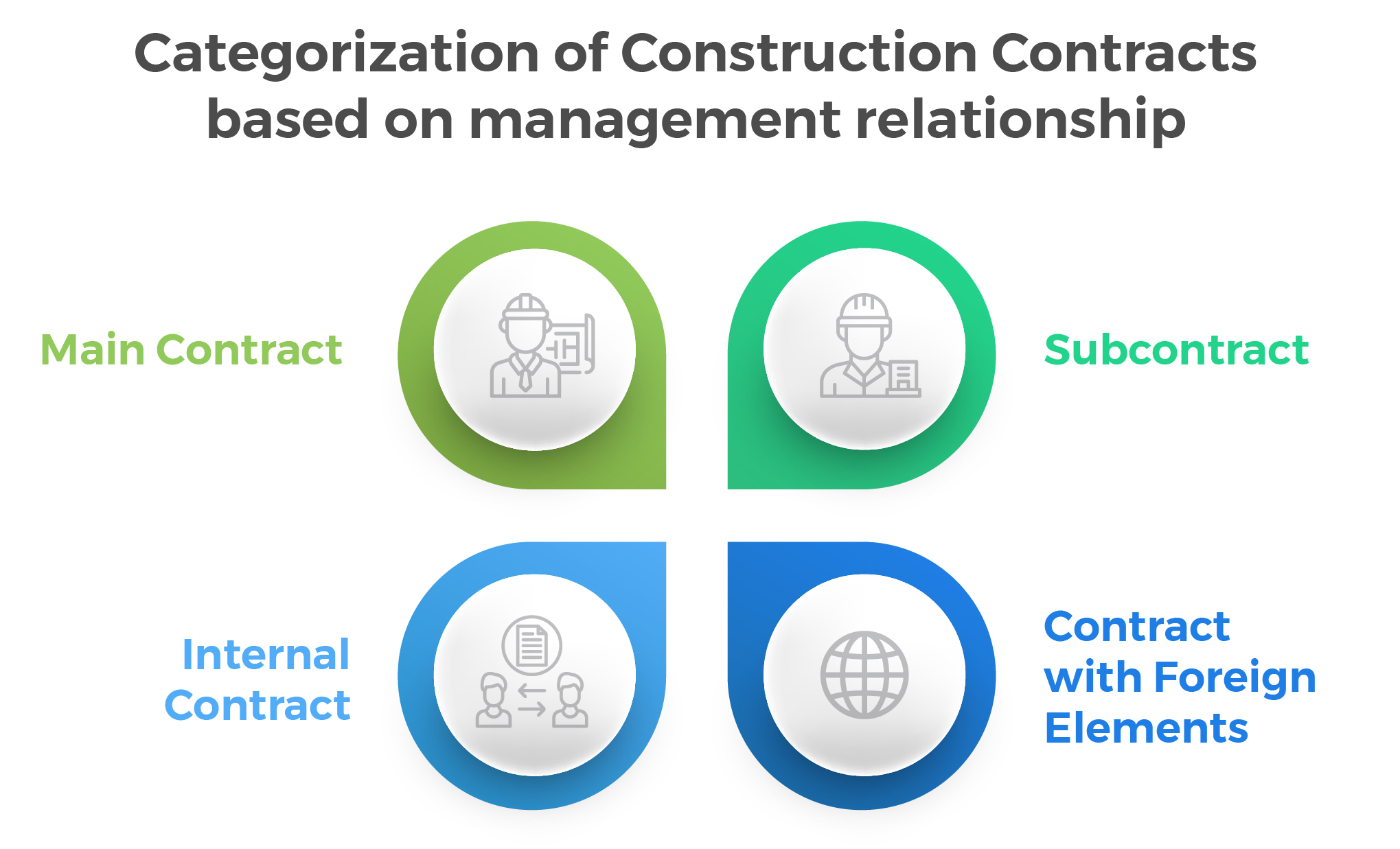
4 types of Construction Contracts categorized by “relationship”
Main Contract
Main contracts are construction contracts signed between the employer and the main contractor/principal contractor[1]. These contracts are signed between the employer and a contractor to perform the main part of the work in a construction investment project.
Additionally, main contracts are applicable when the chosen contractor is capable of performing the majority of works relative to construction design consulting; procurement of plants, materials, and equipment; or construction and installation of works.
In main contracts, main contractors are responsible for all the materials, workers, tools, equipment, and methods to complete the works, construction, and construction items specified in the contract documents.
On the other hand, the employer may enter into multiple main contracts to implement works, construction, and construction items in the event that expeditions are required or a reduction of costs for preparation stages are deemed necessary. However, in the event that multiple main contracts are signed, parties need to be mindful of the following:
- Main contracts must be consistent in the aspect of key milestones, quality of work and able to fulfill the fundamental objectives of the approved project.
- The employer must be capable of simultaneous management and coordination of the activities of multiple contractors.
- The total areas of the construction site and the proposed construction methods must account for the simultaneous performance of work by contractors.
Subcontracts
Subcontracts are construction contracts signed between the main contractor/principal contractor and the subcontractor[2]. These contracts are signed in order to assign the performance of part of the main contractor/principal contractor’s work.
Usually, subcontracts are often applicable to works, construction, or construction items that involve a work volume of a specialized nature or is industry-specific that the main contractor/principal contractor does not have sufficient expertise for. The work volume undertaken by subcontractors is exceed 30-percent (30%) of the main contract’s work volume.
Internal Contracts
Internal contracts are construction contracts in which both the principal and the contractor belong to the same organization or entity[3].
These contracts are considered a rather particular type of contract, since these are contracts of the smallest scale in the implementation of construction projects. The name of the contract is clearly indicated so by stating “internal”, which means belonging to a single organization/entity.
In practice, Internal contracts are often most utilized by teams of workers.
Construction Contracts with Foreign Elements
Construction contracts with foreign elements are those signed by a foreign contractor with a domestic contractor or employer[4].
It should be noted and understood that construction contracts with foreign elements are not limited to those between the Employer (especially Employers of infrastructure or public projects) and foreign contractors. As a matter of fact, construction contracts also exist between foreign contractors (either as the main contractor/principal contractor) and domestic subcontractors. For example, in some projects, such as Urban Railway No.1 at Ho Chi Minh City, construction contracts exist between foreign contractors.
In order to implement these construction contracts with foreign elements, construction contractors often have to obtain permits in Vietnam (click here for more details).
Based on the nature of the work
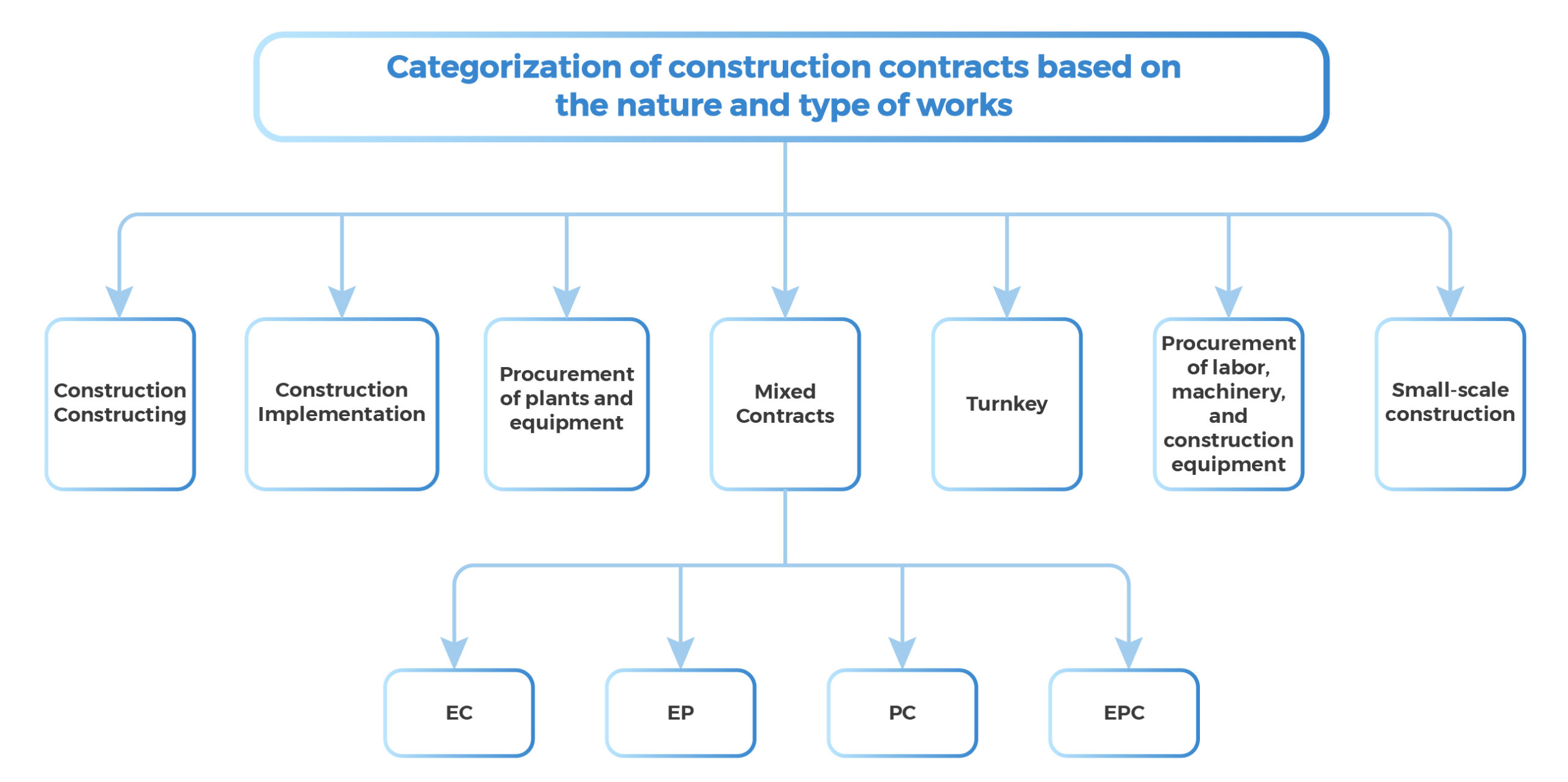
11 types of contracts categorized by “nature of the work”
Construction consulting contracts
Construction consulting contracts (abbreviated as consulting contracts) are contracts to perform part of, or the entire consulting works in investment construction activities.
Consulting contracts are contracts in which the target is the consulting services rendered by the service provider to the employer. These consulting services may include one or some of the consulting works relative to: construction planning, bid openings, construction implementation, procurement of construction equipment; acceptance of finished work, and other consulting activities in relative to construction.
The template for construction consulting contracts is provided in Appendix II enclosed with Circular No 02/2023/TT-BXD, which is often used in consulting contracts for the preparation of a feasibility study report/construction survey/construction design/construction supervision.
Construction implementation contracts
Construction implementation contracts (or contracts for construction) are contracts concluded for the implementation of construction, construction items, or construction works in accordance with the technical specifications; the principal construction implementation contracts are construction contracts for the implementation of all construction in an investment construction project.
The template for construction implementation contracts is provided in Appendix III enclosed with Circular No. 02/2023/TT-BXD
Contracts for Procurement of plants and equipment
Contracts for the procurement of plants and materials are contracts concluded for the purpose of procuring plants and equipment that would be utilized in the construction of works in accordance with the construction design; the principal construction implementation contracts are construction contracts for the procurement of plants and materials for all constructions in an investment construction project.
Mixed Contracts
Mixed contracts are contracts that combine two or more types of contracts, some common types of mixed contracts are as follows:
(i) Engineering – Construction Contracts (EC)
- Engineering – Construction Contracts are contracts concluded for the performance of engineering works and implementation of construction and construction items.
- Principal Engineering – Construction Contracts are contracts concluded for the performance of engineering works and implementation of all construction in an investment construction project.
(ii) Engineering – Procurement Contracts (EP)
- Engineering – Procurement Contracts are contracts concluded for the performance of engineering works and procurements of plants and materials to be utilized in the construction of works in accordance with the technical specifications.
- Principal Engineering – Construction Contracts are contracts concluded for the performance of engineering works and procurements of plants and materials for all construction in an investment construction project.
(iii) Procurement – Construction Contracts (PC)
- Procurement – Construction Contracts are contracts concluded for the procurement of plant and materials, as well as for the implementation of construction and construction items.
- Principal Procurement – Construction Contracts are contracts concluded for the implementation of all construction and construction items in an investment construction project, as well as the procurement of plants and materials for such construction.
(iv) Engineering – Procurement – Construction Contracts (EPC)
- Engineering – Procurement – Construction Contracts are contracts concluded to perform works ranging from the procurement of plants and materials to the construction of works, as well as the testing, acceptance, and handover of works to the principal.
- Principal Engineering – Procurement – Construction Contracts are contracts for the engineering, procurement, and construction of all works in an investment construction project.
EPC Contracts are often applicable to complex projects that have high technical and/or technological requirements and require strict synchronization from the engineering stages to the procurement and construction stages. Prior to the application of EPC contracts, the investors are responsible for the evaluation of technical and/or technological requirements, as well as the synchronization of the stages so that the objective and conditions of the approved project may be fulfilled. Additionally, such an evaluation would also help to ensure the applicability of EPC contracts in comparison to other types of contracts.
Turnkey Contracts
Turnkey contracts are construction contracts concluded for the performance of all works in an investment construction project, ranging from the establishment of the project, engineering, and procurement of equipment to the construction of works.
Contracts for Procurement of labor, machinery, and construction equipment
Contracts for Procurement of labor, machinery, and construction equipment are contracts concluded for the procurement of engineers, workers (collectively referred to as labor), machinery, construction equipment, and other necessary vehicles to be used in the implementation of construction, construction items, packages, or construction of works per the construction design.
Contracts for small-scale construction
Contracts for small-scale construction are contracts concluded for the performance of packages with values under the limit for small-scale construction packages in accordance with the law on bidding. In addition, the scope of work of these contracts usually covers work involving low technical requirements that may be easily performed.
Other types of construction contracts
Based on the contract price model
Based on the contract price model, Construction contracts are categorized as follows:
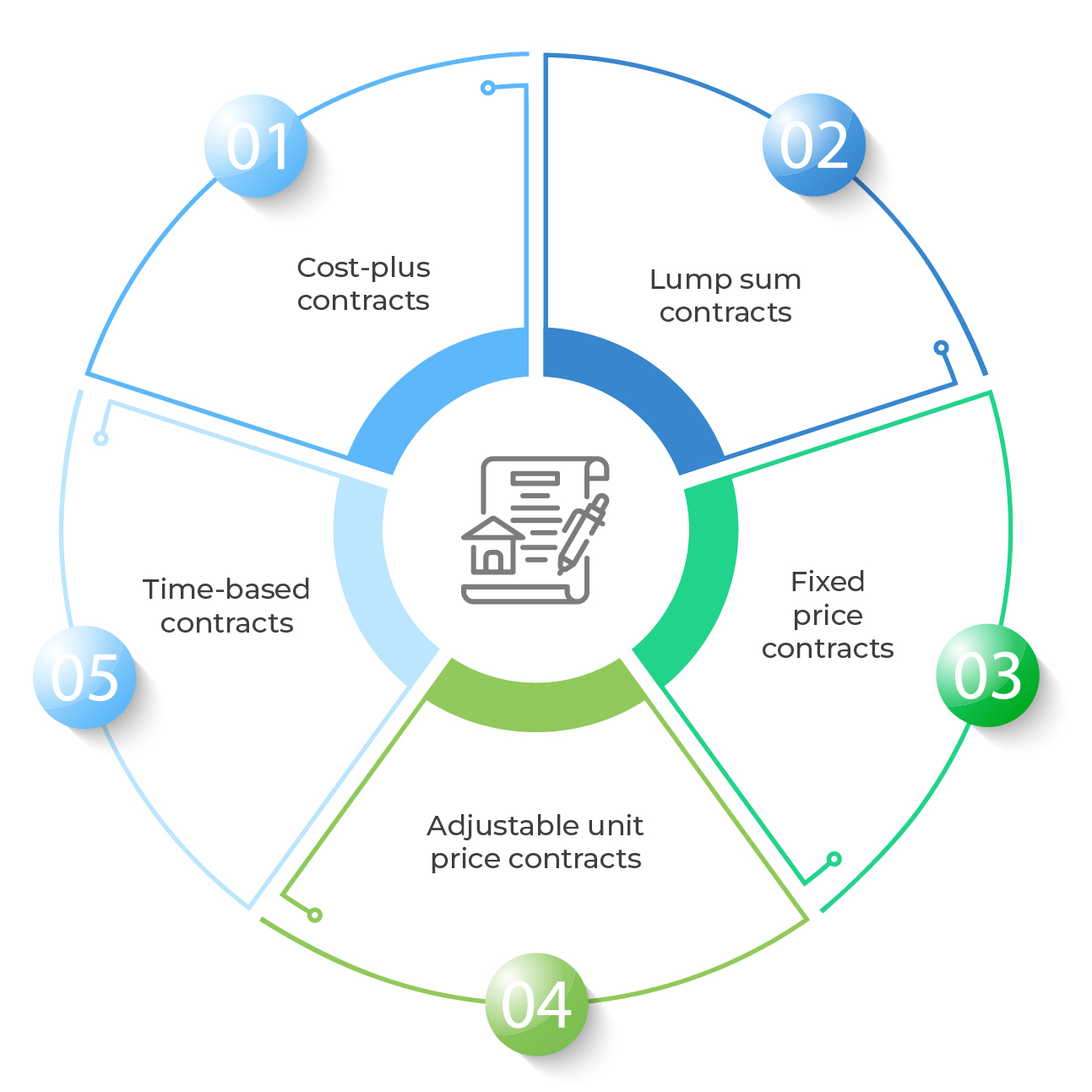
5 types of contracts categorized by “contract price model”
Lump sum contracts
Lump sum contracts are contracts in which the price is fixed throughout the performance of all works in the contract. The payment of lump-sum contracts may be made in multiple installments throughout the performance of the contract or in whole upon the completion of the contract. The total amount to be received by the contractor upon the fulfillment of all contractual obligations is exactly as specified in the contract.
Fixed-price contracts
Fixed-price contracts are contracts in which the price is determined based on the fixed price of each work item multiplied by the corresponding work volume. Fixed-price means that the price of units is not subject to change throughout the performance of the contract, with the exception of force majeure events[5].
The contractor is paid based on the volume and quantity of work accepted in accordance with the fixed price specified in the contract.
This contract is often applied to works, construction items, or construction in which quantity may not be determined prior to the conclusion of the contract.
Adjustable unit price contracts
Adjustable unit price contracts are contracts in which the price may be adjusted based on the agreement regarding the scope of work in the contract. The contractor is paid based on the volume and quantity of work accepted, using either the unit price specified in the contract or an adjusted price.
The total contract value is determined by multiplying the adjusted unit price (after price fluctuations are accounted for) by the corresponding volume of work.
This type of contract is applicable to packages in which – at the time of contract negotiation – parties are not sufficiently conditioned to determine the quantity, unit price, and miscellaneous risks affecting the contract price such as price fluctuation during contract performance.
Time-based contracts
Time-based contracts could be or are determined based on remuneration to experts, miscellaneous expenses (not included in the remuneration), and the time worked, which may be calculated on a monthly, weekly, daily, or hourly basis.
Time-based contracts are applicable to consulting services contracts, and the contract price is calculated based on the time worked on a monthly, weekly, daily, or hourly basis and miscellaneous expenses (not included in the remuneration). The contract is paid based on the actual time worked based on the remuneration corresponding to the position and work specified in the contract.
This contract may also be applicable to construction contracts that involve consulting works in investment construction activities.
Combined price contracts
Combined price contracts are construction contracts that utilize multiple price models such as lump-sum, fixed price, adjustable price contracts, etc. whichever is most appropriate for the nature of work involved in the contract.
Cost-plus contracts
Cost-plus contracts are contracts whose prices are not determined at the time of contract conclusion – parties only agree on management costs, overhead, and profit as the scope of work and the direct costs may not be determined by the parties at that time.
Conclusion
Construction contracts are diverse, therefore, depending on the scale and circumstances of the work, construction, and construction items, therefore it is best for the principal and the contractor to agree on the appropriate applicable types of contracts.
Contact
Within the construction industry, CNC is grateful to be a reliable and trustworthy partner that Clients place their faith in. This is only possible due to the professionalism and credibility demonstrated by CNC coupled with our years of experience.
In Vietnam, CNC is honored to be a leading law firm that dedicates resources to the development of legal services relative to construction, particularly in-depth in the areas of Construction Contract Consulting Services and Construction Contract Management Services
These two types of services have afforded CNC the opportunity to earn their reputation in the legal industry. The name CNC, itself, is based on the combination of Construction Contracts and Counsel
Our belief is that, while fifty percent (50%) of a project’s success is attributable to careful and meticulous preparation during Contract negotiations, the other fifty percent (50%) is determined by the management of the implementation of construction contracts. Therefore, CNC incessantly endeavors to accompany Clients from project start to project finish to be operated and handed over, and ensuring that disputes will not occur in the process.
Click here to see more on CNC’s Services
To make any requests in relation to legal services within the field of construction, please contact CNC via the address below:
CNC Vietnam Co. Ltd
Address: 28 Mai Chi Tho, An Phu Ward, Thu Duc City, Ho Chi Minh, Vietnam
Phone: +84-028 6276 9900
Hotline: +84-916545618
Email: contact@cnccounsel.com
Website: cnccounsel
[1] Article 3.3.a Decree No. 37/2015/ND-CP on detailed regulations on construction contracts (“Decree No. 37”)
[2] Article 3.3.b Decree No.37
[3] Article 3.3.c Decree No. 37
[4] Article 3.3.d Decree No.37
[5] Article 15.3.b Decree No. 37