




Precedent No. 02/2016/AL on property disputes
The first 6 precedents promulgated by the People’s Supreme Court, which went into effect on 01/06/2016, marked an important milestone in the application of precedents in practice. Among the 6 promulgated precedents, Precedent No. 02/2016/AL is the first precedent addressing civil issues. More specifically, this precedent is pertains to a fairly common dispute in which an overseas Vietnamese requested a local Vietnamese to purchase real estate in Vietnam under the latter’s name.
The article, below, is part of the series on Precedents, written by CNC’s legal staff with the purpose of providing readers with vital information on Precedents – particularly Precedent No. 02/2016/AL and its legal value as well as its application in practice.
Overview of Precedent No. 02/2016/AL on Property Disputes
Prior to promulgation of the 2014 Law on Housing, overseas Vietnamese encountered certain limitations relative to the ownership and purchase of real estate in Vietnam. Specifically, overseas Vietnamese were not allowed to partake in transfers of land use rights, instead, they could only have land use rights in Vietnam under a land lease.[1]
As such, overseas Vietnamese would often bypass the limitations by purchasing or owning real estate in Vietnam under the name of their acquaintances who still reside in the country. However, this was also an issue as the acquaintance could transfer away the land use right without the approval of the overseas Vietnamese and claim all of the transfer amount to themselves. Regarding such issues, judicial practice has shown that Courts have various approaches to the above issue. Therefore, the People’s Supreme Court promulgated Precedent No. 02/2016/AL on property disputes to provide a uniform approach to the issue.
Legal issues in Precedent No. 02/2016/AL on Property Disputes
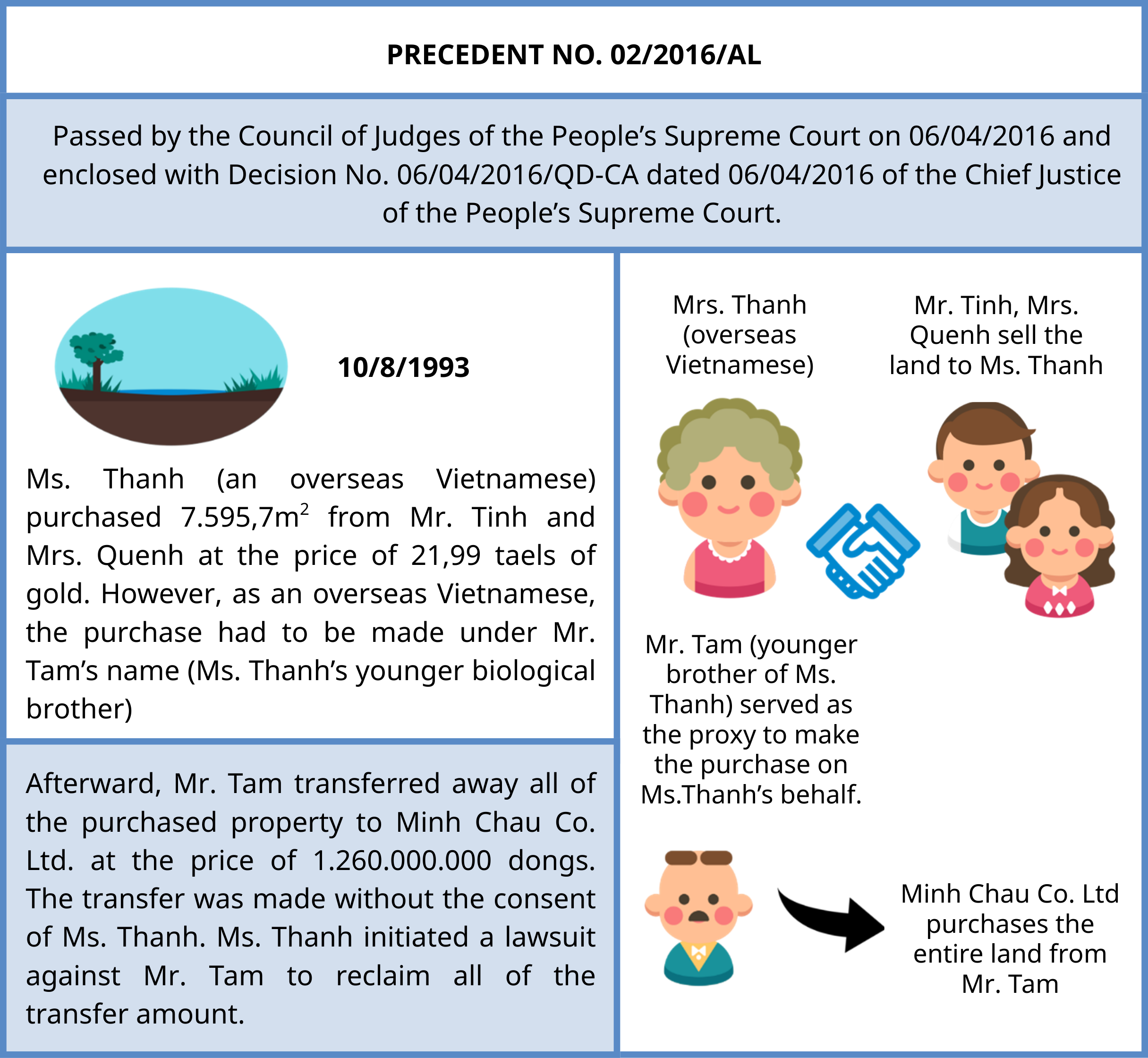
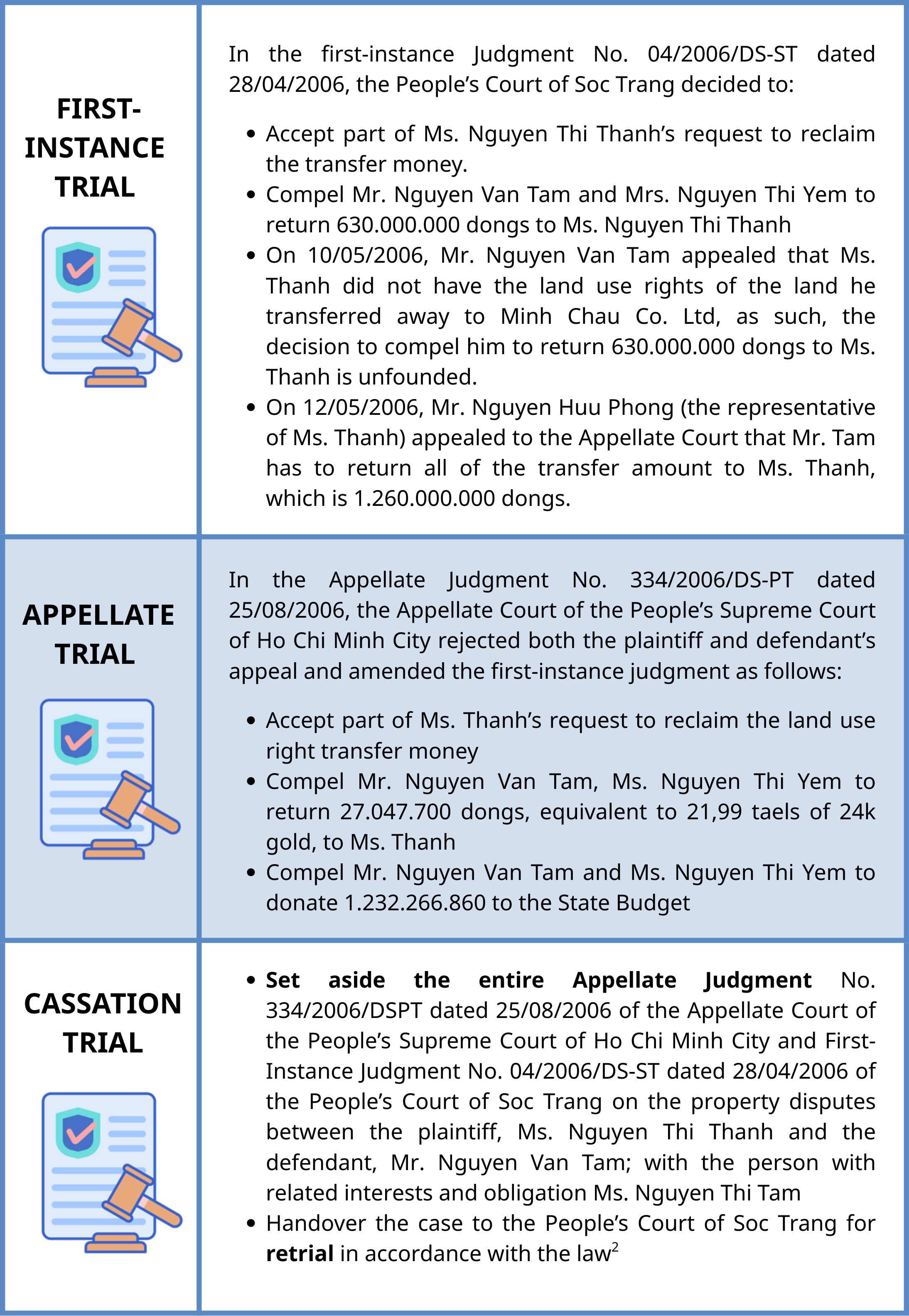
Summary of the case:
Law provisions relevant to Precedent No. 02/2016/AL on property disputes
Article 137 and Article 235 of the Civil Code 2005
Solutions provided by Precedent No. 02/2016/AL on property disputes
In Precedent No. 02/2016/AL on property disputes, the land use rights of both Ms. Thanh and Mr. Tam are not recognized. Accordingly, the Court only:
- Recognizes the investment made by Mrs. Thanh in Mr. Tam’s obtainment of the concerned land use right.
- Recognizes the contribution of Mr. Tam in the preservation, maintenance, and renovation of the land which could be attributed to the increase in value of the land. Therefore, the transfer amount (after deducting Ms. Thanh’s investment of 21,99 taels of gold) should be view as the joint profits of Mrs. Thanh and Mr. Tam. If the contribution of Mr. Tam could not be determined, Mrs. Thanh and Mr. Tam shall be deemed to be equal in term of contributions[3]
Practical Application of Precedent No. 02/2016/AL on property disputes
Commentary on Precedent No. 02/2016/AL on property disputes
The solution of Precedent No. 02/2016/AL has the following advantages:
Advantages of Precedent No. 02/2016/AL
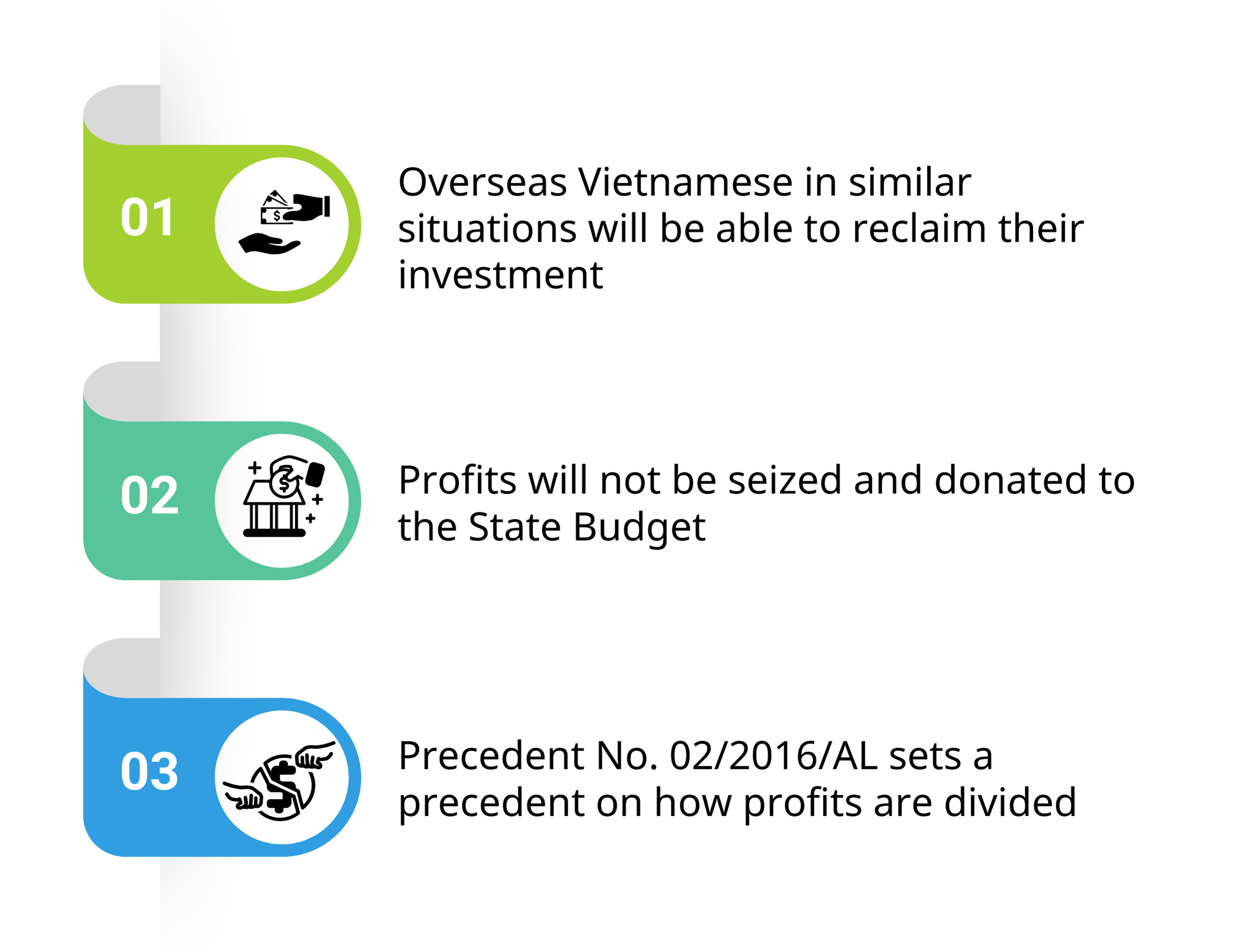
Firstly, overseas Vietnamese in similar situations will be able to reclaim their investment
The purpose behind this is the recognition of overseas Vietnamese’s efforts and resources spent, as well as the protection of their legal interests.
Secondly, profits WILL NOT be seized and donated to the State Budget
At the time of the first-instance trial and appellate trial, the 2005 Civil Code was in effect and a provision regarding the seizure and donation of the involved profits was non-existent, as such, both parties are now entitled to these profits. Inappropriate and baseless seizure of profits would be inconsistent with the law and would likely adversely affect the rightful interests of the parties.
Thirdly, Precedent No. 02/2016/AL sets a precedent on how to divide profits among the principal and the proxy regarding land use rights when the transaction is deemed null and void.
Accordingly, profits are divided based on the contributions of each party and are only divided in equal portions between the parties when the contribution of each party is undetermined. This is a step forward in the determination and division of profits, instead of favoring “equal division” in all situations, parties are rewarded based on their efforts.
While Precedent No. 02/2016/AL does have its merits, caution must be exercised throughout its application:
Considerations in the application of Precedent No. 02/2016/AL
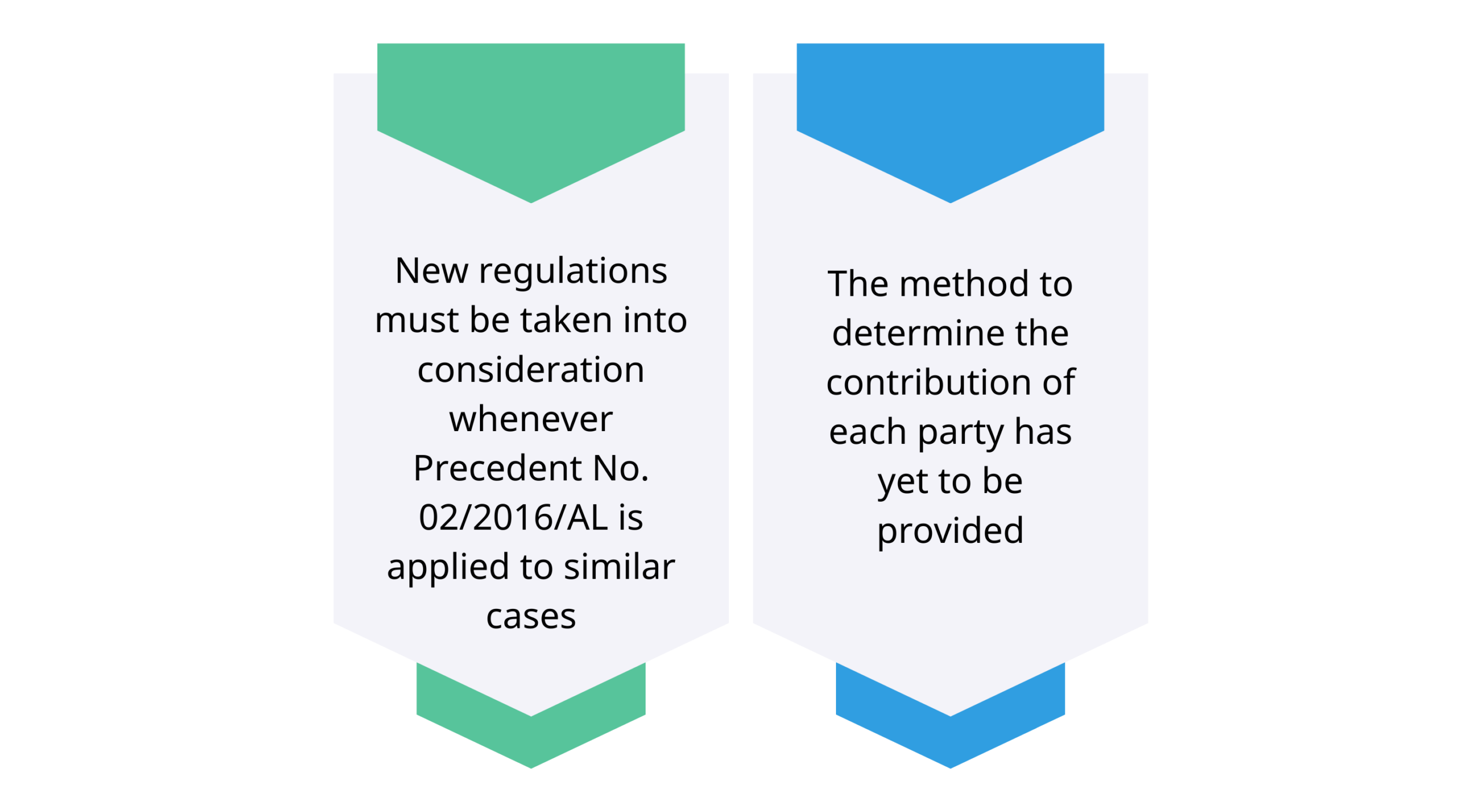
Firstly, clear regulations on the overseas Vietnamese’s ownership of land use rights and other immovable property in Vietnam are NOW available. Therefore, these regulations must be taken into consideration whenever Precedent No. 02/2016/AL is applied to similar cases.
Specifically, according to the 2013 Law on Land and the 2014 Law on Housing, overseas Vietnamese ownership of land use rights would come with certain limitations, obligations, and requirements[4]. As such, the parties might intentionally commit breaches of law under the assumption that whenever disputes arise, Precedent No. 02/2016/AL would allow them to retrieve their money and profits.
Secondly, although Precedent No. 02/2016/AL mentioned the division of profits based on parties’ contributions, the method to determine the contribution of each party has yet to be given.
In the absence of any available method for determination of parties’ contributions, Precedent No. 02/2016/AL opted for a tentatively unsatisfactory and unfair solution, which is equal division.
Application of Precedent No. 02/2016/AL on property disputes
In disputes involving entitlement to profits, the People’s Court of Ho Chi Minh City applied Precedent No. 02/2016/AL in the appellate trial and allowed the proxy to earn half of the increased value of the disputed property.
More specifically, Mr. Tee, a Malaysian, initiated a lawsuit against Nguyen Thi Xuan T for 4.38 billion dongs of the value of the house located at 149/B31 (formerly 183/B16), Ly Thanh Tong Street, Tan Thoi Hoa Ward, Tan Phu District, Ho Chi Minh City. Accordingly, Mr. Tee purchased the house at a cost of 2.8 billion dongs under the name of Mrs. T. Meanwhile, Mrs. T managed and made use of the disputed house.
The representative of the People’s Supreme Procuracy of Ho Chi Minh City recommended the application of Precedent No. 02/2016/AL to divide the increased value of the house equally.
The Appellate Court also found that the nature, circumstances, and legal issues in this case resemble that of Precedent No. 02/2016.
As such, based on this precedent, it was substantiated that Mr. Tee, who could not purchase the house legally at the time as a foreigner must have relied on Mrs. T to act as his proxy and purchase the house on his behalf. Therefore, Mr. T’s request to reclaim the money spent to purchase the house is validated
Regarding the increased value of the house, since it was Mr. Tee’s money that was spent to purchase the house, and Mrs. T was responsible for the purchase, management, preservation, and renovation of the house on Mr. Tee’s behalf, both are deemed to have made significant contributions. As a result, the increased value of the house was divided equally among the two parties.
Based on these findings, the Appellate Court amended the first-instance judgment and forced Mrs. T to return 3.59 billion dongs to Mr. Tee.[5]
While the above is an exemplary case of the application of Precedent No. 02/2016/AL, judicial practice also observes issues and inconsistencies of this precedent’s application.
The inconsistencies in the application of Precedent No. 02/2016/AL
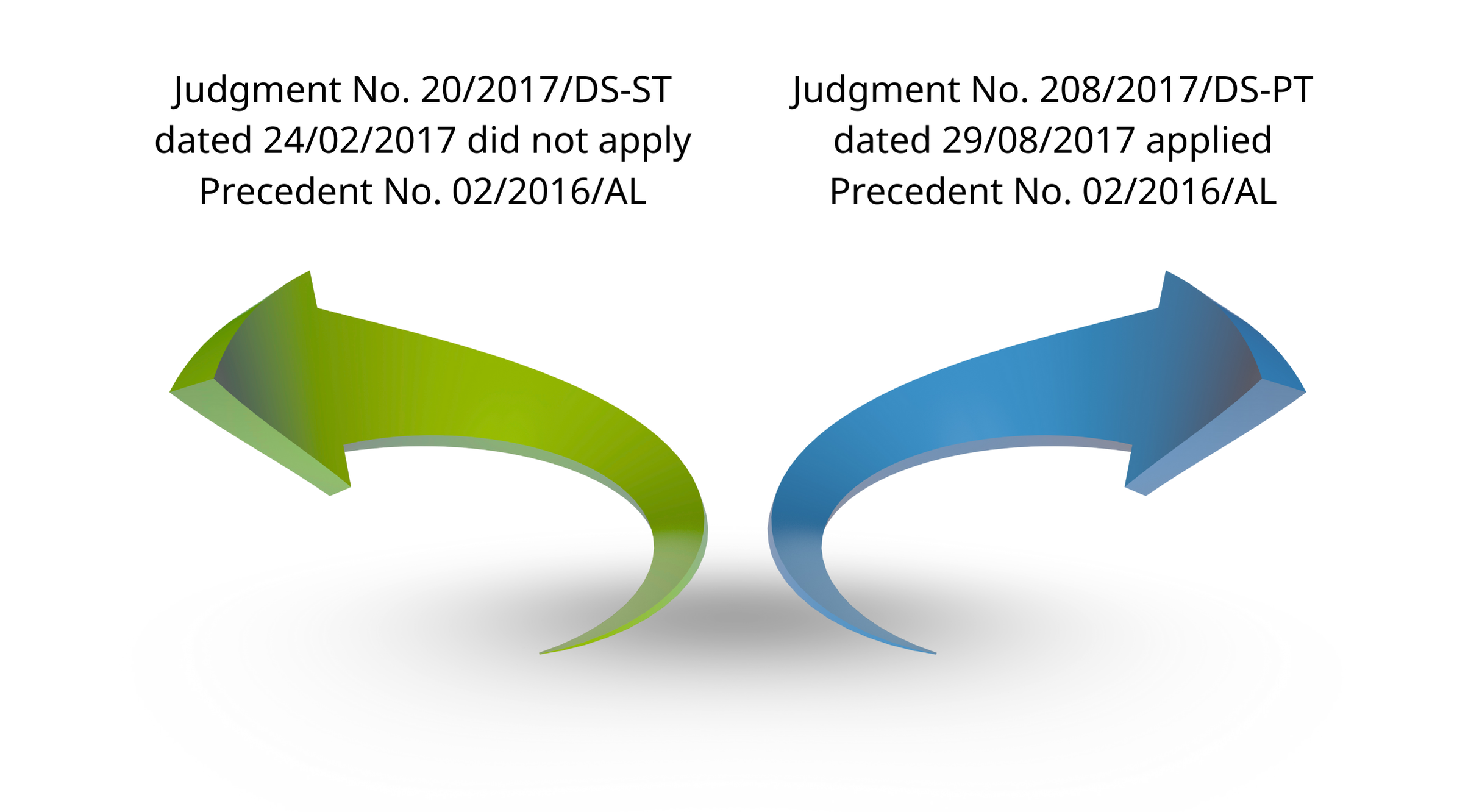
In particular, a case on “property disputes” accepted by the People’s Court of Can Tho also shared a plethora of resemblances to Precedent No. 02/2016/AL, which is the purchase of property by overseas Vietnamese under the name of a local Vietnamese. However, the People’s Court of Can Tho did not apply Precedent No. 02/2016/AL in Judgment No. 20/2017/DS-PT dated 24/02/2017.
A provisional explanation was included in the findings of the judgment, namely the difference in circumstances. Accordingly, in Precedent 02/2016/AL, the overseas Vietnamese made the transaction, directly, with the owner of the property (land), however, in the case handled by the People’s Court of Can Tho, the overseas Vietnamese “made the transaction “indirectly” by handing the money to a proxy instead of the property’s owner.
Conversely, in Judgment No. 208/2017/DS-CP dated 29/08/2017 of the People’s High Court of Ho Chi Minh City, an overseas Vietnamese also made the transaction “indirectly“ by handing the money to a proxy so that the latter could make the purchase. However, the Court applied Precedent No. 02/2016/AL and compelled the proxy to return the house to the overseas Vietnamese.[6]
This demonstrates that the judges’ subjective interpretation of “similar legal issues” would be a decisive factor in the application of Precedent No. 02/2016/AL.
Takeaways from Precedent No. 02/2016/AL on property disputes
Advice
Considering Precedent No. 02/2016/AL and the current law, it is in the best interests of overseas Vietnamese to make purchases by themselves instead of relying on proxies to purchase real estate in Vietnam due to the following reasons:
Advice for overseas Vietnamese who want to purchase real estate in Vietnam
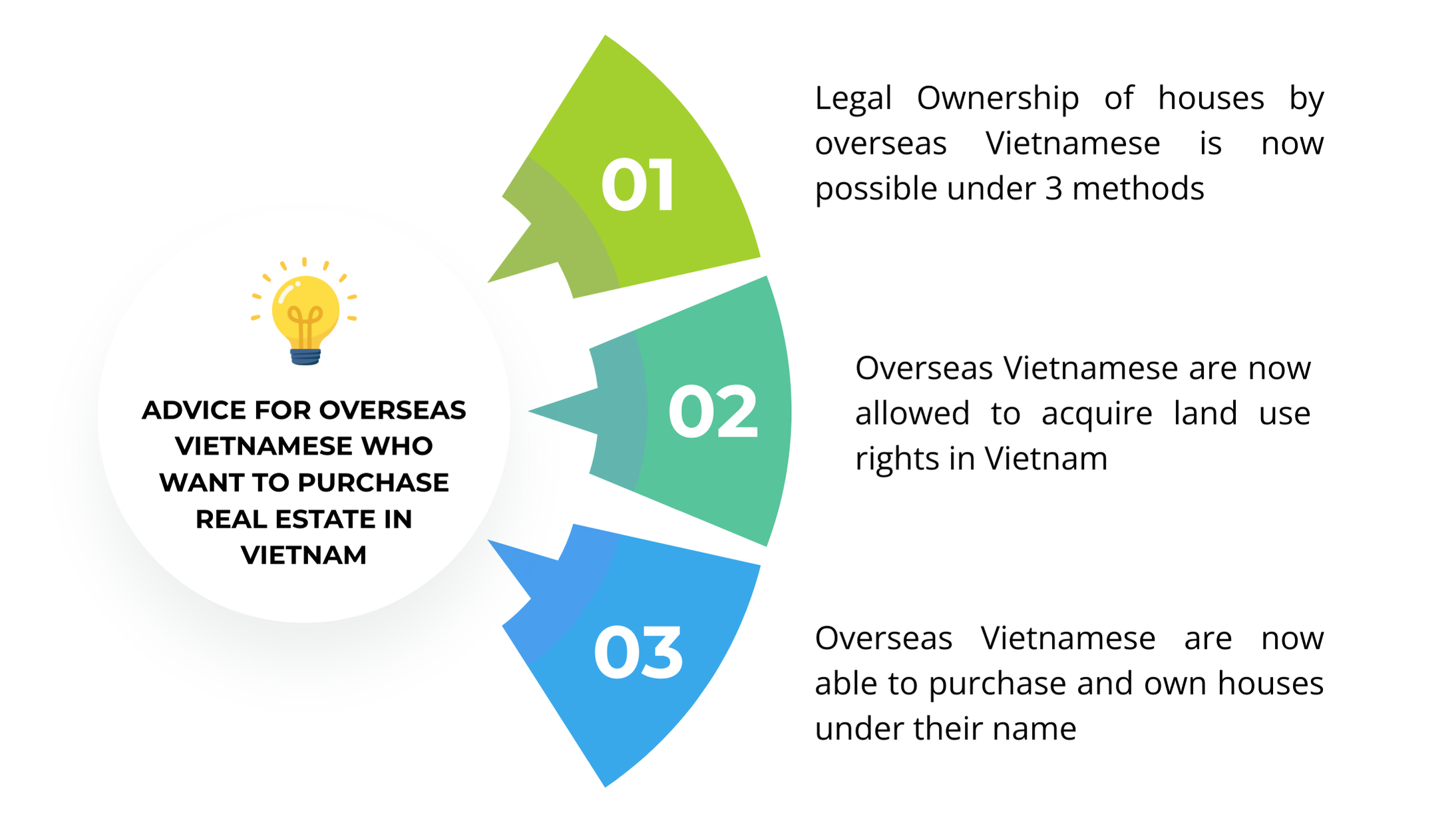
Firstly, legal ownership of houses by overseas Vietnamese is now possible under the 2014 Law on Housing via the following methods:
- Purchase or lease purchase of commercial housing from real estate enterprises and/or cooperatives;
- Purchase, receipt of gift, inheritance from, or Exchange with households and/or individuals;
- Transfer of land use rights within commercial housing projects where housing construction is, is permitted per the laws.[7]
Secondly, the 2013 Law on Land now allows overseas Vietnamese to acquire land use rights in Vietnam
“Overseas Vietnamese who are eligible to own houses in Vietnam under the law on housing may acquire land use rights through purchase, lease-purchase, inheritance, or donation of houses associated with land use rights, or acquire land use rights in housing development projects”[8]
Lastly, per the Law of Vietnam, overseas Vietnamese no longer require proxies as they are now able to purchase and own houses under their name, provided that all the requirements are satisfied.
From the example shown in Precedent No. 02/2016/AL, it is evident that the use of proxies in the purchase of houses in Vietnam contains a myriad of potential risks.
Risk Mitigation Measures
While the purchase and ownership of houses by overseas Vietnamese under their name are now possible, certain requirements must be satisfied. As such, cases in which overseas Vietnamese rely on proxies (due to not being able to fulfill all of the requirements), and by extensions, disputes of a similar nature, still exist. Taking pages from Precedent No. 02/2016/AL, overseas Vietnamese in similar situations are strongly encouraged to prepare the following evidence throughout the transfer of land, housing to minimize the risks:
Risk Mitigation Measures for overseas Vietnamese who purchase buildings or land under the name of their acquaintances
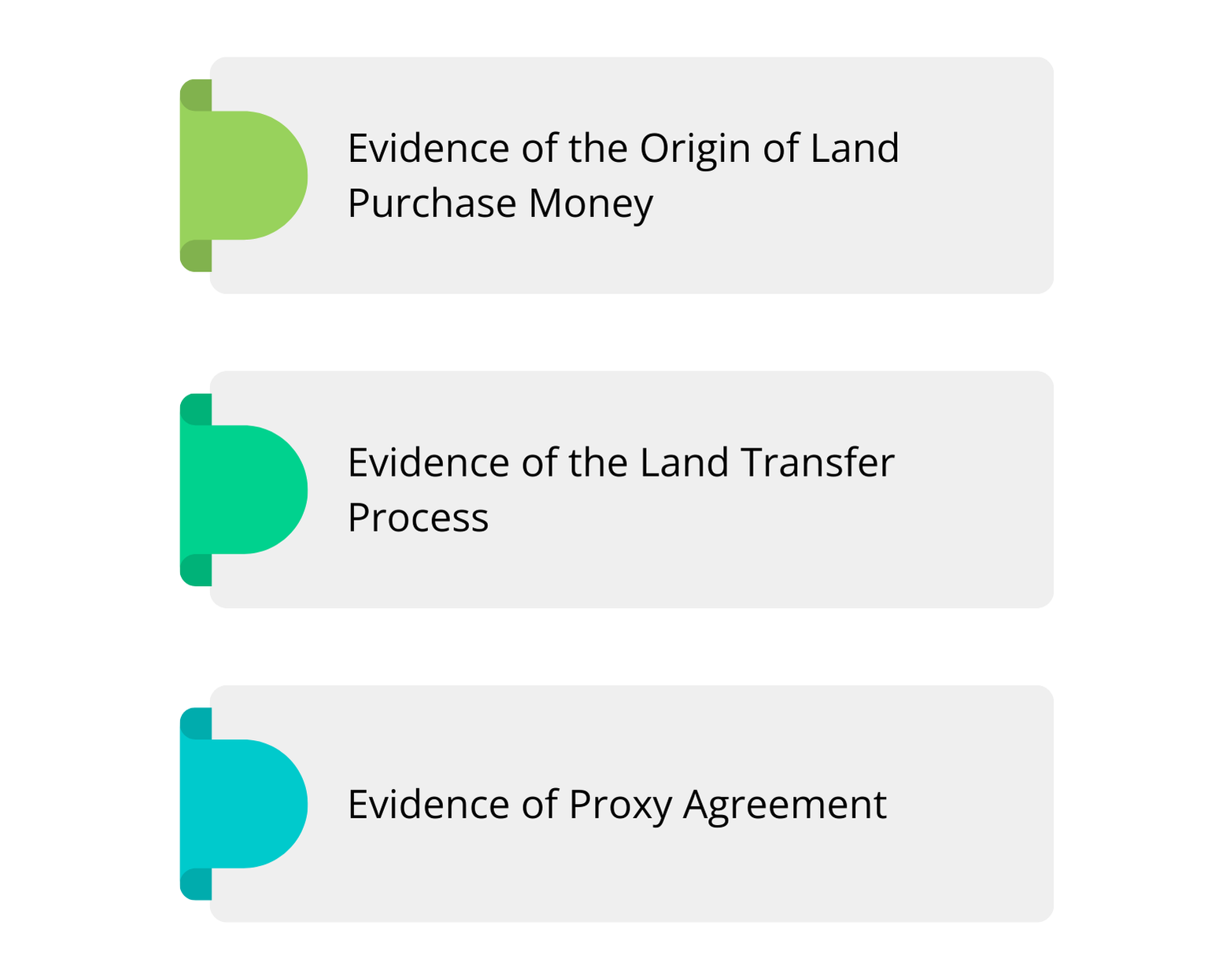
Evidence of the Origin of Land Purchase Money
If money were to be transferred to the proxies, the purpose of the transfer should be explicitly specified, which is to purchase real estate under the proxy’s name. Afterward, the documents recording such specifications must be carefully preserved and safeguarded.
Evidence of Land Transfer Process
Throughout the transfer, if overseas Vietnamese do not pay or contact the seller, directly, meeting minutes are encouraged to be made for each process and phase of the transfer.
Evidence of Proxy Agreement
If overseas Vietnamese are not present in Vietnam to prepare evidence of the transfer/purchase of real estate, the proxy agreement between the overseas Vietnamese and their proxies is encouraged to be made in writing. The agreement must detail the method of transfer and transfer process. Most importantly, the proxy must confirm in the agreement that the purchase of real estate under their name IS made on behalf of the overseas Vietnamese.
Aside from the above, more evidence focusing on the following points need to be prepared:
- Point 1: Specifying the exact amount of money spent by the principal for the proxy to make purchases on behalf of the former
- Point 2: Confirmation of the proxies that they are acting on behalf of the principal
- Point 3: Specifying the remuneration that the overseas Vietnamese pays to the proxy in case the purchased land use rights/ houses were to be transferred away. This is necessary because If the contribution of parties is not clearly defined, the increased value of the transferred assets would be divided equally in accordance with Precedent No. 02/2016/AL
Conclusion
In a timely and reasonable approach, Precedent No. 02/2016/AL has acknowledged and addressed some issues pertaining to disputes between overseas Vietnamese who legally do not have the right to ownership of real estate and their proxies who own the house in their stead. However, within the context of the constantly changing legal system, Precedent No. 02/2016/AL also has certain demerits and shortcomings.
Therefore, any contributions by readers, researchers, or fellow law practitioners would help develop precedents for cases similar to Precedent No. 06/2016/AL, but more comprehensively and prominently, so that a “perfect” solution and its uniform application may be achieved.
Contact
CNC VIETNAM LAW FIRM COMPANY LIMITED
Address: 28 Mai Chi Tho, An Phu Ward, Thu Duc City, Ho Chi Minh City, Vietnam
Phone: (84) 28 6276 9900
Email: contact@cnccounsel.com
Website: cnccounsel
Managed by:
Ms. Nguyen Thi Kim Ngan | Partner
Email: ngan.nguyen@cnccounsel.com
Or
Huynh Thi Phuong Thao | Legal Assistant
Phone: (84) 028 6276 9900
Email: contact@cnccounsel.com
Disclaimers:
This article is prepared or used for the purpose of introducing or updating clients on the issues and/or developments of legal perspectives in Vietnam. The content presented in this article shall not constitute advice of any kind and could be subjected to changes without advance notice.
For more articles, please visit: http://cnccounsel.com/an-le/an-le-tai-viet-nam
[1] Article 80, Law on Land 1993
[2] The Council of Judges of People’s Supreme Court (2016), Cassation Decision No. 27/2010/DS-GDT on the case of “property dispute” in Soc Trang, People’s Supreme Court
[3] The Council of Judges of People’s Supreme Court (2016), Cassation Decision No. 27/2010/DS-GDT on the case of “property dispute” in Soc Trang, People’s Supreme Court
[4] Article 7, 8, Law on Housing 2014; Article 5, 169, 186, Law on Land 2013
[5] Judgment No. 558/2020/DS-PT dated 23/10/2020 of the People’s High Court of Ho Chi Minh City on earning yield“
[6] Le Minh Thuy, Hong Duc University, “Vai trò của thẩm phản trong xây dựng và áp dụng án lệ hiện nay”, Journal of State Management
[7] Article 8, Law on Housing 2014
[8] Article 169.1, Law on Land 2013