




Foreigners Buying Property in Vietnam – When an Informal Land Deal Turns Risky
There are no “small clients” at CNC. Only real legal problems that deserve serious attention.
In this case, we were approached by an elderly Singaporean national who has been living in Vietnam for many years and has been legally married to a Vietnamese citizen for more than ten years, as evidenced by a valid marriage registration certificate.
>>> See how to legally get married in Vietnam here.
Two years ago, his wife purchased a plot of land together with a house constructed on it. What appeared to be a straightforward family investment soon became a serious legal concern.
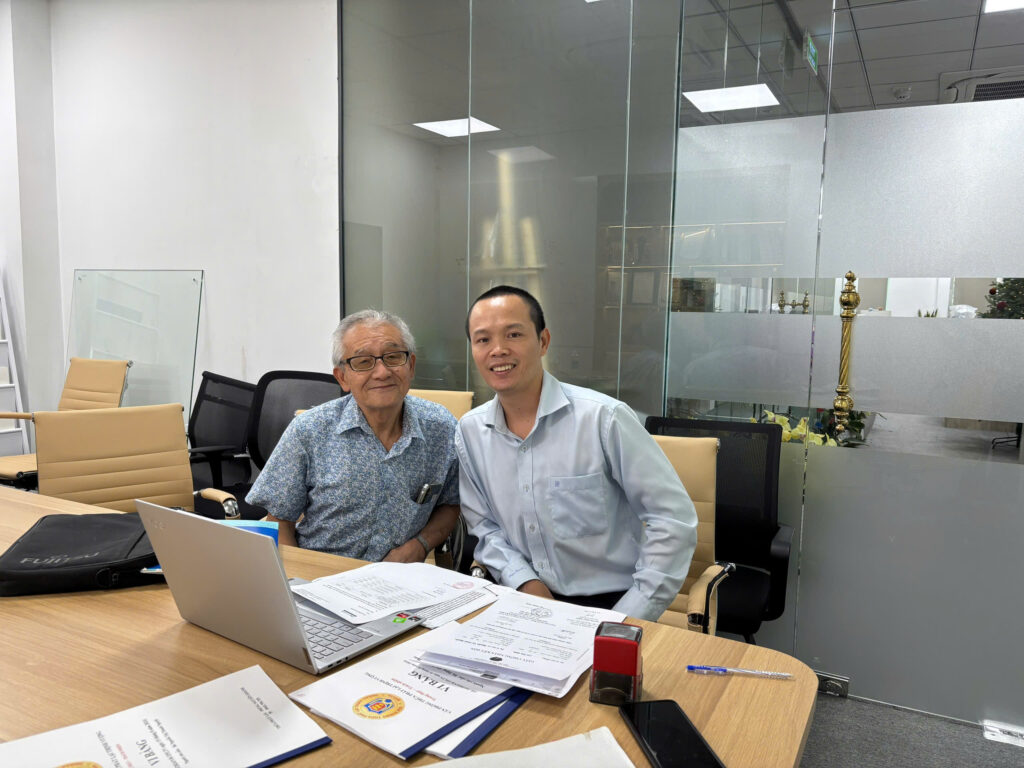
An elderly client visiting CNC for legal advice on a property purchase in Vietnam
The Issue
The property transaction was carried out based on a document witnessed by a Thừa phát lại (bailiff), rather than a notarised and registered transfer at a notary office, as required under Vietnamese land law.
In practice, many buyers mistakenly assume that a Thừa phát lại–witnessed document provides sufficient legal security. While such documents may have evidentiary value in certain circumstances, they do not substitute notarisation or confer lawful land-use rights.
When the client later explored the possibility of obtaining a Pink Book (Land Use Right Certificate), he discovered that:
- The land was recorded across three separate cadastral map parcels;
- There was no clear or complete legal land-use documentation from the seller;
- Apart from the Thừa phát lại–witnessed purchase agreement, the only supporting document was a survey report prepared by a private company, which has no legal validity for land registration purposes.


Parties often misunderstand the legal effect of bailiff-witnessed transactions
The client became understandably anxious. His primary concern was whether his wife had been misled or defrauded, and whether the property he believed he had purchased lawfully could ever be formally recognised under Vietnamese law.
>>> See the legal effects of bailiff-witnessed documents here.
Our Initial Legal Assessment
Upon reviewing the documents, we were able to clarify one important point early on: the transaction was unlikely to involve forged documents, as the agreement had been formally witnessed by a Thừa phát lại.
However, this reassurance did not resolve the core legal problem.
Under Vietnamese land law (published by the Office of Land Registration under the Department of Natural Resources and Environment), the issuance of a Pink Book is subject to strict statutory conditions, including (among others):
- the seller’s lawful land-use rights;
- proper notarisation of the transfer;
- consistency and legality of cadastral records; and
- the land’s eligibility for registration.
None of these mandatory conditions were satisfied in this case.

Survey reports and Land Use Right Certificates are frequently mistaken for one another
Why the Situation Was Particularly Distressing
The client’s concern was compounded by past experience. He had recently sold an apartment purchased from a well-known project developer, yet had faced difficulties in obtaining a Pink Book for that apartment in District 7.
The prospect of encountering the same legal dead-end again, this time with a privately purchased house and land, left him feeling exposed and disappointed.
CNC’s Legal Position
Based on a comprehensive review of the documents and applicable law, CNC advised that:
- The purchase agreement was highly vulnerable to being declared invalid, as it did not comply with mandatory legal requirements; and
- The seller did not possess a lawful right to transfer the land.
Critically, the legal defect arose from the seller’s position, not from any fault on the part of the buyer (our client).
Proposed Legal Options
To protect the client’s interests, we outlined two legally sound pathways, allowing the client to make an informed decision:
- Proceeding, at the client’s discretion, with attempts to regularise the land and pursue issuance of a Pink Book, with full awareness of the legal risks and limitations; or
- Initiating court proceedings to (i) seek a declaration that the transaction is invalid; and (ii) recover the purchase price, together with accrued interest and related losses.
CNC’s Experience with Foreign Property Transactions
Cases like this are not isolated. CNC is frequently instructed by foreign individuals and mixed-nationality families seeking advice on purchasing property in Vietnam, structuring transactions lawfully, and avoiding hidden land-related risks.
Over the years, we have built substantial practical experience in advising foreigners on property acquisition in Vietnam, from transaction structuring and compliance checks to dispute resolution when things go wrong.
>>> For a detailed discussion on this topic, please see our article: Purchasing Property in Vietnam as a Foreigner
Current Status
While the legal process remains ongoing, the client has gained:
- clarity over his legal position;
- confidence in navigating Vietnam’s complex land-law framework as a foreign resident; and
- reassurance that his interests are being handled by lawyers experienced in foreign-related property and dispute matters.
Key Takeaway
This case illustrates a recurring and often misunderstood risk: documents witnessed by a Thừa phát lại may serve evidentiary purposes, but they do not legalise land ownership or replace statutory requirements for land registration.
Need Legal Advice on Property Purchase in Vietnam?
Foreigners and mixed-nationality families often face hidden legal risks when purchasing property in Vietnam — especially where transactions are informal, improperly notarised, or based on Thừa phát lại–witnessed documents.
CNC regularly advises foreign clients on:
-
Lawful structuring of property purchases in Vietnam
-
Legal feasibility of obtaining a Pink Book
-
Risk assessment of existing land transactions
-
Dispute resolution and recovery of purchase monies where transactions are invalid
With extensive experience assisting foreign individuals, expatriates, and cross-border families, CNC is well-positioned to help you navigate Vietnam’s complex property and land-law framework.
📩 Contact CNC today for a confidential consultation and protect your legal and financial interests.

CNC Vietnam Law Firm
Address: The Rise Building, 2A1 Nguyen Thi Minh Khai, Sai Gon Ward, Ho Chi Minh City, Vietnam
Phone: (84) 28-6276 9900
Hotline: (84) 916-545-618
Email: contact@cnccounsel.com
Website: cnccounsel
Facebook: https://www.facebook.com/cnclaw
LinkedIn: https://linkedin.com/company/cnccounsel