



Double-hatting in arbitration
Upon the occurrence of a dispute, one of the most important procedures that parties need to perform at the initial stages is the appointment of the Arbitrator. In relation to this issue, parties are advised to exercise caution in the selection of Arbitrator since such selection could significantly affect the entire arbitral proceeding. The selected Arbitrator should meet the requirements regarding not only the expertise and experiment, but also the independence, impartiality, and objectivity.
However, in the recent years, instances of “double-hatting” have been observed from international practices. Double-hatting refers to cases where an individual who, at the same time or within a short period of time, assume multiple different roles in different arbitration cases. This phenomenon raises many complex legal and professional ethic issues, especially in relation to conflicts of interest and the independence of the Arbitrator.
In this article, CNC shall provide clients with the necessary information on double-hatting in arbitration, which we hopes will be of use to the clients in their selection of Arbitrator and participation in dispute resolution via arbitration at both domestic and international level.
Download PDF file at here
Introduction to Double-hatting in arbitration
As of the current, Double-hatting or dual-hatting has yet to have an official definition in arbitration. However, according to ICSID, in the resolution of investment dispute between the nations, this term could be interpreted as cases where an individual acts in two different roles in different arbitration cases simultaneously or within a short time period[1]. This term encompasses not only cases where the Arbitrator also act as a lawyer, but also other roles such as expert witness or Mediator in separate dispute resolution processes.[2]
In terms of the positives, this benefits all parties in dispute resolution via arbitration, as there are less restrictions in the selection of Arbitrator. Concurrently, by assuming multiple roles, Arbitrator could improve their skills and gain experience as a lawyer that support the Arbitrator and vice-versa, experience in adjudicating arbitration cases also enhances the quality of lawyer’s practices[3]. This helps not only the Arbitrator, but also the disputing parties, since the latter is aided by highly-skilled and experienced individual who have a more comprehensive view of the matter.
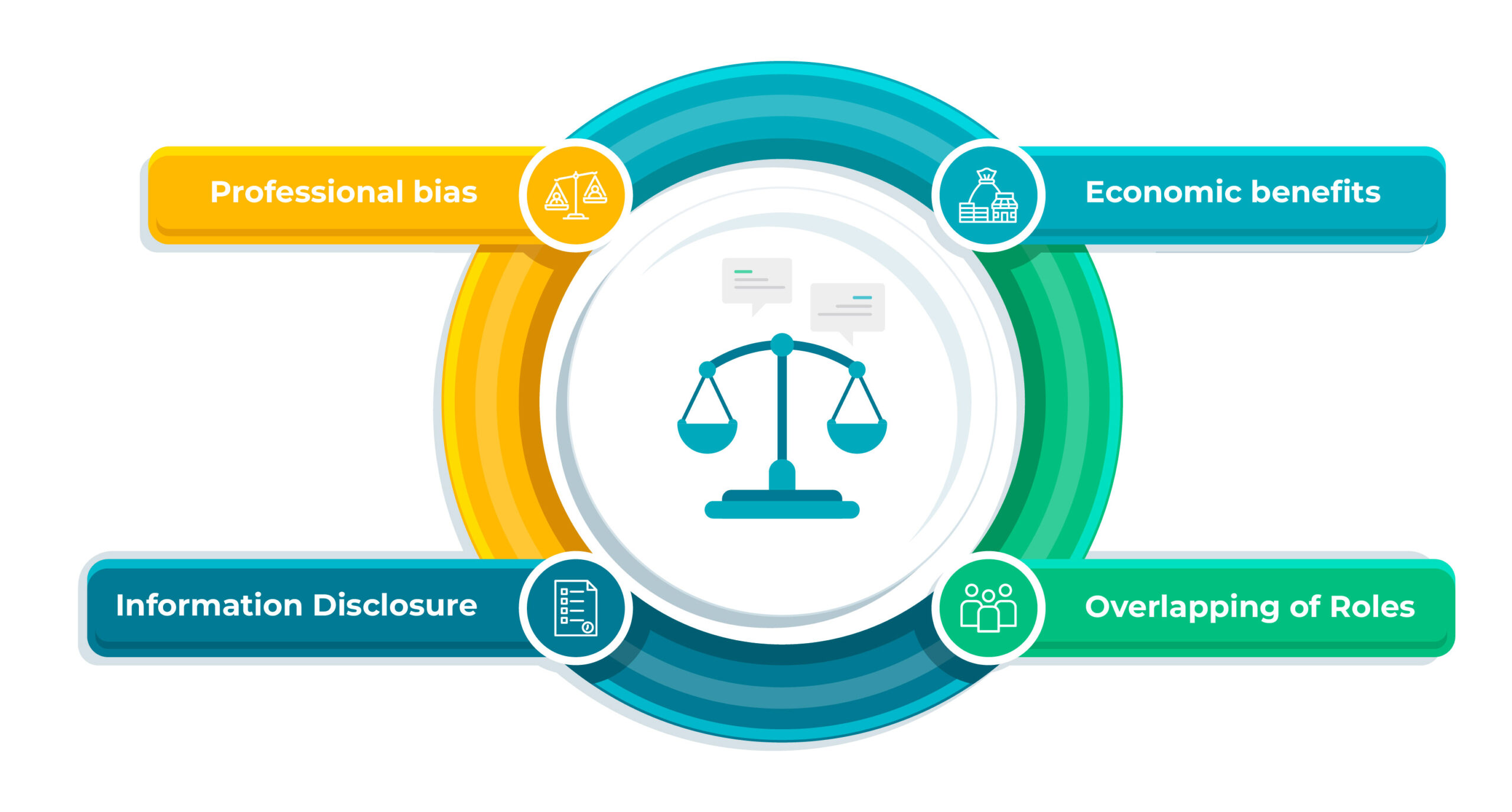
However, this also raises doubts and confusions regarding the independence and impartiality of the Arbitrator, as well as other conflicts when a person simultaneously acts in different roles. These doubts often revolve around the possibility of preferential treatment due to professional bias or economic benefits, the risks of confidential information being disclosed, and the overlapping in the approaches since an individual could serve as both the “adjudicator”, as well as the “counsel”, etc. Therefore, transparent announcement mechanism, ethical standards, and strict regulations are required to regulate this issue, lest it leads to the decrease in the trust of the parties in arbitration, or in worse scenarios, the setting aside of the arbitral award and or loss of the award’s enforceability.
The doubts regarding Double-hatting
Due to the above, there exist many arguments revolving around whether cases of “double-hatting” should exist. In practice, besides debates of hypothetical nature, instances of “double-hatting” also exist in arbitration cases.[4] The foremost reasons are the demands for the continuance of professional activities, as well as the absence of absolute prohibitions in the majority of the current legal system and the arbitration rules. This causes “Double-hatting” to be considered both an “inevitability” and a common dilemma regarding the independence and impartiality of the Arbitrator.
In Vietnam, Law on Commercial Arbitration 2010 (“Law on TTTM 2010”), the primary law that govern arbitration activities, has yet to provide for this issue directly. However, this legal document does indirectly address the issue by setting out mandatory requirements for the Arbitrator and other parties who participate in the arbitration through provisions on the independence, impartiality, information disclosure respectively in Article 4, Article 20, Article 42 of Law on TTTM 2010.
Common types of double-hatting
Currently, it is rather difficult to pinpoint the occurrence frequency of “double-hatting” due to shortage of statistics. However, from the available data, it could be observed that the number of double-hatting cases in arbitration cases is quite significant. Accordingly, in international arbitration, a research analyzing 1077 arbitration cases (either ended or currently ongoing as of 01/01/2017) conducted in 2017 has concluded that double-hatting is observed in approximately 58% of the cases[5].
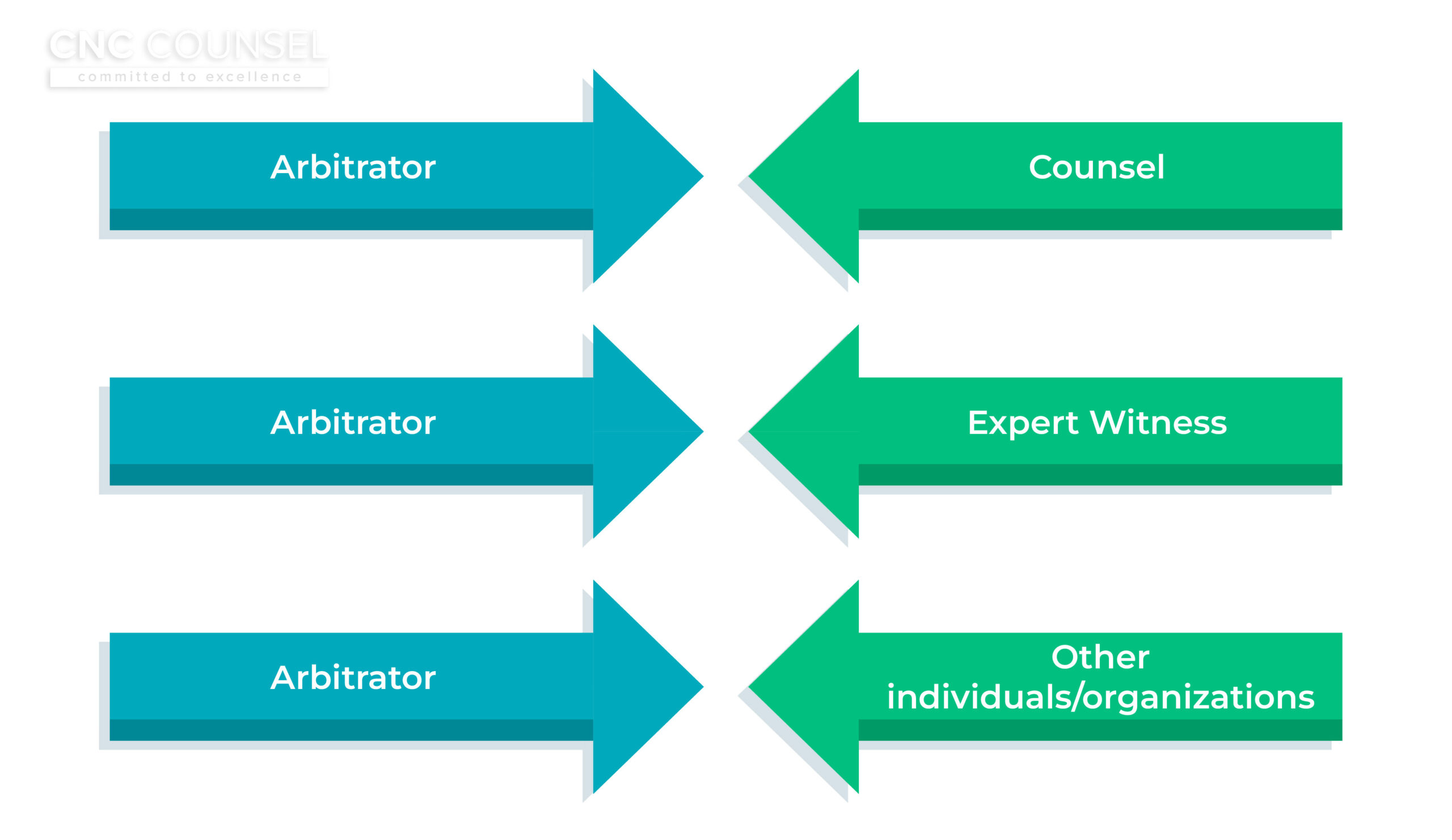
Among which, the most common types of double-hatting are categorized into 3 primary groups: Arbitrator – Counsel Double-hatting, Arbitrator – Expert Witness Double-hatting, Arbitrator – Others Double – Hatting.
Arbitrator – Counsel Double-hatting
The most common and debatable type of double-hatting is when an individual serve as an arbitrator for one case, while also serve as the Counsel in another arbitration case. This put the objectivity and impartiality of the person who assumed these roles into questions since the legal perspectives presented by that person when they are serving as the counsel could affect their judgments when they serve as the arbitrator, which could result in bias during the adjudication process.
Furthermore, the parallel nature of these two roles also carries the risks of conflicts of interest. For example, a lawyer who is currently defending his/her client might also serve as the Arbitrator in another case where the disputing parties/counsels are overlapped or there are overlapping details. An exemplary case would the Malaysia V Ghana case[6]. The Respondent challenged the Arbitrator appointed by the Claimant since that Arbitrator is the counsel of the Plaintiff in another arbitration case. This leads to doubts from the parties regarding the possibility of the Arbitrator could be influenced by the professional bias. Moreover, the accessibility to a large volume of documents and evidence also raise the issue of information confidentiality, since the person in question could either inadvertently or intentionally use the information obtained from one case in another case.
Arbitrator – Expert Witness Double-hatting
An individual participating as the Expert witness of one case then immediately serve as the Arbitrator in another case is another situation that raises people’s doubts. With in-depth expertise, these witnesses would often provide evaluations or technical perspectives that would guide the Arbitral Tribunal. The issue in question is that when such a person assumes the role of the adjudicator in another case. In that case, the previously stated opinions could affect the objectivity of the arbitrator during the evidence inspection and evaluation process. For instance, in the case of Vito Gallo v Canada[7], the Claimant challenged the Arbitrator appointed by the Respondent since that Arbitrator has once served as the counsel for another country (not a party to the dispute), who is also a member of NAFTA similar to the disputing party, and this could lead to the perception of “judgment may appear to be impaired by the potential interest of the advised State Party in the proceedings”
Aside from the risk of skewed perception, having such dual role also raises the disputing parties’ doubts regarding the neutrality. Being both the “explainer” and the “adjudicator”, one could hardly escape the assumption that the judgments could be influenced by the previously established opinions. Furthermore, the possibility of conflict of interest still remains if the parties in the previous arbitration cases directly or indirectly related to the current case.
Arbitrator – Other Double-hatting
Aside from profession-related conflicts, the personal or organizational relationship of the Arbitrator is also a source of scrutiny. For example, Arbitrators who have close relationship with the disputing parties, history of collaboration with the lawyer of either party, or membership in a organization whose interests are affected by the result of the case. These relationships, whether direct or indirect, would raise doubt regarding the possibility of preferential treatment and partiality during the dispute resolution process.
Another risk is the financial or professional benefits of the Arbitrator. For example, if the Arbitrator holds shares in an enterprise related to one of the disputing parties, or holds a position within an organization that is closely connected to the case, that Arbitrator’s independence and impartiality would be put under suspicion. To illustrate, in the Canepa v Spain case[8], the Respondent challenged the Arbitrator appointed by the Claimant since this Arbitrator is related to the third-party funder, and the lack of the disclosure of this information by the Arbitrator demonstrate the lack of impartiality or independence. In these cases, if the issue is not disclosed and addressed in a timely manner, it could become a ground for one party to request for replacement of Arbitrator or the setting aside of the arbitral award.
Solutions for Double-hatting in arbitration
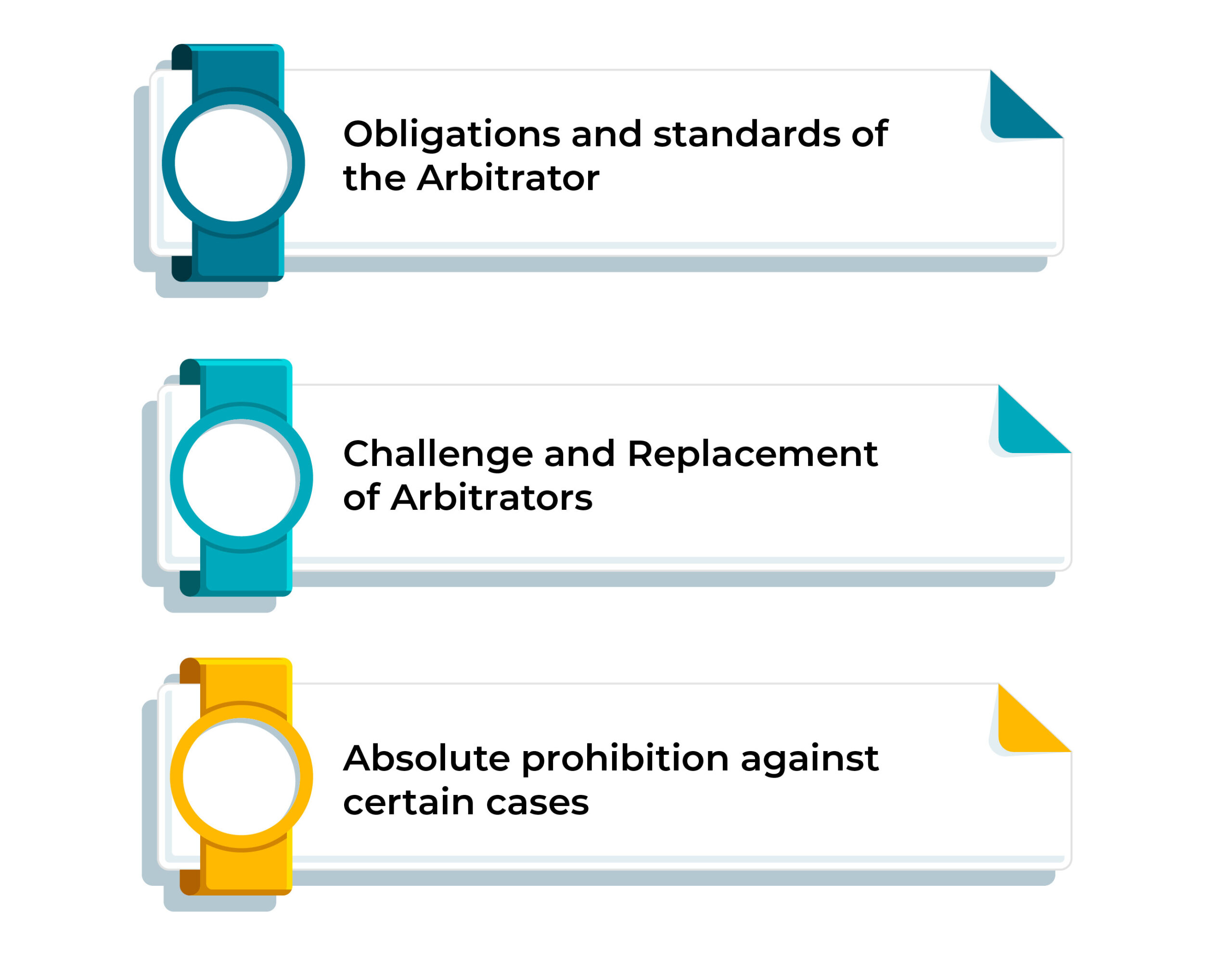
Obligations and standards of the Arbitrator
International laws
One of the most important mechanisms for mitigation of risks from “double-hatting” is the establishment of disclosure obligations and mandatory requirements for the Arbitrator. Accordingly, an Arbitrator is obliged to disclose all other professional roles that are currently undertaken by that Arbitrator, including acting as the lawyers, experts, or witnesses in other cases. This disclosure obligations allow the parties to have necessary information to evaluate potential conflicts of interest and give their decision on whether to accept the participation of the Arbitrator.
Moreover, many arbitration institutions have also set out the mandatory ethical requirements and practice standards for the Arbitrator. Accordingly, a person must satisfy these ethical requirements and practice standards to become an Arbitrator. Concurrently, during the arbitration process, the arbitration institutions shall also set out requirements and conduct supervision to ensure that the Arbitrators maintain their independence and impartiality, as well as, avoiding any action that could affect the fairness of the adjudication process.
In particular, the issuance of the guidelines or equivalent documents plays an important role in the establishment of “standards” for parties participating in the arbitration. Among which, the most notable is the IBA Guidelines on Conflicts of Interest that have been widely used in both commercial arbitration and international investment arbitration since 2004. Accordingly, aside from the provision of general principles of disclosure, these IBA Guidelines also provide 3 lists of practical application that cover scenarios that might take place in practice. These lists are the detailed instructions for the parties participating in the arbitration on cases that could cause conflicts of interest or situations where Arbitrator should disclose information.
Recently, the Code of Conduct[9] of ICSID and UNCITRAL published in 2024 could be considered a significant progression in the establishment of the general standards, the enhancement of the transparency, and the reduction of the possibility of conflicts of interest. To be specific, Article 4 of the Code of Conduct set the limitations on the undertaking of multiple roles by specifying that the arbitrator could not simultaneously be the legal representative or expert witness.
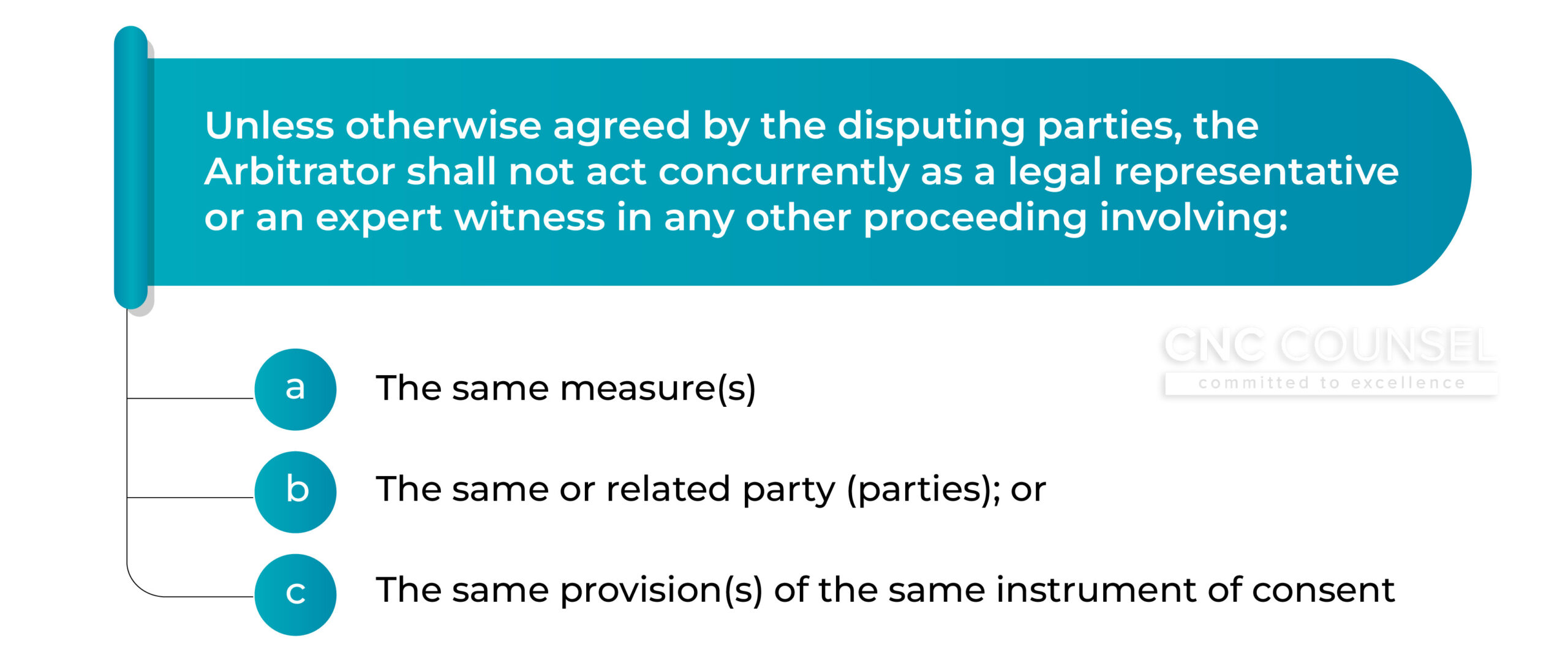
Limitations in the undertaking multiple roles by the Arbitrators
The Laws of Vietnam
In Vietnam, the laws also inherit the spirit of international arbitration laws. Accordingly, one of the fundamental principles in dispute resolution via arbitration is that the Arbitrator shall be impartial, independent, and objective[10]. Specifically, to ensure one’s impartiality and objectivity, the Arbitrator shall not be involved in conflicts of interest with the parties, or with the lawyers of the parties, or with other Arbitrators.
To ensure such independence and impartiality, Article 20 of Law on TTTM 2010 has provided in details on the standards for the Arbitrator and a person appointed to become the Arbitrator must also satisfy the mandatory requirements in accordance with the laws to assume this role. Furthermore, Article 42(2) of Law on TTTM 2010 also provided that: “[…] Arbitrators shall provide a written notice to the Arbitration institutions or the Arbitral Tribunal on the issues that might affect their impartiality and objectivity”. This is the adoption of Article 12, UNCITRAL Model Law on International Commercial Arbitration.
In addition to the laws, arbitration institutions, which include the Vietnam International Arbitration Center (“VIAC”), also establish the mechanisms and specialized management tools in order to effectively regulate and address conflicts of interest, especially double-hatting, thereby contributing to the assurance of independence, transparency, and integrity in arbitration.
First and foremost, VIAC Arbitration Rules (“VIAC Rules”) clearly demonstrate the principles on the Arbitrator’s independence and impartiality through strict regulations. Article 16 of VIAC Rules provides a list of mechanisms that ensure the independence and objectivity of the Arbitrator throughout the arbitral proceeding, such as the obligations to provide timely notice on any issues that could affect the impartiality and obligations to not concurrently acts as the lawyers for any parties, as well as detailed provisions of cases where an individual shall not be qualified to become the Arbitrator if there exist conflicts of interest or signs of impartiality
Moreover, the Arbitrator’s Statement enclosed with Decision No. 103/QD-VIAC dated 01/06/2022 of the President of Vietnam International Arbitration Center[11] is an important legal tool, established based on the selective inheritance of IBA Guidelines on conflicts of interest and appropriate adjustments to ensure conformity to Vietnam’s practice.
Accordingly, prior to the official participation in any arbitration case at VIAC, any person who has the Arbitrator role must perform the due diligence and make full and detailed disclosure of any previous and current relationship with any disputing party and their representative, as well as any issue that could raise doubts regarding neutrality. The Statement also categorizes the conflicts of interest into three groups:
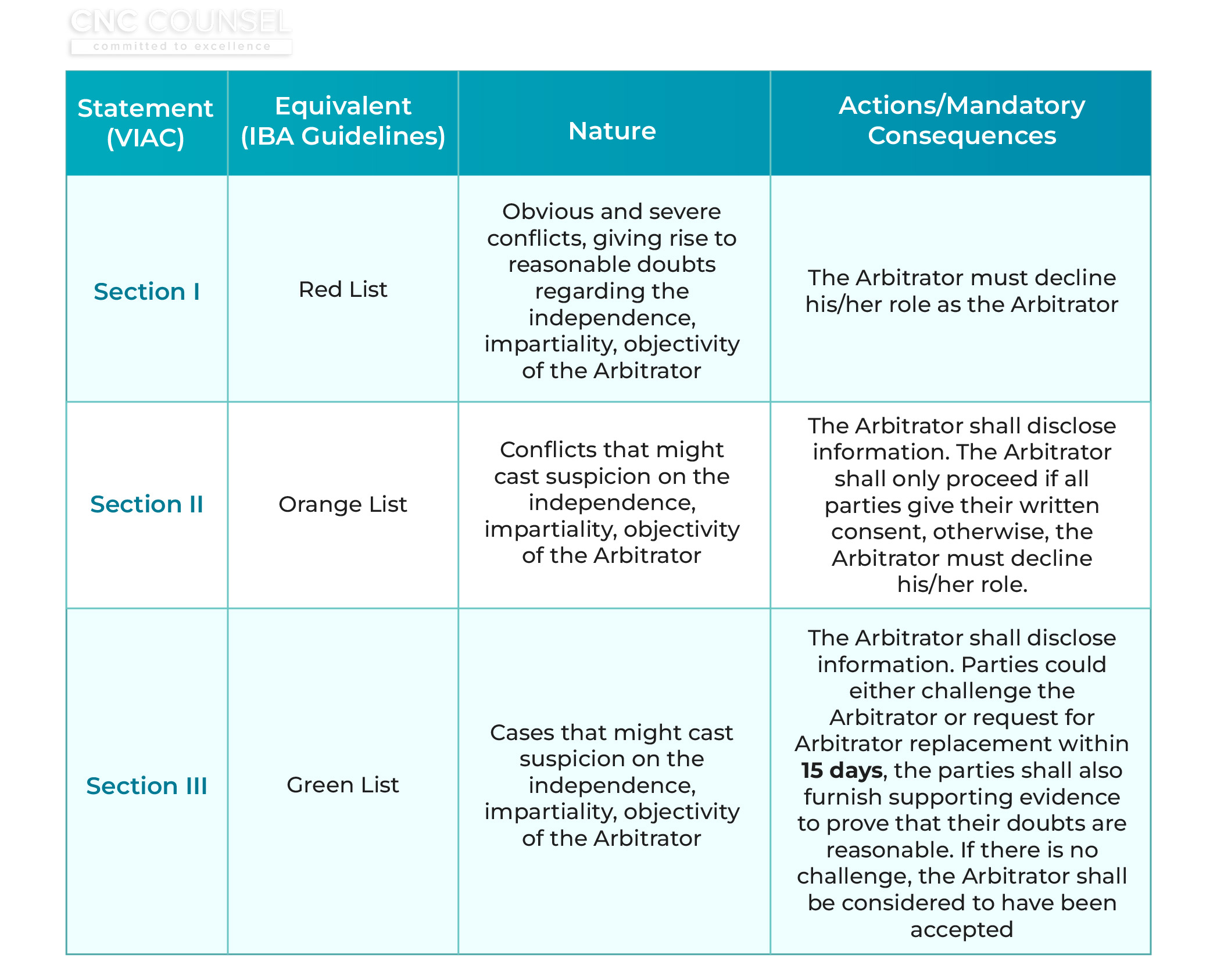
Once a person has accepted the role of an Arbitrator, that person must commit to not act as a lawyer or a representative of any party in that dispute, and must resolve the case in a diligent, expeditious, and efficient manner. The person taking on the role of an arbitrator shall be fully responsible for the failure to comply with the commitments, and such failure could result in severe consequences such as arbitrator replacement or setting aside of the arbitral award due to breach or arbitration procedures.
Challenge and replacement of Arbitrators
Aside from the obligations of the Arbitrator, disputing parties are also given rights to proactively protect their interests through the mechanisms for challenge and replacement of Arbitrator. Once signs of conflicts of interest are detected, such as the Arbitrator also concurrently serving as the lawyer in a related case, parties could request the arbitration institution to consider and issue a decision on arbitrator replacement. This mechanism both ensures the parties’ freedom in the selection of Arbitrator, and consolidates the faith of the parties in the fairness of the dispute resolution process.
In practice, the challenge mechanism not only addresses obvious cases of violation, but also serves as a supervision tool, compelling the Arbitrator to be more cautious in their disclosure of information and maintaining of professional transparency. This contributes to enhance the integrity and legitimacy of the entire international arbitration system.
For international arbitration, this right is provided in the UNCITRAL Model Law on International Commercial Arbitration and in the arbitration rules of international arbitration institutions such as ICC, SIAC, LCIA, or the UNCITRAL Arbitration Rules
To be specific, Articles 12 and 13 of the UNCITRAL Model Law allow one of the parties to challenge arbitrator if there exist circumstances that give rise to reasonable doubts regarding the independence and impartiality of arbitrator, or when the arbitrator does not meet the expertise requirements as agreed by the parties. The challenge procedures must be initiated within a certain time limit, starting from the moment the challenging party become aware of the ground for challenge, and the competent body (the Arbitral Tribunal or a body appointed by the arbitration institution) shall review and decide. Furthermore, Article 14 of the UNCITRAL Model Law also provides the replacement of arbitrator in the event that that arbitrator could not perform their duty or does not act in a timely manner.
Similarly, major international arbitration institutions also provide these issues in a detailed manner. The ICC Arbitration Rules (Articles 14 and 15), SIAC (Articles 15 and 16), LCIA (Article 10) and UNCITRAL Arbitration Rules (Articles 12 and 13) all affirms the rights to replace or challenge arbitrators based on reasonable grounds. These provisions contribute to the assurance of transparency, objectivity, and credibility of international arbitration proceeding.
In Vietnam, the rights to challenge and replace arbitrators are specified in Article 42 of the Law on TTTM 2010. Accordingly, disputing parties could request for the replacement of arbitrator in one of the following cases: “(1) The Arbitrator is a relative or representative of one party; (2) The Arbitrator has an interest related to the dispute; (3) There is a clear ground to conclude that the Arbitrator is neither impartial nor objective; (4) The Arbitrator was a mediator, representative or lawyer of one party before the dispute is brought to arbitration for settlement, unless such is consented in writing by the parties. This provision is also provided in more details in the Articles 16 and 17 of the VIAC Arbitration Rules.
Absolute prohibition against certain cases
Although the majority of the international arbitration system does not fully prohibit “double-hatting”, there are some opt for a stricter approach: absolute prohibition. An exemplary case would be Court of Arbitration for Sport (CAS)[12], accordingly, it is completely forbidden for Arbitrators and Mediators to concurrently act as lawyers to ensure absolute impartiality in all sports cases, which is sensitive and viral in nature.
The application of absolute prohibition demonstrates the efforts of some organizations in the complete elimination of risks of conflicts of interests. However, this approach also sparks debates since it greatly reduces professional opportunities and resources of the experts Therefore, this solution is often applicable in unique fields, where the impartiality and credibility of dispute resolution mechanisms are considered of paramount important, such as international sports or investment disputes that involves significant political or economic matters.
In Vietnam, the laws on Arbitration have yet to provide any mechanism for the absolute prohibition of double-hatting. However, there do exist cases where the Arbitrator are not allowed to concurrently hold other roles such as arbitration cases involving the European Union–Vietnam Free Trade Agreement (EVFTA)[13]
Conclusion
Double-hatting could be considered an inevitable practice in arbitration. While there are undeniable merits, there also exists certain doubts regarding the impartiality and objectivity. Therefore, it would be well-advised to place more emphasize on this issue prior to the initiation of any arbitral proceeding, and such an issue should be regulated by transparent regulations and strict ethical standards to maintain the fairness and credibility of arbitration as a whole.
Managed by
 |
Tran Pham Hoang Tung I Partner
Phone: (84) 901 334 192 Email: tung.tran@cnccounsel.com |
 |
Nguyen Le Anh Thu | Legal Assistant
Phone: (84) 932 705 676 Email: thu.nguyen@cnccounsel.com |
 |
Nguyen Thi Hong Nhung I Collaborator
Phone: (84) 347 924 900 |
Contact
For more information, please contact:
CNC Vietnam Law Firm Co., Ltd
Address: 2A1 Nguyen Thi Minh Khai, Sai Gon Ward, Ho Chi Minh City
Phone: 028 6276 9900
Hotline: 0916 545 618
Email: contact@cnccounsel.com
Website: cnccounsel
We would be honored if you could visit CNC’s office, where you can directly share your circumstances with the best-suited Lawyer for your specific case. Naturally, in the event that you could not make arrangement for direct meeting, you could also send an email to us via the address contact@cnccounsel.com or call (+84-24) 6276 9900
Disclaimer
This information is prepared or used for the purposes of introducing or updating clients of the issues and/or developments of the legal perspective in Vietnam. The information in this article shall not constitute a legal advice of any kind and could be changed without notice in advance.
————————————
[1] ICSID, Code of Conduct – Background Papers, Double-hatting, https://icsid.worldbank.org/sites/default/files/Background_Papers_Double-Hatting_(final)_2021.02.25.pdf, accessed on 10/09/2025
[2] Dennis H. Hranitzky and Eduardo Silva Romero, ‘The ‘Double Hat’ Debate in International Arbitration’ (2010) New York LJ.
[3] Mauro Rubino-Sammartano, Double Hatting, https://www.lexology.com/library/detail.aspx?g=c458ef3c-ca44-4f36-a3cc-9416da3d0c22, accessed on 10/09/2025
[4] Mauro Rubino-Sammartano, Double Hatting, https://www.lexology.com/library/detail.aspx?g=c458ef3c-ca44-4f36-a3cc-9416da3d0c22, accessed on 10/09/2025.
[5] Malcolm Langford, Daniel Behn, Runar Hilleren Lie, The Ethics and Empirics of Double Hatting, https://www.researchgate.net/publication/319562787_The_Ethics_and_Empirics_of_Double_Hatting, accessed on 01/10/2025.
[6] Telecom Malaysia v Ghana, https://www.italaw.com/sites/default/files/case-documents/ita0922.pdf, accessed on 02/10/2025.
[7] Vito G. Gallo v Government of Canada, https://www.italaw.com/sites/default/files/case-documents/ita0352.pdf, accessed 02/10/2025.
[8] Canepa v Spain, https://www.italaw.com/sites/default/files/case-documents/italaw11108.pdf, accessed on 02/10/2025.
[9] See more at: https://icsid.worldbank.org/resources/code-of-conduct.
[10] Article 4.3, Law on TTTM 2010
[11] Arbitrator’s Statement, https://www.viac.vn/images/Arbitration/Administered-of-Arbitration/Arbitrator-Statement/[VIAC]-Ban-Tuyen-bo-cua-TTV.pdf, accessed on 31/10/2025.
[12] Article S18, CAS Arbitration Rules
[13] Article 3.40 of the EU Vietnam Investment Protection Agreement (EVIPA), which reads:
“The Members of the Tribunal and of the Appeal Tribunal shall be chosen from persons whose independence is beyond doubt. They shall not be affiliated with any government.1 They shall not take instructions from any government or organisation with regard to matters relating to the dispute. They shall not participate in the consideration of any disputes that would create a direct or indirect conflict of interest. In doing so, they shall comply with Annex 11 (Code of Conduct for Members of the Tribunal, Members of the Appeal Tribunal and Mediators). In addition, upon appointment, they shall refrain from acting as counsel or as party-appointed experts or witnesses in any pending or new investment protection dispute under this or any other agreement or under domestic laws and regulations.”