




The aviation legal framework of Vietnam has recently undergone a historic reform with the enactment of the Law on Civil Aviation 2025, along with 05 Decrees and 10 Circulars providing guiding implementation details, which will be drafted and submitted to the competent authorities for promulgation by the Civil Aviation Authority of Vietnam in 2026 [1].
As of the date of this article (July 2026), the Law on Civil Aviation 2025, together with Decree No. 205/2026/ND-CP, Decree No. 208/2026/ND-CP, Decree No. 215/2026/ND-CP, Decree No. 221/2026/ND-CP, Decree No. 222/2026/ND-CP, and Decree No. 223/2026/ND-CP, have simultaneously entered into force as of 1st July 2026. These legislative amendments are aimed not only at modernizing the civil aviation sector but also at ensuring harmonization with the Law on Land 2024 (as amended), the Law on Investment 2025, and other specialized legal instruments.
This Article analyzes several groundbreaking statutory updates introduced under the civil aviation regulatory framework of 2026, alongside the commercial opportunities arising from this new legal framework that both domestic and international investors should consider when entering this high-potential market.
I/ A paradigm shift in state governance: From centralization to specialized oversight
For nearly two decades, Vietnam’s aviation sector operated under a centralized model where the Ministry of Transport (MOT) served as the sole “conductor” for everything from flight safety to infrastructure investment. The most significant structural change is the elevation of the Ministry of Construction (MOC) to a leading role in the state management of airport investment and construction. However, as the demand for aviation infrastructure surged, this model revealed limitations regarding the specialized expertise required for complex civil construction projects. A shift is now underway with the introduction of the 2025 Law on Civil Aviation and its accompanying implementing decrees; one of the most significant changes is the designation of the Ministry of Construction as the lead agency assisting the Government in exercising unified state management over airports. Under the new framework, the Civil Aviation Authority of Vietnam (CAAV) is now specified as the specialized authority under the MOC for performing aviation safety functions specifically related to airport infrastructure.
This ensures that airport projects are scrutinized under rigorous national construction standards and urban planning regulations, effectively resolving the “standard overlap” that previously stalled major infrastructure developments.
1.The 2030 – 2050 vision: A Multi-hub aviation network
The Government of Vietnam has officially established a transformative roadmap for the national airspace under Decision No. 648/QD-TTg dated June 7, 2023 of the Prime Minister approving the Master Plan on Development of the National Airport and Airfield System for the 2021–2030 Period, with a Vision to 2050; and Decision No. 1140/QD-BXD dated July 1, 2026 of the Ministry of Construction, approving the adjustments to the Master Plan on the National Airport System for the 2021–2030 Period, with a Vision to 2050. This pivotal shift in the 2026 regulatory framework extends far beyond mere transport operations; it represents a multi-sectoral economic blueprint coordinated under the auspices of the Ministry of Construction.
The adjusted Master Plan on the National Airport System outlines key ambitious targets for Vietnam, including the operation of 36 airports by 2030, comprising 19 international and 17 domestic airports. Under this Master Plan, the primary focus lies on major gateway airports, namely Noi Bai and Gia Binh in the North, alongside Tan Son Nhat and Long Thanh in the South. The Master Plan also ensures that over 95% of the population will have access to an airport within a 100-kilometer radius.
II/ Groundbreaking reforms in the 2026 Civil aviation regulatory framework
- Transformation of the ransformation of the land management model: Professional airport infrastructure developers and operators
Pursuant to Point dd Clause 2 Article 104 of the Law on Civil Aviation 2025, the entirety of Article 208 of the Law on Land 2024 has been amended to permit provincial-level People’s Committees to directly lease land with annual rental payments to airport enterprises for the construction of terminals, aviation service facilities, and non-aviation service facilities.
Furthermore, Clause 4 Article 208 stipulates: “Airport investors and airport enterprises are entitled to sublease land under the form of annual land rental payments…” This constitutes the most critical regulatory development by explicitly establishing the “Right to Sublease Land” for airport enterprises.
Previously, the Airport Authority (“AA”) acted as an intermediary in land management and leasing, leaving airport enterprises in the position of “sublessees” and depriving them of autonomy in developing adjacent land funds. The new regulations permit airport enterprises to lease land directly from provincial-level People’s Committees and grant them subleasing rights. This provides enterprises with the regulatory mechanisms and resources needed to truly become professional infrastructure developers, enabling them to mobilize socialized capital from secondary investors to develop an (“Airport City“) ecosystem, which includes components such as hotels, commercial centers, and logistics facilities.
2. Resolving procedural bottleneck: exemption from in-principle investment approval
Article 30 of the Law on Civil Aviation 2025 establishes a landmark exception: Investment projects for the expansion or upgrading of facilities within an airport, which are located on land leased by the State and comply with the detailed master plan, are now exempt from the in-principle investment approval procedures.
Previously under the former Law on Investment, even minor upgrade items within airport boundaries were required to undergo the in-principle investment approval process by competent authorities, causing delays that dragged on for years. The new regulations enable airport enterprises to proactively execute projects immediately after the investment plan is approved by the Ministry of Construction pursuant to Article 37 of Decree No. 205/2026/ND-CP. This milestone development effectively reduces procedural preparation time by at least 6 to 12 months.
3. Dual-use land mechanism: Resolving conflicts between civilian and defense land use
Also under Article 30 of the Law on Civil Aviation 2025, airport enterprises are now permitted to construct new facilities or upgrade existing dual-use facilities on national defense and security land without undergoing land-use purpose conversion procedures.
In practice, upgrading taxiways on military land was previously extremely complex due to hurdles in land-use conversion procedures. This new mechanism maintains the existing status of national defense land while still permitting civil exploitation. However, Clause 3 Article 41 of Decree No. 205/2026/ND-CP explicitly stipulates that upon project expiration, the assets must be transferred to the State, and compensation shall only be reimbursed at the remaining net book value as verified by audited accounting records.
4. Resolving the regulatory gap regarding transitional land managed by airport authorities
Practice shows that thousands of hectares of cleared land are currently “on hold” under the temporary management of Airport Authorities, left unexploited due to various legal bottlenecks.
Currently, Article 96 of Decree No. 102/2024/ND-CP and the transitional provisions under the Law on Civil Aviation 2025 have resolved these bottlenecks. Specifically, they authorize provincial-level People’s Committees to reclaim such land areas from the Airport Authorities and lease them directly to airport enterprises. This effectively eliminates the legal deadlock over “on-hold” land, unlocking valuable land resources for productive investment and development.
5. Abolition of administrative pricing mechanism in favor of market-based agreement
Historically, the State maintained fixed rental rates for airport premises, which diminished investment attractiveness and failed to reflect the true commercial value of individual locations within airports. However, in line with the development of the market economy, the new Law has abolished State-regulated pricing for premises leases and essential services. Airport enterprises now hold the autonomy to formulate their own pricing schemes based on investment costs and commercial advantages.
III/ Decoding the next-generation airport investment ecosystem
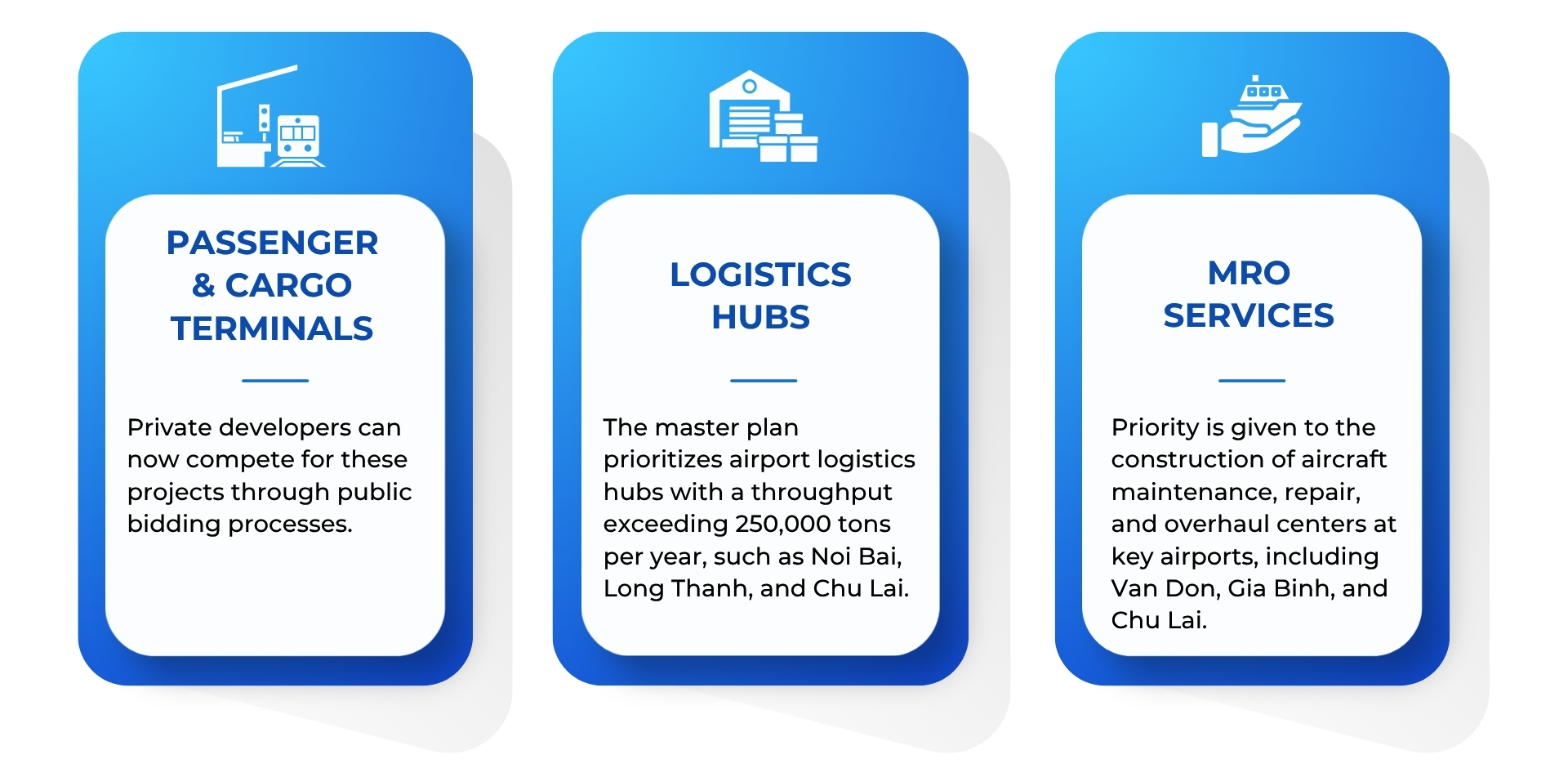
The greatest bottleneck of the Law on Civil Aviation 2006 lay in its ambiguous classification of airport facilities. However, Decree No. 205/2026/ND-CP on airports and airfields, which entered into force on July 1, 2026, has revolutionized the sector by providing a detailed classification of “essential infrastructure” and “aviation service facilities.” For private investors, the most remarkable highlight resides in the investor selection mechanism. If an airport enterprise lacks the capacity to invest in service facilities (such as passenger terminals, cargo terminals, or fueling systems) in accordance with the approved master plan, the State shall conduct a public bidding process to select an alternative investor.
This regulation directly resolves historical bottlenecks, unlocking a golden opportunity for professional infrastructure developers to participate in high-profit segments, such as aviation logistics hubs or Maintenance, Repair, and Overhaul (MRO) hangars. Notably, for international airports, the construction of cargo terminals is now strictly regulated, requiring locations that do not adjoin or directly connect to the aircraft apron to ensure security. This structural requirement drives a substantial demand for automated internal airport transport technology solutions.
The new guiding Decrees to the Law on Civil Aviation 2025 have introduced competitive, transparent, and public investment rules, while creating numerous investment opportunities in service facilities for interested enterprises and investors. The Law on Civil Aviation 2025 now mandates public bidding for non-essential infrastructure facilities if the primary airport enterprise fails to execute them in accordance with the approved Master Plan. This opens the door for private capital to enter highly lucrative segments, including:
Sponsoring master plan: a strategic starting point
For the first time, the law permits organizations to sponsor master plans by providing airport planning dossiers as non-refundable products. This offers a strategic opportunity for major investors to proactively propose and shape the technical landscape of future projects, provided that transparency and public interests are safeguarded.
Furthermore, provincial-level People’s Committees are now empowered to propose new airports within their respective provincial master plans, on the condition that non-state budget capital is mobilized for investment and construction. This decentralization allows investors to cooperate directly with local authorities to develop specialized regional airports.
IV/ Raising the standards of the air transport industry
While the Law on Civil Aviation 2025 opens its doors to infrastructure investment, the new regulatory framework tightens financial and operational discipline for air transport operations. Decree No. 208/2026/ND-CP establishes a technical barrier regarding minimum equity, which is strictly tied to fleet size to mitigate systemic risk, specifically:
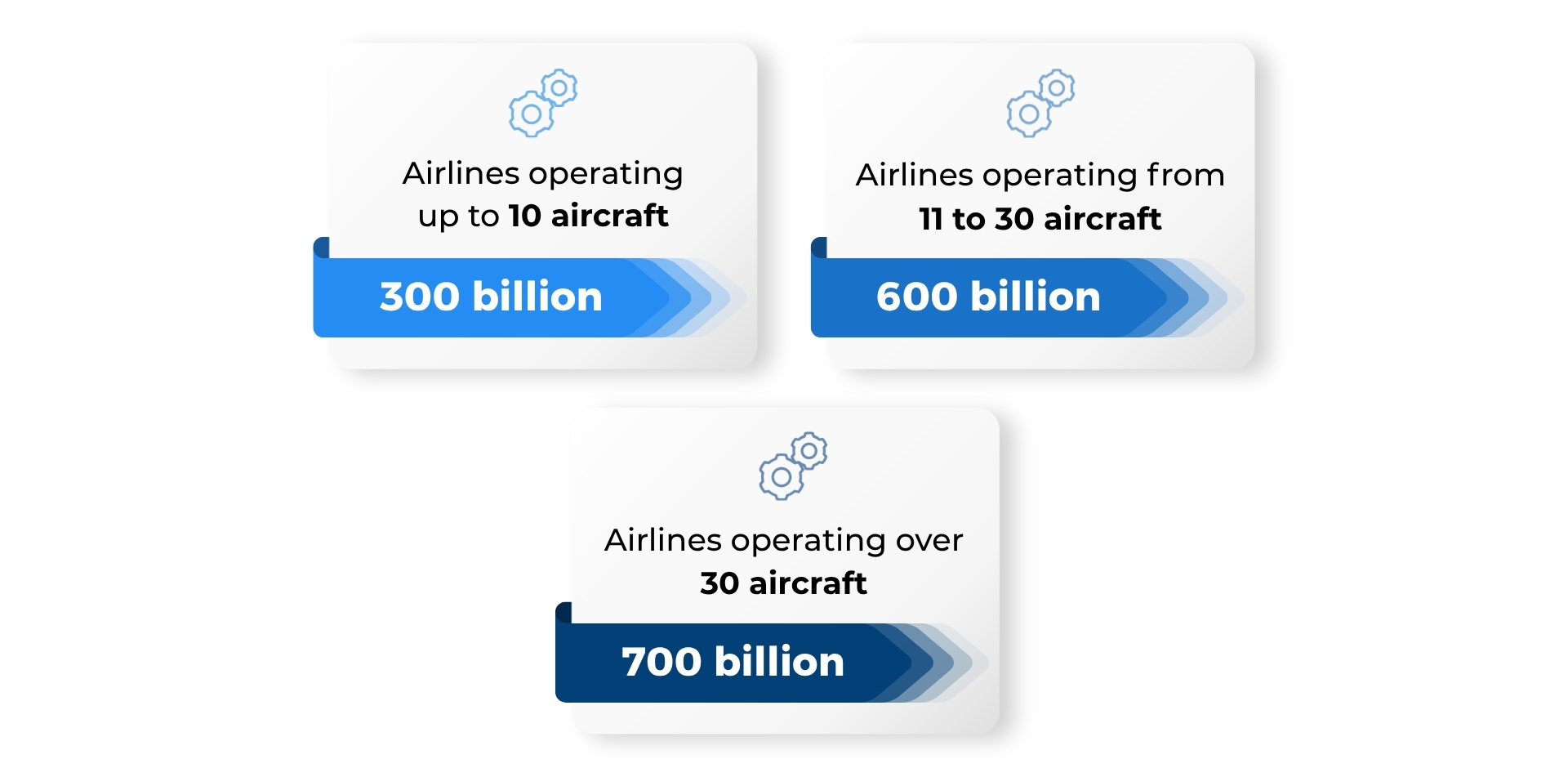
Most importantly, investors must comply with the regulation on “Maintaining equity thresholds for three (03) consecutive years.” Failure to meet these capital thresholds at any point during the initial three-year period shall result in the immediate revocation of the business license. This sends a strong message from the Government of Vietnam: it welcomes only investors with long-term and substantive financial commitment.
Regarding foreign ownership, the cap remains maintained at 34%, but the new law emphasizes the controlling role of the Vietnamese side. The largest shareholder must be a Vietnamese legal entity that is not controlled by foreign parties. This ensures national security while continuously leveraging international capital and technology.
V/ General aviation: the “blue ocean” of specialized airfields
One of the limitations of the Law on Civil Aviation 2006 was its oversight of the General Aviation sector and airfields located outside major airports. Currently, the Law on Civil Aviation 2025 and its guiding instruments, such as Decree No. 205/2026/ND-CP, have formalized “specialized airfields” on land, water surfaces, and even artificial structures (such as oil rigs or high-rise rooftops) under a clearer regulatory framework.
Unlike commercial airports, these airfields can be constructed on land, water surfaces, or artificial structures (oil rigs, high-rise buildings). This creates a niche market for corporate aircraft operators, helping to bypass congestion at major airports and fostering a specialized surrounding economic service ecosystem, ranging from agriculture and oil and gas to rescue operations and luxury tourism.
This signals a booming opportunity for helicopter services, air taxis, and specialized flights serving agriculture, oil and gas, or luxury tourism. The approval process for the location and design of these airfields has now been clearly decentralized, with the Ministry of Defense presiding over security positioning and the Civil Aviation Authority of Vietnam governing flight technical standards.
For major industrial conglomerates or hospitality real estate investors, owning a private specialized airfield is no longer a distant prospect, enabling them to optimize supply chains and elevate service quality. Above all, this provides infrastructure flexibility and immense economic advantages for enterprises operating in tourism, real estate, hospitality, or catering to ultra-high-net-worth clients. Accordingly, resort or industrial park investors can now integrate private aviation infrastructure directly into their assets, significantly multiplying asset value due to the convenience it provides.
VI/ International standard safety and security
In the context of increasingly complex global aviation security developments, Decree No. 215/2026/ND-CP codifies a three-tiered security risk assessment system. This allows competent authorities to deploy proportionate and flexible response measures, preventing the overextended application of stringent security controls that would otherwise deplete valuable resources.
Regarding safety, Decree No. 221/2026/ND-CP mandates that all operational entities (ranging from airlines to catering and fueling service providers) implement a Safety Management System (SMS) approved by the Civil Aviation Authority of Vietnam. A groundbreaking mechanism has also been introduced through the “Voluntary Reporting” system. The State encourages aviation personnel to proactively report potential risks without fear of disciplinary action, aiming to foster a substantive “safety culture” rather than a compliance-heavy, administrative-based culture.
VII/ Digitalization and administrative reform toward a “Paper-Less Aviation” roadmap
To realize the objective of transforming Vietnam into a regional aviation hub, the Law on Civil Aviation 2025 places digitalization at its core. The new regulatory framework mandates the receipt and processing of applications in electronic environments. Digital signatures and electronic data now hold equivalent legal validity to physical documents across all procedures, from aircraft nationality registration to airport slot applications.
The turnaround time for administrative procedures has also been impressively reduced. For instance, amending aircraft registration details or reissuing lost or damaged licenses now takes only three (03) to five (05) working days. This represents a major leap forward, minimizing opportunity costs for investors and enhancing operational flexibility for fleet management.
VIII/ Recommendations for international investors
Based on the profound transformations detailed above, investors should monitor and consider the following strategic recommendations to capture market opportunities in Vietnam:
- Monitor Shifting Local Master Plans: Closely track provinces that are upgrading domestic airports to international status or proposing specialized airfields. The expansion of regions like Chu Lai or Van Phong offers immense multimodal logistics potential.
- Proactively Participate in Master Planning: Investors are entitled to sponsor master plans by providing airport planning dossiers as non-refundable products. Participating at an early stage allows investors to thoroughly understand infrastructure development orientations and build the necessary capacity to bid for promising aviation service facilities in alignment with international operational standards.
- Prioritize Integrated Logistics Models: Given the new classification of service facilities, projects that integrate air cargo warehousing with value-added services (logistics centers) will emerge as the new “gold mines”.
- Focus on Cold Chains and High-Tech Cargo: With the new design and security standards for cargo terminals (requiring non-direct connectivity to the apron), the demand for automated warehousing technology and cold logistics is substantial. Investors should focus on cold-chain supply solutions, which are currently facing a critical shortage in Vietnam.
- Build Compliance Frameworks from Day One: Do not wait until the licensing phase to structure safety and security frameworks. Integrating international safety and security standards starting from the project design and personnel training phases will provide a major competitive edge when the CAAV conducts its actual capacity appraisals.
The new 2026 regulatory framework is not merely a adjustment of numbers; it represents a comprehensive paradigm shift from administrative command-and-control to governance based on standards and efficiency, creating a launchpad for Vietnamese aviation to take off. This new legal framework represents an infrastructure capital demand opportunity valued at USD 25 billion, and Vietnam is actively inviting smart, sustainable global capital flows to jointly scale its airspace.
IX/ What CNC can support?

- Foreign Direct Investment: Company establishment, Investment registration, and Post-registration compliance such as tax, accounting, labor, insurance, payroll, and Outsourced Legal Department services;
- Business Operating Licenses: We assist in obtaining operating licenses for specific business activities including manufacturing, trading, services, e-commerce, healthcare, education, or food & beverage (restaurants), etc.;
- M&A Services: Conducting Legal Due Diligence Reports; Structuring transaction frameworks; Drafting and Negotiating transaction documents; Advising on competition law compliance, including economic concentration control filings and related approvals; Obtaining necessary approvals and licenses; and Post-closing support;
- Personal Data Protection: Support in complying with personal data protection regulations, including drafting and reviewing Data Protection Impact Assessments (DPIAs), Data Processing/Transfer Agreements, Privacy Policies, and other required documents under the Personal Data Protection Law (PDPL);
- Dispute Resolution: Court litigation and commercial arbitration (VIAC, SIAC, ICC); and
- Legal Retainer Services.
Please feel free to contact Mr. Chris Luong – Partner via email: chris.luong@cnccounsel.com or Ms. Ngan Nguyen – Partner via email: ngan.nguyen@cnccounsel.com for further support.
Contact Us
 |
Nguyen Thi Kim Ngan I Partner
Phone: (84) 919 639 093 Email: ngan.nguyen@cnccounsel.com |
 |
Luong Van Chuong I Partner
Phone: (84) 938 04 7969 Email: chris.luong@cnccounsel.com |
 |
Kieu Nu My Hao I Associate
Phone: (84) 28 6276 9900 Email: hao.kieu@cnccounsel.com |
 |
Bùi Thị Minh Phương I Legal Assistant
Phone: (84) 28 6276 9900 Email: phuong.bui@cnccounsel.com |
Liên hệ
Mọi thông tin vui lòng liên hệ:
CÔNG TY LUẬT TNHH CNC VIỆT NAM
Địa chỉ: 2A1 Nguyễn Thị Minh Khai, Phường Sài Gòn, TP. Hồ Chí Minh
Điện thoại: 028 6276 9900
Hotline: 0916 545 618
Email: contact@cnccounsel.com
Website: cnccounsel
Copyright © CNC Counsel. All rights reserved. Ownership: This documentation and content (Content) is a proprietary resource owned exclusively by CNC Counsel. Use of this Content does not of itself create a contractual relationship, nor any attorney/client relationship, between CNC Counsel and any person. Disclaimers: The Content provided is for informational purposes only and may not reflect the latest legal or regulatory developments. Summaries of laws, regulations, and practices are subject to change. This Content does not constitute legal or professional advice for any specific situation and should not be relied upon as a substitute for reviewing and complying with applicable laws, rules, regulations, or official forms. Always seek legal counsel before making any decisions or taking any action based on this Content. CNC Counsel, along with its editors and contributing authors, make no guarantees regarding the accuracy of the Content and explicitly disclaim any liability for any consequences resulting from actions taken, allowed, or omitted, whether fully or partially based on any part of the Content. The Content may include links to external websites, and external sites may also link to it. CNC Counsel is not responsible for the content or functionality of any such external websites and disclaims all liability for any issues arising from their content or operation. Please note: Past results do not guarantee similar outcomes.
[1] Read at: https://caa.gov.vn/hoat-dong-nganh/xay-dung-va-trinh-ban-hanh-15-van-ban-quy-pham-phap-luat-huong-dan-thi-hanh-luat-hang-khong-dan-dung-viet-nam-20260105160054346.htm