




08 standouts of Law on Construction 2025
Law on Construction 2025, which is promulgated by the National Assembly on 10/12/2025, shall take effect as of 01/07/2026 (with the exception of those that have already taken effect as of 01/01/2026)
In this article, CNC shall present 08 standouts of Law on Construction 2025 in comparison with Law on Construction 2014 (amended and supplemented) (hereafter abbreviated to as “Law on Construction 2014”), as prepared by Partner Tran Pham Hoang Tung and Junior Associate Pham Nguyen Tan Trung.
08 standouts of Law on Construction 2025
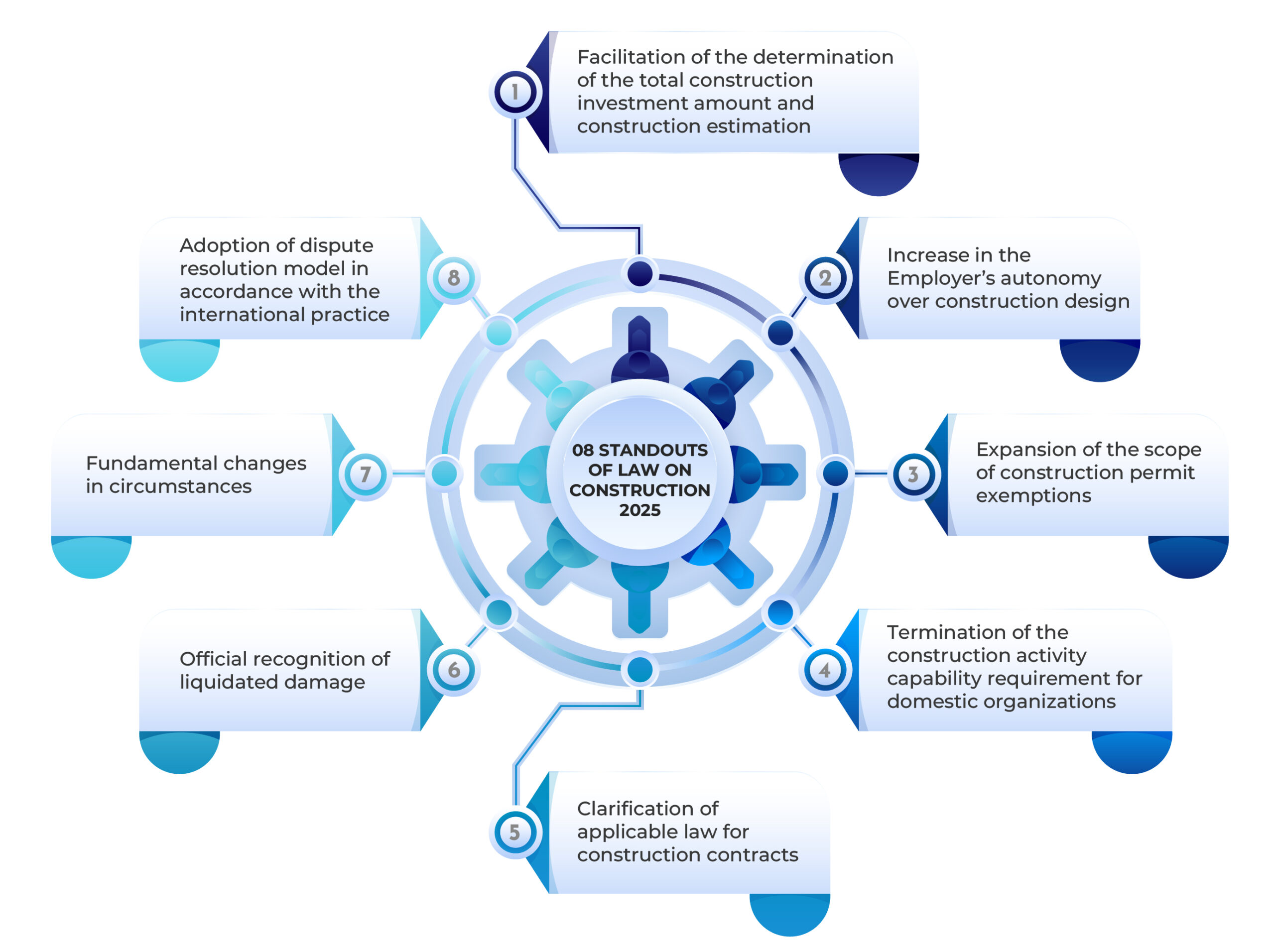
Download PDF file is here1. Facilitation of the determination of the total construction investment amount and construction estimation
Law on Construction 2014 provides that the total construction investment could be determined through the data on the cost of “similar completed constructions”.[1]
However, for projects/constructions that are implemented in Vietnam for the first time, the issue of whether it is reasonable to reference the cost of “similar completed projects” in foreign countries to determine the total construction investment amount of those projects/constructions is put into question.
While Law on Construction 2014 does not prohibit such action, practical observation shows that referencing the cost of “similar completed constructions” of foreign countries to determine the total construction investment amount is extremely difficult due to the absence of detailed legal frameworks. This greatly impedes the relevant parties, even the authorities, in the establishment, inspection and approval of the total construction investment amount or construction estimation for projects that are implemented for the first time in Vietnam for a long time, such as urban railways.
To address this problem, Law on Construction 2025 has expressly allow investment deciders to reference, use price/ cost data of projects/constructions that are completed in foreign countries to determine the total construction investment amount and construction estimation.
Furthermore, Law on Construction 2025 also allow the reference and use of price/ cost data of projects/constructions that are “in the middle” of the implementation process in foreign countries[2], thereby allowing relevant parties to have information that are accurate, detailed, and appropriate to the international market when determining the total construction investment amount or construction estimation.
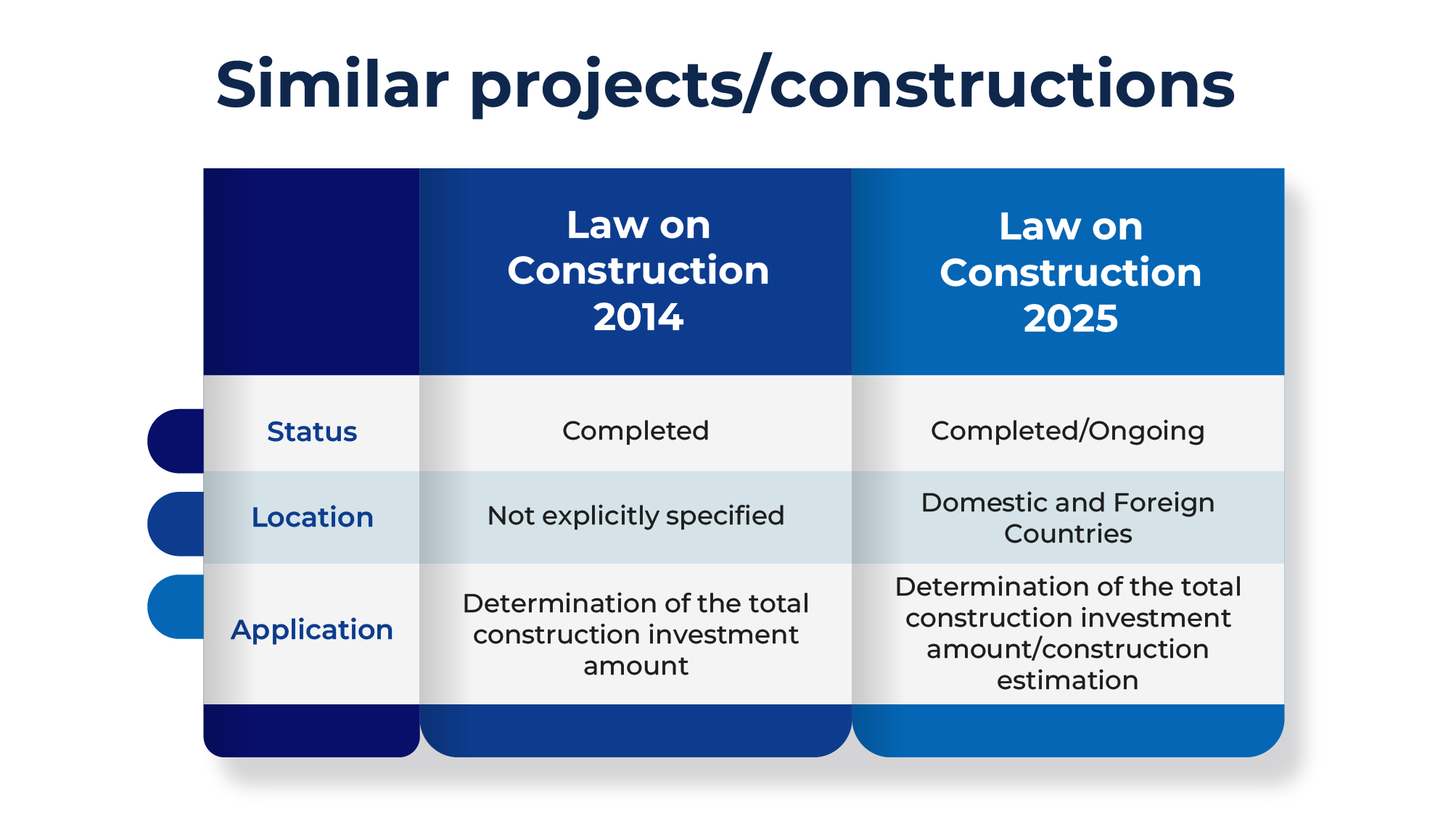
Comparison of the determination of similar constructions/projects under the Law on Construction 2014 and Law on Construction 2025
2. Increase in the Employer’s autonomy over construction design
In accordance with Law on Construction 2014, basic design and the construction design thereafter must be inspected by authorities specialized in construction prior to approval.
To be specific, aside from the basic design inspection during the inspection of feasibility study report, competent construction-specialized authorities shall conduct inspection for (i) technical design and construction estimation in the event of 3-step design or (ii) construction drawing design and construction estimation in the event of 2-step design.[3]
However, according to the Law on Construction 2025, in the spirit of favoring decentralization and delegation and the principle of “an issue shall only be inspected once by the authorities throughout the implementation of the projects”, the inspection of designs subsequent to the basic design are no longer required. Accordingly, the employer shall be in charge of the inspection, supervision, and approval of the construction designs that are implemented subsequent to the approval of the project.[4]
The increase in the Employer’s autonomy over construction designs subsequent to the project approval helps simplify the procedures for construction design approval, thereby shortening the time required for project implementation.
3. Expansion of the scope of construction permit exemptions
Compared to Law on Construction 2014, the scope of construction permit exemptions of the Law on Construction 2025 has been expanded.
Specifically, Law on Construction 2025 has made the following additions to cases of construction permit exemptions:
- Investment project under special investment procedures;[5]
- Airport, construction located within airport, constructions that guarantee flight activities outside airport;[6]
- Constructions that already their Feasibility study reports inspected by construction-specialized authorities and approved;[7]
- Grade IV Construction works, or detached housing works with a scale of less than 07 stories and a total construction floor area of less than 500 m2 and are not located in certain area.[8]
The expansion of the scope of construction permit exemption by Law on Construction 2025 marks an important progression in the simplification of administrative procedures, thereby further facilitating project implementation.
However, it should be noted that the employer of the above projects/construction must still satisfy other requirements for construction commencement[9] and deliver the notice of construction commencement to the competent local authorities, unless they are state-secret works, emergency or urgent works, or temporary construction works, detached housing works.[10]
4. Termination of the construction activity capability requirement for domestic organizations
According to Law on Construction 2014, organizations participating in construction activities must possess construction activity capacity certificates issued by the Ministry or Department of Construction corresponding to the type and grade of the construction works in which they participate. To be specific, the Ministry of Construction shall issue certificates of grade I capacity and Department of Construction shall issue certificates of grade II and III capacity.[11]
Starting from 01/07/2025, while organizations participating in construction activities are still required to fulfill the requirements prescribed by the laws and declare their own capacity to serve as basis for review, the requirement of construction activity capacity certificates are no longer required of organizations.[12]
In other words, with the Law on Construction 2025 taking effect, specific capacity requirements are no longer applicable to domestic organizations and only applicable to certain professions[13]. However, these organizations must declare their own capacity on the website of the Ministry of Construction to serve as reference basis for contractor selection by Employer.[14]
5. Clarification of applicable law for construction contracts
Law on Construction 2014 specifies that construction contracts are (i) civil contracts and (ii) required to be consistent with the provisions of the Law on Construction and relevant law provisions.[15]
In other words, under Law on Construction 2014, construction contracts shall be governed by (i) Civil Code, (ii) Law on Construction, and (iii) other relevant law provisions.
Practical application has showed that the determination of “relevant law provisions” remains a debated measures among both scholars and law practitioners, as well as the Courts’ approaches in their resolution of cases. For instance, for legal issues related to construction contracts that are not specifically provided by the Law on Construction, would those legal issues be governed by the Law on Commerce, or would it be directly governed by the Civil Code?
Those opines that Law on Commerce shall apply base their reasoning on the fact that construction activities are conducted by those who partake in commercial activities and the presence of profits.
Meanwhile, those argue that Civil Code shall directly govern base their reasoning on Article 138.1 of the Law on Construction 2014, which clearly defines that “construction contracts are civil contracts”.
The difference in the approach to the application of governing law for construction contract as analyzed above leads to difference in the legal consequences, the specifics are detailed in the table below:
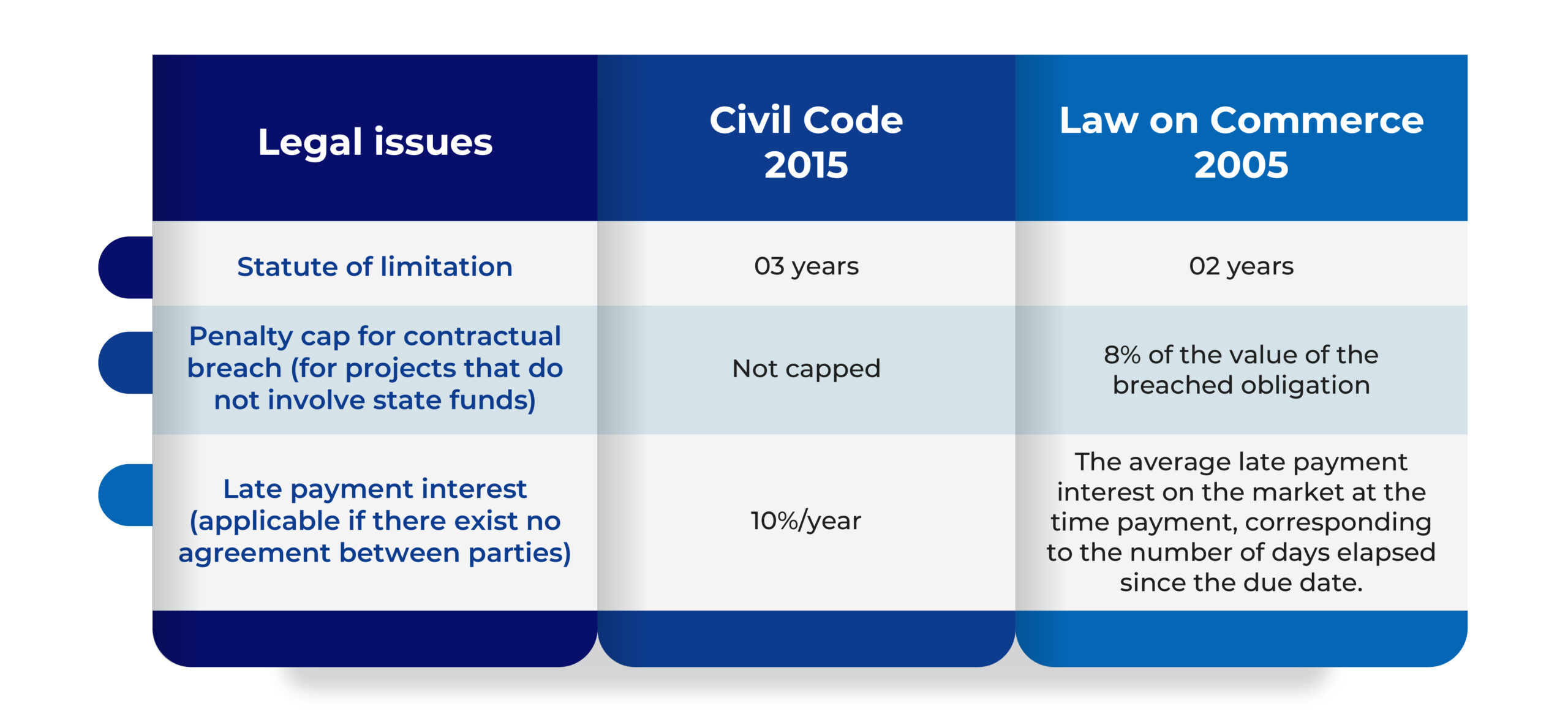
Comparison between the Civil Code 2015 and Law on Commerce 2005
The inconsistency in the approach as demonstrated above result in the lack of predictability in the determination of applicable law for construction contracts, which could give rise to disputes between parties throughout the implementation of construction contracts.
Under Law on Construction 2025, the above dilemma has fundamentally been resolved. Accordingly, Law on Construction 2025 provides that issues not covered by the Law on Construction shall be governed by provisions on contract of the Law on Investment, PPP Law, and Civil Code.[16] In other words, Law on Construction 2025 has expressly excluded the Law on Commerce from the governing laws applicable to construction contracts.
6. Official recognition of liquidated damage
Prior to effective date of the Law on Construction 2025, whether the concept of liquidated damage (“LD”) being recognized remain an issue of debate among scholars and law practitioners, as well as the Courts’ approaches in the resolution of cases.
To be specific, many LD clauses are often considered as a penalty clause by the Court, which shall be subject to the limitation of 8% of the value of the breached contractual obligation in accordance with Law on Commerce 2005. The popular reasoning given by these Courts is that damage compensation must be based on the “actual damage”.[17]
In other words, currently, the majority of the Courts does not recognize LD clause even though there exist effective judgments that recognize the validity of LD clauses in construction contracts.[18] This is because those judgments are not precedents, and therefore do not have binding effects on other cases.
Under Law in Construction 2025, parties are allowed to agree on liquidated damage correspond to (i) breached contractual obligations and (ii) the severity of the breach, and (iii) the separation of this clause from the penalty clause.[19]
To put it in another way, Law on Construction 2025 has official recognized LD clauses in construction contracts, thereby facilitating parties’ ability to forecast potential damage and mitigating the burden of proving actual damage that was incurred as a result of each contractual breach, especially breaches for which damage could hardly be proven such as breach of agreed progress milestone.
However, it should be noted that, once a contract already has LD clauses, the determination of the compensation amount corresponding to the “severity of the breach” as stipulated by Article 86.2 of the Law on Construction 2025 is a debatable issue that causes difficulties in the practical application. This is because the evaluation of “severity of breach” is very challenging and subject to the subjective views of each party. We hope that in the near future, Vietnam would come up with more detailed guidelines, or the judicial authorities would provide their official approaches to the resolution of this issue.
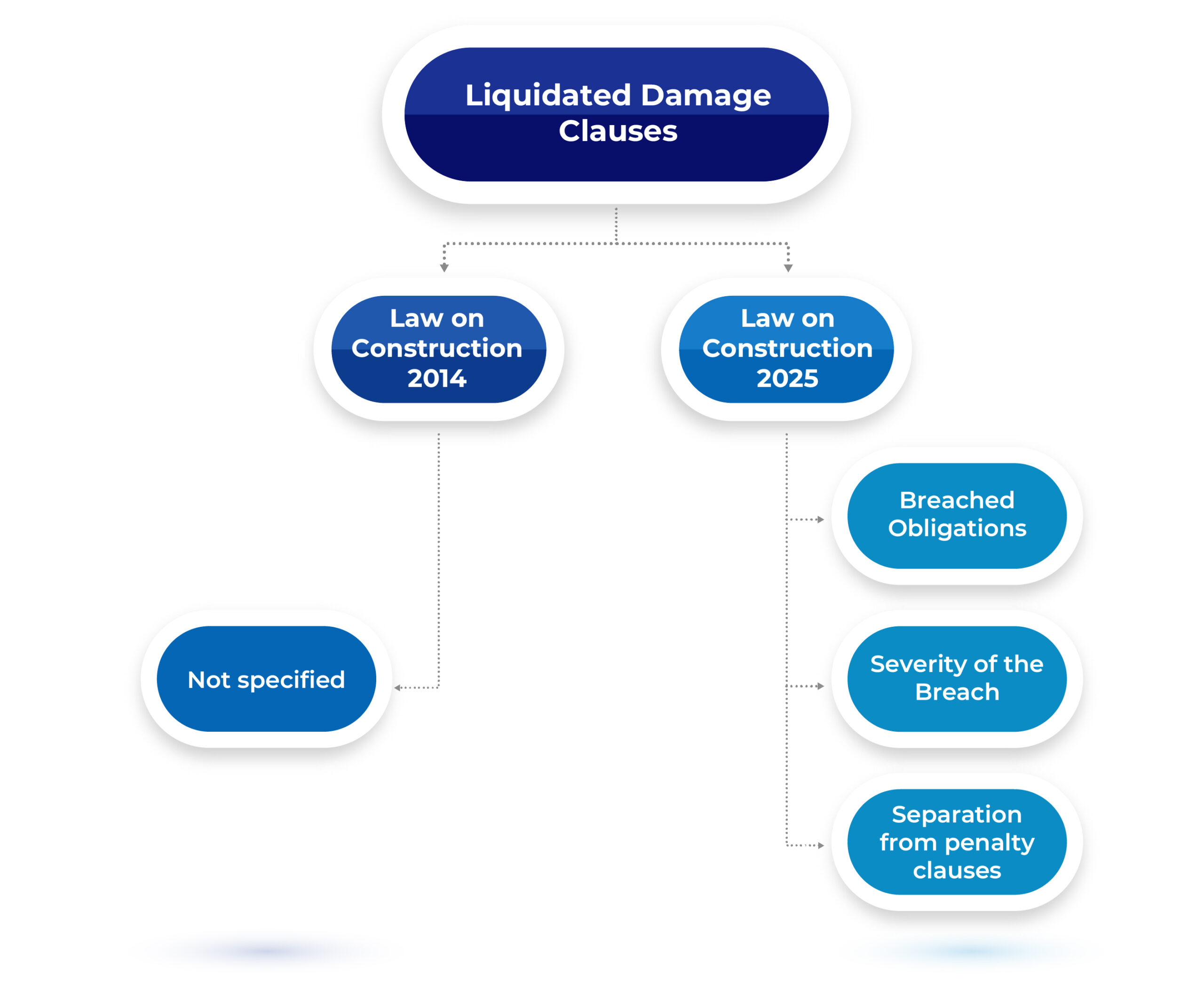
Comparison of the provisions on liquidated damage in the Law on Construction 2014 and Law on Construction 2025
7. Fundamental changes in circumstances
Fundamental changes in circumstances is a legal concept that exists in the Civil Code 2015 but is not covered by the Law on Construction 2014.
In Law on Construction 2025, this concept is finally expanded upon in an explicit manner. Accordingly, Law on Construction 2025 provides that fundamental changes in circumstances include:[20]
- Changes in policies and laws made by the State;
- Unforeseeable geological conditions;
- Other cases as prescribed by relevant laws.
As such, an event shall be considered as a “fundamental change in circumstances” under Law on Construction 2025 if that event has sufficient elements that constitute a “fundamental change in circumstances” in accordance with the Civil Code 2025. Concurrently, Law on Construction 2025 also considers two types of events, namely (i) Changes in policies and laws made by the State and (ii) Unforeseeable geological conditions as “fundamental changes in circumstances” by default.
In the event of “fundamental changes in circumstances” during the performance of construction contracts, parties may agree with each other to amend the construction contract[21] and make adjustments to the public investment project.[22]
8. Adoption of dispute resolution model in accordance with the international practice
Law on Construction 2014 provides that dispute arising out of construction contracts shall be resolved through means such as: negotiation, mediation, Arbitration and Litigation.[23] These four methods are all traditional means of dispute resolution.
Furthermore, Law on Construction 2014 also indirectly, through Decree No. 37/2015/ND-CP, stipulate the method of dispute resolution through Dispute Adjudication Board.[24] However, the Dispute Adjudication Board provided in this Decree is more akin to a mediation body rather than a method of dispute resolution, which is inconsistent with the international practices.
With the Law on Construction 2025 taking effects, aside from the traditional dispute resolution methods, the adoption of dispute resolution model in accordance with the international practice are also provided. Accordingly, parties are fully empowered to agree on dispute resolution via the Dispute Adjudication Board/ Dispute Avoidance and Adjudication Board per the norms of international construction contract template such as FIDIC. These are prompt and effective means of dispute resolution that are applied worldwide.
However, for the participating parties – especially in projects that involve public investment capital – to have concrete basis to apply the model of Dispute Adjudication Board, we believe that the competent authorities should promptly issue guidelines on the procedures for the application of this mechanism, including guidelines on the selection of member of the Dispute Adjudication Board, the establishment and function of the Dispute Adjudication Board, the issuance of the dispute resolution decisions and the enforcement of such decision by the parties.
Law on Construction 2025 also specify that the cost for dispute resolution incurred by the Employer shall also be considered a part of the total investment amount of the project.[25] This allows projects (especially public projects) to have a legitimate source of funds to undertake legal procedures or hire Dispute Adjudication Board.
Managed by
 |
Partner I Tran Pham Hoang Tung
Phone: (84) 901 334 192 Email: tung.tran@cnccounsel.com |
 |
Junior Associate I Pham Nguyen Tan Trung
Phone: (84) 347 924 900 Email: trung.pham@cnccounsel.com |
Contact Us
For further information, please contact:
CNC Vietnam Law Firm
Address: The Rise Building, 2A1 Nguyen Thi Minh Khai, Sai Gon Ward, Ho Chi Minh City, Vietnam
Phone: (84) 28-6276 9900
Hotline: (84) 916-545-618
Email: contact@cnccounsel.com
Website: cnccounsel
We would be delighted to welcome you at CNC’s office, where you’ll have the opportunity to consult with the lawyer best suited to your circumstances. Of course, if you are unable to meet in person, simply email us via contact@cnccounsel.com or call us via (+84-28) 6276 9900.
It would be a pleasure for CNC’s lawyers to help you build a solid legal foundation, thus ensuring the success and sustainable development of your project!
Disclaimers:
This article has been prepared and published for the purpose of introducing or informing our Clients and potential clients on information pertaining to legal issues, opinions and/or developments in Vietnam. Information presented in this article does not constitute legal advice of any form and may be adjusted without advance notice.
———————————————————
[1] Article 134.3 Law on Construction 2014.
[2] Articles 75.3(b) and 76.2(c) Law on Construction 2025.
[3] Article 82 Law on Construction 2014.
[4] Article 29.1 Law on Construction 2025.
[5] Article 43.2(a) Law on Construction 2025.
[6] Article 43.2(d) Law on Construction 2025.
[7] Article 43.2(e) Law on Construction 2025.
[8] Article 43.2(g) Law on Construction 2025.
[9] Article 48 Law on Construction 2025.
[10] Article 43.3 Law on Construction 2025.
[11] Article 148.4 Law on Construction 2014.
[12] Article 56.1(g) Law on Railways 2025.
[13] Articles 88.1, 88.2 and 88.6 Law on Construction 2025.
[14] Article 88.6 Law on Construction 2025.
[15] Articles 138.1 and 138.5 Law on Construction 2014.
[16] Article 4.2 Law on Construction 2025.
[17] See more: New approach of Vietnam’s Courts on Liquidated Damages – CNC | Công ty Luật TNHH CNC Việt Nam
[18] Judgment No. 660/2022/KDTM-PT dated 10/11/2022 of the People’s Court of Ho Chi Minh City regarding “Disputes on contracts for construction of works”.
[19] Articles 86.2 and 86.3 Law on Construction 2025.
[20] Article 13.2 Law on Construction 2025.
[21] Article 84.2(d) Law on Construction 2025.
[22] Article 28.2(c) Law on Construction 2025.
[23] Article 146.8 Law on Construction 2014.
[24] Article 45.2 Decree No. 37/2015/NĐ-CP.
[25] Article 86.5 Law on Construction 2025.