




9 notable points under Decree No. 210/2026/ND-CP detailing construction contracts
On 15 June 2026, the Government issued Decree No. 210/2026/ND-CP detailing and guiding the implementation of certain provisions of the Law on Construction regarding construction contracts (“Decree 210/2026”). This Decree takes effect from 1 July 2026 and replaces Decree No. 37/2015/ND-CP dated 22 April 2015 and Decree No. 50/2021/ND-CP dated 1 April 2021.
Compared with the provisions of Decree No. 37/2015/ND-CP dated 22 April 2015 and its subsequent amendments and supplements[1] (hereinafter collectively referred to as “Decree 37”), Decree 210/2026 introduces 9 notable new points, as follows:
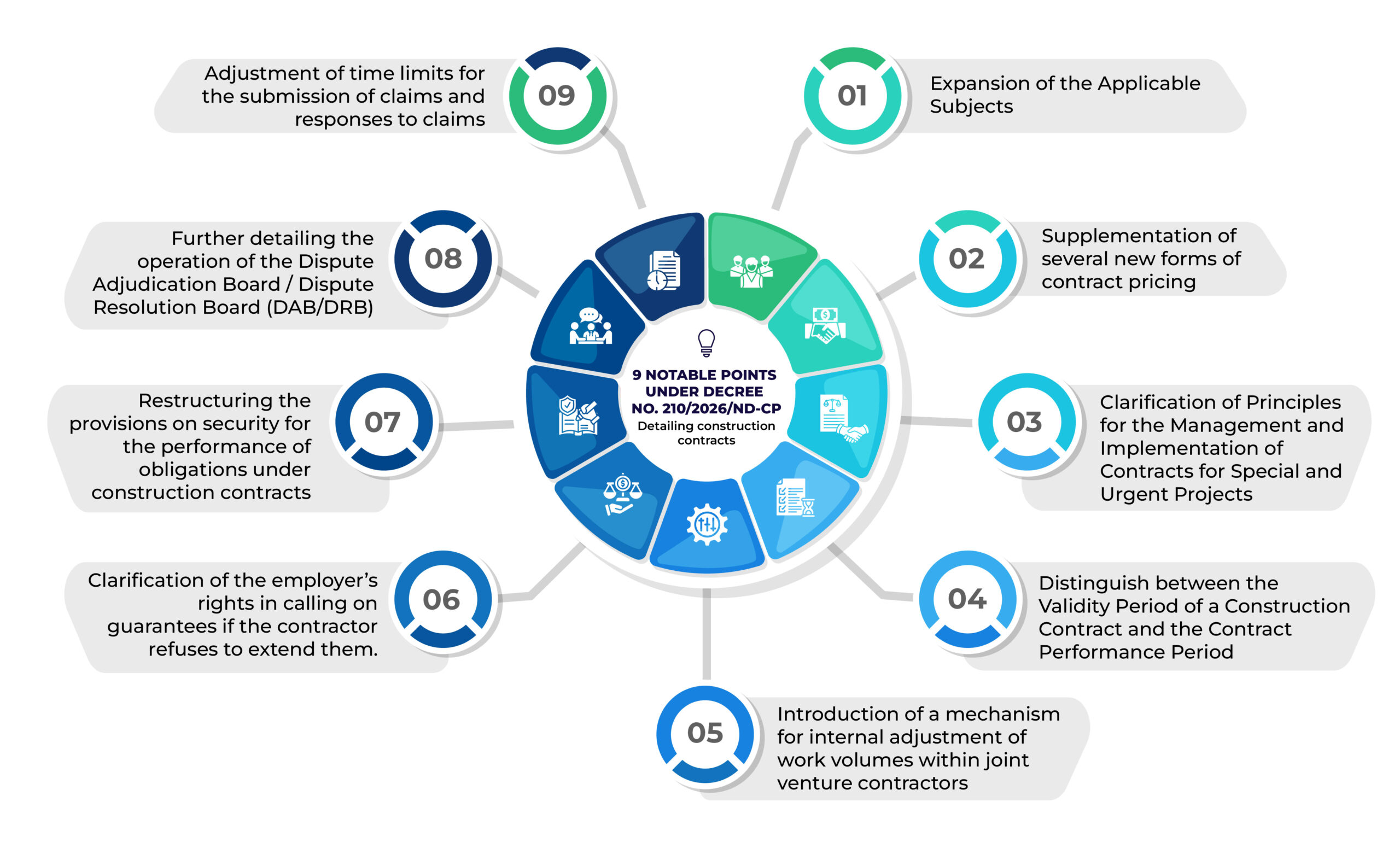
1. Expansion of the Applicable Subjects
- Pursuant to Article 1.2 of Decree 37, the subjects of application of this decree include organizations and individuals involved in the establishment and management of construction contracts for construction investment projects funded by public investment capital, state capital other than public investment capital, as well as construction contracts entered into between PPP project enterprises and construction contractors implementing bid packages under public–private partnership (PPP) projects. Accordingly, entities participating in construction investment projects funded by private capital (or other lawful sources of capital) are not required to apply Decree 37, but are encouraged to refer to and apply its provisions on a voluntary basis.
- Under Decree 210/2026, the scope of application has been further expanded. Specifically, Article 2 of Decree 210/2026 provides that: “This Decree applies to employers, contractors, and other organisations and individuals involved in the conclusion and management of construction contracts.”
Accordingly, Decree 210/2026 adopts a broad and general approach by defining the subjects of application as the contracting party, the contractor, and organisations and individuals involved in the establishment and management of construction contracts.
In other words, in addition to the subjects prescribed under Decree 37, Decree 210/2026 expands the scope of application to include organisations and individuals involved in establishing and managing the performance of construction contracts for construction investment projects funded by private capital (other lawful sources of capital).
2. Supplementation of several new forms of contract pricing
- Decree 37 classifies construction contracts primarily based on pricing forms, including lump-sum contracts, fixed unit price contracts, adjustable unit price contracts, time-based contracts, cost-plus-fee contracts, hybrid contracts, and other types of contracts.[2]
- Certain modern types of contracts that are well aligned with practical needs are proposed to be added to Article 6.2 of Decree 210/2026, notably Output‑Based Contracts and Percentage‑Based Contracts.
Accordingly, an Output‑Based Contract is a construction contract under which, at the time of contract execution, the parties agree that the contract price shall be determined based on specific requirements regarding the quantity and quality of the output products; the contract payment value shall be based on the results of contract performance as accepted in terms of the quality and quantity of the output products and other relevant factors (if any).[3]
A Percentage‑Based Contract is a construction contract under which, at the time of contract execution, the parties agree that the contract price shall be determined as a percentage of the cost or the value of the work to be performed.[4]
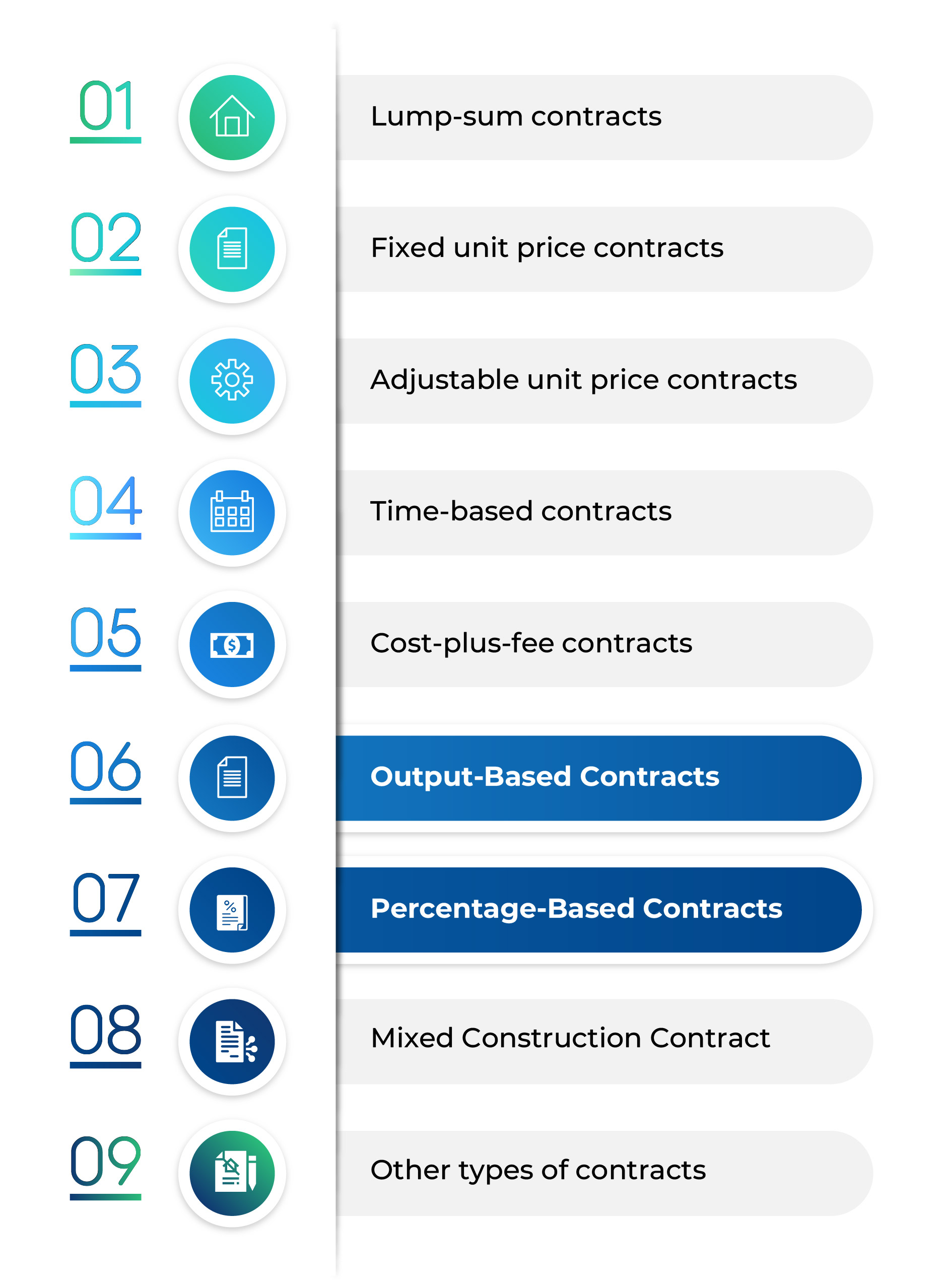
Classification of contracts by contract pricing forms as prescribed in Decree 210/2026
3. Addition of provisions to clarify the principles for managing the implementation of contracts for special and urgent projects
Prior to 1 July 2026, the principles governing the implementation of construction works under emergency orders are stipulated in Article 130 of Construction Law 2014[5]; however, no specific guidance has been provided under Decree 37 in this regard.
- In addition to inheriting the provisions of the previous legislation, Construction Law 2025[6] provides for corresponding provisions in greater detail under Article 70, while also introducing additional principles governing the implementation of special public investment projects.
Decree 210/2026 also introduces additional provisions to clarify the principles for managing the implementation of contracts applicable to special public investment projects and emergency or urgent projects and works. Specifically, employers are vested with the authority to autonomously decide on contract formation (including the execution of framework contracts and partial contracts) and to manage contract implementation in order to ensure timeliness, while remaining fully responsible for their decisions.
Clause 6, Article 4 of Decree 210/2026 provides as follows: “For construction contracts under special public investment projects; emergency or urgent projects and works, employers are entitled to independently decide on the execution and management of construction contracts to ensure timeliness and flexibility in accordance with the requirements of the project or work (including the execution of framework contracts and partial contracts), ensure progress and quality, and take responsibility for their decisions.”
4. Distinguish between the Validity Period of a Construction Contract and the Contract Performance Period.
- Pursuant to Clause 1, Article 14 of Decree 37, the contract performance period is defined as follows: “the contract performance period shall be calculated from the effective date of the contract until the parties have fulfilled all obligations under the executed construction contract.”
It appears to overlap two distinct concepts: the validity period of the contract and the contract performance period. From a legal perspective, the contract performance period refers to the time required for the contractor to complete the works and hand them over to the employer in accordance with contractual requirements, and therefore does not coincide with the contract validity period, which extends until the contract is legally terminated (whether due to full performance of all obligations by the parties or termination by one party, etc.).
Due to the lack of clear distinction between these two concepts under Decree 37, many projects (particularly those funded by public investment) have encountered difficulties. Specifically, where the contract performance period expires, but the contractor has not completed the works, the parties are compelled to execute an addendum extending the schedule in order to maintain the contract’s validity and allow the employer to proceed with disbursement.
- To address the above issues, Decree 210/2026 clarifies these two concepts as follows:
“The Validity Period of a Construction Contract means the period from the date on which the construction contract becomes effective until the parties have fulfilled all contractual obligations, including the time for execution of additional works and completion of contract liquidation procedures (if any); or until the contract is terminated in accordance with applicable law.”[7]
“The Performance Period of Construction Contract Works means the period calculated from the effective date of the contract or from the commencement date of the works as agreed by the parties, until all works under the contract have been completed and duly accepted in accordance with contractual provisions (including any extensions granted in accordance with the contract); excluding the warranty period, design author’s supervision period, and contract liquidation procedures (if any). The performance period of construction contract works shall be as agreed by the parties in the construction contract. For construction contracts for packages under public investment projects, the performance period of construction contract works shall be the period for performance of the relevant package in accordance with the law on bidding.”[8]
5. Introduction of a mechanism for internal adjustment of work volumes within joint venture contractors
- Under Decree 37[9], the allocation of work scope among joint venture members must comply with the original joint venture agreement. At the same time, this Decree does not provide detailed regulations for situations where joint venture members intend to reallocate work internally during contract performance. However, pursuant to Clause 2, Article 4 of Circular No. 02/2023/TT-BXD dated March 3, 2023[10] (“Circular 02”) and Clause 24, Article 140 of Decree No. 214/2025/NĐ-CP dated August 4, 2025[11] (“Decree 214”), the adjustment of work scope among joint venture members is permitted, provided that specific prescribed conditions are satisfied.
Therefore, Decree 210/2026 supplements provisions on the adjustment of work scope among joint venture members to ensure consistency with the regulations set out in Circular 02 and Decree 214. Where the adjustment of work scope among joint venture members does not result in any change in the contract price, the awarder (employer) shall make a decision based on the unanimous agreement of all joint venture members, the qualifications and experience of each member, and such adjustment must ensure compliance with requirements relating to safety, quality, efficiency, schedule, and contract performance timeline[12].
This mechanism is prescribed to ensure flexibility in the coordination and mutual support among joint venture members throughout the performance period of the construction contract.
6. Clarification of the employer’s rights in calling on guarantees if the contractor refuses to extend them.
While Decree 37 merely sets out the general principle that a contractor shall not be entitled to the return of the performance security if it refuses to perform the contract after it has taken effect or commits other breaches as stipulated in the contract[13], Decree 210/2026 introduces a highly significant new sanction. Specifically, a contractor shall not be entitled to the return of the performance security where it causes delay due to its own fault and refuses to extend the validity of the performance security[14].
In certain main contracts between the employer and the contractor, refusal to extend the validity of the performance guarantee in cases where the contractor is behind schedule is expressly defined as a contractual breach, entitling the employer to demand payment under the performance security from the issuing bank.
However, for contracts that do not expressly contain such provisions, this supplemental regulation provides the employer with a stronger legal position in circumstances where the contractor deliberately delays performance while the performance guarantee is approaching expiry and yet fails to take any action to extend the validity of the performance security.
7. Restructuring the provisions on security for the performance of obligations under construction contracts.
- Pursuant to Decree 37, provisions on security for the performance of contractual obligations (including performance security and payment security) are regulated separately under Article 16 and Article 17. At the same time, the value of performance security is determined within the range of 2% to 10% of the construction contract price. In cases involving higher risk mitigation, the value of performance security may be increased but shall not exceed 30% of the contract price and must be approved by the competent investment decision-maker.[15]
- Article 13 of Decree 210/2026 restructures the provisions on security for the performance of obligations under construction contracts in alignment with the Construction Law 2025. This is achieved by consolidating the regulations on performance security and payment security, while classifying such security into two categories: (i) construction contracts under public investment projects and PPP projects, and (ii) other construction contracts, to ensure consistency with the scope of application of Decree 210/2026.
- Decree 210/2026also amends the provisions relating to cases where the value of performance security may be higher, by introducing a cross-reference to the applicable procurement legislation. Specifically: “The amount of performance security shall be determined within the range of 2% to 10% of the construction contract price; where it is required to provide a contract performance security higher than 10% for risk mitigation purposes, such requirement shall be implemented in accordance with the law on bidding.”[16]
8. Further detailing the operation of the Dispute Adjudication Board / Dispute Resolution Board (DAB/DRB)
- Pursuant to the current regulations under Clause 2, Article 45 of Decree 37, the Dispute Resolution Board acts as an intermediary body assisting the parties in resolving disputes through amicable settlement, rather than serving as a formal dispute adjudication body in the sense commonly recognized under international practice (such as under standard FIDIC Conditions of Contract). As a result, the application of the Dispute Resolution Board model in Vietnam has, in practice, faced various challenges and has not been widely adopted.
- To address this inadequacy, Point (a), Clause 5, Article 86 of the Construction Law 2025 has officially recognized “international dispute resolution mechanisms” as one of the methods for resolving construction contract disputes, which implicitly includes the Dispute Resolution Board mechanism.
- In line with the spirit of the Construction Law 2025, Decree 210/2026 introduces more specific provisions on the Dispute Resolution Board, recognizing its role as a dispute resolution body to align with international practices (such as those under the FIDIC Conditions of Contract). Decree 210/2026 clearly provides that the parties may establish a DAB/DRB immediately after the execution of the contract, on a standing basis throughout the contract performance period, or only after a dispute has arisen. It also emphasizes that members of the DAB/DRB must ensure objectivity, independence, and the absence of any conflict of interest with the parties.
Specifically, Points a and b, Clause 3, Article 17 of Decree 210/2026 provide as follows:
“3. The application of the international practice–based dispute resolution model (hereinafter referred to as the Dispute Settlement Board model) as prescribed in Point b, Clause 5, Article 86 of the Construction Law shall be governed as follows:
a) The parties shall specifically agree in the contract on the timing for establishing the Dispute Settlement Board (which may be established immediately after the execution of the contract, operate on a standing basis during the contract performance period, or be established after the occurrence of a dispute); the number, criteria, qualifications, and experience of the members of the Dispute Settlement Board in accordance with the requirements of the contract and the nature and scope of the works under the construction contract; the binding nature of dispute adjudication decisions or recommendations; the procedures for selecting members of the Dispute Settlement Board; and the procedures and subsequent steps to be taken where a party disagrees with a decision or recommendation on dispute adjudication;
b) Members of the Dispute Settlement Board selected must ensure objectivity, independence, and the absence of any conflict of interest with the parties.”
9. Adjustment of time limits for the submission of claims and responses to claims
- Pursuant to Clauses 3 and 4, Article 44 of Decree 37, the time limit for the parties to issue a notice of claim is within fifty‑six (56) days from the date on which an issue arises as a result of one party’s performance of the contract being inconsistent with the agreed contractual terms. The party receiving the claim is entitled to a period of up to twenty‑eight (28) days to provide grounds and supporting evidence in response to such claim and to determine whether the claim is acceptable.
- Corresponding provisions are also set out in Clause 4, Article 21 of Decree 210/2026 ; however, the limitation on the time period for the claiming party to issue a notice of claim to the other party has been abolished. In addition, for public investment projects and PPP projects, the time limit for the party receiving the claim to respond (either accepting or rejecting the claim, with reasons to be clearly stated in the event of rejection) is prescribed as seven (07) days from the date of receipt of the claim. Specifically, Clause 4, Article 21 of Decree 210/2026 provides as follows:
Article 21. Claims During the Performance of Construction Contracts
…
4. In addition to the provisions of Clauses 1, 2, and 3 of this Article, with respect to construction contracts under public investment projects and PPP projects, within seven (07) days from the date of receipt of a claim, the party receiving the claim shall respond in writing to the claiming party, clearly stating whether it accepts or rejects the claim; in the event of rejection, the reasons for such rejection must be clearly specified.
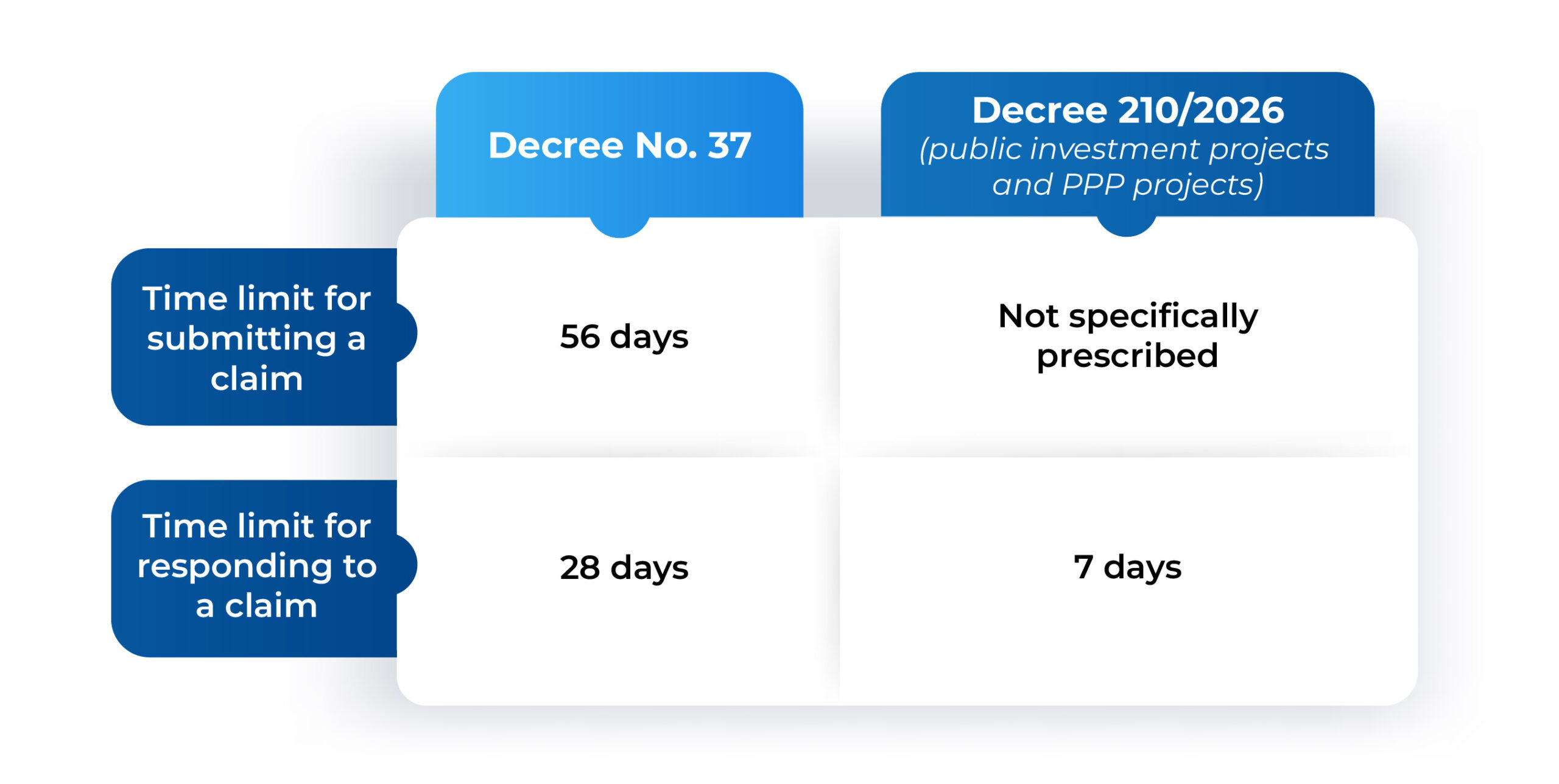
Comparison of claim handling time limits under Decree 37 and Decree 210/2026 (applicable to public investment projects and PPP projects)
Managed by
 |
Tran Pham Hoang Tung I Partner
Phone: (84) 901 334 192 Email: tung.tran@cnccounsel.com |
 |
Nguyen Thi Nhu Ngoc I Senior Associate
Phone: (84) 986 435 462 Email: ngoc.nguyen@cnccounsel.com |
Contact Us
For further information, please contact:
CNC Vietnam Law Firm
Address: The Rise Building, 2A1 Nguyen Thi Minh Khai, Sai Gon Ward, Ho Chi Minh City, Vietnam
Phone: (84) 28-6276 9900
Hotline: (84) 916-545-618
Email: contact@cnccounsel.com
Website: cnccounsel
We would be delighted to welcome you at CNC’s office, where you’ll have the opportunity to consult with the lawyer best suited to your circumstances. Of course, if you are unable to meet in person, simply email us via contact@cnccounsel.com or call us via (+84-28) 6276 9900.
It would be a pleasure for CNC’s lawyers to help you build a solid legal foundation, thus ensuring the success and sustainable development of your project!
Disclaimers:
This article has been prepared and published for the purpose of introducing or informing our Clients and potential clients on information pertaining to legal issues, opinions and/or developments in Vietnam. Information presented in this article does not constitute legal advice of any form and may be adjusted without advance notice.
——————————————
[1] Decree No. 50/2021/ND-CP dated 01 April 2021 and Decree No. 35/2023/ND-CP dated 20 June 2023;
[2] Clause 2, Article 3 of Decree 37;
[3] Point e, Clause 2, Article 6 of Decree 210/2026 ;
[4] Point g, Clause 2, Article 6 of Decree 210/2026 ;
[5] The Law on Construction No. 50/2014/QH13 promulgated on 18 June 2014, together with its amendments and supplements;
[6] Law on Construction No. 135/2025/QH15 promulgated on 10 December 2025;
[7] Clause 1 Article 10 of Decree 210/2026;
[8] Clause 2 Article 10 of Decree 210/2026;
[9] Clause 1, Article 4 of Decree 37;
[10] Circular guiding the implementation of certain provisions on construction contracts.
[11] Decree detailing certain provisions and implementation measures of the Law on Procurement on contractor selection.
[12] Point c Clause 5 Article 23 of Decree 210/2026;
[13] Clause 5, Article 16 of Decree 37;
[14] Point đ, Clause 2, Article 13 of Decree 210/2026;
[15] Clause 3 and 4 Article 16 of Decree 37;
[16] Point dd, Clause 2, Article 13 of Decree 210/2026;