




Overview of liquidated damages
Liquidated damages (“LD Clauses”) is a mechanism exists in both the common law system and civil law system.
In the current context of globalization, the integration of international regimes into the legal framework of Vietnam is no longer a strange occurrence. However, the harmonization of this clause within the current legal system of Vietnam prove to be a challenge as their exist difference in the approaches adopted.
In practice, many disputes regarding LD clause have occurred, which in turn led to the many different approaches to the interpretation and application of liquidated damage clauses being adopted by jurisdictions after having considered relevant contractual context of each particular case. As a result, the question of how to appropriately interpret and apply this clause is a legal issue that legislative bodies at Vietnam in general and parties who wish to apply these clauses within the territory of Vietnam in particular need to make careful considerations and evaluations.
Definition, origin and role of the liquidated damage clause.
Liquidated damage could be interpreted as a mechanism that allow request for damage compensation recognized by both the common law system and the civil law system. Liquidated damage could be explained as a contractual clause in which parties agree on a reasonable compensation for the damage incurred by one party due to contractual breach made by the other party.
Liquidated damage originated from penal bond[1], a concept first appeared in the 14th Century in England and subsequently in the United States. Accordingly, this is a form of contract performance guarantee that involve the payment of a sum equivalent to the value of the penal bond by the party who fails to comply with the contract to the aggrieved party. Once a breach occur, the breaching party shall immediately make the full payment of the value of the penal bond, which is often higher than the value of the breached obligation, without accounting for whether or not actual damage have been incurred or the leval of the damage incurred.
Due to its inequal nature, in some instances, the breaching parties are obligated toward the aggrieved party the payment of an unreasonable amount, even if the breach did not cause any damage to the aggrieved party. As a result, the Court of equity in England and the Courts in the United States had to use their powers to regulate the harsh nature of penal bonds in multiple occassions, which in turn cause the application of penal bonds in practice become less frequent.
However, in some cases, the judges of Courts in the United States realize that, for actual damage that could not be accurately identified, setting a fixed amount of compensation in advance is reasonable and necessary as it would reduce the uncertainty and vagueness in the rulings of the Court. Concurrently, the full rejection of an agreement on liquidated damage could be considered an infringement of the parties’ right to freedom of contract, a highly preserved and respected right under the law of the United States.
Throughout years of development and due to the influence of factors that give rise to their validity, liquidated damage clauses have undergone constant changes. However, in term of nature, liquidated damages still revolve around the combination of two core factors, which are (i) Freedom of contract and (ii) Rationality and Equity.
Observedly, with the penal bond as the starting point, liquidated damage clauses have undergone gradual development in the United States and filtering out the absurdity of penal bonds[2]. The application of liquidated damage clause have brought about various benefits for parties involved in transactions in particular and the legal system in general. Specifically, it expedites the dispute resolution and allow the compensation amount to be identified upon the conclusion of the contract, thereby saving time for both the parties and the competent authorities.
Liquidated damage also prvodies a form of relative assurance for the parties in a contract. In the event of a breach, the aggrieved party will always be entitled to the amount previosly agreed upon, serving as a reminder for both parties to exercise greater caution in fulfilling their contractual obligations.
Liquidated damage clauses in international unified legal documents
-
Liquidated damage in Convention on Contracts for the International Sale of Goods (CISG 1980)
Alongside penalty clauses, LD clauses have caused significant conflicts in terms of legal approaches across national legal systems. Although the CISG drafting committee made considerable efforts, it was ultimately unable to reach a common approach to incorporate liquidated damages and penalty clauses into the CISG. As a result, these provisions were not directly included in the Convention.
According to Rule 2, Opinion 10[3], CISG Advisory Council, a party may agree to compensate the other party with a specified amount in the event of a breach pursuant to Article 6 of the CISG on the principle of freedom of contract. Accordingly, CISG does not exclude the validity of liquidated damages clauses when the parties choose the CISG as the governing legal documents for their contractual rights and obligations.
Based on the comments at Rule 3.3, the Advisory Council clarify that Article 4[4] CISG is applied to explain that CISG does not govern the validity of the contract or the provisions contained therein, hence, the validity of penalty clause and liquidated damage clause shall be decided by the national law since CISG does not provide for the validity of these clauses.
Penalty and liquidated damages clauses may be enforceable in one country but not in another. Therefore, unless such clauses are deemed unenforceable under the applicable national law, they can still be applied within the framework of the CISG. However, the CISG Advisory Council also notes that when assessing the reasonableness or proportionality of a liquidated damages clauses or when determining whether a certain amount qualifies as liquidated damages, such evaluation should not rely solely on the domestic law of a particular country. It must also take into account what is considered reasonable in international commercial practice in order to interpret and apply liquidated damages clauses agreed by the parties in the contracts.
-
Liquidated damages in Principles for International Commercial Contracts (PICC) and Principles of European Contract Law (PECL)
UNIDROIT is the abbreviation of International Institute for the Unification of Private Law, whose headquarters is located in Rome, Italy, and was intially established in 1926 as an auxiliary organ of the League of Nations, and later re-established in 2024 subsequent to the dissolution of the League of Nation based on a multilateral agreement for the purpose of studying the demand and methods for the modernization, harmonization, and unification of private law, particurlary commercial law, among nations[5]
In 1994, UNIDROIT has issued the first edition of the Princicples for the International Commercial Contracts (PICC), which have its second, third, and most recently fourth edition published in 2004, 2010, and 2016 respectively for the purpose of providing a general standard and harmonize provisions of commercial contracts, which include LD clause as specified in Article 7.4.13[6].
Clause 1 of Article 7.4.13 PICC recognizes the validity of LD clauses, accordingly, the payments of the sum to the aggrieved party is separate from the actual damage incurred by that party, and the breaching party shall not be able to rely on basis that actual damage incurred by the aggrieved party is lower than the sum or not exist at all. Notwithstanding the foregoing, to avoid abuse of this provision, Article 7.4.13 does allow for the reduction (but not rejection) of the sum for liquidated damage, provided that there are bases that this sum is grossly excessive.[7]
The term “grossly excessive” in comparison to the incurred damage could be interpreted as the unequality that any ordinary person in the same circumstance would conclude so. This approach is also adopted by the Principles of European Contract Law (PECL), accordingly, Article 9:508[8] specifies that, once a breach occurs, the aggrieved party shall be awarded a specified sum by the breaching party, irrespective of its actual loss. However, this sum might be reduced if it is grossly excessive in relation to the loss resulting from the non-performance and the other circumstances.
Overall, liquidated damage is a fairly common regime that is recognized in many international legal documents despite being under different names, however, the common points shared by LD clauses are that LD clauses shall be fully applicable if the sum is reasonable and consistent with the agreement of parties in light of the damage incurred by the aggrieved party, and the sum could be reduced if it is considered grossly excessive in comparison to the actual damage.

Liquidated damages (LD) in some international legal documents
Liquidated damage clauses within the context of the current legal system of Vietnam
In term of practice, liquidated damage has yet to be officially recognized by the law of Vietnam. In Civil Code 2015 and Law on Commerce 2005, the only two recognized monetary remedies are (i) Damage compensation; and (ii) Penalty
Article 360, Civil Code 2015 on damage compensation due to breach of obligation specifies that, in the event of damage due to a breach of obligation, the breaching party shall be obligated to compensate the aggrieved party for all of the damage, unless the parties agreed or the law provided otherwise.
Currently, the question of whether the allowance of parties agreement and other law provisions indicate the legislator’s recognition of a pre-agreed payment obligation of a sum in the event of damage compensation due to one party’s fault remain unaddressed. This is because, based on the most widely-accepted explanation, this clause shall only be considered in situations where parties could agree on the full or partial compensation of damage, the latter would be calculated based on the damage ensued.
However, a clear distinction should be made that LD clauses are entirely independent of damage compensation clauses and penalty clauses. While damage compensation and liquidated damage clauses share the purpose of serving as the compensation for the damage incurred by one party due to the failure to comply with the contractual obligations of the other parties, the bases to determine these two sum are entirely different. LD clauses allow for parties’ negotiation and agreement during the signing of the contract based on the estimation of the potential damage if one of the parties breach the contract, conversely, damage in damage compensation shall only be recognized if an damaging act occur, specific, acutal, traceable damaged has ensued, and there exist a causality connection between the two.
Simultaneously, liquidated damage clauses should not also be viewed as penalty clauses. While both Liquidated damage clauses and penalty clauses are both limited within some certain threshold, however, penalty clauses, as its name implies, are clauses whose purpose is to serve as a warning and punishment for the parties if they breach or fail to fulfill their obligations. Meanwhile, the purpose of liquidated damage is to serve as a mechanism to compensate for the loss ensued due to damaging acts

How to differentiate liquidated damage, damage compensation, and penalty from each other
Although being a separate concept, liquidated damage do share some similiarities with damage compensation and penalty. This inadvertently caused difficulties to jurisdictions in Vietnam in respect of whether to recognize or annul liquidated damage clauses during the dispute resolution. Judgment No. 08/2017/KDTM-PT dated 8/12/2017[9] of the People’s Court of Tay Ninh Province is a notable example. The summary of the judgment is as follow:
“During the period from 26/08/2016 to 20/11/2016, Rubber T Co. Ltd (“Plaintiff”) and Rubber N JSC (“Defendant”) concluded 11 contracts for sale and purchase of natural rubber with the total value of 36.963.738.000 VND (VAT -included).
The payment structure is that the Plaintiff shall pay 10% or 30% (depending on each contract) to the Defendant within a specified time, the remaining 90% or 70% shall be paid prior to the receipt of the goods. The Plaintiff have fulfilled the payment obligations of the above-mentioned 10% or 30% for all the contracts.
However, in relation to the good delivery obligations, the Defendant has delivered to the Plaintiff 42 tons of rubber per Contract No. 158.2016/HDKT (The Plaintiff had made full payment for these 42 tons), the remaining 63 tons per this Contract and the volumes per the other 10 contracts, however, were not delivered.
Upon the expiry of the delivery time, the Defendant remained unable to deliver sufficient amount of goods despite constant reminder and price support given by the Plaintiff, thus adversely affecting the performance of the other contracts concluded by the Plaintiff with other third parties and the business operation of the Plaintiff, which in turn forced the Plaintiff to purchase substitute goods at a higher price. Subsequently, the Plaintiff filed a lawsuit against the Defendant at the People’s Court of Tay Ninh Province, in which, the Defendant is requested to: (i) Return the advance payment 10% or 30% of all contracts, equivalent to 5.452.188.000 VND, and (ii) to compensate the damage due to the difference in the total value of undelivered goods per the market price and the contract price, which is 26.509.560.000 VND
The Defendant reject the (ii) request made by the Plaintiff and only agree to compensate 8% of the value of the undelivered goods in accordance with the 11 contracts as specified in Articles VI of the contracts, which read: “If one of the parties unilaterally and intentionally acts in a manner that is inconsistent with the contract, and such acts caused the other party to incur damage, that party shall be obligated to compensate the other party an amount equal to 8% of the total value of the contract”
At the first-instance trial, the Court accept the request for damage compensation made by the Plaintiff, the Defendant then subsequently appealed at the Appellate Court. The appellate court then made the following finding: “…Whereas the content of Article VI in all 11 contracts are vague and in consistent with the law, to be specific: While the two parties in fact agreed on a penalty, the wording used in the contract is that of damage compensation, which caused confusion and consequently, the annulment and of this provision. Since the provision is annulled and the Plaintiff does not request the application of penalty, the decision to not accept this request made by the first-instance court is substantiated. Concurrently, according to the provisions at Article 302 Law on Commerce 2005, damage compensation shall be based on the actual and direct damage incurred by the aggrieved party and the direct profits that the aggrieved party would have been entitled to. The amount to be compensated could only be determined subsequent to a breach of contract, as such, the damage compensation (if any) could not be anticipated and prescribed in the contract and could only be determined subsequent to the occurrence of breaches attributable to the breaching party and actual damage incurred by the aggrieved party…”
Therefore, applying the provision of Law on Commerce 2005 on damage compensation based on direct and actual damage, the appellate court has decided to: (i) accept the request for the return of all advance payments for 11 contracts, which is 5.452.188.000 VND, and (ii) accept the compensation request for the difference in the total value of undelivered goods per the market price and the contract price, which is 17.256.008.000 VND, since the Claimant has to purchase materials at a higher price to substitute for the amount of rubber that Company N fail to deliver”
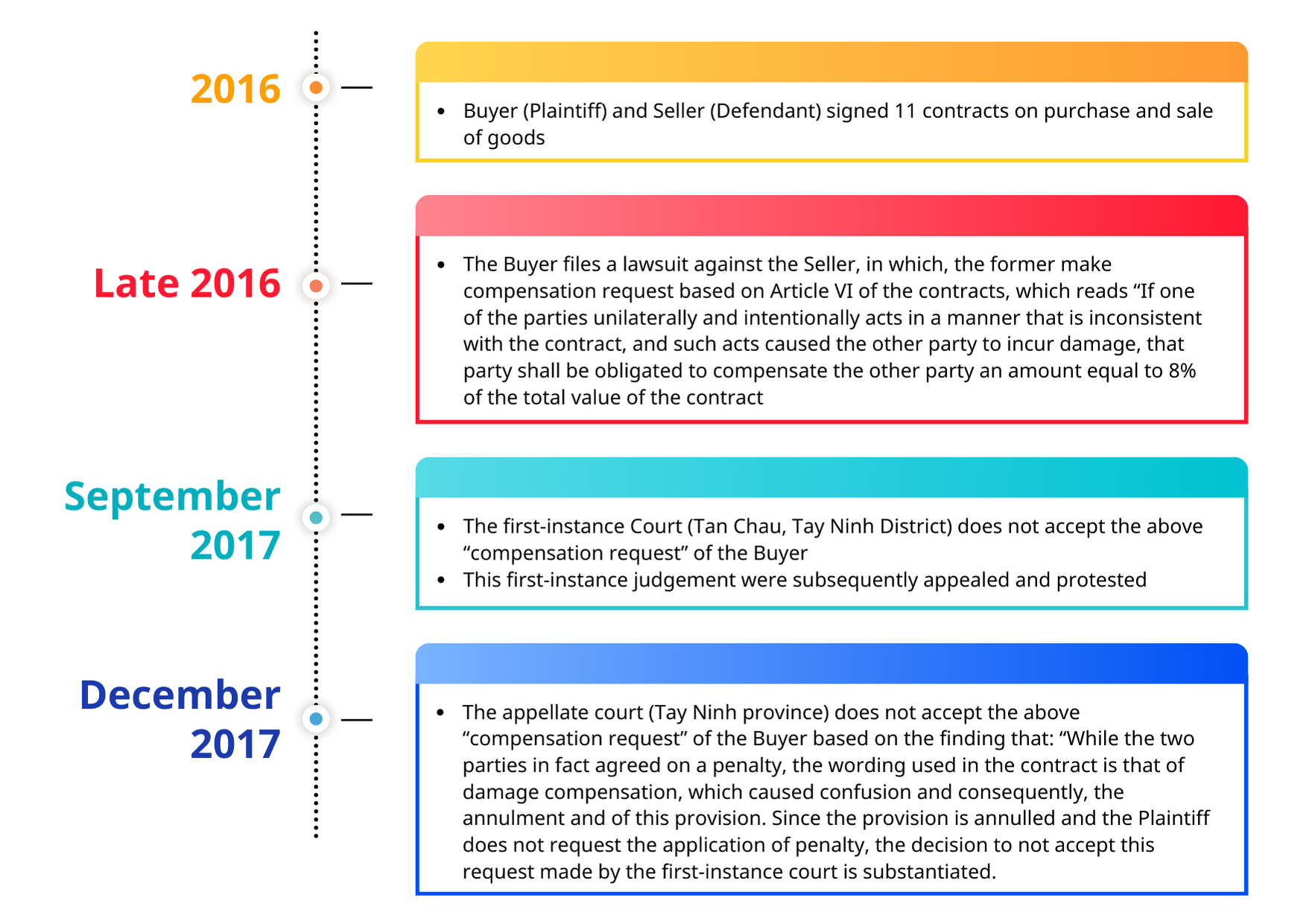
Summary of the key developments of Judgment No. 08/2017//KDTM-PT dated 08/12/2017 of the People’s Court of Tay Ninh
Observedly, this judgment of the People’s Court of Tay Ninh Province has partial reflect the opinion of Vietnamese Courts that the basis for damage compensation is actual and direct damage. However, in a recent unofficial conference on CISG in Ho Chi Minh City, the former judge of the Court of Economy of Ho Chi Minh City confirmed that, in judicial practice, the Court of Economy of Ho Chi Minh City had recognized a pre-established payment obligation of a sum in the event of damage compensation between the parties as it is the will of the parties and the Court of Economy of Ho Chi Minh City shall respect it.
Although this is an unofficial conference, this still reflects that there exist differences in the evaluation and recognition of LD clauses among different Courts within the context that the legal validity of this clause is rather vague within the framework of the current legal system of Vietnam. Supporting this view, an arbitrator of the Vietnam International Arbitration Center (VIAC) also asserted that, once a dispute occur, if parties has agreed on liquidated damage, the Arbitral Tribunal shall respect this decision by the parties, even if this pre-agreed sum this lower than the actual damage incurred, unless there are evidence indicating that this sum is grossly excessive in comparison to the damage incurred by the aggrieved party, in which case, the Arbitral Tribunal shall consider and reduce the agreed amount to a reasonable range.
From the above perspective and analysis, it could be claimed that, liquidated damage would not be entirely annulled under the law of Vietnam, however, the legalization this clause within the current legal system of Vietnam remain a complex legal issue that require further contemplation.
Therefore, if contracting parties wish to apply this clause, except for those who utilize international model templates that allow for the application of this clause, the parties need to use appropriate wording to express the actual intent on utilizing the pre-agreed sum for damage compensation in the event of damage. Currently, the application of liquidated damage clauses in Vietnam remains risky and has no clear legal foundation, detailed interpretation of this clause should be made so that situations where the aggrieved party could not achieve their initial wish when there are disputes involving this clause could be avoided.
Click here to download this article
[1]https://en.wikipedia.org/wiki/Penal_bond
[2] See more: https://ir.lawnet.fordham.edu/flr/vol45/iss7/3/
[3] See more: https://www.cisgac.com/cisgac-opinion-no10/
[4] CISG 1980
Article 4: This Convention governs only the formation of the contract of sale and the rights and obligations of the seller and the buyer arising from such a contract. In particular, except as otherwise expressly provided in this Convention. It is not concerned with:
(a) the validity of the contract or of any of its provision or of any usage;
(b) the effect which the contract may have on the property in the goods sold.
[5] See more: https://moj.gov.vn/tctccl/tintuc/Pages/nghien-cuu-trao-doi.aspx?ItemID=16
[6] UNIDROIT Principles of International Commercial Contracts 2016
7.4.13 Agreed payment for non-performance
(1) Where the contract provides that a party who does not perform is to pay a specified sum to the aggrieved party for such non-performance, the aggrieved party is entitled to that sum irrespective of its actual harm.
(2) However, notwithstanding any agreement to the contrary the specified sum may be reduced to a reasonable amount where it is grossly excessive in relation to the harm resulting from the non-performance and to the other circumstances.
[7] See more: https://www.unidroit.org/instruments/commercial-contracts/unidroit-principles-2016, page 290, 291
[8] See more: https://www.jus.uio.no/lm/eu.contract.principles.parts.1.to.3.2002/9.509.html
[9] See more: https://congbobanan.toaan.gov.vn/2ta58433t1cvn/chi-tiet-ban-an