





A/ Introduction
At its Second Session in November 2026, the 16th National Assembly adopted 38 new laws introducing significant changes to investment, real estate, taxation, labour, data and state administration. CNC Counsel is pleased to present this legal update, outlining the new legislation by sector, its key highlights and recommended actions for businesses and investors.
1. Land, housing and real estate business
| No. | Legislation | Effective date | New provisions and key highlights | Practical implications for businesses and investors |
|---|---|---|---|---|
| 1 | Land Law (revised) | 1-Jul-27 | • Issuance of certificates: expanded to undocumented land used before 1 July 2014 and land transferred before 1 August 2024 but not yet registered in the transferee’s name. • Disputed land: the undisputed portion may be certified if subdivision requirements are met. • Financial obligations: deferral of land use levy payments for eligible cases. • Land recovery: livelihood restoration support for at least three years and measures addressing delayed compensation payments. • Land prices: new land price schedules and adjustment coefficients from 1 January 2028. | Projects involving land with complex historical use may have additional options for regularising their documentation. However, each parcel, subdivision requirements and financial obligations should be assessed individually rather than assuming eligibility for certification. Developers should update compensation, livelihood support and land cost estimates based on the project implementation timeline. |
| 2 | Housing Law (revised) | 1-Jul-27 | • Social housing: restrictions on eligible resale purchasers and prices during the first five years; thereafter, once certified, resale at an agreed price to eligible purchasers. • Priority: persons with meritorious service, persons with disabilities and persons with two or more children, subject to childbirth timing requirements. • Land recovery: persons not yet compensated with housing or residential land may purchase social housing without a lottery. • Apartment buildings: clarification of the authority of owners’ meetings and oversight of management boards. | Social housing developers should review purchaser eligibility documentation and resale controls, as transactions with ineligible purchasers may be invalidated and the housing recovered. For commercial apartment buildings, governance rules and the allocation of responsibilities among developers, management boards and operators should be updated. |
| 3 | Law on Real Estate Business (revised) | 1-Jul-27 | • Deposits: capped at 5% once the property is eligible for business transactions. • Payments: initial payment capped at 30% including the deposit, 70% before handover and 95% before certificate issuance. • Lease-purchase of off-plan housing: initial payment capped at 30% and total advance payments at 50%. • Electronic identification: identification codes for houses, buildings and serviced land. • Disclosure: legal status, disputes, mortgages and standard-form contracts. | Developers should review reservation and deposit arrangements and collection schedules to avoid raising funds before eligibility requirements are satisfied. Payment caps directly affect project cash flow and financing needs. Certain limits, such as the 5% deposit cap, already appeared in the 2023 law and should not all be regarded as new. |
| 4 | Law on Property Auction (revised) | 1-Jul-27 | • Advance deposits: 20–50% of the starting price for residential land for individuals and 10–20% for project land. • Sanctions: refusing auction results or refusing to sign auction minutes may result in a ban of six months to five years. • Protection of bona fide purchasers: treatment of property rights where a related judgment is amended or annulled. • Starting price: participants are deemed to accept it; a lottery applies where multiple participants maintain that price. | Investors should arrange funding before participating in auctions, as failure to proceed may affect eligibility for future auctions. The specific deposit levels prescribed by the Government and conditions for protecting bona fide purchasers should be checked before acquiring assets with a history of disputes. |
2. Investment, enterprises, commerce, finance and taxation
| No. | Legislation | Effective date | New provisions and key highlights | Practical implications for businesses and investors |
|---|---|---|---|---|
| 5 | Law amending the Law on Investment | 31-Mar-27 | • Special incentives: expanded to R&D, data centres, 5G, semiconductors, AI and international logistics. • Projects of particular importance: the Government determines exceptional incentive packages. • Green projects: accelerated depreciation of machinery and equipment at up to twice the normal rate. | These policies may improve the financial viability of high-tech and green projects, particularly those requiring substantial upfront capital. Investors should establish eligibility, decision-making authority and incentive duration before incorporating benefits into financial models, rather than assuming all projects in priority sectors qualify. |
| 6 | Law on Development of Small and Medium-sized Enterprises | 1-Jul-27 | • Criteria: up to 300 employees, VND 150 billion in capital or VND 400 billion in revenue. • Tax: the reference materials mention a three-year corporate income tax exemption and lower rates for small and micro enterprises. • Premises: at least a 30% reduction in land sublease rent for five years. • Public procurement: packages below VND 20 billion reserved for SMEs. | Expanded criteria may enable more businesses to access capital, premises and market support. Businesses should verify size thresholds and eligibility for each policy, particularly avoiding assumptions that tax incentives or access to procurement packages apply unconditionally. |
| 7 | Law amending the Laws on Corporate Income Tax, Non-agricultural Land Use Tax and Personal Income Tax | 1-Jan-27 | • Household businesses: revenue threshold for choosing a tax calculation method increased to VND 10 billion per year. • Idle land: tax rate of 0.2% from 1 July 2027; land used for improper purposes taxed at 0.15%. • Personal income tax: exemption for individuals selling meals to schools and healthcare facilities. • Taxable land prices: fixed for three rather than five years, with aggregation of areas of multiple residential land parcels. | Businesses holding undeveloped land should assess holding costs and investment schedules. Household businesses should compare tax calculation methods, accounting costs and conversion into enterprises. Specific commencement dates should be checked before preparing tax budgets. |
| 8 | Law amending the Law on Securities | 1-Mar-27 | • Sandbox: controlled testing of new technologies, products and services. • Personnel: revised management and professional practice standards. • Procedures: streamlined securities registration and depository procedures. | The sandbox may help financial institutions develop new products within permitted limits, but does not authorise unrestricted commercial operations. Securities companies should monitor participation requirements, testing limits, investor protection and updated personnel standards. |
| 9 | Law amending the Laws on Commerce, Competition, Foreign Trade Management and Protection of Consumer Rights | 1-Jul-27 | • Consumer data: separate consent for each collection purpose. • Digital competition: additional rules on manipulative interface design. • Consumer protection: expanded role of commune-level People’s Committees. • Foreign trade: decentralised licensing and certification of origin. | Digital platforms and retailers should review consent interfaces, data policies and complaint procedures. Bundling multiple processing purposes into one choice may no longer be appropriate. Importers and exporters should update their understanding of competent authorities and origin certification procedures. |
| 10 | Law amending the Law on Intellectual Property | 1-Mar-27 | • Assignments: removal of registration of industrial property and plant variety rights assignment contracts, according to the reference materials. • Expert assessment: shift from business conditions to notification. • Plant varieties: failure to pay maintenance fees results in suspension of protection titles. | Reduced procedures may accelerate IP transfers in M&A and restructuring. However, parties should verify effectiveness requirements, enforceability against third parties and evidence of ownership, while maintaining a schedule of protection fees. |
| 11 | Law amending the Laws on Accounting and Independent Audit | 1-Mar-27 | • Financial statement signatories: competency certification required. • Chief accountants: training certificate and at least two years of experience. • Certificates: renting or borrowing certificates may result in suspension of business operations. • Accounting services: shift to post-compliance inspections. | Businesses should check the qualifications of financial statement signatories and chief accountants, including outsourced personnel. Reduced business conditions do not eliminate responsibility for reporting quality; service contracts should clearly allocate responsibilities and require evidence of compliance. |
| 12 | Law on Bidding (revised) | 1-Mar-27 | • Healthcare: greater hospital autonomy in pharmaceutical procurement. • Technology: expanded procurement autonomy and direct appointment for science, technology and digital transformation. • Integrity: tighter controls on direct appointment, bid rigging and conflicts of interest. | Suppliers of medicines, equipment and technology solutions may access more flexible procurement opportunities. However, they should identify when special contractor selection methods are permitted and maintain transparent records of pricing, qualifications and conflicts of interest. |
| 13 | Law on State Budget | 1-Jan-27 | • Management framework: integration of state budget and public investment management. • Group C projects: simplified procedures. • Decentralisation: adequate resources for commune-level authorities and stronger fiscal discipline. | Public project contractors should monitor changes to approvals, funding allocation and disbursement. Simplified procedures may shorten preparation but do not guarantee prompt payment if budget conditions are unmet. Competent authorities and payment provisions should be reviewed. |
3. Energy, environment and sustainable development
| No. | Legislation | Effective date | New provisions and key highlights | Practical implications for businesses and investors |
|---|---|---|---|---|
| 14 | Law amending the Law on Electricity | 1-Jun-27 | • Electricity prices: market-based pricing and gradual elimination of cross-subsidies. • Residential electricity: peak and off-peak tariffs where technical conditions permit. • Infrastructure: PPPs for transmission grids and incentives for offshore wind and waste-to-energy projects. | Energy investors should assess pricing mechanisms, capital recovery and contractual risk allocation. Energy-intensive businesses should consider adjusting operating schedules, while distinguishing residential tariffs from those applicable to production. |
| 15 | Law amending the Law on Environmental Protection | 1-Mar-27 | • Procedures: narrower scope of environmental impact assessments and environmental permits, with a shift to registration. • Decentralisation: local appraisal and licensing, and risk-based post-compliance inspections. • Emissions: low-emission zones, controls on petrol and diesel vehicles, and a carbon market. • Environmental consultancy: separate competency milestone on 1 January 2028. | Lower-risk projects may benefit from shorter investment preparation, but waste control and operational obligations remain. Businesses should reassess project classifications, transitional permits and long-term emissions compliance costs. |
| 16 | Law on Marine and Island Resources and Environment (revised) | 1-Jul-27 | • Communities: protection of access to the sea and coastal zones. • Sea areas: establishment of use rights through auctions and certificates. • Environment: expanded monitoring, data and pollution control. | Port, offshore wind and coastal tourism projects should assess sea area use rights alongside land use rights. Community access to the sea may affect site design and operations and should be considered from the project preparation stage. |
4. Labour, social insurance, healthcare and social welfare
| No. | Legislation | Effective date | New provisions and key highlights | Practical implications for businesses and investors |
|---|---|---|---|---|
| 17 | Law amending the Labour Code and the Laws on Archives, Gender Equality, Red Cross Activities and Employment | 1-Mar-27 | • Public holidays: two additional paid holidays on 27 July and 24 November. • Labour outsourcing: shift from licensing to deposits and notification. The client must require full payment of wages. • Online employment services: provided by employment service enterprises. | Businesses should update working calendars, overtime costs and 2027 production plans if the holidays are confirmed. For outsourced labour, contracts should allocate wage payment responsibilities and provide for monitoring of supplier compliance. Amendments concerning archives and gender equality are not detailed in the reference materials. |
| 18 | Law amending the Law on Social Insurance | 1-Mar-27 | • Payments: beneficiaries may change the method and place of receipt of pensions and allowances. • Social insurance fund: safe, sustainable and transparent investment with capital preservation. • Scope: the reference materials indicate no expansion of compulsory social insurance to digital platform workers or supplementary pensions. | The changes primarily concern fund management and beneficiaries’ choice of payment method. Businesses using flexible labour should not infer that all platform workers are exempt from insurance obligations; actual employment relationships and applicable rules must be assessed. |
| 19 | Law amending the Law on Occupational Safety and Health | 1-Mar-27 | • Reporting: workers may report accidents directly to competent authorities or trade unions. • Protection: intimidation or obstruction of reporting is prohibited. • Scope: reporting and investigation also cover accidents involving workers without employment contracts. • Training: businesses may organise training internally or engage training providers. | Factories, construction sites and logistics operators should establish accident reporting channels that do not disadvantage reporters. Safety management should extend to subcontractors and workers without contracts, with training records and clear allocation of responsibilities. |
| 20 | Law amending the Laws on Children, Persons with Disabilities, Medical Examination and Treatment, Pharmacy, the Elderly and Health Insurance | 1-Mar-27 | • Health insurance: the reference materials mention 100% coverage at primary-level facilities and eligible observation bed charges. • On-demand treatment: coverage within entitlement limits and advance disclosure of out-of-pocket charges. • Older persons: priority from age 75. • Older persons: priority from age 75. • Pharmacy: prohibition of medicine sales via livestreams and unauthorised e-commerce. | Healthcare facilities should review insurance coverage and disclosure of patient-paid costs. Pharmaceutical businesses and digital platforms should distinguish lawful sales channels from prohibited methods. The reference materials do not establish that all primary-level services are fully covered. |
| 21 | Law amending the Law on Prevention and Control of Tobacco Harms | 1-Jul-27 | • Products: statutory recognition and expansion of bans on e-cigarettes, heated tobacco, nicotine pouches and shisha. • Distribution: prohibition of sales to persons under 18, through vending machines and online, except specified lawful transactions. • Locations: smoking prohibited on university, college and academy premises; sales prohibited within 100 metres of educational institutions. | Businesses should review product portfolios, locations and distribution channels, including existing inventory. E-cigarettes and heated tobacco should not be understood as prohibited only from 2027, as an earlier resolution already imposed a ban. Separate commencement dates for each restriction should be checked. |
| 22 | Law on Donation, Removal and Transplantation of Human Tissues and Organs and Donation and Removal of Cadavers (revised) | 1-Jan-28 | • Age: registration from age 18; persons under 18 may donate only regenerative tissue to siblings with parental consent. • Living donation: persons aged 18 to under 25 may donate only within the family; donation outside the family from age 25. • Protection: expanded prohibited conduct and the right to refuse donation at any time. | Healthcare facilities should update procedures for verifying age, family relationships and voluntary consent. Consent records must be carefully managed and procedures should allow donation to stop upon a valid refusal. |
| 23 | Law on Adoption (revised) | 1-Mar-27 | • Eligibility: expanded adoption prohibitions relating to domestic violence, child abuse and certain convictions. • Child’s views: age threshold reduced from nine to seven. • Consent: children and biological parents may change their minds before handover. • Inheritance: adopted children retain inheritance rights in relation to biological parents, according to the reference materials. | Social welfare organisations and adoptive parents should update screening, consultation with children and consent confirmation procedures before handover. Inheritance rights should be considered alongside civil law when preparing wills or administering estates. |
5. Technology, data, security and technical standards
| No. | Legislation | Effective date | New provisions and key highlights | Practical implications for businesses and investors |
|---|---|---|---|---|
| 24 | Law on Data Security | 1-Jul-27 | • Classification: five risk levels, with risk assessments from level 3. • Audit: levels 4–5 require audits and reporting. • Protection: lifecycle management, prohibition of data poisoning and rules concerning AI. | Banks, fintech companies, data centres and AI businesses should inventory their data, identify responsible parties and review supplier contracts. Assessment, audit and reporting costs may affect system design; classification criteria should be verified before implementation. |
| 25 | Law on Electronic Identification and Authentication | 1-Jul-27 | • Identity: automatically generated when sufficient data are available. • Authentication: banking, securities, telecommunications, e-commerce and social media accounts. • Reuse: no recollection of data already held by state authorities; existing accounts remain usable. | Digital service providers should assess account registration and customer identification processes, connectivity to identification systems and information security. Sector-specific implementation timelines should be checked before requiring customers to authenticate again. |
| 26 | Law on Protection of Important Works Relating to National Security | 1-Jul-27 | • Classification: three groups of works, with other important works divided into classes I–III. • Public rights: compensation, support, complaints and denunciations. • Information: disclosure of protection boundaries to affected residents. | Infrastructure investors and projects near important works should identify protection boundaries before acquiring land or designing construction. Operational and access restrictions may affect feasibility; compensation mechanisms and competent authorities should be clarified. |
| 27 | Law amending the Laws on Management and Use of Weapons, Explosives and Supporting Tools; and Fire Prevention, Firefighting, Rescue and Salvage | 1-Mar-27 | • Fire safety acceptance: developers conduct their own acceptance inspections against appraised designs and assume responsibility. • Firefighting equipment: removal of pre-circulation licensing. • Supporting tools: removal of business licensing according to the reference materials. | Developers should strengthen design controls, construction quality and acceptance documentation. Reduced procedures do not mean lower safety standards; construction contracts should allocate responsibility for rectifying defects and providing acceptance evidence. |
| 28 | Law amending the Law on Metrology | 1-Mar-27 | • Refunds: review and repayment of overcharges arising from systemic measurement equipment or software errors. • Security: protection of measurement software and data. • Management: digital platforms and risk-based post-compliance inspections. | Electricity, water, fuel and retail businesses should establish procedures to detect errors, retrieve measurement histories and process refunds. Systemic errors may affect many customers simultaneously, so technology contracts should address remediation and data retention responsibilities. |
6. Criminal law, justice and state administration
| No. | Legislation | Effective date | New provisions and key highlights | Practical implications for businesses and investors |
|---|---|---|---|---|
| 29 | Penal Code (revised) | 1-Mar-27 | • Penalties: the reference materials mention abolition of the death penalty for six offences, with four remaining subject to it. • Offences: 11 new offences, including in crypto-assets, cybersecurity and consumer protection. • Transition: certain unexecuted death sentences commuted to life imprisonment, with separate commencement dates under the implementing resolution. | Businesses should review criminal exposure in digital finance, data and customer protection. As the reference materials do not specify the elements of each offence, no conclusion can yet be drawn about particular conduct or the scope of criminal liability of commercial legal entities. |
| 30 | Criminal Procedure Code (revised) | 1-Mar-27 | • Proceedings: recognition of electronic and online procedural activities. • Guilty pleas: new procedure for voluntarily admitting guilt and accepting punishment. • Evidence: priority given to collecting and recovering data from copies. • Compensation: may be separated into civil proceedings where proof requirements are not yet met. | Businesses should standardise electronic evidence retention and data preservation when investigations arise. The guilty plea procedure should be distinguished from overseas plea bargaining mechanisms; the pilot resolution on non-conviction-based asset recovery is a separate instrument. |
| 31 | Law on Organisation of Criminal Investigation Bodies (revised) | 1-Mar-27 | • Organisation: abolition of the Investigation Agency of the Supreme People’s Procuracy, according to the reference materials. • Jurisdiction: investigation of certain corruption, official misconduct and offences against judicial activities transferred to the Security Investigation Agency of the Ministry of Public Security. | Legal practitioners and businesses should update points of contact for reporting offences, handling files and cooperating with investigations. For ongoing matters, transitional provisions should be checked to identify the authority responsible for continuing the case. |
| 32 | Law on Handling of Administrative Violations (revised) | 1-Jan-28 | • Fines: maximum VND 1.5 billion for individuals and VND 3 billion for organisations, with sector-specific limits. • Enforcement: community service in lieu of penalties in eligible cases is mentioned. • Coercive measures: possible suspension of electricity, water, internet, vehicle inspection or registration. • Payment: revised instalment arrangements and legal recognition of electronic records. | Businesses should reassess provisions for administrative violation risks and potential operational disruption from coercive measures. The general maximum fine should not be applied to every violation; the relevant sector, offender, conditions and enforcement procedures must be identified. |
| 33 | Law on Lawyers (revised) | 1-Mar-27 | • Entry to the profession: national examination replacing the traineeship assessment, with streamlined procedures. • Ownership: the reference materials mention non-lawyer members contributing up to 30% of charter capital. • Training: recognition of foreign postgraduate law degrees, with a 12-month traineeship retained. | If the capital contribution mechanism is confirmed, law firms may have additional financing and governance options. Eligible organisational forms, voting rights, professional independence and client confidentiality should be clarified before changing ownership structures. |
| 34 | Law on Legal Normative Documents | 1-Mar-27 | • Hierarchy: clarification of legal effect from the Constitution to decisions of commune-level People’s Committees. • Forms: retention of five forms previously proposed for removal, including Government resolutions and joint resolutions. • Emergencies: resolutions adjusting laws while the National Assembly is not in session, effective for up to one year according to the reference materials. | Businesses and lawyers should verify hierarchy, authority and duration where rules overlap. Emergency mechanisms may be temporary and should not be relied on as a stable long-term project basis without checking their duration. |
| 35 | Law on Compulsory Purchase and Requisition of Property (revised) | 1-Mar-27 | • Scope: narrower compulsory purchase and expanded requisition of digital infrastructure, digital assets, livestock and sea areas. • Authority: commune-level authorities in disasters, epidemics and rescue operations. • Protection: shorter payment timelines and greater transparency. | Essential infrastructure investors should assess potential interruptions to asset exploitation in emergencies. Financing, insurance and commercial contracts should be reviewed for force majeure, compensation and risk allocation in the event of requisition. |
| 36 | Law on Implementation of Grassroots Democracy (revised) | 1-Mar-27 | • Participation: digital platforms supplement rather than replace in-person participation. • Confidentiality: information protection and support for persons with limited access to technology. • Feedback: heads of organisations receive petitions and disclose resolution outcomes. | Businesses within the law’s scope should review workplace dialogue, information disclosure and feedback mechanisms. Digital channels may increase participation but should preserve confidentiality and in-person options for those unable to use technology conveniently. |
7. Culture, tourism and international cooperation
| No. | Legislation | Effective date | New provisions and key highlights | Practical implications for businesses and investors |
|---|---|---|---|---|
| 37 | Law amending the Laws on Physical Training and Sports, Tourism, Libraries, Cinematography, Cultural Heritage, Advertising and Press | 1-Jan-27 | • Sports: authority to decide on international competitions delegated to ministers. • Tourism: provincial specialised authorities recognise tourist sites. • Advertising: removal of separate licences for advertising channels. • Cinematography: tighter control of unlawful films online. | Tourism, events and media businesses may benefit from shorter procedures but should update their understanding of competent authorities and content control responsibilities. The reference materials do not detail amendments concerning libraries, heritage and the press. |
| 38 | Law on International Agreements (revised) | 1-Mar-27 | • Authority: People’s Committees of communes outside border areas and special zones may sign agreements subject to Government criteria. • Form: electronic signing and streamlined procedures. • Scope: exclusion of ODA, PPP and civil and commercial contracts. | Local international cooperation may become easier, but investors should distinguish government cooperation agreements from project contracts carrying commercial obligations. Authority to sign an agreement does not automatically replace investment approvals or investor selection procedures. |
B/ Recommendations for businesses and investors
From a business and investment legal advisory perspective, CNC recommends the following priorities to help businesses and investors promptly review their compliance obligations:
| Business category | Priority areas of law | Pay attention to |
|---|---|---|
| Foreign investors and FDI enterprises | Investment, tax, land, data security | Investment incentives, project structuring, financial obligations and data governance. |
| Real estate developers | Land, housing, real estate business, auctions, tax, fire safety | Land portfolio legal status, project costs, fundraising, contracts and acceptance inspections. |
| Banks, securities companies and fintech | Securities, data security, electronic identification, consumer protection | eKYC, data governance, financial products and customer protection. |
| Manufacturing enterprises | Labour, social insurance, occupational safety, electricity, environment | Personnel and energy costs, licences and production safety. |
| Technology and e-commerce businesses | Data security, electronic identification, commerce, competition, intellectual property | User authentication, customer consent, intellectual property and technology contracts. |
| Infrastructure and energy investors | Electricity, investment, bidding, state budget, marine resources | PPP mechanisms, investor selection, funding and sea area use rights. |
| Businesses undertaking M&A transactions | Investment, tax, securities, intellectual property, accounting, data security | Transaction conditions, legal due diligence, ownership structures and post-completion obligations. |
| Law firms and advisory organisations | Lawyers, legal normative documents, administrative violations | Professional practice conditions, ownership models, legislative updates and compliance advisory services. |
C/ Five key legal trends for businesses and investors
Taken together, the 38 new laws adopted at this session represent more than isolated changes in individual sectors. We identify several legislative trends that may shape Vietnam’s investment and business environment in the years ahead:
1. Shift from prior approval to post-compliance inspections and greater responsibility for self-compliance
A prominent trend is the reduction of licensing procedures and business conditions, alongside greater autonomy for businesses. This is evident in environmental protection, bidding, intellectual property, accounting, fire safety and labour outsourcing legislation. However, fewer procedures do not mean less legal responsibility. Businesses may need to assess their own eligibility, retain evidence of compliance and assume responsibility when state authorities conduct subsequent inspections. Internal compliance management systems will therefore become increasingly important.
2. Promoting investment in high technology and emerging industries
Investment, securities and enterprise development policies indicate a preference for high-value-added sectors such as semiconductors, artificial intelligence, data centres, financial technology and the energy transition. Alongside conventional investment incentives, regulatory sandboxes and special incentives may create additional room for business models not yet fully regulated under existing legislation. International investors should monitor these policies closely, particularly when developing their Vietnam market entry strategies.
3. Reshaping the costs and mechanisms of real estate development
The concurrent revision of the Land Law, Housing Law, Law on Real Estate Business, Law on Property Auction and tax legislation highlights the need to assess real estate projects within an interconnected legal framework. A project may be affected simultaneously by changes in land prices, taxes on unused land, compensation costs, fundraising conditions and disclosure obligations. Investors should therefore update both their legal and financial plans rather than reviewing project licensing requirements alone.
4. Data becomes a critical subject of legal governance
The Law on Data Security, Law on Electronic Identification and Authentication, and rules on consumer protection, digital competition and electronic proceedings may create cross-sector compliance obligations. Data is not merely a business asset but must also be classified, protected, managed and controlled throughout its lifecycle. These requirements are particularly relevant to M&A transactions in technology, finance, insurance and e-commerce. Legal due diligence should pay greater attention to data exploitation rights, collection methods, transferability and liability arising from data security incidents.
5. Decentralisation and digitalisation of administrative procedures
Many new laws reallocate administrative authority between central and local governments and expand the use of electronic records, transactions and platforms. While this may reduce processing times, the transitional period may give rise to differing interpretations and practices across localities. Businesses should identify the competent authority for each procedure, particularly for projects approved or underway before the new laws take effect.
HOW CNC CAN ASSIST?
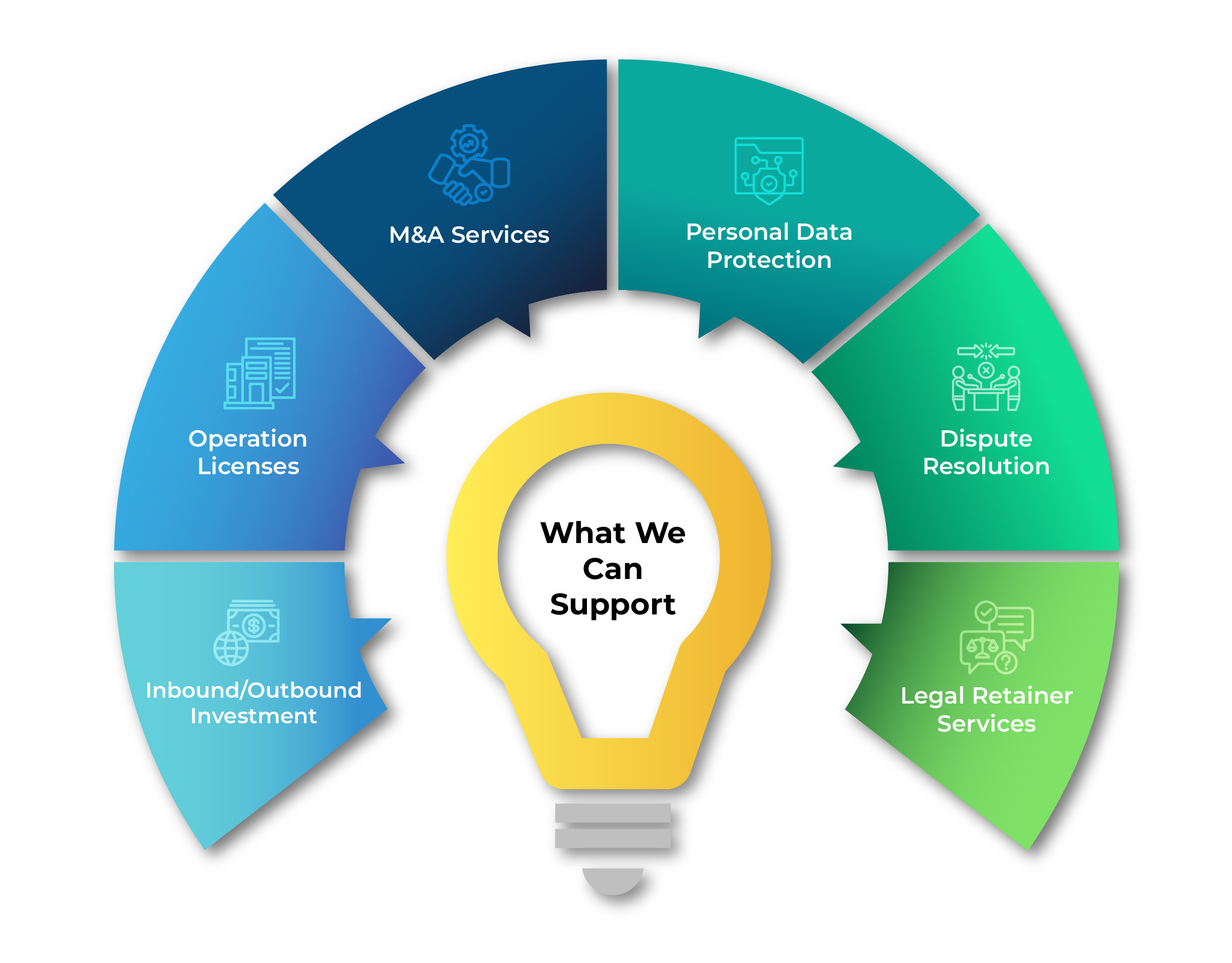
- Inbound/Outbound Investment: Company Establishment, Investment Registration and Post-registration Services in relation to tax, accounting, labor, insurance, salary, and outsourced legal department;
- Operation Licenses: We could provide support in the application for operation licenses for business activities in fields such as manufacturing, commerce, services, e-commerce, healthcare, education, or food & beverage (restaurants);
- M&A Services: Conduct legal due diligence, structure transactions, draft and negotiate transaction documents, provide advice on competition law compliance (including merger control filings and related approvals), obtain necessary regulatory approvals and licenses, and provide post-closing support;
- Personal Data Protection: Provide support in compliance with the data protection regulations, including the drafting and reviewing of Data Protection Impact Assessment (DPIAs), Data Processing/Transfer Agreement, Privacy Policies, and other necessary documents under the Personal Data Protection Decree (PDPD);
- Dispute Resolution: Litigation and Commercial Arbitration (VIAC SIAC ICC); and
- Legal Retainer Services per the clients’ requests.
Please contact Mr. Chris Luong – Partner through the email address of chris.luong@cnccounsel.com through the email address for prompt and timely support.
Managed by
 |
Luong Van Chuong I Partner
Phone: (84) 938 04 7969 Email: chris.luong@cnccounsel.com |
Contact Us
CNC Vietnam Law Firm
Address: The Rise Building, 2A1 Nguyen Thi Minh Khai, Sai Gon Ward, Ho Chi Minh City, Vietnam
Phone: (84) 28-6276 9900 – 081 235 3839
Hotline: (84) 916-545-618
Email: contact@cnccounsel.com
Website: cnccounsel
We would be delighted to welcome you at CNC’s office, where you’ll have the opportunity to consult with the lawyer best suited to your circumstances. Of course, if you are unable to meet in person, simply email us via contact@cnccounsel.com or call us via (+84-28) 6276 9900.
It would be a pleasure for CNC’s lawyers to help you build a solid legal foundation, thus ensuring the success and sustainable development of your project!
————————————
Copyright © CNC Counsel. All rights reserved. Ownership: This document and its contents (the Materials) are proprietary resources exclusively owned by CNC Counsel. Use of the Materials does not in itself establish any contractual or lawyer-client relationship between CNC Counsel and any party. Disclaimer: All Materials are provided for informational purposes only and may not reflect the latest legal developments. All summaries of laws, regulations and practices are subject to change. The Materials do not constitute legal or professional advice on any specific matter and are not intended to substitute for consulting (and complying with) the detailed provisions of applicable laws, rules, regulations or forms. Clients are advised to seek legal advice before deciding to take or refrain from any action based on the information in the Materials. CNC Counsel, its editors and authors do not warrant the accuracy of the Materials and disclaim liability to any party for actions taken in reliance on all or any part of the Materials. The Materials may contain links to external websites, and external websites may link to the Materials. CNC Counsel is not responsible for the content or operation of any such external website and disclaims all liability in connection with its content or operation. Note: past results do not guarantee similar outcomes in the future; each matter is different.