




What are Construction Contracts?
According to Clause 1 Article 138, 2014 Law on Construction (amended and supplemented in 2020), construction contracts are civil contracts established in writing between principals and contractors to perform, in part or in whole, the work in investment construction activities.
According to the above provision, there is no distinction regarding whether parties to construction contracts must be traders or enter into the contract for profit-driven purposes or not – any construction contract would be considered a civil contract rather than a commercial contract from the moment it is established. In other words, the applicable law provisions for construction contracts are those of civil laws and construction laws instead of commercial laws.
This has been further affirmed and clarified in the Cassation Decision No. 12/2019/DS-GDT dated 24/09/2019 of the Judge’s Council of the People’s Supreme Court.
Accordingly, the People’s Supreme Court found that “Besides, Contract No. 16/HDTC/12 dated 22/02/2012 between Quang Minh Company and Tay Nguyen Company in relation to construction activities was established based on Contract for Construction No. 01/HD-XP/HD dated 18/08/2011….the application of commercial laws to resolve this dispute is not appropriate. In this situation, it should be determined that the disputed relationship falls within the construction sector, therefore, the construction laws should be applied. In cases where construction laws do not provide for relevant issues, the Civil Code shall be applied instead”.

Construction contracts are civil contracts
The Draft of Precedent No. 06/2024 has also been recommended based on the above Cassation Decision No. 12/2019/DS-GDT dated 24/09/2019 and is expected to be passed in the near future.
More on Draft of Precedent No. 6 here.
Types of Construction Contracts
Depending on different criteria, construction contracts could be categorized into different types. Such as Principal Contract, Contract for Design and Construction, EPC/Turnkey Contract, and Subcontract.
Based on Article 140, 2014 Law on Construction (amended and supplemented in 2020), Construction contracts are categorized as follows:
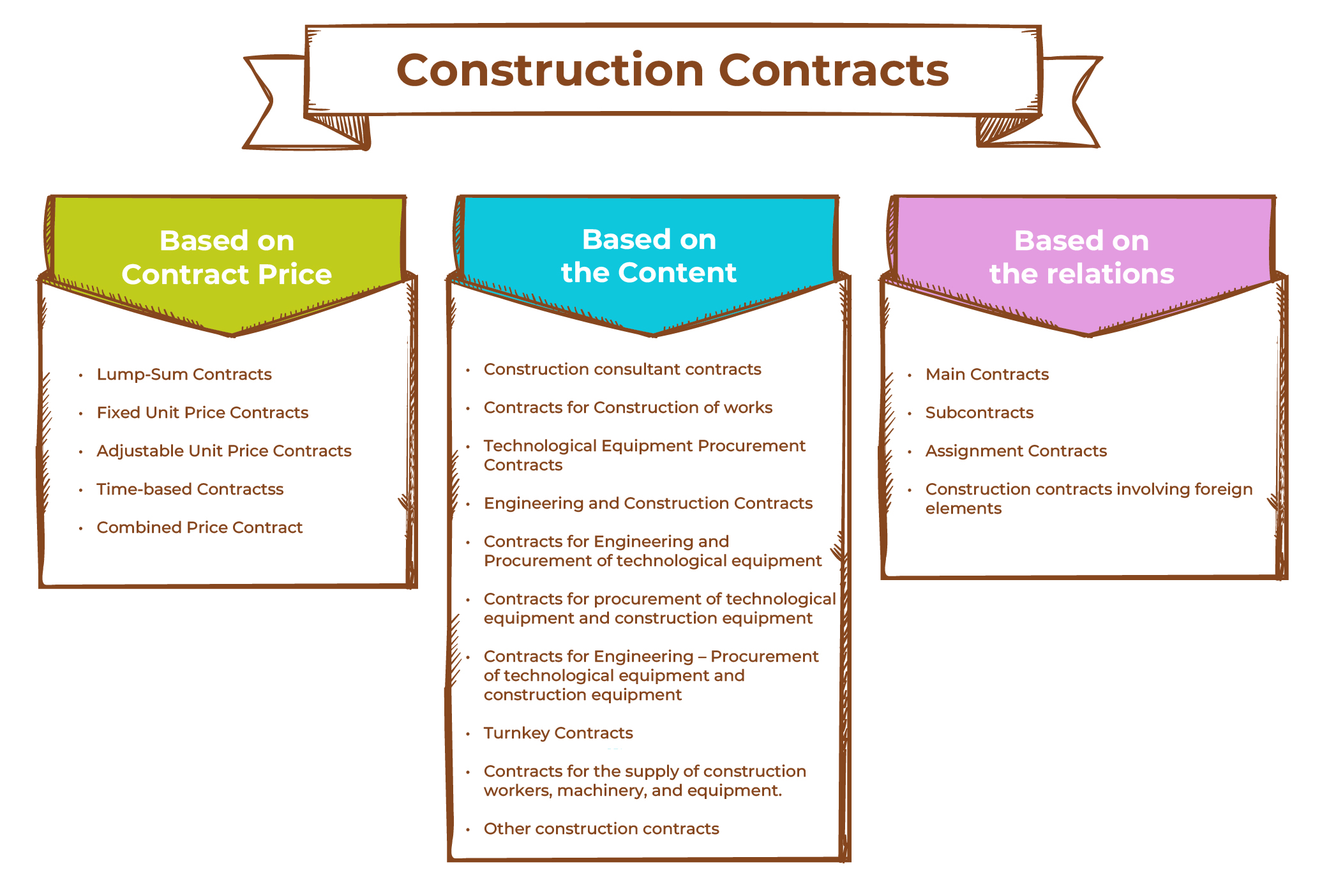
Types of Construction Contracts
More details on Construction Contracts, and their features, as well as methods of application here.
Principles for Conclusion of Construction Contracts
Similar to other civil contracts, the conclusion of Construction Contracts must adhere to the fundamental principles of civil laws, including[1]
- Voluntary, equal, and free cooperation that does not contradict laws and social morality
- The Employer or the Principal must ensure that they have adequate financial capability to compensate according to the contract
- The Employer has completed the selection of contractors and concluded the contract negotiation process.
- A joint venture agreement must be available IF/WHEN the contractor is or becomes a joint venture
- Parties in the joint venture must sign and stamp (if applicable) the construction contract unless agreed upon otherwise by the parties.
Principles for Implementation of Construction Contracts
Similar to the conclusion of construction contracts, construction laws also require parties to comply with the following principles during the implementation[2]:
- Compliance with the agreement in the contract pertaining to the scope of work, quality requirements, quantity, category, schedule, methods, and other agreements.
- Honest, cooperative, and legal
- No infringement upon the interests of the state, community, and lawful interests of other organizations, and individuals.
Validity of Construction Contracts
Construction contracts are effective immediately after their conclusion or as agreed by the Parties, provided that the[3]:
- Signees of construction contracts possess authority and full civil act capacity
- Conclusion of contracts adheres to principles set forth in Article 138.2, 2014 Law on Construction, and
- Contractor is fully qualified in accordance with the law to implement the Works
Article 146.8, 2014 Law on Construction (amended and supplemented in 2020) also affirmed the validity of Construction Contracts by requiring parties to comply with the contractual agreement and commitments during the implementation of contracts, as well as to maintain equality and cooperativeness during the dispute resolution.
Content of Construction Contracts
For a unique sector such as construction, it is understandable that the content of Construction Contracts is rather detailed, complex, and covers a myriad of issues. Below, CNC has listed 72 of the most important issues of a typical Construction Contract.
- Definition and Interpretation
- Applicable Language for the Contract
- Applicable Language for communication between parties
- Applicable Law
- Contract Document and Priority
- Individual and Joint Responsibilities
- Compliance with the law
- Site Handover – Employer to Contractor
- On-site personnel of the Employer and the Employer’s Contractors
- Financial arrangement obligations of the Employer
- Plants, materials, and equipment provided by the Employer
- The role, authority, and responsibilities of the Engineer (if any)
- Engineer’s Instructions
- Engineer’s Determinations
- The role, authority, and responsibilities of the Contractor
- Issuance and Maintenance of Performance Bond
- Contractor’s Representative
- Contractor’s Documents
- Contractor’s Cooperation Obligations
- Setting Forth and Monitoring Obligations
- Labor Safety Obligations
- Obligations to ensure the quality of work
- Site Access
- Obligations to mitigate impacts on the residents surrounding the site
- Goods Transport Contractor
- Contractor’s Equipment
- Contractor’s Environmental Protection Obligations
- Temporary utilities for construction
- Construction Process/Progress Reports
- Site Security
- Contractor’s on-site activities
- Discovery of Antiques and Cultural Relics
- Subcontractor’s role, authority, and responsibilities
- Employment of workers, benefits, and work hours
- Core Personnel
- Requirements on the construction machinery and equipment
- Samples Submission
- Inspection
- Testing
- Defects and Defects Remedy
- Ownership of Plants
- Commencement
- Construction Completion Time
- Preparation, submission, and update of Construction Schedule
- Extension of Construction Completion Time
- Delay Damage
- Construction Suspension by the Employer
- Consequences of Suspension
- Re-commence of Construction subsequent to suspension
- Testing and Inspection prior to Construction Completion
- Handover of Work to the Employer
- Remedy of Defects subsequent to the handover of Works by the Contractor
- Costs for Remedy of Defects subsequent to the handover of Works by the Contractor
- Measurement and Evaluation of Work completed
- Variations
- Contract Adjustment due to changes in law
- Contract Adjustment due to changes in cost
- Contract Price and Payment
- Advance Payment
- Interim Payment
- Final Payment
- Retention
- Currency
- Contract Termination by Parties
- Contractor’s Site Supervision Obligations
- Force Majeure
- Construction Insurance
- Employee Insurance
- Third Party Liability Insurance
- Claim by Parties, and
- Dispute Resolution.
Rewards, Penalties, and Indemnities in Construction Contracts
One of the more notable aspects of Construction Contracts are the provisions on rewards, penalties, and indemnity.
Accordingly, Article 146 of the 2014 Law on Construction (amended and supplemented in 2020) specifies as follows:
- Regarding rewards and penalties: Parties must have detailed agreements that are recorded in the contract for these rewards and penalties to be applicable.
- For state-funded construction projects, the maximum penalties MUST NOT exceed 12-percent (12%) of the value of the breached obligation.
- For construction projects that ARE NOT state funded, there is currently no specific provision on the penalty amount. Parties may make use of provisions of the 2014 Law on Construction (amended and supplemented in 2020) to apply to their situation
- Aside from the agreed penalty amount, the breaching party may also indemnify the other party, or any third party (if any) in accordance with this Law or other relevant laws.
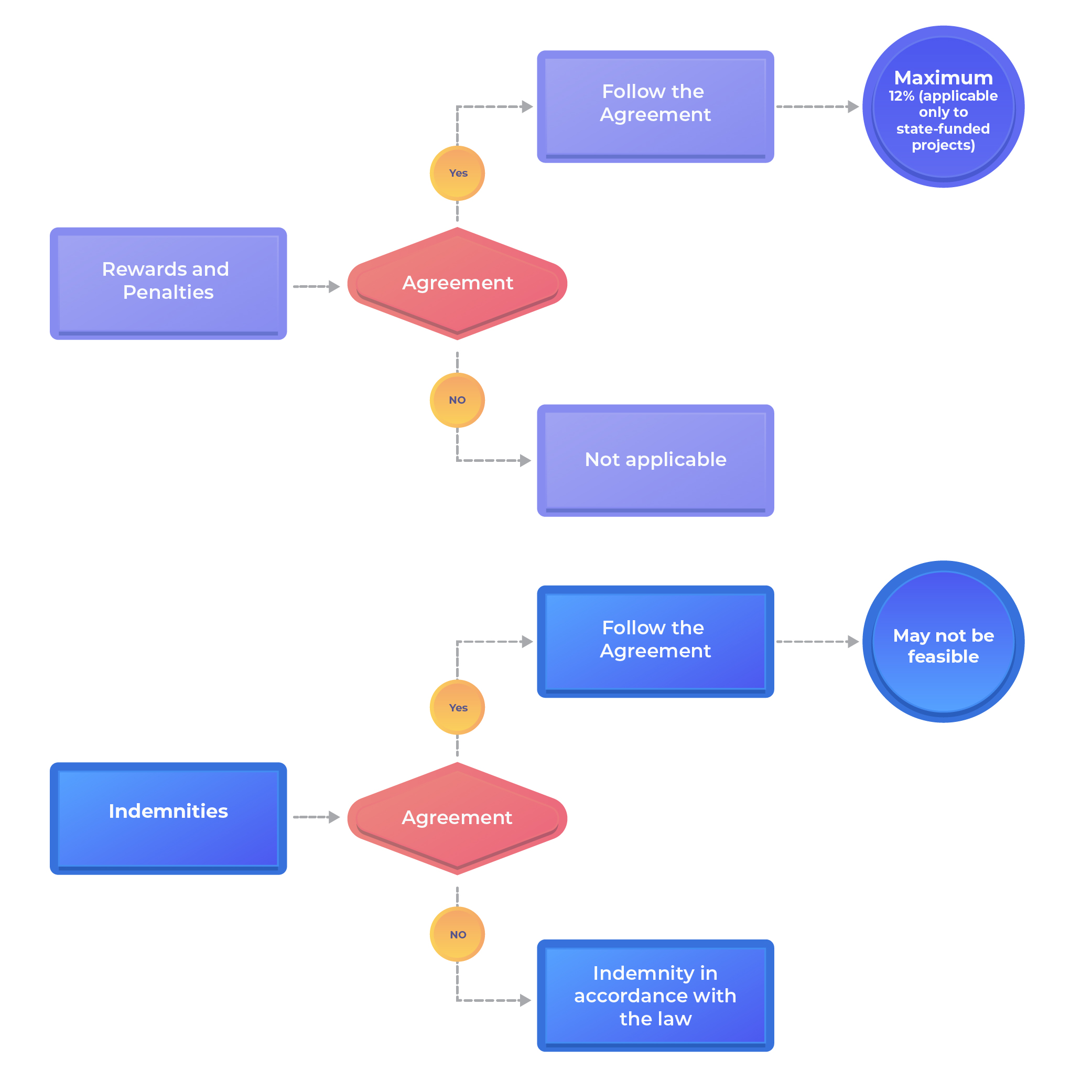
Rewards, Penalties, and Indemnities in Construction Contracts
Construction Contract Templates
Below, CNC introduces 5 commonly seen Construction Contract templates for Clients reference and selection
Template 1: Housing Construction Contract Template
Template 2: Rough Construction Contract Template
Template 3: Template of Construction Contract for Completion
Template 4: Interior Construction Contract Template
Template 5: Factory Construction Contract Template
See more on Construction Contract Templates
With more than 12-years of experience in the legal industry, CNC is proud to have collected hundreds of Construction Contract Templates that are presently available on hopdongmau. Each Contract is considered as a valuable experience that CNC has acquired through the provision of our services to our Clients.
These .doc format Construction Contract Templates would help Clients to have more options in their consideration and selection of the most appropriate contract template.
Contact
CNC offers support on legal advice, negotiation, or preparation of any Construction Contract, please contact CNC via the contact information provided below.
CNC’s lawyers take pride in their work on and experience with Construction Contract Templates issued by the Ministry of Construction, FIDIC, and NEC. Our associates are fluent in Vietnamese, English, and Chinese which serves as great advantage for our firm, as well as our clients with respect to communication with our Clients and potential clients.
CNC Vietnam Law Firm Co. Ltd
28 Mai Chi Tho, An Phu Ward, Thu Duc City, Vietnam
Phone: 028 6276 9900 | Hotline: 0916 545 618
Email: contact@cnccounsel.com | Website: https://cnccounsel.com
Facebook: https://facebook.com/cnclaw/
Linked: https://linkedin.com/company/cnccounsel
—————————————–
[1] Article 138.2, Law on Construction 2014
[2] Article 138.3, Law on Construction 2014
[3] Article 139, Law on Construction 2014