



Fundamental Changes of Circumstances in Construction Contracts
Practical Perspectives from Legal, Contract Management and Cost Consultancy
In the first months of 2026, the Vietnamese construction market has been experiencing an unprecedented period of volatility.
From geopolitical tensions and military conflicts in the Middle East, supply chain disruptions, and escalating fuel prices, to mounting pressure from public investment disbursement and infrastructure demand, all of these factors are creating cascading impacts directly affecting the costs and schedules of construction projects.
Diesel prices have surged. Steel, cement, asphalt, and construction input materials continue to fluctuate. Logistics and transportation costs have increased significantly. Commercial assumptions once considered “reasonable” at the tender stage are no longer valid.
What is particularly notable is that: most projects are not “impossible to perform”..
Construction works may still proceed. Projects may still be completed. However:
- actual costs have significantly exceeded the original budget;
- project schedules have become increasingly difficult to maintain;
- and the commercial equilibrium of contracts is being severely disrupted.
Against this backdrop, the issue of fundamental changes of circumstances in construction contracts has become one of the most discussed topics among:
- Employers;
- Contractors;
- Contract Managers;
- Commercial Teams;
- Consultants;
- and construction law practitioners.
When “ordinary commercial risk” is no longer ordinary
In practice, many businesses are currently facing difficult questions:
- Does the increase in material prices constitute force majeure?
- Can Article 420 of the 2015 Civil Code be applied?
- Are contractors entitled to request contract adjustments?
- How should employers respond while protecting both budget and project progress?
- What supporting documents are required for a cost escalation claim?
- If no agreement is reached, where will disputes ultimately lead?
These are no longer merely academic questions. They are practical issues arising daily across:
- infrastructure projects;
- EPC projects;
- energy developments;
- airport projects;
- transportation works;
- public investment projects;
- and large-scale construction developments.
In Official Letter No. 5026/BXD-KTQLXD dated 3 April 2026, the Ministry of Construction also acknowledged that, in many projects:
- actual costs have significantly deviated from tendered prices;
- original schedules are no longer feasible;
- and certain initial commercial assumptions underlying the contracts are no longer appropriate.
Following this, various directives, resolutions, and governmental instructions have continuously been issued to address difficulties relating to fuel prices, construction materials, and public investment progress.
In this context, understanding the true nature of:
- “Force Majeure”;
- “Fundamental Change of Circumstances”;
- and “commercial equilibrium of contracts”
has become more important than ever.
Is a Fundamental Change of Circumstances in Construction Contracts Truly Different from Force Majeure?
This is currently one of the most debated issues within the construction industry.
In reality, many businesses tend to:: “categorize every major disruption as force majeure”.
However, from a legal perspective, “Force Majeure” and “Fundamental Change of Circumstances” are two entirely different mechanisms.
While force majeure is generally associated with: situations where contractual performance becomes impossible, a fundamental change of circumstances in construction contracts relates to situations where:
- the contract may still be performed,
- but continuing performance under the original terms may seriously disrupt the commercial equilibrium between the parties.
This is precisely why Article 420 of the 2015 Civil Code is increasingly being invoked in:
- negotiations;
- cost escalation claims;
- dispute boards;
- and construction disputes.
Nevertheless, one of the biggest challenges today is that: many businesses are aware of Article 420, but do not yet fully understand how to apply it properly.
An Event That Goes Beyond Legal Theory — Focusing on How the Market Actually Operates
In response to these practical challenges, CNC, together with experts in:
- legal practice;
- contract management;
- and cost consultancy
is organizing the following seminar:
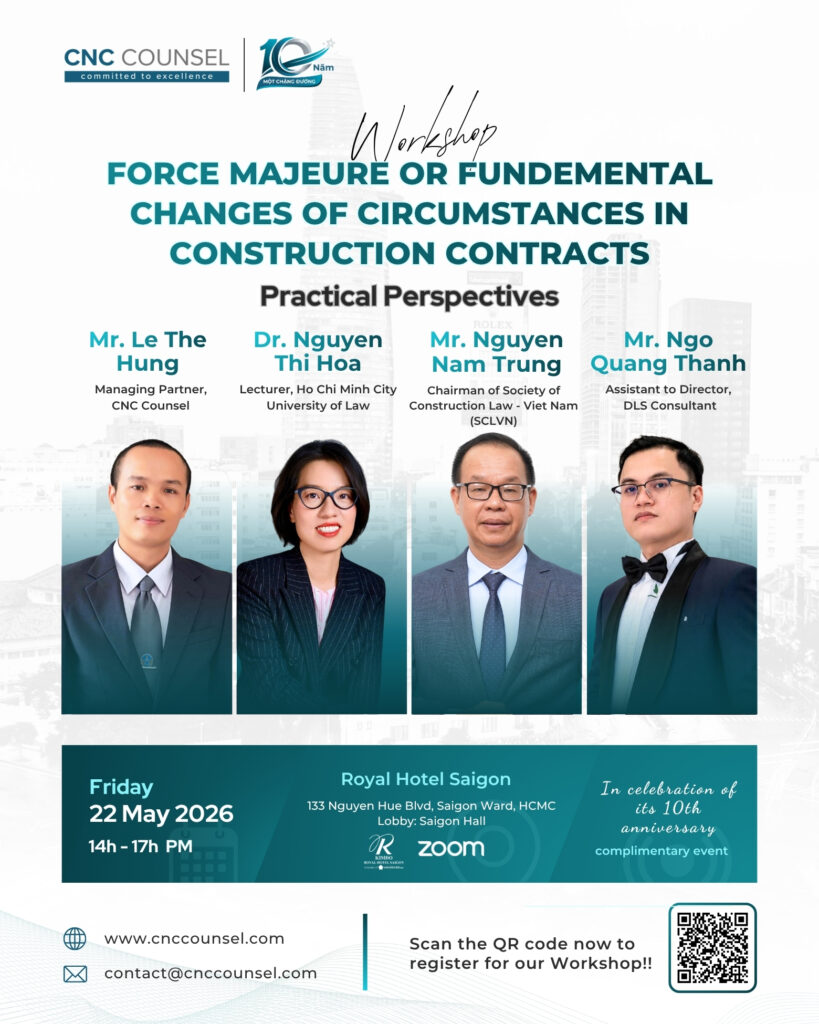
“Fundamental Changes of Circumstances in Construction Contracts – Practical Perspectives from Legal, Contract Management and Cost Consultancy”
What distinguishes this program is that: it is not merely a theoretical legal seminar.
Instead, the event is designed as a multidisciplinary practical forum where issues will be examined from:
- legal perspectives;
- project operation perspectives;
- claim and contract management perspectives;
- cost data perspectives;
- and commercial perspectives.
In other words: the program is not only about “legal provisions”, but about: what businesses should actually do when contractual equilibrium begins to collapse.
Practical Perspectives to Be Shared During the Program
Legal Perspective: How Should Article 420 Truly Be Understood?
Although Article 420 of the 2015 Civil Code has existed for nearly a decade, in practice:
- many businesses still confuse “Force Majeure” with “Fundamental Change of Circumstances”;
- or view Article 420 merely as a mechanism to “request price increases”.
In reality, the essence of Article 420 lies in: contract rebalancing.
This topic will be analyzed in depth during the seminar:
- When does cost escalation remain an ordinary commercial risk?
- When may it qualify as a fundamental change of circumstances?
- What are the actual conditions for application?
- Where does the burden of proof lie?
- Why do many claims fail despite substantial cost increases?
Contract Management Perspective: Why Do Many Claims Fail?
In project practice, the issue is often not:
“whether costs have increased.
Rather, it is:
“whether such impacts can be properly substantiated”.
Many contract adjustment requests encounter difficulties due to:
- lack of baseline data;
- insufficient market data;
- inability to prove actual impacts;
- inability to demonstrate mitigation efforts;
- or failure to establish the connection between market changes and disruption of contractual commercial equilibrium.
From a contract management and project operation perspective, the seminar will discuss:
- effective claim strategies;
- documentation logic;
- negotiation approaches;
- and practical lessons learned from contractors’ experiences.
Cost Consultancy Perspective: Data Is Becoming the Most Powerful Tool
One of the biggest changes in today’s market is that:
pricing data and market data are becoming decisive factors in contract adjustment request.
Participants will gain insights into:
- construction material price trends;
- the impact of fuel prices on construction costs;
- methods for assessing actual cost impacts;
- and how cost consultants evaluate the reasonableness of adjustment requests.
This is particularly important in a context where:
- auditors;
- employers;
- regulatory authorities;
- and dispute boards/arbitral tribunals
are requiring increasingly higher standards of proof.
Featured Speakers
Dr Nguyen Thi Hoa has been a lecturer at Ho Chi Minh City University of Law since September 2019, where she mainly teaches and conducts research in international business law and alternative dispute resolution in international commercial disputes.
From 2018 to August 2019, Dr. Hoa worked at the Ho Chi Minh City Department of Justice, where her work notably focused on legal advisory in areas such as contract law, construction law, investment law, international dispute resolution, promotion of commercial arbitration activities, and the recognition and enforcement of decisions issued by foreign competent authorities in Vietnam.
In August 2018, Dr. Hoa successfully defended her PhD dissertation at Paris-Panthéon-Assas University in France on the topic: “Dispute Resolution Procedures in International Construction Projects Using FIDIC Standard Forms of Contract.” She also gained practical experience working for a Paris-based law firm specializing in construction law from August to December 2018.
Between 2020 and 2022, Dr. Hoa participated as Scientific Secretary in a state-level research project titled “Arbitration as a Dispute Resolution Method in the Context of International Economic Integration,” funded by the National Foundation for Science and Technology Development (NAFOSTED) under Project No. 505.01-2020.02, headed by Professor Đỗ Văn Đại.
From 2021 to 2023, she completed a university-level research project as principal investigator on the topic “Third Parties in Commercial Arbitration Law.” In addition, Dr. Hoa has published numerous academic articles in reputable international journals on arbitration and dispute resolution in international construction projects. She also possesses practical experience acting as an expert in disputes resolved through international arbitration proceedings.
Since April 2022, Dr. Hoa has served as a peer reviewer for the prestigious international journal Journal of Legal Affairs and Dispute Resolution in Engineering and Construction (indexed in Scopus, ranked Q1 from 2020–2024), published by the American Society of Civil Engineers.
Dr. Hoa is currently a member of the Executive Committee of the Vietnam Society of Construction Law. In 2023, she also acted as an expert witness in a contractual dispute resolved before the Singapore International Arbitration Centre (SIAC).
Dr. Nguyen Thi Hoa will provide in-depth academic and legal perspectives on:
- the distinction between force majeure and fundamental change of circumstances;
- applicable legal conditions;
- the legislative rationale behind Article 420;
- and how these concepts are viewed in relation to international practice.

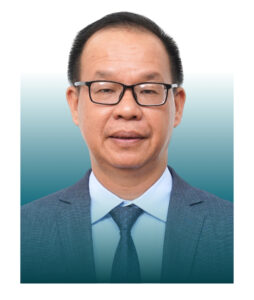
Mr Nguyen Nam Trung
Mr Nguyen Nam Trung is a construction engineer with more than 25 years of experience in contract management and dispute resolution in industrial, civil, and infrastructure construction projects.
He has served as an arbitrator at the Vietnam International Arbitration Centre (VIAC) since 2020, and is also listed as an Arbitrator/Adjudicator at arbitration centers in Brunei, Malaysia, Myanmar, Russia, Japan, Thailand, and China.
Mr. Trung is a FIDIC-certified trainer and adjudicator, and is included in the FIDIC President’s List of Approved djudicators. He currently serves as Chairman of the Society of Construction Law – Vietnam (SCLVN).
Drawing from international practical experience, Mr. Trung will share:
- real challenges currently faced by contractors;
- claim documentation strategies;
- negotiation experiences;
- and common “pain points” in dealing with project cost fluctuations.
Mr Ngo Quang Thanh
Mr Ngo Quang Thanh is a quantity surveyor and construction cost management specialist with more than 10 years of experience in Vietnam’s construction industry. He holds degrees in Civil Engineering and Law, and has also completed the professional lawyer training program at the Judicial Academy of Vietnam.
Mr. Thành is a certified MRICS (Member of the Royal Institution of Chartered Surveyors) and a member of the Vietnam Society of Construction Law.
He is currently serving as Senior Quantity Surveyor and Assistant to the Director at DLS Consultant.
His expertise includes cost planning, tender and contract management, construction cost control, variation assessment, final account settlement, and payment management for large-scale civil and industrial projects. With a combined background in engineering and law, together with practical experience working for both employers and consultants, Mr. Thành brings a well-rounded and practical perspective to construction cost management and contract administration.
Representing one of Vietnam’s leading cost consultancy and tender advisory firms, Mr. Ngo Quang Thanh will provide perspectives from market data and cost consultancy, including:
- assessment of cost impacts;
- material price fluctuation analysis;
- construction market trends;
- and methodologies for evaluating the reasonableness of contract adjustment requests.

Le The Hung
Le The Hung possesses extensive experience in the fields of Construction and Real Estate. He currently leads the Litigation and Dispute Resolution Practice at CNC Counsel, a specialized Vietnamese law firm providing legal support to project stakeholders, including employers, contractors, consultants, subcontractors, banks, and financial institutions throughout the entire project lifecycle.
Mr. Hùng regularly advises and represents clients in international disputes before major arbitral institutions, including the Vietnam International Arbitration Centre (VIAC), International Chamber of Commerce (ICC), Singapore International Arbitration Centre, Hochiminh City Comercial Arbitration Centre – TRACENT), and The Middle Commercial Arbitration Center (MCAC), as well as various other arbitral centers in Vietnam.
He is also a frequent speaker and panelist at professional seminars and workshops organized by the Vietnam International Arbitration Centre, the Vietnam Society of Construction Law, and Ho Chi Minh City University of Law.
In recognition of his professional contributions, Law.asia named Mr. Hùng among the Top 100 Most Influential Lawyers in Vietnam for two consecutive years from 2024 to 2025.
As a specialist in construction law, EPC projects, FIDIC contracts, and international dispute resolution, Mr. Hùng will share:
legal strategies for applying Article 420;
- the concept of contract rebalancing;
- common mistakes in cost escalation claims;
- and practical approaches to minimizing disputes while preserving commercial interest.

What Will Participants Gain?
The seminar is designed with strong practical orientation, focusing on: “frameworks that can be directly applied to ongoing projects”.
Participants will have access to:
✅ A Framework for Assessing the Applicability of Fundamental Changes of Circumstances in Construction Contracts
Including questions such as:
- Are the changes objective in nature?
- Did they occur after contract execution?
- Could they reasonably have been foreseen?
- How severely do they affect cost structures and project schedules?
- Have mitigation measures been implemented?
This framework is particularly important for:
- contractors;
- employers;
- commercial managers;
- contract managers; and
- project legal teams.
✅ Claim Preparation and Evidentiary Checklists
Including:
- baseline records;
- pricing data;
- impact documentation;
- mitigation records;
- and logical linkage between market changes and disruption of commercial equilibrium.
This is also one of the key factors determining whether a claim for the application of the doctrine of fundamental change of circumstances in a construction contract would be sufficiently persuasive.
✅ A “Contract Rebalancing” Perspective”
One of the key insights of the seminar is that: Article 420 is not a mechanism for “requesting price increases“. Rather, it is: a mechanism for rebalancing contracts.
This means that solutions may include:
- schedule adjustments;
- cashflow adjustments;
- risk reallocation;
- modification of implementation methods;
- or restructuring of contractual commercial arrangements.
✅ A Dispute Avoidance Perspective
Instead of approaching issues from a: ““win–lose” perspective, the program aims to address, “how contracts can continue operating sustainably.”
This mindset is particularly important for:
- EPC projects;
- infrastructure developments;
- public investment projects;
- and long-term construction contracts.
Program Information
According to the program agenda:
- 14:00 – 14:15: Opening Remarks
- 14:15 – 14:45: Force Majeure vs Fundamental Change of Circumstances
- 14:45 – 15:15: Contractor’s Perspective
- 15:15 – 15:45: Cost Consultancy Perspective
- 15:45 – 16:15: Legal Perspective
- 16:15 – 16:45: Q&A and Practical Discussion
Format: Online & Offline.
- Online via Zoom
- Offline: Royal Hotel Saigon, 133 Nguyen Hue Blvd, Saigon Ward, HCMC. Lobby: Saigon Hall
In a Volatile Market, Understanding Article 420 Is No Longer an Academic Exercise
As war, fuel prices, logistics disruptions, and public investment pressures simultaneously affect the construction market, many contracts are entering a situation where:
they remain performable, but no longer commercially balanced.
In this context, properly understanding and applying the concept of fundamental changes of circumstances in construction contracts is no longer merely a legal issue:
- a project management issue;
- a commercial strategy issue;
- a risk management issue;
- and in many cases.
Through practical perspectives from legal practice, contract management, and cost consultancy, the seminar aims to provide:
- practical analysis;
- applicable frameworks;
- claim and negotiation strategies;
- and valuable lessons learned from the market.
to help businesses better evaluate, respond to, and navigate today’s rapidly changing environment.
Registration
📌 Physical attendance is limited.
📌 Priority confirmation will be given to:
- employers;
- contractors;
- consultants;
- contract/commercial/cost managers;
- and project legal teams.
👉 Register here:
REGISTRATION LINK: https://us06web.zoom.us/webinar/register/WN_nS9lB5b4RySqPVdctKN81g
Or QR Code

📩 For further information regarding the program and participation:
- Email: trang.huynh@cnccounsel.com
- Hotline: 094 756 6869
We look forward to welcoming and engaging with you at the event.
Disclaimer: The contents of this program and article are intended solely for academic and professional discussion purposes. They do not constitute legal advice for any specific matter. The application of Article 420 of the 2015 Civil Code or any contract adjustment mechanism must be assessed based on the specific circumstances of each contract and project.