




Initial public offering of shares (IPO) in Vietnam
Conditions, procedures and risks that enterprises should anticipate
Vietnam’s securities market is entering a rare period of intense IPO activity. Since the beginning of 2026, the HOSE has successively welcomed the listings of Techcom Securities (TCX) and LPBank Securities (LPBS), together with the plan of Dien May Xanh Investment (DMX) to raise more than VND 14,360 billion[1]. A number of international institutions forecast that the total value of IPOs in Vietnam over the 2026-2028 period may reach approximately USD 50 billion, equivalent to 12% of current GDP[2]. Major brands such as Highlands Coffee, THACO and VNG are also expected to conduct an IPO or to list in the near future.
This wave’s momentum comes from several directions. From a macroeconomic perspective, FTSE Russell has officially upgraded Vietnam’s securities market from “Frontier Market” to “Secondary Emerging Market”. The allocation of Vietnamese stocks into FTSE Russell’s index baskets will be implemented from 21 September 2026 under a multi-phase roadmap, with estimated passive inflows of approximately USD 1.7 billion, not counting the accompanying active flows[3]. In addition, the Government has issued a series of pillar resolutions, including Resolution No. 68-NQ/TW on private economic development and Resolution No. 59-NQ/TW on international integration. These orientations share the objective of developing the private economic sector and strengthening international integration, thereby creating a favourable foundation for capital raising and investment attraction in the securities market.
In parallel with these policy orientations, the legal framework governing IPO activities has also been substantially updated. The base layer comprises the Law on Securities No. 54/2019/QH14 dated 26 November 2019 (“Securities Law 2019”) and Decree No. 155/2020/ND-CP dated 31 December 2020[4] (“Decree 155”). The amending and supplementing layer comprises Law No. 56/2024/QH15 dated 29 November 2024, effective from 1 January 2025[5] (“Law No. 56”), Decree No. 245/2025/ND-CP dated 11 September 2025, effective on the same date[6] (“Decree 245”), and Circular No. 19/2025/TT-BTC dated 5 May 2025, effective on the same date[7] (“Circular 19”).
Enterprises planning an IPO therefore need to cross-check both layers of regulations: most of the original conditions under the Securities Law 2019 remain in effect, while a number of important provisions on dossiers, procedures and public company conditions have been amended in a stricter direction.
This article sets out three main topics:
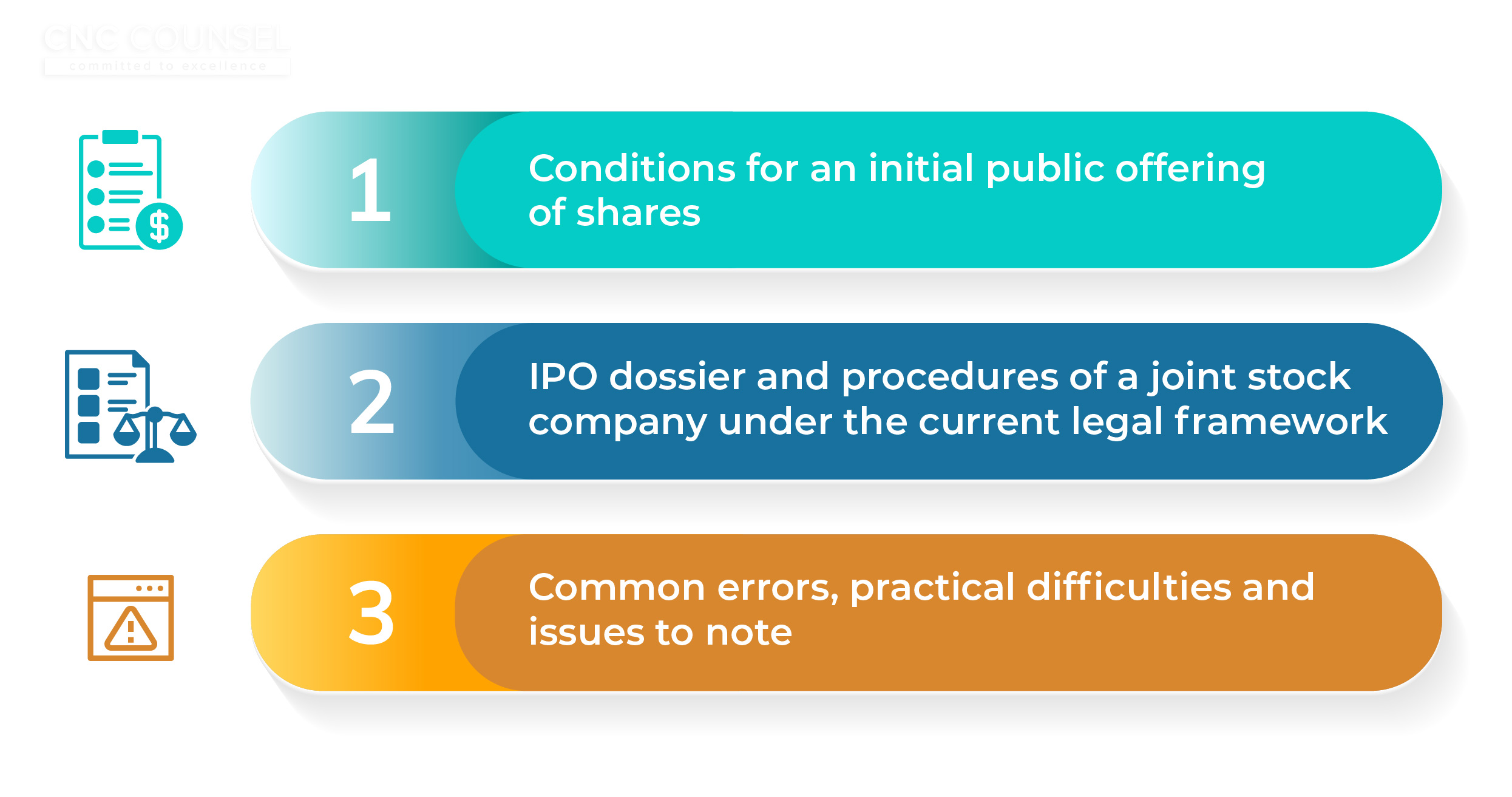
Conditions for an initial public offering of shares
Baseline framework of conditions under the Securities Law 2019
Article 15.1 of the Securities Law 2019 provides that a joint stock company wishing to make an initial public offering of shares must simultaneously satisfy the following 09 groups of conditions:
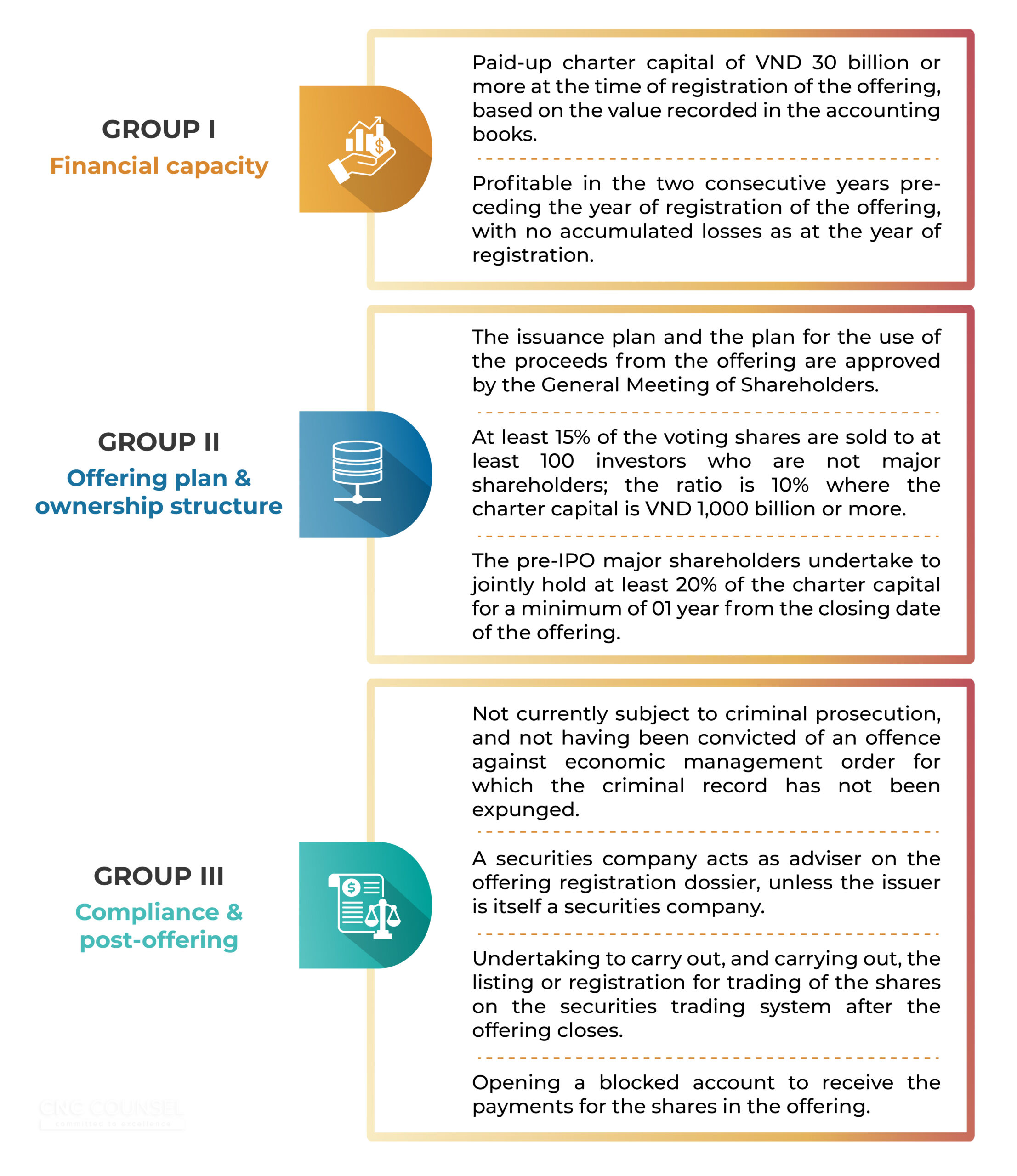
The 09 groups of conditions for an initial public offering of shares by a joint stock company
Where the IPO is carried out through the conversion of a limited liability company into a joint stock company, the corresponding conditions are provided in Article 15 of Decree 155 (as amended and supplemented by Decree 245).
New points introduced by Law No. 56, Decree 245 and Circular 19
Law No. 56 does not replace the entire framework of conditions under Article 18.1 of the Securities Law 2019 but amends and supplements it selectively; at the same time, it imposes additional requirements relating directly to the offering registration dossier.
Law No. 56 added point (k) to Article 18.1 of the Securities Law 2019, under which the dossier for registration of an initial public offering of shares must include a report on the paid-up charter capital as at the time of registration of the offering, audited by an independent audit firm.
Circular 19 sets out this requirement in detail: the report on paid-up charter capital must be prepared for a period of at least 10 years up to the time of registration of the initial public offering (or from the date of establishment if the enterprise has been in operation for less than 10 years) and must obtain an unqualified audit opinion[8].
This is the change with the greatest practical impact on private enterprises preparing for an IPO, as capital contribution records from earlier years are often no longer fully retained.
IPO dossier and procedures of a joint stock company under the current legal framework
IPO dossier
Pursuant to Article 18.1 of the Securities Law 2019 (as supplemented by point (a), Article 1.7 of Law No. 56) and Article 11 of Decree 155 (as amended and supplemented by Article 1.6 of Decree 245), the dossier for registration of an initial public offering of shares by a joint stock company now comprises:
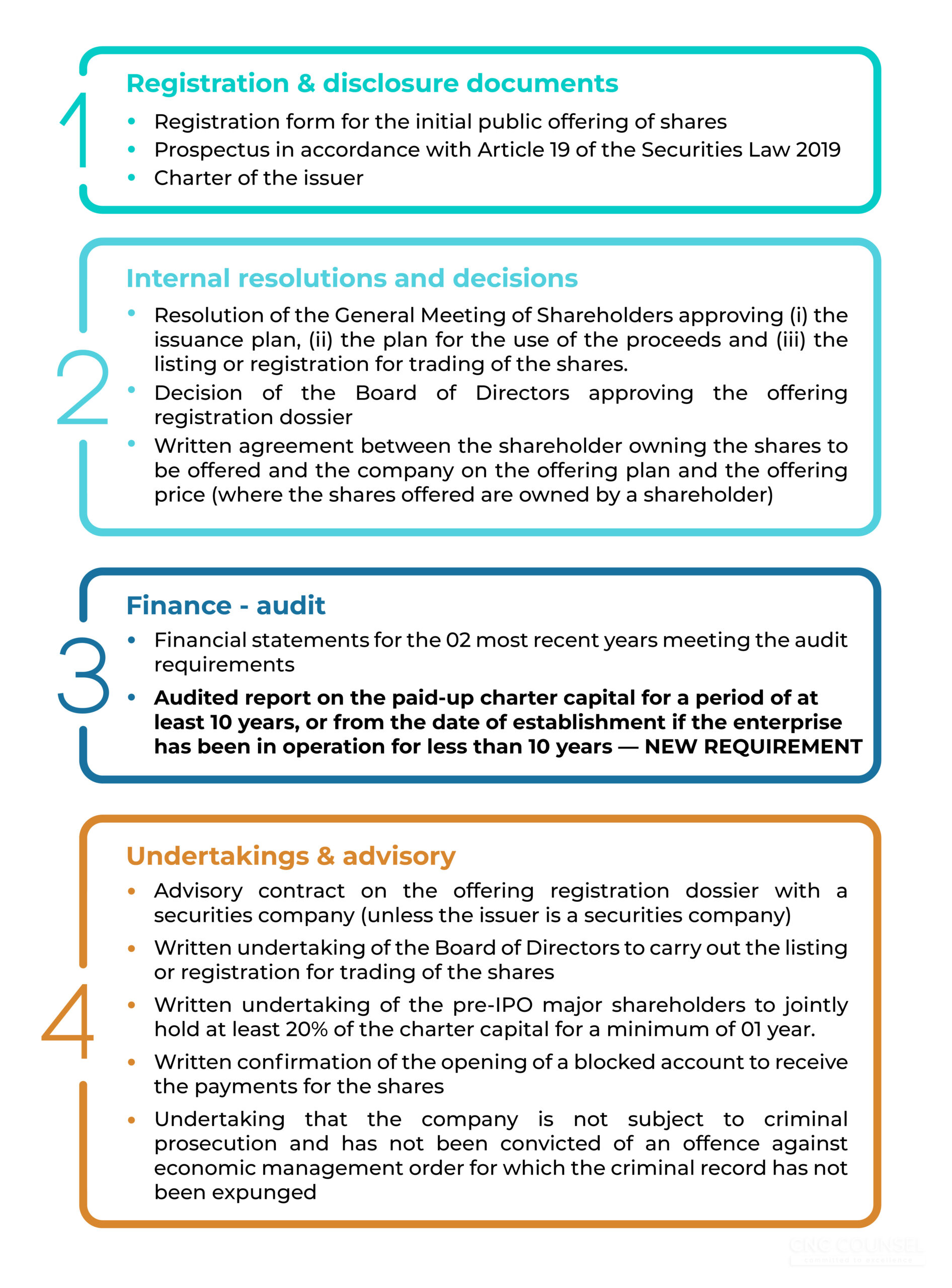
The 13 categories of documents in the dossier for registration of an initial public offering of shares
IPO and listing registration procedures
Decree 245 introduced the mechanism of “registration for listing of shares simultaneously with the IPO” by adding Article 111a to Decree 155. This is the change with the greatest procedural impact: the Stock Exchange reviews the listing dossier in parallel with the State Securities Commission’s review of the IPO dossier, instead of having to wait for the offering to be completed before the listing procedure can begin, as was previously the case.
The IPO and listing registration sequence has therefore also changed considerably. Under the previous regulations, an enterprise had to complete the IPO procedures first, then submit the listing dossier and wait for the Stock Exchange to review it within a time limit of 30 days in order to obtain a listing approval decision; the listing registrant then had to bring the shares into trading within 90 days from the date of approval. The simultaneous mechanism allows the total time from submission of the dossier to the shares officially commencing trading to be shortened significantly.
Under the new regulations, the IPO and listing registration sequence is carried out in accordance with the following flow chart:
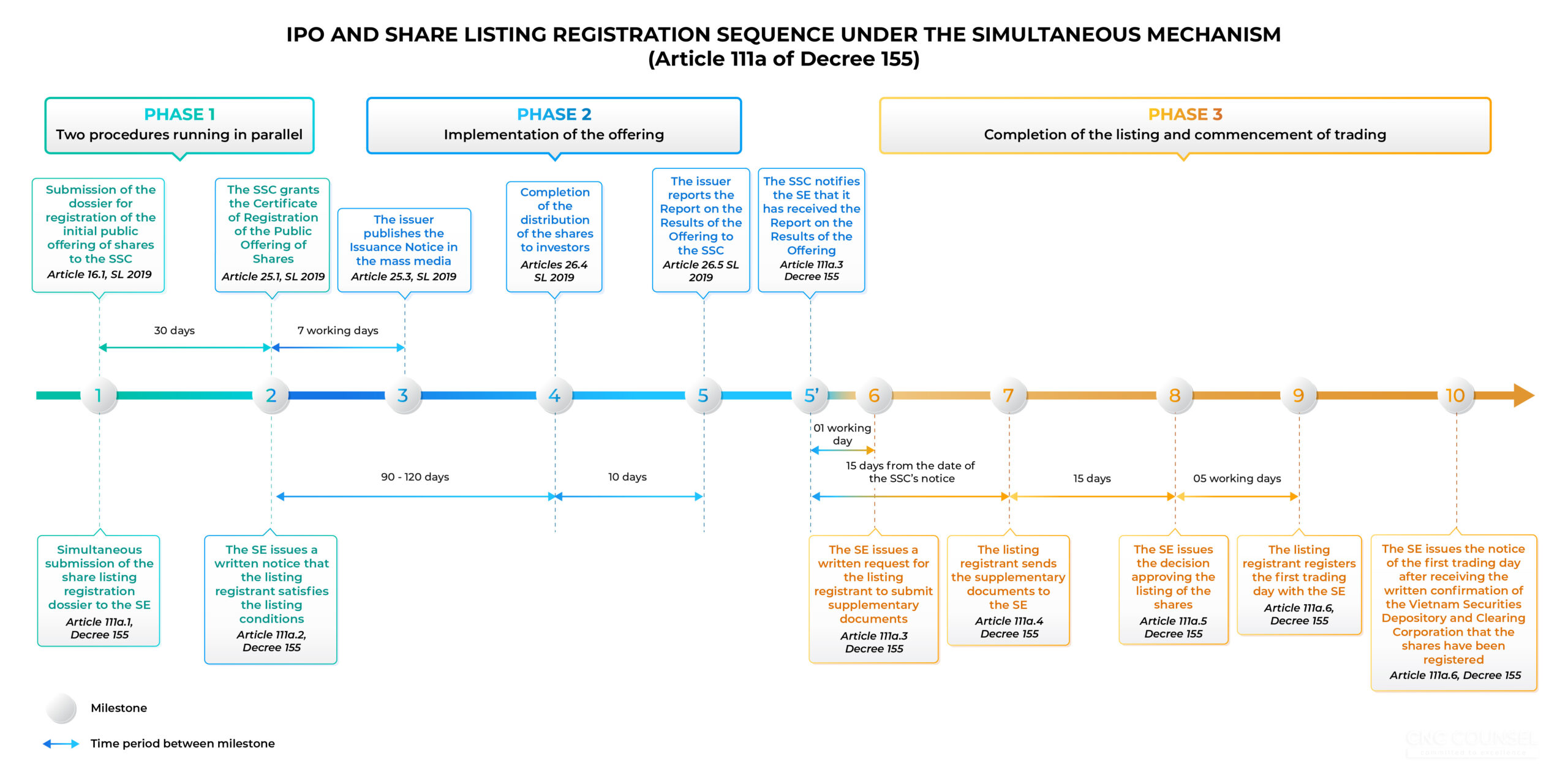
IPO and share listing registration sequence under the simultaneous mechanism (Article 111a of Decree 155)
Note: The time limits stated above are the maximum statutory time limits; the actual timing depends on the quality of the dossier and on the number of times the regulator requests explanations or supplementary documents.
Common errors, practical difficulties and issues to note
Legal perspective
Many enterprises begin preparing their internal legal documentation rather late, which results in inconsistencies among the charter, the resolutions of the General Meeting of Shareholders, commercial contracts and undertaking documents. One point frequently overlooked is the change of control clause in commercial contracts and credit agreements currently in effect. Pre-IPO ownership restructuring may trigger a counterparty’s right to terminate the contract if it is not reviewed and addressed from the outset. The undertaking of the major shareholders to hold at least 20% of the charter capital must also be carefully documented from the preparation stage, since this is a mandatory condition that must be maintained continuously for one year from the closing date of the offering.
Accounting and audit perspective
The new requirement for a report on the paid-up charter capital covering a period of at least 10 years under Circular 19 is currently the greatest practical barrier for many private enterprises. Capital contribution history spanning many years is often associated with cash transactions, asset valuations, or internal cash advances for which the documentation has not been fully standardised. Common shortcomings include a lack of documents evidencing the cash flows of the initial capital contributions; capital contributions not made within the time limit stated in the business registration but without appropriate accounting treatment; capital transfer transactions between related individuals that do not reflect the correct value or in respect of which tax obligations have not been fulfilled; and inconsistencies between the legal records and the accounting books. These shortcomings directly affect the ability to obtain an unqualified audit opinion, and may even lead to requirements for retrospective adjustments or to a reconsideration of the target capital structure.
For enterprises conducting an IPO following a restructuring (consolidation, merger or acquisition), Article 30 of Decree 155 (as amended and supplemented by Decree 245) requires the preparation of an audited pro forma financial information report with an unqualified opinion, in order to demonstrate satisfaction of the conditions on profits in two consecutive years and the absence of accumulated losses. This pro forma reporting requirement is generally applied where the restructuring transaction reaches a materiality threshold relative to the enterprise’s total assets.
Tax perspective
Previously, Vietnamese tax law provided no exemption mechanism for intra-group ownership restructuring transactions carried out for the purposes of an IPO. Since the entry into force of the Law on Corporate Income Tax 2025 and Decree No. 320/2025/ND-CP, certain intra-group capital transfer transactions have been excluded from taxation where they simultaneously satisfy the conditions that there is no change in the ultimate parent company of the participating parties holding direct or indirect ownership in the enterprise in Vietnam after the restructuring, and that no income arises[9]. The scope of this exclusion is, however, relatively narrow, and enterprises still need to review each transaction carefully. Intra-group transactions such as advances, receivables, payables and loans between the target enterprise and its owners may be deemed by the tax authority to constitute income subject to corporate income tax or personal income tax. Interest expenses and procurement costs recorded in the construction-in-progress account also risk being disallowed as deductible expenses where the supporting documentation is incomplete.
Income from the transfer of capital contributions in limited liability companies and partnerships is subject to a tax rate of 20% on the difference between the transfer price and the cost base, applicable to both corporate income tax and personal income tax; whereas the transfer of shares and securities is subject to 0.1% on the transfer price of each transaction. From 1 July 2026, the method of determining taxable personal income will be adjusted in accordance with the Law on Personal Income Tax 2025 and Decree No. 253/2026/ND-CP[10]. This is a factor to be considered carefully when selecting the ownership model before restructuring. Carrying out tax due diligence in parallel from the early stage of the preparation process, rather than leaving it to the final sprint before the IPO, helps the enterprise control its risks and preserve its negotiating position with investors.
Administrative sanctions
Administrative sanctions in the securities sector are provided for in Decree No. 156/2020/ND-CP, as amended and supplemented by Decree No. 128/2021/ND-CP and, most recently, by Decree No. 306/2025/ND-CP (effective from 9 January 2026).
It should be noted that Decree No. 306/2025/ND-CP does not amend Articles 9 and 10 of Decree No. 156/2020/ND-CP – the two provisions that directly govern violations relating to the offering registration dossier and to the conduct of a public offering of securities. The penalty levels applicable to enterprises conducting an IPO therefore remain those prescribed in Decree No. 156/2020/ND-CP.
Decree No. 306/2025/ND-CP affects enterprises conducting an IPO mainly in three groups of provisions: (i) the addition, in Article 4, of the sanction of suspension of securities trading activities for a period of 01 month to 24 months, together with the adjustment, in Article 5, of the principles for applying aggravating circumstances to repeated violations and, in Article 7, of the mechanism for transferring case files showing signs of a criminal offence; (ii) the tightening of sanctions applicable to the private offering and issuance of securities under Article 8 and Articles 8a, 8b and 8c – a group of transactions commonly used in pre-IPO funding rounds; and (iii) the amendment of the sanctions relating to public company governance under Article 15, which apply as soon as the enterprise becomes a public company following the offering.
The penalty levels directly related to IPO activities are summarised as follows: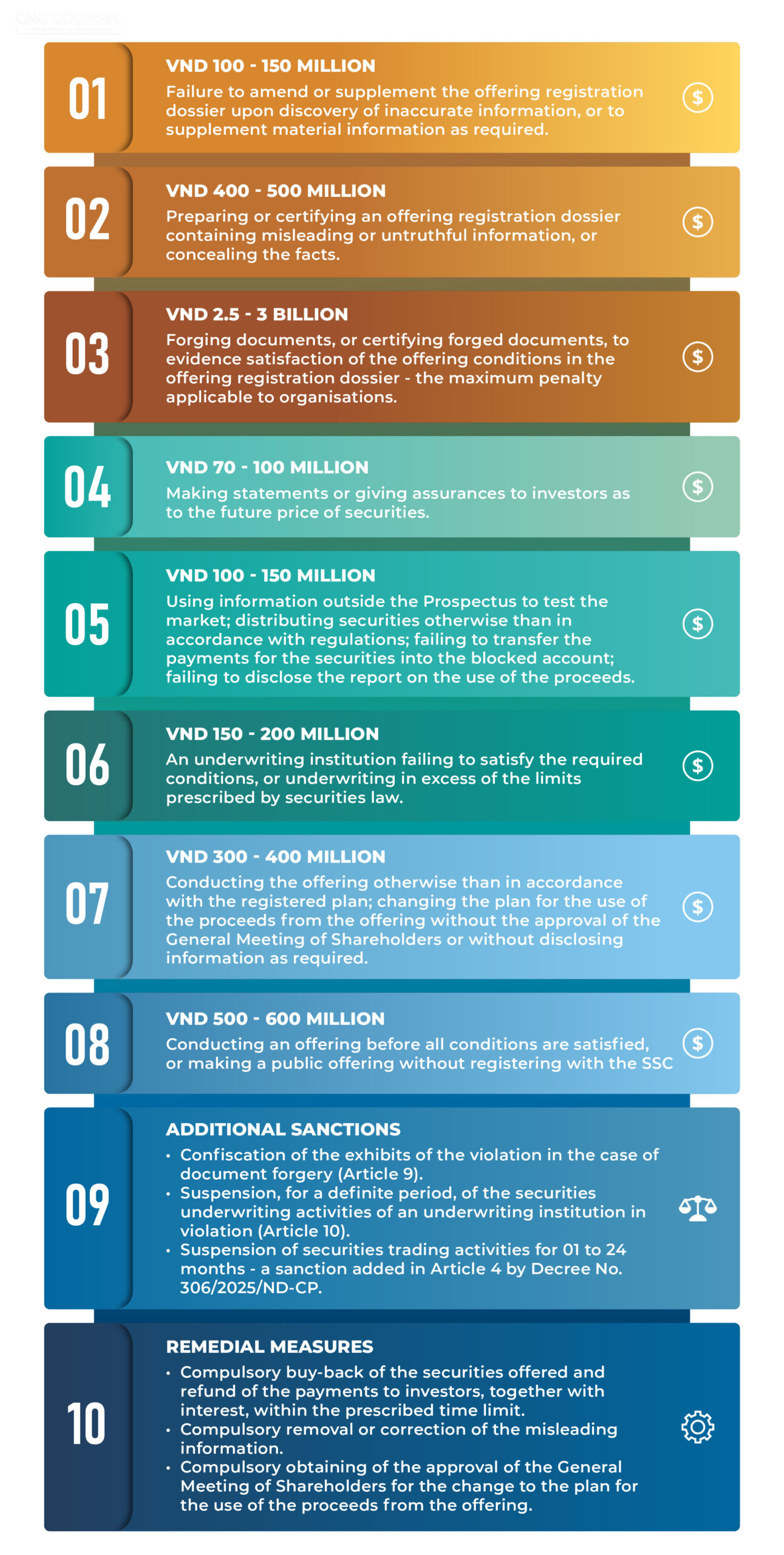
Administrative sanctions directly related to IPOs (Articles 9 and 10 of Decree No. 156/2020/ND-CP, consolidated version)
Note on the scope of application: The fine levels stated above apply to organisations; the fine applicable to individuals is one half (1/2) of the fine applicable to organisations. The maximum fine is VND 03 billion for organisations and VND 1.5 billion for individuals.
Recommendations
To avoid concentrating all of the work in the final sprint before the dossier submission deadline, enterprises should prepare for an IPO in the following order of priority:
Start the review at the very beginning, 12-18 months before submission of the dossier: systematise the history of the formation of, and changes in, the charter capital over at least 10 years. This is usually the most time-consuming step, and one that is difficult to remedy retrospectively if the capital contribution records and vouchers from earlier years are no longer complete.
Proceed in parallel, not sequentially: ownership restructuring, tax due diligence and the standardisation of legal and accounting records should be carried out simultaneously from the earliest stage.
Consider the simultaneous listing mechanism early: take advantage of Article 111a of Decree No. 245 to shorten the time required to bring the shares into trading; this requires the listing dossier to be prepared in parallel with the IPO dossier from the outset, rather than after the IPO has been completed.
Document the undertaking of the major shareholders rigorously: the undertaking to hold at least 20% of the charter capital should be set out in a legally binding written document from the preparation stage, as this is a condition that must be maintained continuously for one year after the closing of the offering.
Seek expert advice early on specific issues: engage at an early stage with specialist legal and tax advisers on the particular issues relating to the conditions, the dossier, or tax and accounting risks, in order to minimise the risk of suspension or cancellation of the offering or of administrative sanctions.
Managed by
 |
Luong Van Chuong I Partner
Phone: (84) 938 04 7969 Email: chris.luong@cnccounsel.com |
 |
Nguyen Thi Nhu Ngoc I Senior Associate
Phone: (84) 986 435 462 Email: ngoc.nguyen@cnccounsel.com |
 |
Nguyen Thanh Long | Legal Assistant
Phone: (84) 941 563 789 Email: long.nguyen@cnccounsel.com |
Contact Us
For further information, please contact:
CNC Vietnam Law Firm
Address: The Rise Building, 2A1 Nguyen Thi Minh Khai, Sai Gon Ward, Ho Chi Minh City, Vietnam
Phone: (84) 28-6276 9900 – 081 235 3839
Hotline: (84) 916-545-618
Email: contact@cnccounsel.com
Website: cnccounsel
We would be delighted to welcome you to CNC’s office, where you’ll have the opportunity to consult with the lawyer best suited to your circumstances. Of course, if you are unable to meet in person, email us via contact@cnccounsel.com or call us via (+84-28) 6276 9900.
It would be a pleasure for CNC’s lawyers to help you build a solid legal foundation, thus ensuring the success and sustainable development of your project!
————————————
Copyright © CNC Counsel. All rights reserved.
Ownership Rights: This document and the content contained herein (Document) are proprietary resources exclusively owned by CNC Counsel. Access to or use of this Document does not, by itself, create any contractual relationship or lawyer-client relationship between CNC Counsel and any person or entity.
Disclaimer: All Documents are provided solely for informational purposes and may not reflect the most current legal developments. Summaries of laws, regulations, and practices are subject to change. This Document is not intended to constitute legal, professional, or other advice with respect to any specific matter. Nor is it intended to substitute for reference to, or compliance with, the detailed provisions of any applicable law, regulation, rule, or official form. Readers are strongly encouraged to seek independent legal advice before taking, or refraining from taking, any action based on the information contained in this Document. CNC Counsel, together with its editors and authors, makes no representations or warranties as to the accuracy, completeness, or currency of the Document and disclaims all liability to any person or entity arising from reliance on all or any part of the Document. This Document may contain links to external websites, and external websites may contain links to this Document. CNC Counsel is not responsible for the content, operation, availability, or practices of any such external websites and expressly disclaims any liability in connection therewith. Note: Past results do not guarantee similar outcomes in future matters. Each matter is unique and must be assessed based on its own facts and circumstances.
————————————
[1] Vietstock, “Is the Record-Breaking 2026 IPO Wave a Sign of a Market Peak or a Capital Reallocation?”
[2] Nguyen The Minh, Director of Research Division at An Binh Securities Joint Stock Company (ABS), cited by Dau Tu, “Vietnam’s Stock Market to Attract at Least USD 50 Billion from IPOs over the Next Two Years.”
[3] VnEconomy, “FTSE Russell Confirms Vietnam Has Passed the Review, Officially Upgraded in September 2026”; Investing.com, “Vietnam’s Stock Market Could Attract Up to USD 8 Billion in Foreign Capital Following FTSE Upgrade,” 8 April 2026 (vn.investing.com).
[4] Decree Providing Detailed Regulations for Implementation of a Number of Articles of the Securities Law 2019;
[5] Law Amending and Supplementing a Number of Articles of the Law on Securities, the Law on Accounting, the Law on Independent Audit, the Law on State Budget, the Law on Management and Use of Public Assets, the Law on Tax Administration, the Law on Personal Income Tax, the Law on National Reserves, and the Law on Handling of Administrative Violations;
[6] Decree Amending and Supplementing a Number of Articles of the Government’s Decree No. 155/2020/ND-CP dated 31 December 2020 Providing Detailed Regulations for Implementation of a Number of Articles of the Law on Securities;
[7] Circular on Registration of Public Companies, Cancellation of Public Company Status, and Audited Reports on Contributed Charter Capital.
[8] This matter is provided for in Article 4 of Circular No. 19/2025/TT-BTC.
[9] Point (i), Clause 3, Article 12 of Decree No. 320/2025/ND-CP;
[10] Decree No. 253/2026/ND-CP dated 30 June 2026 providing detailed regulations on certain articles and measures for the organization and implementation of the Law on Personal Income Tax.