




10 key changes in construction investment cost management under Decree No. 206/2026/ND-CP
On 15 June 2026, the Government issued Decree No. 206/2026/ND-CP providing detailed regulations on construction investment cost management (“Decree 206/2026”). This Decree elaborates on matters relating to construction investment cost management prescribed under Law on Construction No. 135/2025/QH15 dated 10 December 2025 (“Law on Construction 2025”) and replaces Decree No. 10/2021/ND-CP dated 9 February 2021[1] with effect from 1 July 2026.
Compared with Decree No. 10/2021/ND-CP dated 9 February 2021 and its amending and supplementing instruments[2] (collectively, “Decree 10”), Decree 206/2026 introduces several significant changes, adjustments and updates aimed at improving the regulatory framework for construction investment cost management. Set out below are ten key changes introduced by Decree 206/2026 as compared with Decree 10:
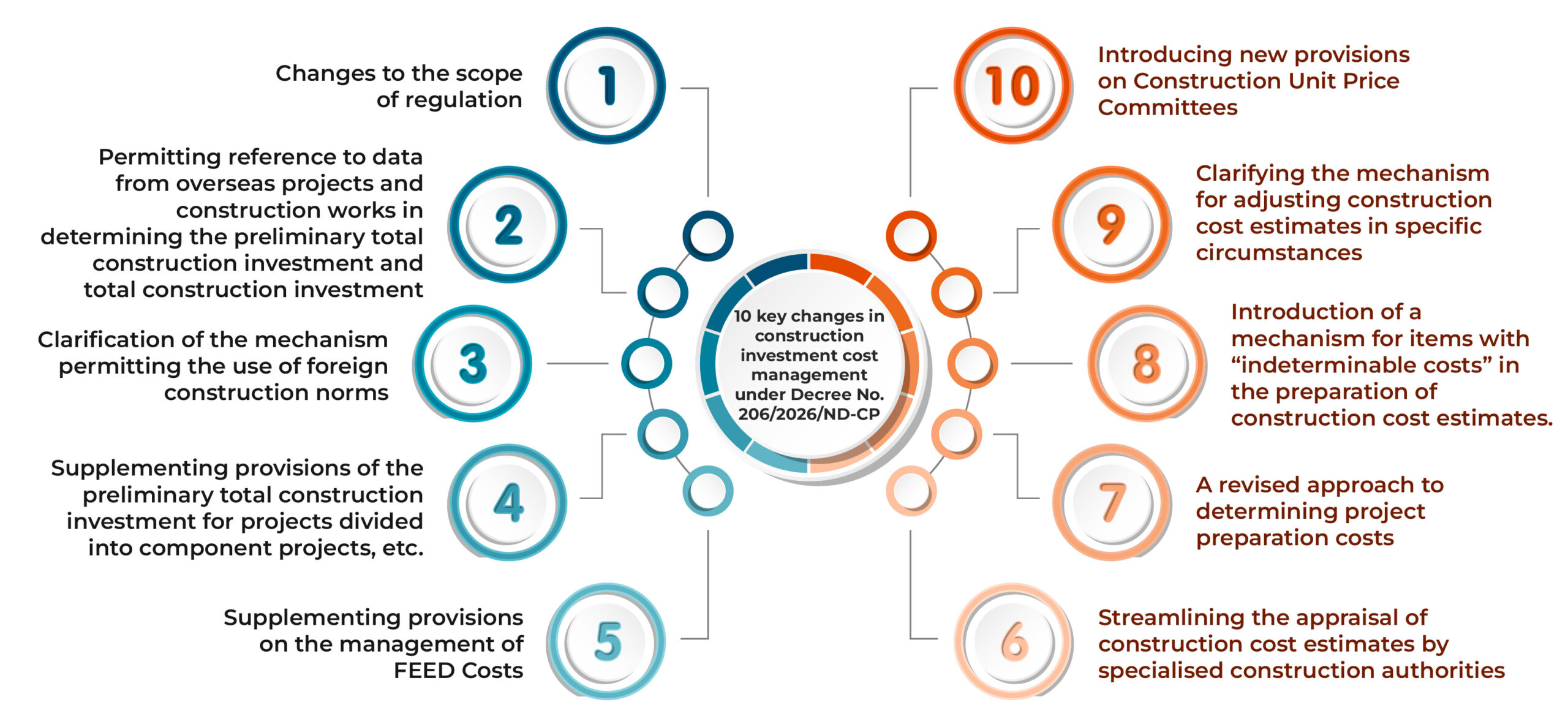
1. Changes to the scope of regulation
Compared with Decree 10, the scope of regulation under Decree 206/2026 has been narrowed to focus specifically on construction investment cost management, including preliminary total construction investment, total investment, construction cost estimates, package prices, construction norms, construction prices, construction price indices, project management costs, consultancy costs, and the rights and responsibilities of relevant entities.
Notably, Article 1.2 of Decree No. 206/2026/ND-CP expressly provides that the Decree no longer governs matters relating to construction contract prices, payment and finalisation of construction contracts, or the payment and finalisation of construction investment capital, as previously regulated under Decree 10.
Accordingly, compared with Decree 10, the scope of regulation under Decree 206/2026 has been narrowed by excluding matters relating to construction contract prices, the payment and finalisation of construction contracts, and the payment and finalisation of construction investment capital.
2. Permitting reference to data from overseas projects and construction works in determining the preliminary total construction investment and total construction investment
Compared with Decree 10, Decree 206/2026 introduces a new mechanism for determining the preliminary total construction investment, under which foreign prices and norms, or cost data from comparable construction works and projects implemented overseas, may be referred to and used, provided that certain conditions are satisfied. Specifically, Article 4.2 of Decree No. 206/2026/ND-CP provides that:
“Where a project is large-scale or technically complex, or employs new technologies not yet commonly used in Vietnam, and where no construction investment cost rates, cost rates, prices for groups of construction activities, prices for components or structural units of construction works, or domestic cost data for comparable projects are available, the preliminary total construction investment may be determined by reference to and use of foreign prices and norms, as well as cost data from comparable construction works and projects completed or under implementation overseas, subject to appropriate analysis, assessment and adjustment to reflect the prevailing price level at the time the preliminary total construction investment is prepared and the conditions for project implementation in Vietnam.”
Similarly, foreign prices and cost data from construction works or projects completed or under implementation overseas may also be referred to and used when determining the total construction investment where there is insufficient basis to determine construction costs using the conventional methods[3].
Accordingly, Decree 206/2026 further implements the provisions of the Law on Construction 2025 concerning the reference to and application of foreign construction prices and cost data[4]. This creates a more flexible mechanism for determining the preliminary total construction investment or total construction investment for projects that are not yet common in Vietnam, such as underground metro systems, high-speed railways, LNG-fired power plants and nuclear power plants, for which suitable cost data and norms are not yet available to determine construction costs using conventional methods.
3. Clarification of the mechanism permitting the use of foreign construction norms
Building on the mechanism permitting the use of foreign construction cost data, as discussed in Section 2 above, Decree 206/2026 further clarifies the mechanism under which project owners may use foreign norms in determining the construction investment costs of their projects.[5]
Accordingly, for large-scale or technically complex public investment projects, or projects applying new technologies not yet commonly used in Vietnam, the project owner may, where necessary, use foreign construction norms to ensure consistency with the project’s applicable standards and technologies. Such norms, however, may not be applied at the project owner’s discretion without further assessment. The project owner must arrange for the collection and translation of the relevant foreign norms and engage a qualified and experienced consultancy organisation to analyse and evaluate them, and to determine the appropriate scope and content, before deciding to use them as a basis for determining construction investment costs. The project owner must also consolidate and report the application of such norms to the investment decision maker for monitoring and management purposes.
In addition, during construction, the project owner is responsible for conducting surveys and collecting actual data to verify the appropriateness of the norms applied, and for submitting the results to the Ministry of Construction, the ministry responsible for specialised construction works, or the provincial-level People’s Committee, as applicable to projects falling within the investment decision-making authority of the relevant locality.
This provision both provides the flexibility necessary for the implementation of projects involving advanced technologies and ensures that the use of foreign construction norms is validated against actual data, thereby contributing to the further development and updating of Vietnam’s system of construction norms.
4. Supplementing provisions on the determination and adjustment of the preliminary total construction investment for projects divided into component projects, independent component projects, and independent compensation, support, resettlement and site clearance projects.
While Decree 10 did not contain specific provisions on this matter, Decree 206/2026 clarifies the preliminary total construction investment of component projects, independent component projects, and independent compensation, support, resettlement and site clearance projects by expressly linking them to the preliminary total construction investment of the overall project under Point a, Article 4.3. Accordingly, the preliminary total construction investment of each component project, independent component project, and independent compensation, support, resettlement and site clearance project, if any, constitutes a component of the preliminary total construction investment of the overall project.
In addition, for projects implemented in the form of public investment, Decree 206/2026 provides that where the preliminary total construction investment of a component project is changed without altering the project objectives or location, exceeding the preliminary total construction investment of the overall project, or adversely affecting the project’s investment efficiency, it is not necessary to adjust the preliminary total construction investment of that component project as stated in the approved investment policy decision. This provision is set out in Point b, Article 4.5.
5. Supplementing provisions on the management of FEED Costs
Compared with Decree 10, Decree 206/2026 supplements and further develops the provisions governing cost management for projects adopting the FEED stage. In particular, the methods for determining FEED costs, the scope of appraisal of the total construction investment by the agency or organisation subordinate to the specialised body of the investment decision maker (project owner), and the basis for determining direct costs in the construction cost estimate are respectively set out in Article 6.3; Article 7.3; and Point a, Article 12.2. These provisions establish a clearer legal basis for the application of the FEED model during project preparation and implementation. They also reflect a more modern approach to construction project management while addressing a regulatory gap not previously covered by Decree 10.
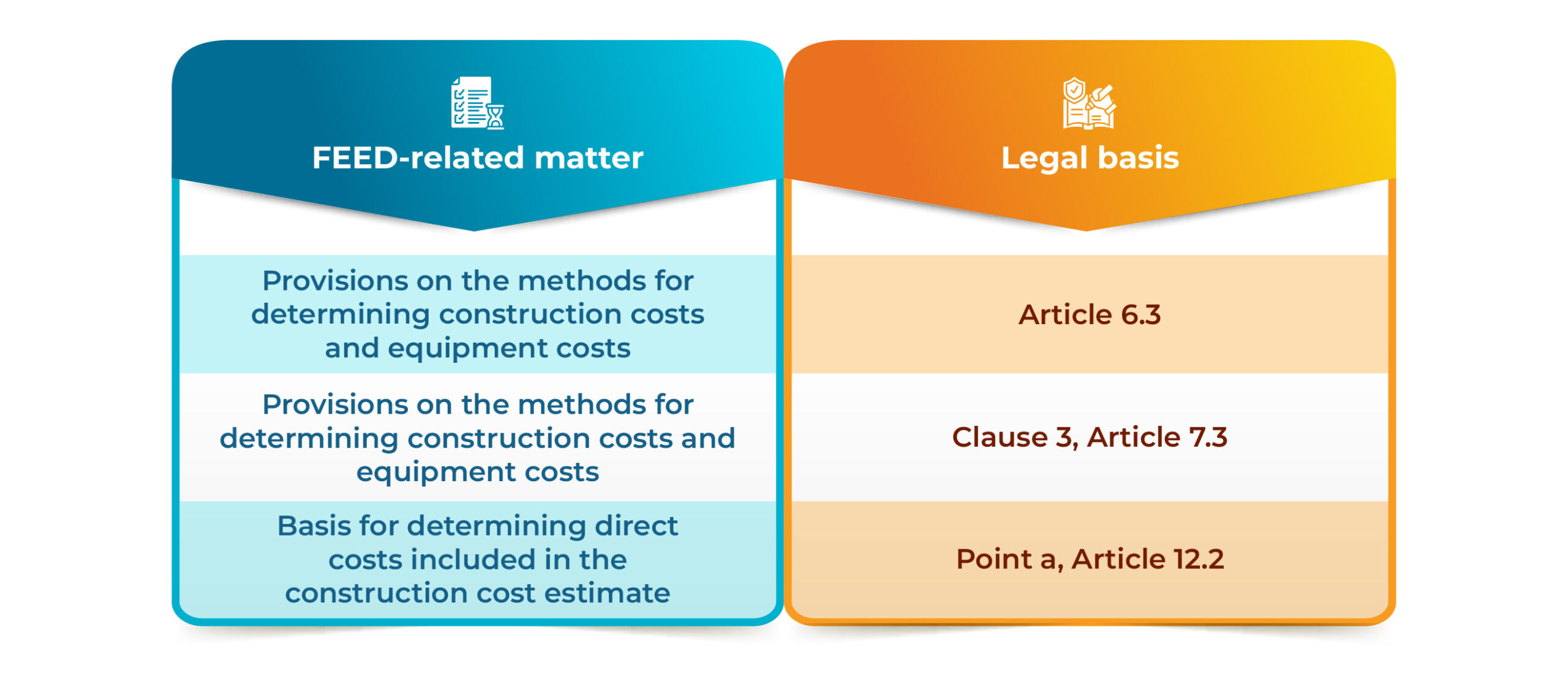
Matters relating to FEED design cost management
6. Streamlining the appraisal of construction cost estimates by specialised construction authorities
Under Law on Construction 2014 (as amended and supplemented)[6] and Decree 10[7], the appraisal of construction cost estimates by specialised construction authorities, conducted concurrently with the appraisal of construction designs developed after the basic design, applied to: construction works funded by public investment capital; construction works funded by state capital other than public investment capital under Group B or larger projects; construction works having major impacts on public safety and interests; and construction works forming part of PPP projects funded by public investment capital.
Under Decree 206/2026, however, specialised construction authorities will no longer appraise construction cost estimates or construction designs developed after project approval (except for certain cases stipulated in Article 16.4 of Decree 206/2026).[8] Accordingly, the project owner will be solely responsible for arranging the appraisal of construction designs developed after project approval and construction cost estimates as the basis for their approval.
This change reflects the policy direction of Law on Construction 2025 to streamline administrative procedures and strengthen the delegation and decentralisation of authority, thereby allowing project owners greater autonomy during project implementation. It also signifies a shift in the role of competent authorities from ex ante review under the previous regulatory framework to ex post supervision.
Similarly, where the project owner adjusts a construction cost estimate without causing the total construction investment to be exceeded, the project owner may arrange the appraisal and approval of the adjustment itself[9], without requiring appraisal by a specialised construction authority as previously required.
7. A revised approach to determining project preparation costs
Under Decree 10, project preparation costs were regulated by specifically listing the categories of work to be included in this cost group. In particular, Article 10.1 of Decree 10 provided: “Project preparation costs comprise the costs of carrying out the following activities: construction surveys; preparation and appraisal of the pre-feasibility study report for construction investment and obtaining investment policy approval, if applicable; preparation and appraisal of the feasibility study report for construction investment and the economic-technical report for construction investment; and other necessary activities relating to project preparation.”
By contrast, Decree 206/2026 adopts a more general approach. Rather than continuing to enumerate each specific category of work, Article 11 of Decree 206/2026 defines project preparation costs as the costs of performing activities during the project preparation stage in accordance with the decree providing detailed regulations on certain provisions of the Law on Construction concerning the management of construction activities.
This approach reflects a shift from a “fixed enumeration” method to a “dynamic cross-reference” method. From a legislative drafting perspective, cross-referring to the specialised regulations on the management of construction activities provides greater flexibility in determining project preparation costs and reduces the risk of the provision becoming outdated when the legal framework changes or when new activities arise during the project preparation stage.
Therefore, when determining project preparation costs under Decree 206/2026, project owners and consultancy organisations should not rely solely on Article 11 of this Decree, but should also review the relevant regulations on the management of construction activities to identify the full scope of activities falling within the project preparation stage.
8. Introduction of a mechanism for items with “indeterminable costs” in the preparation of construction cost estimates.
Under Decree 10, when preparing a construction cost estimate, direct costs were required to be determined based on construction quantities and corresponding construction prices. Specifically: “Direct costs, comprising material costs, labour costs, and construction machinery and equipment costs, shall be determined based on quantities and detailed construction unit prices, or based on quantities and composite construction prices applicable to groups or types of construction activities, structural units or components of the construction works.”[10]
Decree 206/2026 retains the principle that direct costs are to be determined based on quantities derived from the design and the corresponding construction prices. However, it introduces a mechanism for dealing with items which costs cannot yet be determined using this conventional method at the time the construction cost estimate is prepared. In such cases, the costs of activities that cannot be determined based on construction quantities and prices may be estimated by reference to the content, scope and nature of the relevant activities. During the subsequent stages of project implementation, the project owner must further clarify such costs as a basis for their management.[11]
This new provision is of considerable practical significance. In practice, not every activity within a project can be fully quantified in terms of quantities, unit prices or construction prices at the time the cost estimate is prepared. This is particularly the case for complex activities that depend on actual implementation conditions, technical solutions, construction methods or multidisciplinary coordination requirements. Allowing costs to be estimated by reference to the content, scope and nature of the relevant activities provides greater flexibility in preparing construction cost estimates and establishes a legal basis for recognising necessary costs that cannot be determined in detail from the outset.
Nevertheless, this estimation mechanism does not permit costs to be determined arbitrarily. The project owner remains responsible for further clarifying, reviewing and managing such costs during the subsequent stages of project implementation. Therefore, this change under Decree 206/2026 provides the flexibility required at the cost-estimation stage while also imposing continuing requirements for cost control and updating throughout project implementation.
9. Clarifying the mechanism for adjusting construction cost estimates in specific circumstances
Under Decree 10, the adjustment of construction cost estimates was regulated in relatively general terms. In particular, Article 15.4 of Decree 10 provided that where the adjustment of a construction cost estimate did not result in the approved total construction investment being exceeded, the project owner would arrange for the adjustment and approve the adjusted cost estimate.
By contrast, Decree 206/2026 adopts a more detailed approach by distinguishing the method for determining an adjusted construction cost estimate according to the status of the relevant construction work or package. According to Article 18.1 of Decree 206/2026, an adjusted construction cost estimate is determined in the following two circumstances:
Scenario 1: For a construction work or package before bid opening, the project owner shall determine the adjusted construction cost estimate based on the subject matter of the adjustment, the prevailing price level and the applicable regulations at the time of adjustment.
Scenario 2: For a construction work or package for which a contract has already been entered into, the project owner shall arrange for the determination of the adjusted construction cost estimate based on the terms of the executed contract, in compliance with the laws on construction contracts applicable at the time of adjustment and the regulations on construction investment cost management.

Circumstances for adjusting construction cost estimates under Decree 206/2026
This approach is of considerable practical significance. Rather than merely establishing a general principle limiting adjustments to construction cost estimates by reference to the total construction investment, Decree 206/2026 clarifies the basis and method for determining adjusted construction cost estimates at each stage of contractor selection and contract performance. This helps address practical difficulties, particularly in relation to packages for which contracts have already been entered into, where any adjustment to the construction cost estimate cannot be considered separately from the contract terms, the type of contract price, the scope of work, the price adjustment mechanism and the agreements established between the parties.
10. Introducing new provisions on Construction Unit Price Committees
Decree 206/2026 also introduces a mechanism for establishing a Construction Unit Price Committee to determine: prices of materials, components and parts of construction works subject to specific or specialised design requirements, standards or technical specifications; prices of technological equipment involving new technologies or forming part of an integrated technological line; and prices in cases where no relevant price information is available on the construction activities information system, the national database on construction activities, local price publications or the cost data of comparable construction works.
This mechanism is provided under Article 24.5 of Decree 206/2026. For projects in respect of which the investment decision is made by the head of a ministry or central authority, the Construction Unit Price Committee comprises representatives of the ministries responsible for specialised construction works, other relevant ministries, sectors and local authorities, the project owner, consultancy organisations and experts. For projects in respect of which the investment decision is made by the Chairperson of a provincial-level People’s Committee, the Committee comprises representatives of relevant departments, authorities and agencies, the project owner, consultancy organisations and experts. The Committee’s operating costs are determined by means of a cost estimate and included in the project’s total construction investment.
This provision helps address practical difficulties in determining and managing construction investment costs, particularly for nationally important projects, large-scale projects, and projects involving specialised technical or technological requirements.
Managed by
 |
Tran Pham Hoang Tung I Partner
Phone: (84) 901 334 192 Email: tung.tran@cnccounsel.com |
 |
Nguyen Thi Nhu Ngoc I Senior Associate
Phone: (84) 986 435 462 Email: ngoc.nguyen@cnccounsel.com |
Contact Us
For further information, please contact:
CNC Vietnam Law Firm
Address: The Rise Building, 2A1 Nguyen Thi Minh Khai, Sai Gon Ward, Ho Chi Minh City, Vietnam
Phone: (84) 28-6276 9900
Hotline: (84) 916-545-618
Email: contact@cnccounsel.com
Website: cnccounsel
We would be delighted to welcome you at CNC’s office, where you’ll have the opportunity to consult with the lawyer best suited to your circumstances. Of course, if you are unable to meet in person, simply email us via contact@cnccounsel.com or call us via (+84-28) 6276 9900.
It would be a pleasure for CNC’s lawyers to help you build a solid legal foundation, thus ensuring the success and sustainable development of your project!
Disclaimers:
This article has been prepared and published for the purpose of introducing or informing our Clients and potential clients on information pertaining to legal issues, opinions and/or developments in Vietnam. Information presented in this article does not constitute legal advice of any form and may be adjusted without advance notice.
——————————————
[1] The Decree on the management of construction investment costs took effect on 9 February 2021;
[2] Decree No. 144/2025/ND-CP dated 12 June 2025 on the delegation and decentralisation of powers in sectors under the state management of the Ministry of Construction, and Decree No. 35/2023/ND-CP dated 20 June 2023 amending decrees in sectors under the state management of the Ministry of Construction;
[3] Point b Article 6.5 of Decree 206/2026;
[4] Point b, Article 75.3 of Law on Construction 2025;
[5] Point d, Article 20.5 of Decree 206/2026
[6] Point d, Article 83a.2 of the Law on Construction 2014 (as amended and supplemented);
[7] Article 13.3 of Decree 10;
[8] Article 16 Decree 206/2026, Article 41 of Decree 217/2026/ND-CP;
[9] Article 18 Decree 206/2026;
[10] Point a of Article 12.2 of Decree No. 10;
[11] Point a of Article 12.2 of Decree No. 10;